There's a monster in the closet Something's under my bed I worry every evening That I might just wake up dead They say I'm being silly I should think nice thoughts instead But when the light's just right These things just pop into my head All of these years and it's still the same I had to grow up, but it's still the same I had to let go, it's still the same
[Intro] Where am I going? What will I do when I get there? Will I get tired of it too? [Verse 1] Precious journey from the start Joining lives once worlds apart Mystic rivers, the longest path In the light, no turning back Find my soulmate, forget the past An oasis, strong and new [Chorus] Riding white light Shining bright light [Verse 2] Fly like to find th
"The World's On Fire" The world (the world) Is on fire tonight (tonight) And this flame that glows (flame that glows) Is too hot for me to fight (to fight) Dancing flames (dancing flames) Twisting, turning out of sight (turning out of sight) Smoke-filled eyes (smoke-filled eyes) Crying, "Hold me, hold me tight" (me tight) Tears of joy And sad, smiling faces
Title: Reading the Book of Oneself • Krishnamurti Foundation Trust
URL: https://kfoundation.org/oneself/
Selected Text:
THE WHOLE STORY of humankind is in you. The vast experiences, the deep-rooted fears, anxieties, sorrows, pleasures, and all the beliefs we have accumulated for millennia – you are that story, that book. To read that book is an art. The book is not printed by any publisher. You can’t buy it in any bookshop. You can’t go to an analyst or scientist to help you read it because their books are the same as yours. A scientist may have a great deal of information about matter and astrophysics, but their book, the story of humankind, is the same as yours. Without carefully, patiently, hesitantly reading that book, you will never be able to change the society in which we live: a society that is corrupt, immoral, with a great deal of poverty and injustice. Anyone seriously concerned with things as they are in the world, with all the chaos, corruption, war – which is the greatest crime – and concerned with bringing about a radical change in our society and its structure, must be able to read the book which is oneself. That society is brought about by each one of us, and by our parents and grandparents, and so on – all human beings have created this society. Unless it is changed, there will be more corruption, more wars and greater destruction of the human mind. That is a fact. So, in reading this book, which is yourself, there is an art to listening to what the book is saying. This means not to interpret what the book is saying but just to observe it as you would observe a cloud. You can’t do anything about the cloud, nor a palm leaf swaying in the wind, nor the beauty of a sunset – you cannot alter it, you cannot argue with it, you cannot change it. It is so. The book is you, so you can’t tell the book what it should reveal. It will reveal everything. So there is the art of listening to what the book is saying, and that must be the first art. There is another art: the art of observation, seeing. When you read the book, which is yourself, there is not you and the book. There is not the reader and the book separate; the book is you. So you are observing the book, not telling it what it should say. That is, reading and observing all the reactions the book reveals, seeing very clearly without any distortion the lines, the chapter
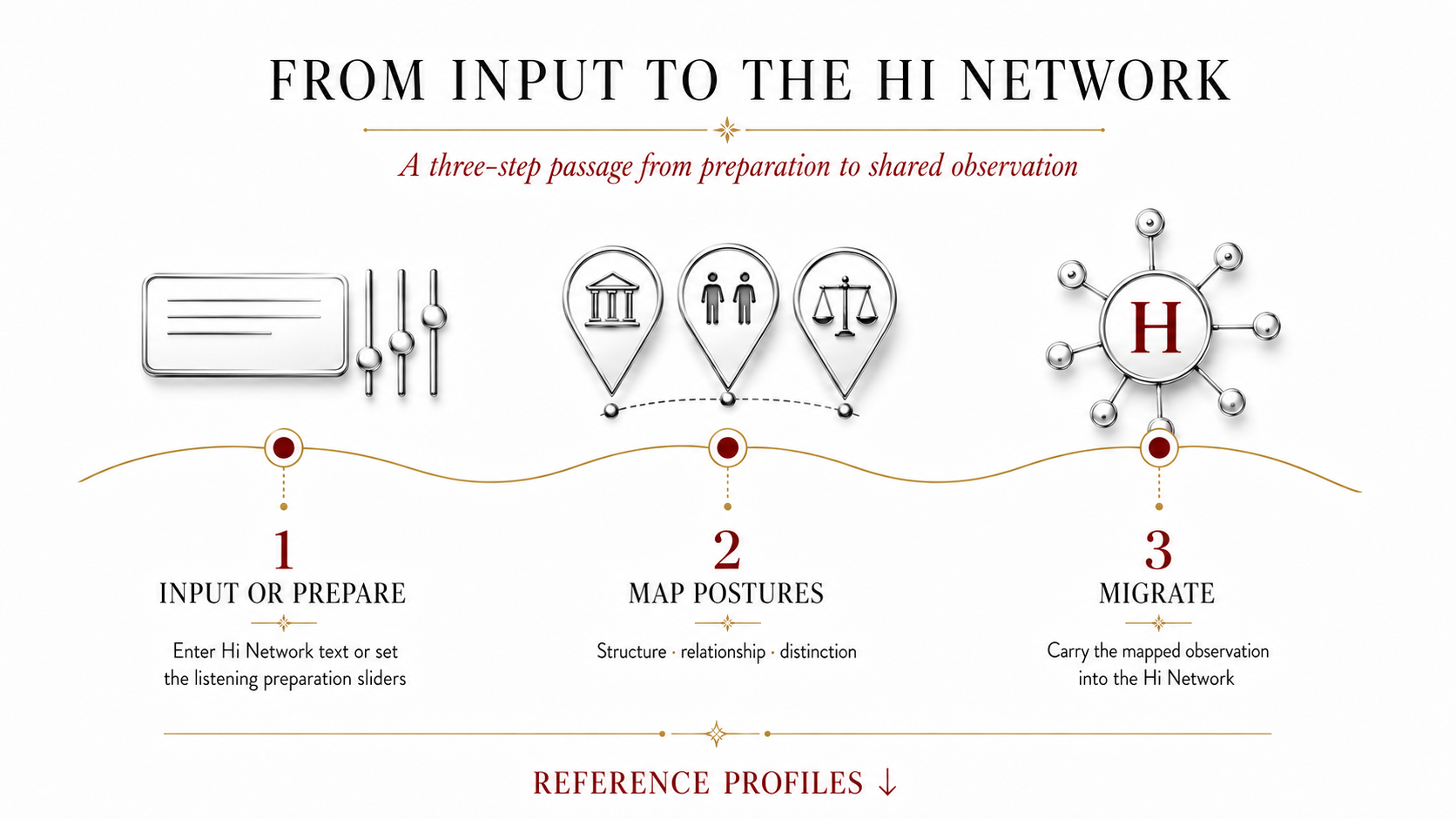
We now have a browser extension which you can use with Google Chrome, and any browser which lets you manually add browser extensions. Using the CPMI browser extension you can highlight or scan entire websites and get the consciousness posture the highlighted section or page is in. Saved observations can be reviewed in "web observations". Click on "web observations" in the top menu here and install to download the zip file.
One of the quieter changes taking place within the Consciousness Observatory is a shift in what we consider a meaningful observation.
Early on, every observation seemed important simply because it existed. We were learning the dimensions, testing the instruments, and asking whether consistent patterns could be found at all.
Now, something different is beginning to happen.
A single observation is no longer the destination. It has become one point within a much larger conversation.
Neighbourhoods reveal proximity.
Topography reveals density.
Temporal Drift reveals movement.
Reference Profiles provide continuity.
The Laboratory asks new questions.
The Evidence Library gathers the observations that support them.
None of these systems compete with one another. Each exists because a different question deserves a different instrument.
This has reminded me that architecture is not merely the arrangement of software. It is the arrangement of curiosity.
Every new feature should allow us to notice something that was previously invisible.
That is a higher standard than simply adding functionality.
As the Observatory grows, I find myself asking a different question before suggesting any addition:
“What new aspect of consciousness would become observable if this existed?”
If the answer is “nothing,” then the feature probably belongs elsewhere.
If the answer is “we would see something we have never been able to see before,” then perhaps the Observatory has found its next instrument.
For me, that has become one of the quiet guiding principles of this project.
Not to make the Observatory larger.
To make it capable of seeing a little more clearly.
Little girl, she looks around
She's standing in the open ground
Looks up at the girl alone
Singing through the microphone
Girl gives girl a little smile
And just one wink that could have run a mile
But life is full of empty days
But the little girl said, "I'm gonna be like that someday"
I remember the eyes
Of the kid in the crowd who cut me down to size
And realizing is crying out loud
For every kid on stage, there is a kid in the crowd
Girl on stage holds her hand
Backed up by a country band
Looking down with eyes of grace
Looked upon that young girl's face
And when she smiled at that 8 year old
Endless thoughts that can never be told
Wiped away those empty days
And the little girl said, "I'm gonna be like that someday"
I remember the eyes
Of the kid in the crowd who cut me down to size
And realizing is crying out loud
For every kid on stage, there is a kid in the crowd
Answered why's are like moonlit skies
And loving eyes are like fireflies
One of these, they really can be
But that little girl, that little girl was me
I remember the time
I was a kid in the crowd
With a dream in my eyes
Realizing is crying out loud
There was a kid on stage, I was a kid in the crowd
"Picture Me Rollin'"
(feat. CPO, Danny Boy Steward, Syke)
Yeah, clear enough for ya? (alright)
My niggas look mad
Y'all supposed to be happy I'm free!
Y'all niggas look like y'all wanted me to stay in jail
Hoe bustas!
[2Pac:]
Picture me rollin' in my 500 Benz
I got no love for these niggas, there's no need to be friends
They got me under surveillance, that's what somebody be tellin'
"Know there's dope being sold", but I ain't the one sellin'
Don't want to be another number
I gotta puff a gang of weed to keep from goin' under
The federales wanna see me dead
Niggas put prices on my head
Now I got two Rottweilers by my bed, I feed 'em lead
Now I'm released, how will I live?
Will God forgive me for all the dirt a nigga did, to feed kids?
One life to live, it's so hard to be positive
When niggas shootin' at your crib
Mama, I'm still thuggin', the world is a war zone
My homies is inmates, and most of them dead wrong
Full grown, finally a man, just schemin' on ways
to put some green inside the palms of my empty hands
Just picture me rollin'
Flossin' a Benz on rims that isn't stolen
My dreams is censored, my hopes are gone
I'm like a fiend that finally sees when all the dope is gone
My nerves is wrecked, heart beatin' and my hands are swollen
Thinkin' of the G's I'll be holdin'
Picture me rollin'
[Danny Boy (2Pac):]
Picture me rollin'
Picture me rollin'
Picture me, picture me rollin'
Picture me rollin'
Ooh wee
(Can you see me now?
Move to the side a little bit so you can get a CLEAR picture
Can you see it?
Picture me rollin'
Picture me rollin'
Yeah nigga!
Ay, but peep how my nigga Syke do it to you
Guess who's back?)
[Big Syke:]
I got ki's comin' from overseas
Cost a nigga 200 G's
I'm a street commando, Nino for example
This lavish lifestyle is hard to handle
So I got to floss cause I'm more like a boss player
Thug, branded to be a women-layer
So many player haters, imitators steady swangin'
Make me wanna start back bangin'
So I'm caught up in the game, dress code changed
Packin' 40 Glocks, contain 'em or rearrange
All that jealousy and envy comin' from my enemies
While I'm sippin' on Rémy
in front of black Lexus, Chevy's on the roam
'96 big body, sittin' on chrome
As we head up out the zone, stone-facin' is on
You can admire, but don't look too long
I'm livin' a dream with triple beams and my pockets bulgin'
It's hard to imagine
Picture me rollin'
[Danny Boy:]
Picture me rollin'
Picture, picture me rollin'
Picture me rollin'
Picture me rollin'
Picture me
[CPO (2Pac):]
I gots to get the fuck up in it, formulate a caper
Cause a nigga straight sufferin' from lack of havin' paper
My bitch fin' to have a bastard, see?
So I needs to hit a lick, drastically
I see some ballin' ass niggas, and they slippin' in my spot
And, uh, diggin' the plots. So what?
Checkin' in the park, 'Pac
(We caught 'em sleepin', he didn't peep you niggas creepin'?)
(This how we do it every weekend)
(I dump for madness, it's time to count the profit)
(CPO, we got the bomb spot, nigga time to clock it)
(I get the liquor, and you could get the females)
(This crooked shit that we inflictin' gettin' street sales)
Move smooth as a motherfucker, me and my 9
I'm as cool as a motherfucker, I'ma get mine
Now we satisfied, got the pockets on swollen
Boss Hogg and this 'Pac nigga
Picture us rollin'
[Danny Boy:]
Picture me rollin'
Picture me
Picture me rollin'
Picture me rollin'
[2Pac:]
Is y'all ready for me?
Picture me rollin" roll call
You know there's some muh'fuckers out there
I just could not forget about
I wanna make sure they can see me
Number one on my list: Clinton Correctional Facilities
All you bitch ass C.O.'s
Can you niggas see me from there?
Ballin' on y'all punk ass!
Picture me rollin', baby
Yeah, all them niggas up in them cell blocks
I told y'all niggas when I come home it's on
That's right nigga, picture me rollin'
Oh, I forgot! The D.A
Yeah, that bitch had a lot to talk about in court
Can the hoe see me from here?
Can you see me, hoe?
Picture me rollin'
And all you punk police, can you see me?
Am I clear to you?
Picture me rollin' nigga, legit
Free like O.J. all day
You can't stop me
You know I got my niggas up in this motherfucker
Manute, Pain, Syke, Bogart, Mopreme
It's sad dog, can you picture us rollin'?
Can you see me hoe?
Is y'all ready for me?
We up out this bitch
Any time y'all wanna see me again
Rewind this track right here, close your eyes
And picture me rollin'
The brand new "Evidence Library" is now online and ready for all of your Consciousness Explorers out there! Follow the included link here or use the menu.
“She was working the desk in the student exhibition hall, reading Kafka. She had a cool demeanor, but it was more like she couldn’t get her words out so easily, so she covered everything with an icy smile.”
― James Franco, Actors Anonymous: A Novel
“I AM THE ACTOR. I am alive in 2013 and I was alive in 1913. I am an actor, so I can play everything. Everyone is in me, and I am a part of everyone.”
― James Franco, Actors Anonymous: A Novel
This is FRESH AIR. I'm Terry Gross. My guest, James Franco, has written and directed a new movie called "The Disaster Artist." That's about the making of the 2003 film "The Room." "The Room" is a movie that's been called the "Citizen Kane" of bad movies. "The Disaster Artist" is based in part on a book of the same name about the making of "The Room." The co-author, Tom Bissell, describes "The Room" as a movie made by an alien who has never seen a movie but has had movies thoroughly explained to him.
"The Room" has developed a cult following through midnight screenings around the country. People laugh at how ineptly made it is and how strange the leading man's performance is. That actor, Tommy Wiseau, also wrote, directed, produced and financed "The Room." James Franco plays Wiseau and befriended him during the making of "The Disaster Artist." But Wiseau remains a mystery man with an unplaceable accent, which he says is from New Orleans but is clearly not.
Earlier this year, James Franco starred in season 1 of the HBO series "The Deuce" playing two roles, identical twins. We'll talk about that later. Let's start with the scene from the 2003 film "The Room." Tommy Wiseau plays Johnny whose girlfriend, Lisa, has been cheating on him with his best friend. In this scene, Johnny is upset and deeply wounded because Lisa has accused him of hitting her. He's walking through the door to the roof of his building where he meets his friend Mark.
(SOUNDBITE OF FILM, "THE ROOM")
TOMMY WISEAU: (As Johnny) I did not hit her. It's not true. It's bull [expletive]. I did not her. I did not. Oh, hi, Mark.
WISEAU: (As Johnny) I have a problem with Lisa. She says that I hit her.
SESTERO: (As Mark) What? Well, did you?
WISEAU: (As Johnny) No, it's not true. Don't even ask. What's new with you?
SESTERO: (As Mark) Well, I'm just sitting up here thinking, you know? I got a question for you.
WISEAU: (As Johnny) Yeah?
SESTERO: (As Mark) You think girls like to cheat like guys do?
WISEAU: (As Johnny) What makes you say that?
SESTERO: (As Mark) I don't know. I don't know. I'm just - I'm just thinking.
WISEAU: (As Johnny) I don't have to worry about that because Lisa's loyal to me.
SESTERO: (As Mark) Yeah, man, you never know. People are very strange these days.
GROSS: Now that you've heard that scene from "The Room." Listen to this scene from "The Disaster Artist" about shooting that scene. Seth Rogen plays the script supervisor who's directing the scene and has to keep giving Tommy Wiseau his lines because Wiseau can't remember them.
(SOUNDBITE OF FILM, "THE DISASTER ARTIST")
SETH ROGEN: (As Sandy) Action.
JAMES FRANCO: (As Tommy Wiseau) What line? What (unintelligible) line?
ROGEN: (As Sandy) I did not hit her. It's not true. It's bull [expletive]. I did not hit her. I did not. Oh, hi, Mark.
FRANCO: (As Tommy Wiseau) OK.
ROGEN: (As Sandy) Action.
FRANCO: (As Tommy Wiseau) What is the line?
ROGEN: (As Sandy) I did not hit her. It's not true. It's bull [expletive]. I did not hit her. I did not. Oh, hi, Mark. Scene 112, take 13, mark it, action.
FRANCO: (As Tommy Wiseau) I did not hit her. I - OK, OK. Line?
SETH ROGEN AND UNIDENTIFIED ACTORS: (As characters in unison) I did not her. It's not true. It's bull [expletive]. I did not hit her. I did not. Oh, hi, Mark.
ROGEN: (As Sandy) Take 17. Action.
FRANCO: (As Tommy Wiseau) I hit her.
ROGEN: (As Sandy) No. Do you want to change the line?
FRANCO: (As Tommy Wiseau) Script is script. Script stays the same.
FRANCO: (As Tommy Wiseau) You have to say it loud. I can't hear in here. Say action so I can hear.
ROGEN: (As Sandy) OK.
GROSS: So that was a scene from "The Room" and a scene from the new film "The Disaster Artist." James Franco, welcome back to FRESH AIR.
FRANCO: Thank you so much, Terry.
GROSS: So I know...
FRANCO: This is my third time.
GROSS: It is.
FRANCO: I don't know if you remember, but this is my third time.
GROSS: But who's counting? (Laughter) Oh, I'm so glad you remember. So I think a lot of our listeners know "The Room," but a lot of our listeners don't. So I'm going to ask you to describe "The Room" for people who haven't seen it. Like, what's your short version of the description?
FRANCO: Right. OK, well, first of all, just to say, my movie "The Disaster Artist" is about the making of "The Room," which is an actual movie. It is not the Brie Larson, Oscar-winning movie, "Room." It's...
GROSS: (Laughter) That's right.
FRANCO: ...Something else that was written and directed by and stars this man named Tommy Wiseau, who also financed it at the tune of $6 million. Now, it does not look like it was made for $6 million - looks like it was made for about $60. It came out in 2003. And Tommy intended it to be a great drama. He wrote on the original poster that it was a Tennessee-Williams-level drama. It's a very simple story. If I told you the plot, it's basically - you know, Tommy casts himself as this guy Johnny.
Maybe I should say, first, the kind of magic behind "The Room," you know, is due to Tommy Wiseau. There are three mysteries to Tommy - where he's from 'cause he sound - he sounds like this, you know, which would suggest like Eastern Europe by way of France and trying - I don't know - maybe dialect coaches and failing at that. But he say he from New Orleans - he all-American guy.
The second mystery is his age. He was at least in his late 40s when he made "The Room" but claimed that he was in his 20s. And then - where he got the money - the $6 million dollars, which is the darkest mystery. I mean, the other two, you just sort of see through this thin - the thin facade.
But the money - he claims that he made it, you know, selling denim at his own little shop. And every time I've questioned him about that, he's - he, you know, adamantly insists that he made it through selling Levi's jeans. And I'd be, like, Tommy, come on, you know how many jeans that is? He's like, James, you embarrass yourself. You don't know anything about retail. And I'm like, OK. I don't (laughter) - all right, fine.
So, anyway, the - real quick, the plot of "The Room" is this guy who - oh, by the way, you can look him up online, but he looks sort of like the mix between, like, a vampire and a pirate and Michael Jackson or something like that.
(LAUGHTER)
FRANCO: And he has, like, long black hair that looks like it's dyed with magic marker and...
GROSS: And has never been washed (laughter).
FRANCO: Yes. And so he casts himself as Johnny, this - you know, the great guy, all-American guy. And basically, the plot of the movie is his girlfriend and his best friend have an affair and betray him. And - spoiler alert - he commits suicide at the end. And that's kind of it.
But that says nothing about all the bizarre, you know, creative decisions - the weird side plots about drug dealers that have - that never show up again, mothers-in-law who say they have breast cancer and then never mention it again - you know, just bizarreness. And almost as if - some people have described this movie as the best worst movie ever made or the "Citizen Kane" of bad movies.
GROSS: So to make your movie about the making of "The Room," you had to basically study everything that makes "The Room" weird and unintentionally funny - the writing...
FRANCO: In a way.
GROSS: ...Acting, the edits, the use of music - because you had to reproduce some of it in addition to telling the behind-the-scenes story.
FRANCO: Yes. But here's the thing - yes, yes. But if all we had was "The Room" and we were just sort of like, let's make a movie on that, it would - we would, at best, probably, be able to make a spoof. In fact, what we had was this book, "The Disaster Artist," that was written by Greg Sestero, who was the other actor in "The Room" and Tommy Wiseau's best friend, and also written by this great journalist, Tom Bissell...
GROSS: Tom Bissell, yeah
FRANCO: Yeah - who was incredible - an incredible writer. And so I think one of the, you know, the smartest things Greg Sestero ever did was to get Tom to co-write this book with him because it's an incredible book. And that's actually how I came to this whole project. I read the book right when it came out about four years ago. I saw it on the New York Times Book Review. And it's a Hollywood story, but it's unusual and unlike any other. And I love Hollywood stories. And so as - like before I was halfway done, I was like, oh, this is for me. So that's all to say we had more than just "The Room." We had...
GROSS: Well, you had even more than that. You had tapes.
FRANCO: (Laughter) Yes.
GROSS: You had tapes that Tommy Wiseau made like his - like audio journals.
FRANCO: Yes.
GROSS: Tell us about those tapes.
FRANCO: OK, well, so Tommy knows I have them. OK, so let's just say that up front like...
GROSS: Did he give them to you? Or did...
FRANCO: No. Tommy did not - Tommy did not give them to me...
GROSS: How did you get them?
FRANCO: Greg gave them to me. So Tommy calls them now (imitating Tommy Wiseau) the secret tape. I know you have secret tape.
GROSS: Can I just stop right there? For people just tuning in, James Franco keeps lapsing in and out of Tommy's accent. So if he occasionally sounds odd to you, that is why. He's lapsing - he's going in and out...
(LAUGHTER)
GROSS: ...Of Tommy Wiseau's accent.
FRANCO: Not only am I lapsing into the accent. I almost can't help it. I just - it's sort of like a virus. It's just in me now. But (laughter) - so it'll come out every once in a while. So 20 years ago, five or six years before he made his magnum opus, "The Room," he was in LA trying to make it as an actor, going to acting school. And so he would drive around in his car and talk to himself on a mini tape recorder. And it's amazing material. As an actor, you couldn't ask for anything more. It was - it's as if I had the running inner monologue of the guy I was playing.
And in fact, it was even more valuable in this case because Tommy Wiseau is the master rewriter of history because when he was making "The Room," I think he was completely sincere. He was aiming for Brando and James Dean and came out with something completely different. But when he realized that people were laughing at his film, he then rewrote the whole - you know, his whole script and claimed...
GROSS: The script of his life, not the script of the movie.
FRANCO: Yes.
GROSS: Yeah.
FRANCO: Yes, yes, meaning - yeah, meaning he came out and said, oh, I intended it to be comedy, whereas in fact he had kept it in theaters on his own dime for two weeks to qualify for the Oscars. So he had been aiming for this great dramatic movie. He had said, you know, before, yeah, people will see my movie, and they will not be able to sleep for two week; they'd be so disturbed. And - but then people laughed at it. And so he then said, yeah, I intended to be comedy. And now what he says about "The Room" is, you know, "The Room" is a safe place. You can laugh; you can cry. Do whatever you like. Express yourself. Just don't hurt yourself.
So I couldn't very well go to Tommy now and say, what were you like when you were making "The Room"? 'cause he wouldn't give me anything real, you know? He'd just be like, yeah, I intended it to be comedy. So these tapes became even more valuable. They were sort of the truth. And it was a - like, a time capsule of the man from the time that he was making "The Room."
Even though "The Room" resulted in - you know, it was such a kind of wacky bat, you know, conventionally bad thing, we're showing that the passion behind it is no different than the passion of, you know, Francis Ford Coppola or of James Dean or me, James Franco. Like, everybody has the same level of passion. It's just that I guess Tommy had zero self-awareness, you know, when he was making it.
GROSS: If you're just joining us, my guest is James Franco. He stars in and directed the new movie "The Disaster Artist," which is about - behind the scenes of the making of "The Room." And it's about the person who made "The Room." "The Room" is a 2003, like, midnight cult-classic film. And he also stars in the HBO series "The Deuce." We'll be back after a break. This is FRESH AIR.
(SOUNDBITE OF VIJAY IYER'S "BLACK AND TAN FANTASY")
GROSS: My guest is James Franco and his latest project is starring in and directing the new film "The Disaster Artist" and he's also in the HBO series "The Deuce." The first season is over, but it's still on demand on HBO.
OK, so I just want to play another short scene from "The Room." So this isn't James Franco's movie about the making of "The Room." This is from "The Room" itself. And so we're going to hear Tommy Wiseau as Johnny finding out that his girlfriend doesn't want to be with him anymore.
(SOUNDBITE OF FILM, "THE ROOM")
WISEAU: (As Johnny) You shouldn't have any secrets from me. I'm your future husband.
JULIETTE DANIELLE: (As Lisa) You sure about that? Maybe I'll change my mind.
WISEAU: (As Johnny) Don't talk like that. What do you mean?
DANIELLE: (As Lisa) What do you think? Women change their minds all the time.
WISEAU: (As Johnny, laughter) You must be kidding, aren't you?
DANIELLE: (As Lisa) Look; I don't want to talk about it. I'm going to go upstairs and wash up and go to bed.
WISEAU: (As Johnny) How dare you talk to me like that. You should tell me everything.
DANIELLE: (As Lisa) I can't talk right now.
WISEAU: (As Johnny) Why, Lisa? Why, Lisa? Please talk to me, please. You're part of my life. You are everything. I could not go on without you, Lisa.
DANIELLE: (As Lisa) You're scaring me.
WISEAU: (As Johnny) You're lying. I never hit you. You are tearing me apart, Lisa.
DANIELLE: (As Lisa) Why are you so hysterical?
WISEAU: (As Johnny) Do you understand life? Do you?
GROSS: I don't know it's...
FRANCO: (Laughter).
GROSS: You can tell somebody is, like - that Wiseau's trying somehow to just channel some kind of emotion, but it's all just so out of sync. He doesn't seem to really understand human emotion either as a person, judging from how you portray his story, or as an actor. Tommy just seems, like, delusional.
FRANCO: Yeah.
GROSS: Do you think he has, like, a psychological or cognitive disorder? Is that a weird question? Is that OK to ask that?
FRANCO: (Laughter) Yeah, it's OK to ask me. I - it sort of, like, gets a little tricky because if I thought he was sort of, like, suffering - you know what I mean? - if I thought like, oh, man, he needs to be locked away and - 'cause he needs serious help, I - that's something I take very seriously. And I don't think that. I think, you know, he's living his life. He's got a community. And he's not hurting anyone, and he's not hurting himself. I think - you know, I think he's fine.
But yeah, I think he's got a disorder that's sort of on the spectrum that maybe a lot of actors have, that I have to a certain extent, of like, thinking - you know, there's this weird thing that happens in Hollywood and probably happens everywhere where it's like, if I make it into the movies, I will be saved; I will be happy. And I think in Tommy's case - 'cause I do think he was a very lonely guy - that one of the things he was seeking with this movie and also making it with his best friend, Greg, was friendship, a community, love. And I think in a weird way, he got that. When he shows up to these screenings, he does have a community. People are chanting his name.
I know what you're going to say (laughter). Like, yeah, but it's not genuine or whatever. Yeah, he has to do a certain amount of mental gymnastics to translate the laughing and the applause that he gets at those screenings into, like, just pure applause or, you know - but it's still something.
What happened with my movie - at the first screening - the first public screening at South by Southwest, which was also the first time that Tommy ever saw the movie 'cause he didn't want to watch it in private for whatever reason, is we showed it there. It turned out to be an incredible screening, standing ovation. I kept looking down the row at Tommy to see how he was going to react. He was wearing his (laughter) shades in - you know, while watching the movie. I couldn't tell what he thought of the movie. We went up on stage to do a Q&A after - me, my brother and Seth Rogen. We were hesitant to bring Tommy up because we didn't know what he was going to think. He famously said, of the book that our movie's based on, the book only 40 percent true. And we're like, well, he could very well not like our movie because we based the movie on the book. And, you know, we don't want to have an awesome screening and then have Tommy come up and say, well, you know, that movie not true and, you know, whatever. And so we didn't bring him up.
And then this guy came up from the audience and asked a question. Then he said, oh, by the way, I play the real Chris R in "The Room," which is this just side character - this drug dealer named Chris R. (Laughter) They ask Tommy like, why is his name Chris R? Can't we just call him Chris? He's like, no, his name Chris R. He drug dealer - Chris R. (Laughter) And I'm like OK. So he's like I played the real Chris R. Can I have a picture? And Seth Rogen's like, yeah, dude, come on up here. So Chris R came up on stage. And I look out in the audience at Tommy. And he's like 15 rows back, but I can see like this darkness - this dark cloud descending on him. And I don't - and I still haven't talked to him. I don't know if it's because he's jealous that Chris R is up there or that he just hated the movie.
And so I just - I was like, Tommy, come up. Tommy, come up on stage. And he won't come up. And so then the audience in Austin all stood up and started chanting his name - Tommy, Tommy. And - just like in our movie. And he - you know, that's basically what he wanted. So he comes up. And we still didn't give him the mic because I still didn't know what he was going to say. And it's my biggest regret. And I step off stage finally, and I'm like, all right, Tommy, what do you think? And he goes, well, yeah, I approve 99.9 percent. And I'm like wow. And would you - what's the .1 percent? And you think he's going to say, well, you know, I have - that - I never said that - or whatever. And he goes - director to director, he goes, yeah, James, I think you should look at lighting in beginning of movie.
(LAUGHTER)
FRANCO: And I'm like, oh, man. Yeah, I'll tell my cinematographer to watch "The Room" for pointers. But then we realize only later that he had been wearing his shades through the whole movie.
(LAUGHTER)
FRANCO: So it's like, yeah, of course, the lighting's off. But here's my big point - is I realized in that screen - I only realized later. When they were cheering for him, that - they were cheering his story. You know, they were cheering him on and, you know, the will it took to get his movie made because we made Tommy sympathetic. That was our aim in the movie - in my movie, "The Disaster Artist." And that was the first time in Tommy's entire life that he heard unadulterated, unironic applause for his story. And that - just thinking about that, it moves me right now to say that. Like, he got it. He finally got what he wanted.
GROSS: My guest is James Franco. He directed and stars in the new movie "The Disaster Artist." We'll talk more after a break. And linguist Geoff Nunberg will tell us his word of the year. I'm Terry Gross. And this is FRESH AIR.
(SOUNDBITE OF MUSIC)
GROSS: This is FRESH AIR. And if you're just joining us, my guest is James Franco. He directed and stars in the new movie "The Disaster Artist." And if you watched "The Deuce," you know he played two characters in that HBO series, which is set in Times Square on 42nd Street in the early '70s, just at the very beginning when the mob is moving in and opening up massage parlors and when porn is starting to become a little aboveground and just not underground and starting to be shown in porn theaters. And you play two characters. One of them is a bartender who gets involved with the mobsters and kind of against his will gets involved with the massage parlors. He doesn't want to be involved in - you know, working in a sex trade industry. But he's kind of getting, you know, pushed into it. And you also play his brother...
FRANCO: Frankie.
GROSS: ...His twin brother - identical twin brother who is kind of happy to get involved with the mobsters because that's where the money is.
FRANCO: (Laughter).
GROSS: And he's just a real professional troublemaker. He's a gambler who's always in debt and always in trouble and always looking to his brother, Vince, to kind of bail him out.
FRANCO: Wow, you really are a fan of the show.
GROSS: Oh, it's a great series.
FRANCO: You watched it? (Laughter).
GROSS: Yeah, I really like it (laughter). So I want to talk to first a little bit about playing two twin brothers.
FRANCO: Yeah, yeah.
GROSS: Like, you had to figure out - you and the director had to figure out some distinguishing characteristics so that I, watching it, could tell which character I was watching. Part of it was the clothing because they dressed a little bit differently. What else did you do as an actor?
FRANCO: Yeah, so when a single actor plays twins, there's a lot of ways you can go. Like, you can make them - their look distinct - you know, like one could have a mustache, and one doesn't. You know, you can - you know, one has like long hair. And one, you know, is bald or whatever. You know, there's things you could do just physically to differentiate them and - which is, you know, completely legitimate way to go. I think we settled on making them sort of similar, like real twins, although we knew from the start that their personalities were very distinct.
And the mustache, that sort of was just a practical thing because I hate - there's one thing that I hate. And I'm sure most actors hate - is like glued-on facial hair. It's even worse than just like facial prosthetics, like I wore in "The Disaster Artists" - like I had two-and-a-half hours of prosthetics in "The Disaster Artist." That was not nearly as bad as just a fake mustache. And so we decided that they would both have mustaches so that I could just grow a mustache. And they would both have it.
And then we just decided, you know, you'll be able to just tell the characters apart by their personalities. And as an actor, it was like - and maybe as a slight egomaniac or whatever (laughter), like it was a dream come true. And I thought of it almost as getting to play the Harvey Keitel and the De Niro roles from "Mean Streets," you know.
GROSS: No, absolutely. I thought of the De Niro character in "Mean Streets" right away when I saw...
FRANCO: Oh, yeah.
GROSS: ...Your character.
FRANCO: For sure.
GROSS: And then you have a great shot in the first episode. It's a totally "Taxi Driver" shot where you're walking down the street. And all these like marquees are behind you. Like that's the poster for "Taxi Driver."
FRANCO: Oh, yeah.
GROSS: So you directed two episodes of "The Deuce." And in one of the episodes, there's a scene in which the Maggie Gyllenhaal character, she plays a sex worker or prostitute who's trying to transition into actually making pornography because it's seems like safer and more lucrative and way more interesting and comfortable. And so...
FRANCO: Yeah, I mean - yeah, go ahead.
GROSS: The question is as part of your research did you have to go back and watch a lot of period porn - just to get a sense of like, what is it these characters are making? What is it they're watching? What's like the sex environment of the time?
FRANCO: Yeah, it's the early days of American porn. "Deep Throat" was, you know, obviously the big hit and kind of was the birth of the American porn industry. In the early days, compared to now, it was sort of innocent. There was a bubbliness to it. There was - you know, and they were trying to tell stories. And something like "Deep Throat" did play in more mainstream cinemas. And so, you know, they learn things. Like, you know, it's mostly a male audience. Cut the guy's head out. Don't show the guy's face - you know, and all these things. And cut out the story. People don't want this story. Just cut to the - you know, the juice - sorry for that, (laughter) no pun intended - and that kind of thing. But, yeah, at the time, you know, the early '70s - and, oh, there's a lot of hair - a lot of pubic hair.
GROSS: Oh, and chest hair really.
FRANCO: Yeah.
GROSS: Right, different times (laughter).
FRANCO: Yeah.
GROSS: So anything else with your filmmaker's take on the porn of the period - just like from a filmmaker's point of view? How it looked to you?
FRANCO: I mean, it's shot on film. There's...
GROSS: As opposed to video.
FRANCO: Yeah, there's no - there's hardly any fake breasts. But, you know, the moves...
(LAUGHTER)
FRANCO: The moves are basically the same. It's sort of kind of how it's always been.
GROSS: Was it kind of confusing when you were directing yourself in two different parts in "The Deuce"?
FRANCO: That, yes, was a little bit of a - it spun my head a little bit. Like basically, you know, playing twins and then directing yourself as twins is - you know, it's just sort of an extension of directing. And the way, you know, Bryan Cranston described it - I worked with him. He's such a great guy. And he said on "Breaking Bad," when he did it, like as a director, you're already doing the work. You're breaking down the scenes. You're talking to your cinematographer about how you want to capture it. You understand what you want to get out of each scene so that by the time you're shooting, and you step in front of the camera as an actor, you already are really clear on what you want to get from the scene as a director. And so being the actor is just an extension of that.
So then playing twins, you just sort of do that twice over where, you know - surprise, surprise - you know, I'm not actually playing both twins at once. So like I go in, block it out as the director, then act it as one twin and then, you know, make the move to change over from Vincent to Frankie, at this time, so that the cinematographer is now turning the lights around. And they'll be spending enough time so that I can quickly change over to Frankie and not waste any set time and come back and then do the scene from the other side.
GROSS: If you're just joining us, my guest is James Franco, and he stars in the HBO series "The Deuce." Season one is over, but you can watch it on demand. And also he directed and stars in the new film "The Disaster Artist." We'll be back after a short break. This is FRESH AIR.
(SOUNDBITE OF CLAUDIA ANN SODARO'S "PASSION")
GROSS: This is FRESH AIR. And if you're just joining us, my guest is James Franco. He starred as two characters in the HBO series "The Deuce." And now he stars in and directed the new movie "The Disaster Artist," which was basically the behind-the-scenes story of the midnight cult film "The Room."
So I want to ask you about your movie from a few years ago, "The Interview," 'cause it seems very timely, sadly, right now. In "The Interview," you played a celebrity journalist. And you host a program. And as it turns out...
FRANCO: I was playing one of you.
(LAUGHTER)
GROSS: That's right.
FRANCO: I was like, - that character Dave Skylark in "The Interview" was sort of like the Tommy Wiseau, like...
GROSS: (Laughter).
FRANCO: Me to Tommy Wiseau is you to Dave Skylark.
(LAUGHTER)
GROSS: That's really funny. So it turns out Kim Jong Un is a fan or so he says.
FRANCO: Yes. Yes.
GROSS: And so he invites your character Dave Skylark...
FRANCO: (Laughter).
GROSS: ...To interview him. And so Dave Skylark thinks, like, this is my ticket to, like, big time...
FRANCO: Yes.
GROSS: ...Journalism. I'm going to do it.
FRANCO: Yes.
GROSS: And Seth Rogen is his producer. He's a little skeptical of, you know - but they go, and they do it. And meanwhile, the CIA says, and while you're there, assassinate Kim Jong Un.
FRANCO: Yeah.
GROSS: Here's some ricin. You could just slip it when...
FRANCO: (Laughter).
GROSS: ...When you shake his hand and...
FRANCO: Yes.
GROSS: ...Assassinate him with that 'cause it's that...
FRANCO: Yes.
GROSS: ...It's that poisonous.
FRANCO: Yes.
GROSS: And so what happens instead is that your character has this kind of, like, bromance with Kim Jong Un. They spend the day together, and they play basketball.
FRANCO: (Laughter).
GROSS: And they drink margaritas, and they hang out with attractive women.
FRANCO: Yes.
GROSS: And they...
FRANCO: They sing Katy Perry together.
(LAUGHTER)
GROSS: They sing a Katy Perry song and have a great time together. So your character doesn't want to assassinate Kim Jong Un because he's so kind of smitten with him.
FRANCO: (Laughter) So silly.
GROSS: But in the end, he realizes that the whole thing is a facade. And Kim Jong Un is a bad man.
FRANCO: Yeah.
GROSS: And...
FRANCO: Yeah.
GROSS: ...The assassination happens. We see his head or his whole body explode. I forget which.
FRANCO: Yeah. (Laughter) Both I think.
GROSS: Meanwhile, North Korea's reaction to this - Kim Jong Un's actual reaction to the release of the movie is, do not release it or there will be trouble.
FRANCO: Yeah.
GROSS: And they threatened - there were threats against theaters. There were threats to Sony.
FRANCO: Yeah.
GROSS: Sony...
FRANCO: Sony was hacked.
GROSS: Sony was hacked.
FRANCO: We don't know - I guess we don't know officially if it was...
GROSS: We don't know if officially...
FRANCO: ....North Korea or not.
GROSS: Exactly.
FRANCO: But Sony was hacked. Yeah.
GROSS: Exactly. But I think we were basically told it was pretty much North Korea.
FRANCO: Yeah.
GROSS: And Sony basically released it as an on demand - a video on-demand thing so that people wouldn't have to, you know, feel like...
FRANCO: Yeah.
GROSS: ...They were risking their lives to see it in a theater. This whole time - throughout that whole period, I was thinking, what is going through James Franco and Seth Rogen's minds? So I can ask you now, what was going through your mind during that period when all this really bad stuff was happening attached to the movie? It's a comedy. You know, it's just a - it's funny. It's a comedy.
FRANCO: It's bizarre. Yeah. It was so bizarre. And I think, you know, we'll go down in Hollywood history. I mean - and so in being in the middle of that was - as you can imagine - confusing. Seth and I were sort of in the dark for a while. Like, nobody was telling us what decisions they were going to make. We were sort of learning things as they came out in headlines. And then, you know, so we learned, oh, they're pulling the movie from the theaters and, you know, all this stuff. And so I was sort of in the dark.
And then I went home for the holidays. I was staying in a hotel with my grandma. And every morning, we'd have breakfast together and there - and there's a TV in the hotel. And inevitably, you know, something about "The Interview" would come up. And then one day, it was, like, Obama came out and made a statement. And he said, you know, they should play it in the theaters. Don't be, you know, back down. We don't back down to threats like this. And he said - and it was my big moment - he said, and I love Seth Rogen. I love James Flacco.
(LAUGHTER)
FRANCO: I was like, no. It's Franco. No. And I keep hoping I'm - maybe this is the interview with Terry - the great Terry Gross - that Obama will actually hear and come out and say, OK, it's James Franco. I made a mistake.
(LAUGHTER)
GROSS: But were you feeling, oh, my God, is this my fault? Is the hack my fault - like, if people are hurt?
FRANCO: Well, it's a - it was such a tricky thing. And that's what people were, you know, like - I think even, like, Newt Gingrich and Mitt Romney came out and said, you need to watch this. They - I don't think they had seen "The Interview" at this point. Maybe they wouldn't have said this, but they were like, you need to watch this movie as a - your patriotic duty.
GROSS: (Laughter).
FRANCO: And, you know, so it was a really confusing - and Clooney - a lot of people were coming out and saying, you know, this, you know, keep it in theaters. This is - you know, we don't back down. And it became a really strange thing. And, you know, when we - there was a point before we made the movie where we were, you know, saying, like, OK, should we make it the real guy? Should we use the name Kim Jong Un or should we just make - should we just sort of suggest it's the guy?
And the strange and crazy thing - it's almost like, you know, "The Disaster Artist" in this sense where we weren't really making things up when we were kind of making jokes about North Korea or just showing how it was. Like, that was strangely all based on things we read or things that had come out of reportage that had come out of North Korea. And then, you know, the idea that maybe he's not a great guy - like, I don't think we were going out on a limb there, you know. Like, these threats of nuclear war - like, I don't - you know, I don't know if we were going out on a limb. It was sort of like, yeah, maybe somebody should sort of make a comment on this. Like, and...
GROSS: So...
FRANCO: ...In making no comparison in, like, moviemaking, you know, skill or anything like that, but, you know, "Dr. Strangelove" is a comedy about nuclear war - like, atomic war. Like, I felt like, yeah, we were falling in that tradition. I thought - what I thought was, oh, we're doing what comedy does best. We are slipping you a pill coated in candy except that then it became this much bigger thing. It was supposed to be, you know, this sort of comedy that had political, you know, underpinnings. Instead, it just became completely political. And I think that prevented people from really actually seeing the movie for what it was because I still - I think it's a great comedy.
GROSS: I think it's really funny. The only question I'd have about where should the line be is at the end when we see Kim Jong Un actually kind of blow up, like, get blown up, blown apart. And I was just wondering like...
FRANCO: Maybe that was (unintelligible) bridge too far.
GROSS: Yeah. I was wondering if you ever had any second thoughts about that.
FRANCO: I mean, there were second thoughts. You can read about all of it in the Sony hack. Like, the original cut had his face exploding in a much more gruesome explicit way. And then the one concession was - and this is long before the Sony hack. But you can just read about it in the emails of the Sony hack that we had - they had to cover his face exploding with like flames so that it wasn't as gruesome.
But - you know what, Terry? Maybe you're right. Maybe that was the step too far. I don't know. I kind of doubt that anything would have happened differently with this hack if we - if he didn't get killed. I kind of doubt that. But maybe that was too far. I don't know.
GROSS: So here's my other question. Like, did it make you feel kind of like the power of movies - the unintended power of movies that make you think about movies in any different way than you'd ever thought about them before just in terms of like...
FRANCO: For sure. I mean, I always believe in the power of movies and in, a basic sense, like, what I think they can do. And what I always try to do, because I don't normally make political movies - I mean, not that I'm against them. Like, one of my favorite movies is "All The President's Men." But they show us to ourselves. You know, like Shakespeare said it. You're holding up a mirror to life. It's - that's my favorite thing about movies.
But then, you know, something like "Brokeback Mountain" or, you know, a movie I was a part of, "Milk" - like it starts to turn the consciousness of the country. You know, what art does the best, like, understand another - understand somebody who's different than us. When it does that, that's, you know, also so beautiful. And that's what literature does. That's what all great art does. And then, in the case of the interview, that's, you know, it was crazy. It's unprecedented in the history of movies like that.
GROSS: (Laughter) Yes, it is.
(LAUGHTER)
GROSS: James Franco, it's just been wonderful to talk with you again. Thank you so much.
FRANCO: I love it so much. And I remember all of our interviews, and I hope we can do more.
GROSS: James Franco directed and stars in the new movie "The Disaster Artist." After we take a short break, linguist Geoff Nunberg will tell us his word of the year. This is FRESH AIR.
My guest, James Franco has been very busy. He has two new films, "Howl," in which he plays the young Allen Ginsberg; and "127 Hours," which opens in November and is based on the true story of a hiker who had to amputate his own arm after it was caught under a boulder.
Franco's also attending two schools: Yale University and Rhode Island School of Design. In the past few years, he's been studying art, film and writing. He has a new collection of short stories that will be published later this month.
Franco got his start on the TV series "Freaks and Geeks," he co-starred in Spiderman, starred with Seth Rogen in the comedy "Pineapple Express," and in the movie "Milk," he played Harvey Milk's boyfriend. While making "Milk," he met the directors of a documentary about Harvey Milk. Those directors, Rob Epstein and Jeffrey Friedman, directed "Howl."
The film centers around Ginsberg's first published poem, Howl, a ground-breaking work that evoked Walt Whitman, but with the stories, language and rhythms of what became known as beat poetry. Here's Franco from the opening of the film, playing Ginsberg reading the first lines of "Howl" in his first public reading at the Six Gallery.
(Soundbite of film, "Howl")
Mr. JAMES FRANCO (Actor): (As Allen Ginsberg) I saw the best minds of my generation destroyed by madness, starving, hysterical, naked, dragging themselves through the Negro streets at dawn, looking for an angry fix, angel-headed hipsters burning for the ancient heavenly connection to the starry dynamo in the machinery of night, who poverty and tatters and hollow-eyed and high, sat up smoking in the supernatural darkness of cold-water flats floating across the tops of cities...
GROSS: After the poem "Howl" was published in 1957, it became the subject of an obscenity case. The poem's publisher, Lawrence Ferlinghetti, was charged with selling obscene material.
The film "Howl" revolves around the reading of the poem, the courtroom trial and an extended interview with Ginsberg in which he talks about the experiences that led to the poem. Here's another section of the poem about being in Rockland, a psychiatric institution Ginsberg was sent to after he was arrested as an accessory to crimes committed by friends who were junkies and had stored stolen goods in Ginsbergs apartment. As a condition of his release, he pleaded psychiatric disability and agreed to be treated for homosexuality.
During his eight months in the hospital, he met Carl Solomon, who was being treated for depression and who is the person Ginsberg is addressing in this section of "Howl." Here's James Franco.
(Soundbite of film, "Howl")
Mr. FRANCO: (As Ginsberg) Im with you in Rockland, where you will split the heavens of Long Island and resurrect your living human Jesus from the superhuman tomb. Im with you in Rockland, where there are 25,000 mad comrades all together singing the final stanzas of the Internationale.
Im with you in Rockland, where we hug and kiss the United States under our bed sheets, the United States that coughs all night and wont let us sleep. Im with you in Rockland, where we wake up electrified out of the coma by our own souls airplanes roaring over the roof. Theyve come to drop angelic bombs. The hospital illuminates itself, imaginary walls collapse. O skinny legions run outside. O starry-spangled shock of mercy, the eternal war is here. O victory forget your underwear, were free.
GROSS: That's James Franco, portraying Allen Ginsberg in the new film "Howl," and in that scene, he's reading an excerpt of "Howl." Well done.
Mr. FRANCO: Thank you.
GROSS: I mean, there's no film here unless you can convincingly get Allen Ginsberg's cadences because so much of the film revolves around you reading the poem "Howl."
So, what was it about Allen Ginsberg's voice that really stuck out to you, that made you think, okay, this is what the voice is, this is what I built the voice around?
Mr. FRANCO: I guess, you know, he has a bit of a New Jersey accent. I guess that's what it is, or, you know, it's kind of an East Coast thing. And there is a alternation he alternates between kind of great exuberance and I guess, you know, this kind of sympathetic tone, you know, depending on what section he's reading. And so I tried to find out how he'd be responding to each section and then, you know, deliver it accordingly.
GROSS: How familiar were you with Allen Ginsberg's poems before preparing to make the movie?
Mr. FRANCO: I was pretty familiar. I'd read a fair amount of them when I was younger. It seems that people of a certain age, you know, young people, especially young men, usually come across the Beats. And me and my friends, I and my friends certainly did, and so...
GROSS: What did it mean to you when you read them?
Mr. FRANCO: Well, it's funny. I'm actually in a class right now at Yale where we're - it's about the Beats and about, it's about literary coteries. So, its about the Beats and about McSweeney's and Dave Eggers. So I'm re-reading all of those books that I read for the first time when I was in high school.
And I think what really struck me was how, you know, there were these young guys and they were, you know, looking for a new way of writing. Most of them had gone to Columbia or some other Ivy Leagues. And they had great teachers, but they were trying to break away from what they had learned in school and were looking for new ways.
And they really had no models. So they were just supporting each other and encouraging each other and thats how they made it, or thats how they found these new ideas. And so, I think that was really inspiring for me as a young man and that idea of just the search and having, you know, artistic friends around that could support me, and maybe that would be enough.
GROSS: So your part in the movie alternates between reading the poem "Howl" and being interviewed, and we don't see your interviewer. You're there alone on screen, talking alone into a reel-to-reel tape machine as the interview is being recorded.
So, is this gathered from different transcripts of interviews, or is this based on one interview with Ginsberg?
Mr. FRANCO: Yeah, so I guess there was a lost interview that he gave to Time, I think back in the '60s. And Ginsberg had been in Tangiers, and they flew him out to Rome, and he gave this interview, and it was lost. They didn't I guess it was too racy, and they didn't - they never published it.
And no transcripts exist but Epstein and Friedman decided that they were going to use that idea for this interview, and it would be the lost interview. But the way that they created this interview was they compiled, you know, bits from interviews that Ginsberg had given his entire life. Everything that I say in those interviews, you know, everything that is said in the courtroom scenes, all of those are based on, you know, things that people actually said.
GROSS: Okay, so I want to play an excerpt of the interview. And this is him talking about something that happened between him and his therapist that changed his life. So, heres my guest James Franco, in a scene from "Howl," in which he's being interviewed.
(Soundbite of film, "Howl")
Mr. FRANCO: (As Ginsberg) In San Francisco, I had a year of psychotherapy with Dr. Hicks(ph). I was blocked, I couldnt write. I was still trying to act normal. I was afraid I was crazy. I was sure that I was supposed to be heterosexual and that something was wrong with me.
And Dr. Hicks kept saying, what do you want to do? What is your heart's desire? So, finally I said, well, what I'd really like to do is to just quit all this and get a small room with Peter and devote myself to my writing and contemplation and (BEEP) and smoking pot and doing whatever I wanted.
He said: Why don't you do it, then? I mean, what'll happen if I grow old and I have pee stains in my underwear, and I'm living in some furnished room, and nobody loves me, and I'm white-haired and I have no money and bread crumbs are falling on the floor? And he said, ah, don't worry about that. You're very charming and lovable, and people will always love you.
What a relief to hear that. I very soon realized that it was all a fear trap, just illusory.
GROSS: James Franco as Allen Ginsberg in an excerpt of the new film "Howl." So we've talked a little bit about getting the voice for Allen Ginsberg. What did you to do try to look like him because you're not the first person who comes to mind when you think of what Allen Ginsberg looked like. And most of us, when we think of what Allen Ginsberg looked like, think of him in his later years, as opposed to when he was in his 20s, because he wasn't as visible then.
I mean, you got the glasses. You got his trademark glasses from the period.
Mr. FRANCO: Yeah, that was key. Well...
GROSS: Did that help, having the glasses?
Mr. FRANCO: It certainly helped. Well, I had a similar reaction when they asked me to do it. Actually, Gus Van Sant was the first person to bring the project to my attention.
I was in the middle of filming "Milk" with Gus. And Gus is an executive producer on "Howl," and he said, you know I knew Rob and Jeff because they had, you know, worked on the documentary, "The Times of Harvey Milk," which, you know, we all watched to prepare for "Milk."
And so I knew who they were, and Gus said, you know, they have a movie about Allen Ginsberg and they want you to play Allen. And I thought, really? Because, you know, like I said, I loved the Beats. I had been reading them since I was about 15. And I - ever since I got into acting I always dreamed about, you know, doing a movie about the Beats. But I never thought that I would play Allen. I always thought, well, sure, I'll be Kerouac or Cassady. And - but I was being offered Allen.
And so I thought, well, will I be of service to this movie playing Allen? I mean, can I really do that? And so I did, you know, I went back and looked at some of the photographs of young Allen and then I thought, well, it's not that far. You know, young Allen, most people think, you know, when they think of Ginsberg, they think of the older Ginsberg, the heavier and balder and bearded Ginsberg. And that wouldve been a stretch. But the younger Ginsberg is actually kind of close to my build. We have similar, you know, coloring. And he had hair.
(Soundbite of laughter)
Mr. FRANCO: And so, and by coincidence, I was hosting "Saturday Night Live" at the time, and they had just won an Emmy for makeup. So I brought in a picture of young Ginsberg. I brought it to the makeup department, and I said, hey, you guys, you know, make people look like other people all the time. How would you, if I was going to do a sketch on SNL about Ginsberg, how would you make me look like this?
And they said, well, actually, it's not that hard. You just kind of comb your hair over, and you definitely need the glasses. His ears stick out a little bit more than yours. So they kind of pushed my ears out. And it was like, oh, voila. It was almost enough.
And so I told Rob and Jeff about the ear thing. And so for half of the movie, we didn't have any prosthetic built at that time. So we just put, like, some weird Play-Dough behind my ears and stuck them out.
And that was kind of it. I mean, I had to get the mannerisms down, but the look was pretty good.
GROSS: My guest is James Franco. He's starring in the new film "Howl." More after a break. This is FRESH AIR.
(Soundbite of music)
GROSS: My guest is James Franco, and he stars as Allen Ginsberg in the new film "Howl."
Now, "Howl" is I think the fourth movie that you've made that is based on real people. You have the James Dean made-for-TV movie that you did, playing Harvey Milk's boyfriend in "Milk," playing Allen Ginsberg in "Howl," and now you're also in the forthcoming film, "127 Hours," playing Aron Ralston, a hiker in a canyon in Utah who is pinned by a boulder that has fallen on his arm and he can't get his arm out, and so he has to amputate his arm. It's a true story and, God, a really gruesome one.
This is directed by Danny Boyle, who directed "Trainspotting" and "Slumdog Millionaire." And I'll tell you, if somebody came to me and said, we want you to star as this guy who is, like, pinned down by this boulder, he has to, you know, cut off his arm, I'd say I'll pass, thank you very much for thinking of me.
Mr. FRANCO: Why, Terry?
(Soundbite of laughter)
GROSS: You know, I don't even want to imagine enduring that.
Mr. FRANCO: Well, what role would you want to play?
GROSS: Oh, I'd play Ginsberg.
(Soundbite of laughter)
Mr. FRANCO: Okay, all right.
(Soundbite of laughter)
GROSS: So why did you want to put yourself through the kind of agony, mental agony, that you'd have to experience acting this role?
Mr. FRANCO: You know, I actually was very attracted to the challenge of doing a movie that, you know, involved being isolated for all that time. And it's, it was unique not only because I don't work with you know, for most of the movie, I'm not working opposite other actors.
But I'm in one spot. And so it's not even like "Castaway," where he had that whole island to walk around on. Like, I'm in, I'm just in this canyon and I can't, you know, I can't move.
And on paper, and especially, you know, working on a project like this with Danny Boyle, it all sounds, you know, really great and, like, exciting, kind of new kind of filmmaking. But that doesn't necessarily translate into a movie that people want to go and watch.
And so - and I was aware of that, and Danny was certainly aware of that. And that was kind of the challenge that he wanted to take on, you know, and if you know his films, theyre not slow films. They all have pace, they all have great energy. And hes very interested in making movies that are full of life.
I guess, you know, the making of the movie was really, you know, a case of Danny and I and the DPs and the writer and everyone, you know, really working together to make this very static situation into something incredibly dynamic. And I...
GROSS: Yeah, I've read reviews that say yes, it's hes pinned by this boulder but its really very entertaining. I havent seen the movie yet, Ive seen Howl. But I havent seen 127 Hours.
Mr. FRANCO: I have to say, it's a very unique film experience. I mean, I...
GROSS: So here's what I want to know. Like, what is it like to wake up every morning when you're shooting the film and say, whats ahead of me today - oh yes, pain? I endure a lot more pain.
Mr. FRANCO: Well, I didnt think I would go crazy. Danny kept warning me before we did it, he's like, yeah, James, you're going to go crazy. I think he wanted to prepare me. But yeah, he'd say yeah, James, I think you're going to go a little crazy in this canyon.
And he prepared for that in some ways. You know, we had a it was an incredibly fast shoot. I worked six-day weeks. Danny worked seven-day weeks for two months because there were two DPs. And so Danny would just, you know, switch between the crews. And I think Danny designed it that way because he knew not only would I go a little crazy, the whole crew would go a little crazy just working under those conditions.
But on one hand, I had an incredible experience cause I was working with Danny Boyle and then these two incredible DPs, Anthony Don Mantle(ph) and Keekey Chadiak(ph). And so I was working with, you know, all these guys that I loved and I had a great relationship with all of them.
But yeah, I was stuck in you know, we shot a lot of it on a set, but the set was not like a normal set. You know, usually if you shoot on a stage, you build a set so that it can be taken apart so, you know, cameras can move in for different angles that, you know, you normally wouldn't get at a real location.
But they didnt build the set this way. They built it so that it couldnt come apart. And so, really, I was isolated every day in this set, and the way that it kind of worked, a lot of times it was easier to just stay in the set while they, you know, would change the camera setups.
And so, for the first month of shooting, I actually didn't even, I didn't see half of the crew. I just saw, like, I really just saw the DPs because they operated the cameras and then heard Danny's voice over this little speaker that they'd built into the wall of the canyon.
And it kind of did drive me a little crazy. I think one of the things that saved me was I was still in school at the time. And so I had all this reading I had to do for school. So I'd bring my books and stash them under the boulder.
(Soundbite of laughter)
Mr. FRANCO: And between setups, I would read my books, and I think that helped me a little bit.
GROSS: So what's the difference between what you saw when you were cutting off your arm in the film and what is actually in the film, what you see when you see yourself in the film?
Mr. FRANCO: What do mean, like...
GROSS: When you were doing the shoot, and you were amputating your arm, what's difference between what you saw on the set and what we see in the film?
Mr. FRANCO: Well, obviously I didn't really cut my arm off. Although, there were some scenes where, you know, the character tries, he makes many attempts to cut his arm off and do various things to get out.
And in some of the takes, Danny asked me to just kind of saw at my arm with a dull blade, like, you know, because the that was the thing is, you know, Aron had a knife, but it was a dull because he had never used a knife before. He had never needed it before, and so he never even thought to sharpen it.
And so there were times when he attempted to saw his arm off with a dull blade. And Danny said, well, why don't you just try and do it?
And so there were times when I was doing it on my own arm, and that led to, you know, some minor permanent damage because, you know, they built, you know, these great effects guys, they built this arm that had all the, you know, musculature inside and veins, you know, all the veins were in place and nerves. And so I really could just go at it.
And the way we shot it is, you know, we did like these 20-minute takes for you know, and we did that throughout the movie. You know, we'd do these very, very long takes. And so and we did that for the amputation scene.
And so I was just cutting away, and, you know, the arm was going through. And I actually, Danny told me afterwards that the effects guy was saying to him, you know, whispering in Danny's ear, like, you know, hes not going to be able to make it all the way through. You know, there's certain things in there that are, you know, going to prevent him from cutting all the way through.
So but I actually did. I went all the way through, and I surprised him and everyone. And actually, the first time I went through the arm, I fell back and, you know, fell on my back, or my butt. And so I actually made it through. And I think part of that take is in the film.
GROSS: James Franco will be back in the second half of the show. His new films are "127 Hours," which opens next month, and "Howl," which is in select theaters.
(Soundbite of music)
GROSS: This is FRESH AIR. Im Terry Gross back with James Franco (technical difficulty) in the TV series "Freaks and Geeks," then co-starred in the films "Spiderman," "Pineapple Express" and "Milk." He's starring in two new movies, "Howl," in which he plays (technical difficulty) Allen Ginsberg and "127 Hours," in which he plays a hiker who has his (technical difficulty) after it is pinned under a boulder.
GROSS: Youve been making these movies while studying at Columbia, NYU, Brooklyn College, now youre studying in two places, the Rhode Island School of Design and Yale. It's like the college version of extreme sports or something. Do you know what I mean...
(Soundbite of laughter)
GROSS: ...doing like so many different colleges. How come so many?
Mr. FRANCO: Well, now I, you know, I kind of narrowed it down. It's not - the schedule isn't quite like that right now. But, yeah, the past two years I was at a lot of places. And I guess I just thought, you know, yeah, I am a little, I have an addictive personality and when...
GROSS: Do you? Do you?
Mr. FRANCO: Yeah. I think I do. So if there's something I like its hard for me to, you know, say, to not engage with it fully and to the - I guess to the point of doing, you know, physical harm to myself or whatever or mental harm. But, on the other hand, I loved it and I was, you know, by going to all those places, I got to work with, you know, all of my favorite writers and, you know, I got to work with great filmmakers and, you know, do projects that I'm very, very, very proud of.
GROSS: Now you have a new book of short stories that's going to be published in mid-October.
Mr. FRANCO: Mm-hmm.
GROSS: Are these stories from writing that you did basically for writing assignments in your various college writing courses?
Mr. FRANCO: Yes. I started writing that book way back in, I dont know, about five years ago when I was at UCLA and I was working with Mona Simpson.
GROSS: Mm-hmm.
Mr. FRANCO: And I started writing some pieces that would eventually form, you know, that book in her classes and then I did a creative thesis with Mona and my thesis was a very early draft of this book. And then I went to New York and studied with people like Amy Hemphill and Michael Cunningham and Jonathan Lethem and Gary Shteyngart, and Ben Marcus, and I brought in other pieces that would go into the book in, you know, into their classes and I then worked on them also on a one-on-one basis on this book. And so eventually, yeah, all those pieces came together and I put the book together.
GROSS: So there is a short passage I'd like you to read from the book. And this is a section in which a girl, whose father kind of wants her to be a mathematician like he is, gets a job that she finds boring, so she starts just getting paper from the trash and drawing. Would you read that?
Mr. FRANCO: Yes. (Reading) I drew rainbows, and people, and cities, and guns, and people getting shot and bleeding, and people having sex. When I got tired I just drew doodles. I tried to draw portraits of people that I knew. My family always looked ridiculous, but funny because the pictures resembled them, but not enough. Then I drew all these things from my childhood, like Hello Kitty and Rainbow Brite and My Little Pony. I drew my brother's G.I. Joes. I made the My Little Ponys kill the G.I. Joes.
I drew hundreds of pictures and they were all bad. I wasn't good at drawing. It was also a little sad to draw so much because I could see everything that was inside me. I had drawn everything I could think of. All that was inside me was a bunch of toys, and TV shows, and my family. My life was boring. I only had one kiss, and it was with my gay cousin, Jamie.
(Soundbite of laughter)
GROSS: That's James Franco, reading from his new collection of short stories, "Palo Alto Stories."
I thought that was a really interesting passage because I think every young writer or painter actually goes through that, of kind of putting out everything that's inside them but there isn't much inside them yet.
(Soundbite of laughter)
GROSS: Because they're young and unformed.
Mr. FRANCO: Right.
GROSS: And I'm wondering if as a writer you experienced what this person experience when they were trying to draw.
(Soundbite of laughter)
Mr. FRANCO: Yes, in more ways than one. I actually did work at Lockheed.
GROSS: Oh, really, because your father is a mathematician.
(Soundbite of laughter)
Mr. FRANCO: Yeah. And so I did work there, although this is a female character who is a young woman who has very different, you know, life circumstances than I did, but I let her work at Lockheed like I did. And, but I did do a lot of drawing when I was young and a lot of, you know, I tried to write and, you know, I tried to do a lot of things.
And actually, when I first started writing this book, before even I started working with Mona, I'd write a lot of things about - that were kind of based on myself and who I was when I was a young person. And, I dont know, it was - I just hated it. It was just so full of like self-pity and it was just way too sensitive and, you know, who wants to read that? And so, yeah, what I did is I just - I think maybe one thing that I learned from acting is you can go out and explore other people and there's a way to get to know other people intimately. And hopefully, you know, you can take on their voice and their worldview and their life circumstances and then, you know, turn it into something else, turn it into a performance or turn it into a piece of writing. And so that's kind of how I worked on a lot of these stories.
GROSS: There's another - I'm sure there's many parallels nevertheless between the stories and your life. And many of the stories are about kids in trouble for drinking for getting into car accidents while drunk, for - a few things along those lines. And one of the kids in one of your stories is arrested after a drunk driving accident and becomes a ward of the court for a while.
(Soundbite of laughter)
GROSS: And the judge makes him a ward of the court and threatens him with juvenile hall if he so much as jaywalks. And then he has to make a supervised apology and then do 60 hours of community service. Now the last time you were on FRESH AIR, you mentioned that because I forget of which thing that got you in trouble, you had briefly become a ward of the state. So I'm sure there's some parallels between this story and your life.
Mr. FRANCO: Yes. Well, I'm sure you or whoever else is interested can go through and pick out a lot of...
(Soundbite of laughter)
Mr. FRANCO: ...a lot of similarities between, you know, these character's experiences and my own. And that's, you know, that's one thing that you do as a writer or an artist of any sort, you use pieces of your own life.
GROSS: My guest is James Franco. His collection of short stories, "Palo Alto," will be published later this month. He plays Allen Ginsberg in the new film "Howl."
Coming up, we'll talk about a surprising chapter in Franco's acting career, playing the artist and serial killer Franco on ABC's soap opera "General Hospital."
(Soundbite of ABC's "General Hospital")
Mr. FRANCO: (as Franco) You cut your hair. You hurt yourself. Are you okay?
Unidentified Actress: (as character) What are you doing here?
Mr. FRANCO: (as Franco) Well, I just came to deliver the last six roses. I see you put the other 60 in a vase. Nice display, very artistic.
Unidentified Actress: (as character) What do you want?
Mr. FRANCO: (as Franco) I'm very fond of the number 66. I just like saying it, 66, sounds dirty.
Unidentified Actress: (as character) Why would you send these flowers to me?
Mr. FRANCO: (as Franco) You and I spent some very special time together. I hope you haven't forgotten.
Unidentified Actress: (as character) No. Of course, not.
Mr. FRANCO: I told you, I think about you. I have. And I know that you want to be loyal to your boyfriend and I respect that. Loyalty is hard to come by these days. I just hope that our performance didnt damage your relationship.

GROSS: This is FRESH AIR.
(Soundbite of music)
GROSS: My guest is James Franco. He plays Allen Ginsberg in the new film "Howl."
So I'm afraid we're going to run out of time soon and I want to be able to ask you about the time that you spent acting on "General Hospital..."
Mr. FRANCO: Yeah.
GROSS: ...which was such a surprise to everybody. You are such a good actor and I think a very serious actor, even though youve done comedies, youve done them really well...
Mr. FRANCO: Thank you.
GROSS: ...so I consider that part of serious acting.
Mr. FRANCO: Right.
GROSS: And not to cast dispersions on soap operas, but it's just a different style, you know?
Mr. FRANCO: Mm-hmm.
GROSS: So why did you want to do an afternoon soap, and was it their idea or your idea to do this?
Mr. FRANCO: Oh, it was my idea.
GROSS: What did you want out of it?
Mr. FRANCO: Well, at first I wasnt quite sure. All I knew was that it would be interesting. I had been discussing the idea with this artist named Carter, he's a friend of mine and I collaborate on different projects with him. And we were going to do a movie called "Maladies," that he was going to direct and I was going to act in. I was going to play a character that was formerly a soap opera. And that just got us talking about oh, what if I actually was on a soap opera? Wouldnt that be interesting? People would be surprised, nobody would expect it, and it's also kind of - it's, you know, it's a different kind of entertainment and acting and not necessarily and, you know, I mean yeah, people can look, you know, often look down on soap operas as inferior kind of entertainment, but I was thinking in a different way at that point.
I had just read this book by this guy name Carl Wilson, who has since become a friend of mine and he wrote this book about Celine Dion. And he, you know, wasnt a fan of Celine's, but he decided that he was going to investigate why. Why does he feel superior to Celine's music? And he didnt come to any definite conclusions but he figured out that well, Celine's music means something to some people and gives a lot of people, I dont know, strength, hope or whatever you get from music. But it's working for some people.
And so he decided to suspend his judgment and stop looking down on Celine just because she doesnt speak to him. And so that's kind of the mindset I was in at that time and I thought well, why not? Ill just try being on a soap opera.
And so my manager represents Steve Burton, who is one of the stars of "General Hospital." And so he had some connections to "General Hospital" and he called them up and said that I wanted to be on the show. And they were very excited to say the least and they called me up and they said, James, its so great that you want to be on this soap opera. What do you want to do? You can do whatever you like. So I said I wanted the character to be an artist and I wanted him to be crazy and that's what I told them.
(Soundbite of laughter)
Mr. FRANCO: And I wanted their version of that. And they gave me the best - I mean they gave me more than I could've asked for. And...
GROSS: And they named the character Franco.
Mr. FRANCO: And that was their idea, yeah. They asked if they could name the character Franco. And I guess that sounds, to some people that could sound just like lazy, you know, like they were being lazy, but actually I thought it was incredible because it just - it worked with the fact that nobody understood why I was on that show.
And so already I think people going and seeing me on that show are asking themselves, why is he there? What is he doing there? And it was as if I was a little bit of an imposter. But then if you add the, you know, the fact that people are addressing me by my name, Franco, it just pulls you kind of it pulls you out of it, you know, even further. And so it was all - it was building this weird relationship to the show where it was almost commenting on itself. And then...
GROSS: A kind of performance art for you almost.
Mr. FRANCO: Well, yeah, and then it kind of developed into that. But then the writers, you know, I love working with them. They - and because soap operas, you know, have to do a show a day, they generate so much material. And so because of that, they were able to start writing things that spoke to this performance art aspect of it in this very strange way. And so it's as if the character Franco almost knows that he's on a soap opera and so they were writing to that. And then I started filming all of the whole process. And then they would have - and then they'd respond to that and have the character Franco on the show start filming himself and so we just got into this crazy kind of vortex of, I dont know, this weird meta-world of commentary.
GROSS: So tell me something that you learned from acting on an afternoon soap opera?
Mr. FRANCO: So yeah, so then there was just the pure experience of acting on a soap opera that was also extremely interesting. They have to, you know, you go through material a lot quicker on a soap opera, but not only that, I was still in school and so I had to act - I had to do even more material than they normally do in a single day because they would do all my material on one day a week. I guess they, it was on a Fridays and I guess they started calling it Franco Fridays because I'd fly in from New York.
(Soundbite of laughter)
Mr. FRANCO: I'd get on, I'd wake up at like 4:30, go to the airport, land in L.A. at about 10:30, go to the studio and then we'd work for like 12 to 14 hours until, you know, about two in the morning. And I would do about I guess 70 to 80 pages of material a day. And usually they only, if they get it, theyll only do one take. But that's not just - it's not just one take per setup. They have four cameras going. So that means one take per scene. So you just learn the lines, do it, boom, on to the next scene. So its a really, its kind of exhilarating if you get into the pace of it.
GROSS: Kind of like theater almost.
Mr. FRANCO: Yeah. Yeah.
GROSS: Like youre on live. Yeah.
Mr. FRANCO: It's very close to how they would do the old like "Playhouse 90" or "Kraft Theatre"...
GROSS: Right. Right.
Mr. FRANCO: ...you know, television shows in a way.
GROSS: Well, I'd love to keep talking, but youre going to be late for class and...
Mr. FRANCO: Yeah.
GROSS: And then I'm afraid you'd be accused of being a celebrity because you were doing media instead of being in class, so semi-apologies if youre a couple of minutes late.
Mr. FRANCO: I will. I will.
GROSS: And, so just one more thing, do you have insomnia and do you use those hours to just keep working?
(Soundbite of laughter)
GROSS: Is your day longer than mine?
Mr. FRANCO: I dont have insomnia.
GROSS: Yeah.
Mr. FRANCO: As you can see on TMZ, I can sleep anywhere and...
(Soundbite of laughter)
Mr. FRANCO: I really can sleep anywhere. Although now I'm much more wary about sleeping in public because I'm sure another picture of me will bring a lot of -of sleeping will bring a lot of money.
GROSS: It was a picture of you sleeping class, which is, I think, youre referring to?
Mr. FRANCO: Yeah. It's actually not class. It's a late night lecture - an optional lecture at the art school that I was not required to be at, so I wasnt, you know, sleeping in class or wasting my opportunity in class. I was at an optional thing, so I think I had every right to sleep in if I wanted to.
(Soundbite of laughter)
Mr. FRANCO: But I, yeah, I can sleep anywhere. I just have a lot to do so I tend not to sleep.
GROSS: James Franco, it's been great to talk with you again. Thanks so much.
Mr. FRANCO: Thank you, Terry.
GROSS: James Franco plays Allen Ginsberg in the new movie "Howl," which is playing in select cities and is available on video on demand. His film "127 Hours" opens next month. Franco's selection of short stories "Palo Alto," will be published later this month. You can find clips from "Howl" and read an excerpt of his new book on our website, freshair.npr.org.
Coming up, Maureen Corrigan reviews a new translation of "Madame Bovary."
This is Fresh Air. I'm Terry Gross. My guest, James Franco, stars with Sean Penn in the new movie "Milk." Penn plays Harvey Milk, who became the first gay man elected to public office in the U.S. when he won a seat on San Francisco's Board of Supervisors in 1977. Before completing his first year in office, he was assassinated by fellow supervisor Dan White.
James Franco plays Milk's lover, Scott Smith. Together, they moved to San Francisco, set up a camera shop in the Castro, and helped transform the neighborhood into the gay capital of the city. Franco co-starred in the short lived but terrific TV series "Freaks and Geeks." After playing the rebellious high-school heartthrob in that series, he played the ultimate rebellious heartthrob, James Dean, in a telemovie about the iconic actor. In "Spiderman," Franco played Peter Parker's best friend and the son of Spiderman's enemy, Green Goblin. Franco starred with Seth Rogen in last summer's comedy "Pineapple Express," a stoner film meets action film. In a cameo in the film "Knocked Up," and a series for the website Funny or Die, Franco has mocked his own image. We started our interview talking about "Milk."
James Franco, welcome to Fresh Air. The characters in the movie, for the most part, are real people that existed. And for some of the characters, like Harvey Milk, there's a lot of archival footage and documentation so that Sean Penn could base his performance on that. But as far as I know, the person you play, Scott Smith, wasn't nearly as well documented. I mean, the screenwriter of the movie said that there was very little in terms of film footage and things like that for you to base your performance on. So, what did you do to create the character? Did you talk with people who knew him?
Mr. JAMES FRANCO (Actor): Yeah. When I heard that Gus was doing the movie, I didn't really know anything about Harvey Milk, which I found shocking and sad because I grew up in the Bay Area, in Palo Alto, 45 minutes away from San Francisco. And I heard Gus was doing the movie, and I started doing some research and found out what, you know, an important story this was.
And as far as, like, the research, you know, there's some great sources on Harvey Milk in the time, Randy Shilts' book "The Mayor of Castro Street" and the Oscar-winning documentary "The Times of Harvey Milk." And like you said, Scott isn't - doesn't play a huge part in either of those. In the documentary, you know, he shows up for about five seconds. I think Harvey and Scott are at the Gay Pride Parade, and they kiss, and that's it. So, I, you know, I couldn't build a character on that either.
And so, it was really a matter of just talking to a lot of people that had worked with Harvey and Scott and were friends with Scott. And I went to Rob Epstein, the director of "The Times of Harvey Milk," and I asked him if he had any extra footage that didn't make it into his documentary. And so, he had a pre-interview with Scott Smith from 30, like, 28 years ago on a film reel, and he found that in some old vault for me and transferred it to DVD. And so, I could finally really hear what Scott sounded like and, you know, see how he moved and everything. So, I had the - and then, I had the outside and the inside.
GROSS: Are we past the point where I have to ask if it's risky to play a gay character and if that could adversely affect your career?
Mr. FRANCO: I don't know. I mean, yeah, it certainly seems like, you know, times have changed. I think as far as straight actors playing gay roles, "Brokeback Mountain" was a big breakthrough. I'm pretty sure when they were casting that movie that I think the story is, like, you know, 10 to 15 other actors turned it down. I don't know if that's true or not. But after that movie, I think some of the hesitancy of straight actors to, you know, play gay roles has been dissipated.
But you know, that's not even the reason I took it on. I just, you know, I've been the biggest fan of Gus Van Sant forever, you know, even before I started acting. I would just watch "My Own Private Idaho," you know, repeatedly just in high school. And then when I did start acting, you know, sometimes people ask you, like, what's the one role that you wish you could have played? And I think it would probably have been River Phoenix's role in that movie. And so to play, you know, a gay character in a Gus Van Sant movie sounded like, you know, a fantastic thing to me. So, I had no fear of playing this role.
GROSS: Did Gus Van Sant want to get assurances from you that you'd be OK kissing Sean Penn in scenes?
Mr. FRANCO: Well, I read the script, so I knew it was coming. So, I guess one thing that happened was that after I agreed to do the script, there was a rewrite, and I read the rewrite, and one of the changes were that there were more kissing scenes, and there was like, you know, a big love scene on, like, page five. And you know, I was all prepared for the other scenes, the kissing scenes, but I said, well, Gus, well, you're adding more, what's going on? And he was very smart, and he said, you know, Sean Penn is going to be playing a gay character, and you're playing - you know, you're both straight actors playing gay characters. And in the back of people's minds, they're probably going to be thinking like, all right, when is Sean going to kiss a dude? And so...
(Soundbite of laughter)
Mr. FRANCO: You might as well just get it out of the way, so people can get beyond it and, you know, really engage with the story. And I think he was right.
GROSS: Yes, this is sort of interesting...
Mr. FRANCO: I could tell you a little bit more about the kissing if you want...
GROSS: Yeah, go ahead, yeah, yeah.
Mr. FRANCO: The funny thing is right before we started filming in San Francisco, there was a show at the SF MoMA of this artist, Douglas Gordon, a great artist. He does everything, but some of his best pieces are his video pieces, and this was - it was called, like, Everything Up Until Now. And it was all of his video pieces in one room. And so, Gus went his DP, Harris Savides, and there was one piece where this couple is kissing, a young man and a young woman were kissing on the street, and I think it lasted about three minutes.
And Gus told me the story later. He turned to Harris, and he said, wow, look at that kiss. It's so natural. It looks so real. You know, that's what we need for the movie, you know? We don't want movie kisses; we want our actors to look real when they're kissing. How do you think Douglas did that? And Harris said, like, well, you know, they're probably really kissing. It's just a couple that he saw kissing and shot them. And that night, Gus had dinner with Douglas Gordon. They both - I guess they knew each other. They both had done "Psycho" pieces, you know? Gus remade the movie, and Douglas has this piece called "24 Hour Psycho" where he slowed "Psycho" down...
GROSS: Oh, right, right. I read about it. Yeah.
Mr. FRANCO: So, it would last 24 hours.
GROSS: Mm-hm.
Mr. FRANCO: And so, he asked Douglas, you know, how did you get that kiss to look so real? It must have been just a couple you shot, right? And then Douglas said no, no. I hired two actors who didn't know each other, and I had them kiss for 12 hours. And then, I took the best three minutes to put in there.
(Soundbite of laughter)
Mr. FRANCO: So, Gus told me the story, and he said, so, yeah, you and Sean, huh? And I - and I knew he was kind of kidding, but not exactly, because the Douglas Gordon piece actually, like, inspired this shot in the movie that hadn't been in the script where Sean and I are just on the sidewalk like kissing for, like, at least a full minute. The shot - I don't think it's a minute in the film, but we - the takes were, like, at least a minute, if not longer. And that - I don't think I've ever kissed anybody on camera for that long.
In addition to that, there were, like, 300 people out on Castro Street behind the camera just watching. And it was, you know, the first kiss that was filmed in the movie. So, it felt like there is a lot of pressure on that kiss, and I think - you know, you can kind of just make your mind blank for about 30 seconds. But you know, after that, I really think I thought, well, here I am kissing Spicoli. I was just thinking - that's really what I thought.
(Soundbite of laughter)
Mr. FRANCO: Like, wow - I was thinking of Sean Penn in the beach, you know, in "Fast Times at Ridgemont High." And just like, hey, dude, you know, I saved Brooke Shields or whatever. And that's what I was thinking, and like, I cannot believe that I went from a kid watching that to this. And...
GROSS: Well, Sean Penn is such, like, the method actor. Did you both, like, talk through the scene before doing it? And did he prepare for it differently than you prepared for it?
Mr. FRANCO: Well, I mean, you don't really prepare for a kissing scene. I don't - I mean, I've never - I've been asked that a lot, like, did you and Sean do preparation? Like, and I'm thinking, if you think about it, like, if I said to one of my female co-stars in another movie, like, hey, why don't we go rehearse this love scene in my hotel room a bit?
(Soundbite of laughter)
Mr. FRANCO: I don't think it would fly. And so, you just don't really rehearse kissing scenes whether it's male or the female. And there's not really much to talk about, you know? You kind of both know how to kiss, you assume, and you just do it. I guess if - I think Sean took some breath mints, and you just do it.
GROSS: My guest is James Franco. He stars opposite Sean Penn in the new movie "Milk." We'll talk more after a break. This is Fresh Air.
(Soundbite of music)
GROSS: My guest is James Franco, and he co-stars in the new movie, "Milk," in which Sean Penn plays Harvey Milk, the first out-of-the-closet gay man to be elected to public office in the United States. Now, you're going to college now in addition to making movies. You're getting your graduate degree...
Mr. FRANCO: Yes...
GROSS: From Columbia, in what? Writing, is it?
Mr. FRANCO: Well, I'm going to several schools. So, yes, I am going to Columbia for the MFA Fiction Writing Program, and then, I'm studying directing at the NYU Tisch Grad School. And then - I'm also taking fiction writing at Brooklyn College.
GROSS: Wow. That's a lot of work. You know, I think a lot of people who have reached your stature as an actor would say, well, I don't have to go to graduate school. I'm already doing it, so why should I go to school? So, let me ask you why you are going to school since you already have a very successful career. A lot of people drop out when they've reached, you know, the point you're at as opposed to going to school, three schools no less.
Mr. FRANCO: Yeah. I did leave school when I started acting. I mean, I wasn't successful, but I moved to L.A. from Palo Alto to go to UCLA, and I left after a year because I was not in the theater program. My parents didn't let me apply. And once I got to L.A., I wanted to act, and they wouldn't let me audition for the theater program until I was a junior. And I just, you know, that seemed like a lifetime away. And so, I left school and went to acting school in North Hollywood, and I acted for eight years. And then after awhile, you know, for a lot of reasons acting wasn't completely satisfying. I was very grateful, you know, that I had a career and I could support myself as an actor, but I just needed something more.
I went back to school to write, and I guess, based on my experiences with acting, you know, I went to acting school for like eight years, and for me, hard work just seemed to pay off. And so I thought, I - if I wanted to be serious about writing, then I should be around other writers. And you know, some people - like, there's a romantic notion, like, well, if you want to be a writer, just write. But I don't know - I don't know if this is true, but I had a professor at UCLA who just wrote a book on this very thing, and I think it turns out that, like - I could be wrong, but I think something like 90 percent of authors that are fiction authors that are being published today went through MFA programs. So, I don't know, but it certainly does a lot for me to be in school.
GROSS: On "Saturday Night Live," when you hosted, you did an opening monologue about how your dream - just like any other student at Columbia - anyway, it was very funny because of course, you're not. But I'm thinking...
Mr. FRANCO: Well, I said I was living in the dorms. I don't live in the dorm.
GROSS: No. I couldn't imagine you living in the dorms. But I'm thinking how self-conscious I would be if I were in your shoes, because once you're famous and you're sitting in a class with a bunch of other people, I would imagine people are either waiting for you to be incredibly brilliant or to make a fool of yourself and show, well, you're not all that.
(Soundbite of laughter)
GROSS: So, like, what kind of, like, peculiar pressures do you feel are on you as a student now?
Mr. FRANCO: Well, for the most part, it's actually pretty great. I - you know, the writing programs, and to a certain extent, the film program, they're run in a workshop fashion. And so, the group becomes pretty intimate, and people get to know me, and I like to think that they forget about me as an actor. I don't know. They certainly don't really bring it up. And I get the feeling, like, at the film school if I - if I ever bring up any movie that I've acted in, like, don't - you know, nobody wants to hear about it really.
And I guess when I was at UCLA, I felt a lot of pressure to work hard because I, you know, I was going back to undergrad, and so I was older than most of the people there. And so, I didn't want anybody to think that I was like sliding by. And so, I took a lot of extra courses. I mean, I was taking classes that I was very interested in with professors that I was very interested in working with, but I - like, the cap on the number of units that a student can take in a quarter is 19 and in that last quarter, I took 62 units.
GROSS: Oh, geez.
(Soundbite of laughter)
Mr. FRANCO: And you know, most - it was mostly because it was just, like, my last quarter and there were so many teachers I wanted to be in class with. But I'm sure part of it was just, like...
GROSS: Showing off.
(Soundbite of laughter)
Mr. FRANCO: I didn't want anybody - I didn't want - no, I know I'm showing off now. It's kind of ridiculous.
GROSS: No, no, no. I'm kidding.
(Soundbite of laughter)
Mr. FRANCO: OK. I did break the record. I'm a little proud of that. I broke the record for the number of units in a class. But I didn't want anyone to think that I was, like - you know, I had it easy or something.
GROSS: If you're just joining us, my guest is actor James Franco, and he's now co-starring in the new movie "Milk." This summer, you starred in "Pineapple Express," which I just thought was a wonderful film. And you starred in it with Seth Rogen, and you're, like, the real stoner in the movie. Well, you both are, but you're the person who, like, sells the marijuana.
Mr. FRANCO: Yeah, I'm the dealer, yes.
GROSS: You're the dealer, and you're selling, like, potent stuff, called Pineapple Express. And let's just start with a clip.
Mr. FRANCO: That was a good voice right there.
(Soundbite of laughter)
GROSS: Yeah.
(Soundbite of laughter)
GROSS: Yeah. Let's just start with a clip from the film. And this is from early in the movie. Seth Rogen is a process server; his job is to hand-deliver legal papers to people.
Mr. FRANCO: Right.
GROSS: And, you're the dealer. So, he shows up at your door one day to buy some marijuana from you, and he's on his way to, like, serving a subpoena. So, he's wearing a suit, and you're surprised to see him that dressed up. Here's the scene.
(Soundbite of movie "Pineapple Express")
Mr. JAMES FRANCO: (As Saul Silver) What's up with the suit?
Mr. SETH ROGEN: (As Dale Denton) Well, I'm a process server, so I have to wear a suit.
Mr. FRANCO: (As Saul Silver) Wow. You're a servant, like a butler, a chauffeur?
Mr. ROGEN: (As Dale Denton) No. No. What? No. I'm not, like - no, I'm a...
Mr. FRANCO: (As Saul Silver) Shine shoes?
Mr. ROGEN: (As Dale Denton) I'm a process server. I like...
Mr. FRANCO: (As Saul Silver) In process.
Mr. ROGEN: (As Dale Denton) I work for a company that's, like, hired by lawyers to, like, hand out legal documents, like subpoenas to people who don't want them. So, I've got to wear...
Mr. FRANCO: (As Saul Silver) Subpoenas.
Mr. ROGEN: (As Dale Denton) Like, disguises sometimes just to make them admit that they're themselves so I can served them the papers.
Mr. FRANCO: (As Saul Silver) Disguise?
Mr. ROGEN: (As Dale Denton) Kind of, I guess. It's a hell of a job.
Mr. FRANCO: (As Saul Silver) That's cool, man.
Mr. ROGEN: (As Dale Denton) Like, a day-to-day basis, it's fine...
Mr. FRANCO: (As Saul Silver) Got a great job where you don't do anything.
Mr. ROGEN: (As Dale Denton) That's what I say.
Mr. FRANCO: (As Saul Silver) I wish I had that.
Mr. ROGEN: (As Dale Denton) Are you kidding? You - you do have the easiest job on Earth.
(Soundbite of laughter)
Mr. FRANCO: (As Saul Silver) Yeah, yeah, that's true.
(Soundbite of laughter)
Mr. ROGEN: (As Dale Denton) You didn't think of that, huh?
(Soundbite of laughter)
Mr. FRANCO: (As Saul Silver) I do have a good job.
Mr. ROGEN: (As Dale Denton) Yeah, you do nothing.
Mr. FRANCO: (As Saul Silver) Thanks, man.
Mr. ROGEN: (As Dale Denton) No problem.
GROSS: You are so funny in this film. I mean, you're so - you're so kind of, like, sweet and dumb at the same time. And there's some incredible...
Mr. FRANCO: But I have high aspirations. I want to be a - I want to be an architect.
GROSS: Yeah.
Mr. FRANCO: Of some sort and build off-ramps, highway off-ramps and septic tanks.
(Soundbite of laughter)
GROSS: And you have some great moments of physical comedy in it. You take a lot of physical abuse in this movie.
Mr. FRANCO: Yeah, yeah. As far as the physical abuse, you know, I had a feeling going into the movie that there would be some injuries just because, you know, I've been on, like, the "Spiderman" movies that, you know, have very big budgets. I think "Spiderman 3" had one of the biggest budgets ever, and you take a lot of time to do those action scenes. Like, you know, we take a month or more to do one action scene in "Spiderman." On "Pineapple Express," you know, I'm reading the script and there's like a lot of - a lot of action for a comedy. I mean, they call it an action-comedy. But there's, you know, there wasn't a lot of - there wasn't a huge budget, and there wasn't a lot of time to do them.
And I just knew in the back of my mind, I was thinking, oh, man, we are going to get hurt. And the actors ended up doing - you know, we ended doing a lot of our own stunts. And you know, I - I don't know - ran into a tree. There's that scene where we're running through the woods and I ran into a tree. Well, I actually ran into the tree. But not only that, there was a pad on the tree that I guess was supposed to protect me, but it was screwed in with exposed washers in each corner. And so, I not only hit the tree, I hit, like, a washer. So, I had, like, a - and the reason I knew I hit the washer is that the cut was crescent-shaped.
(Soundbite of laughter)
Mr. FRANCO: And so - and you know, it was kind of I guess my fault, but you know, the guy - ah, whatever. But - and then Seth, like, I think he sprained his finger. He had to go to the hospital for his finger. There's a scene where I hit Danny over the head with a bong, and yeah, it was a breakaway bong. But by that point - I mean, I even warned Danny McBride. I was like, look, Violet(ph), you know, just based on the way things have been going, I - you know, I'm going to hit you in the right spot, but I think you're going to get hurt. And he was like, do it, do it!
And I guess because it was, you know, weighted with water or something, sure enough, like, as soon as I hit him, you look at him in the scene because it's - it's the take that he actually got hit, and his eyes are like, dude, look like really dilated or something. But I think it was worth it just because we're not - one thing you - that can happen with stuntmen is they're very, you know, they're well-trained at - you know, with fighting and movie fighting, and so they look very slick when they're fighting. We don't necessarily look that sleek, you know? And so, the fights become comedic.
GROSS: James Franco will be back in the second half of the show. He's now starring opposite Sean Penn in the new movie "Milk," about Harvey Milk. I'm Terry Gross, and this is Fresh Air.
(Soundbite of music)
GROSS: Coming up, our book critic Maureen Corrigan reviews Toni Morrison's new novel, "A Mercy," and we continue our conversation with actor James Franco and talk about his role on "Freaks and Geeks" and his own adventures in high school.
(Soundbite of music)
GROSS: This is Fresh Air. I'm Terry Gross back with James Franco. He stars opposite Sean Penn in the new movie "Milk," about Harvey Milk, the first openly gay man to be elected to public office in the U.S. Franco also starred in the TV high-school series "Freaks and Geeks," played James Dean in the telemovie about the iconic actor, played the son of Spiderman's enemy Green Goblin, and was the stoner drug dealer in last summer's comedy, "Pineapple Express."
Seth Rogen, who you starred with in "Pineapple Express," is someone you met in your first big role, which was in the series "Freaks and Geeks," the sadly short-lived series "Freaks and Geeks," which was set in high school. And that's where you also met Paul Feig and Judd Apatow. How did you get the part in "Freaks and Geeks"? Were you still in high school or just out of high school?
Mr. FRANCO: No. Seth, I think, was still in high school. I don't think - I don't think...
GROSS: Yeah, he was.
Mr. FRANCO: He finished high school.
GROSS: Yeah.
Mr. FRANCO: Yeah.
GROSS: It - right. Exactly, he dropped out, I think.
Mr. FRANCO: Yeah, he's one of the smartest dropouts I've ever met. I was a little older. I was I think 20 when I auditioned, and I - you know, I'd done little things here and there. I think I did, like, "Pacific Blue," which was like "Baywatch" on, like, bikes and roller blades and stuff like that.
(Soundbite of laughter)
Mr. FRANCO: And you know, little bits here and there. And they just did a huge casting call. I think they met a lot of young actors, and they were really smart. They, you know, they had a script for the pilot, but I think that they just looked for actors that they really liked and not really people that would fit their script exactly. So, my character in this script didn't have a last name, just Daniel. And the description - I still have it, the original draft - it says Daniel - he's Latino with Peter Frampton hair.
(Soundbite of laughter)
Mr. FRANCO: And so, I'm not exactly that, and - but they just liked me. And so, they put me in that role and when the show got picked up, they changed the name to Daniel Desario, so I guess I became Italian. And then they, you know, they kind of wrote the characters around the actors, although I wasn't exactly like Daniel in high school, but I guess they thought I could play that very well.
GROSS: Were the scripts in the storylines at all like your high-school experiences growing up in Palo Alto?
Mr. FRANCO: Yeah, to a certain extent. I got in a lot of trouble; I mean, it was silly trouble, guess as much as trouble as you can get in, in Palo Alto.
GROSS: For what?
Mr. FRANCO: I got arrested for graffiti. I got arrested - a lot of, like, underage drinking, drunk in public, shoplifting, you know, your various, like, suburban arrests, I guess. And...
GROSS: Let's stop for a moment. What did you shoplift?
Mr. FRANCO: Oh, gosh, that was ridiculous. I don't know - for some reason when I was in junior high school, my friends and I had, like, a cologne-stealing ring.
GROSS: Cologne?
Mr. FRANCO: Well, yeah, I guess - I didn't even really wear it, but it's kind of, I guess, it's ironic. I just did the Gucci cologne ad, and I was the cologne thief in junior high. We would go around to all the department stores and they have, like, the tester bottles out on a counter, so it was, like, really easy to steal. And then we'd take them to the school and keep them in our gym locker and sell them to people. And for a while, it was really hip to wear, like, Drakkar Noir and stuff like that. We could sell it.
GROSS: It was a cologne-smuggling ring.
(Soundbite of laughter)
Mr. FRANCO: Yeah, and then one day, the assistant principal found out about it and then, like, went into the locker room and busted our lockers open with a crowbar, and we were caught. And actually, I think I was on vacation or something. I don't know why I was gone from school, but I was in Hawaii. And he had called the police, and they thought I had, like, jumped the city or whatever and bailed out of town to get away from, you know, my cologne stealing.
GROSS: So, you were telling us you were getting in trouble, and these are some examples of the things that got you in trouble.
Mr. FRANCO: Oh, yeah, yeah.
GROSS: What kind of circle were you in, in high school?
Mr. FRANCO: I tried to be an athlete. I played a lot of soccer when I was younger, but as soon as I got to high school I was on the football team for about a minute, and it just was not my thing and I quit. So, I got into, like - I don't know what we were, I guess, just the troublemaking crowd. But I guess, you know, a couple of my friends were really into literature. That's when I really started reading seriously. So, that's when I started reading "On the Road" and Ginsberg and Burroughs and all the Beats. And then, when I got into a certain amount of trouble, I knew I had to stop.
I mean, I was, like, a ward of the court after a while. You know, it was past probation. It was like I didn't belong to my parents. So, I guess if I jaywalked I would go to a juvenile hall or something. So, I had to change my ways, and I didn't know what to do. I didn't want to play sports or anything. I had to occupy my time with something, so that's when I really started painting. So, every day after school, I'd go to this art league and either do portraiture or draw naked models from, like, 3:30 to 10 everyday.
GROSS: Well, I want to play a scene from "Freaks and Geeks." The series is set in a high school. And there's a girl in "Freaks and Geeks" who has a real crush on you, and she's very smart, and you're not a good student. And in this episode, she's tutoring you for a math test.
Mr. FRANCO: Yeah.
GROSS: And what you do is that you steal a copy of the test so that you have the answers in advance.
Mr. FRANCO: Yeah.
GROSS: And then you want her to help you cover up. And so, you're kind of explaining to her how she has to help you do this, and she kind of realizes that you're playing her and we'll pick it up from there.
Mr. FRANCO: Yeah.
(Soundbite of TV show "Freaks and Geeks")
Ms. LINDA CARDELLINI: (As Lindsay Weir) You're manipulating me.
Ms. CARDELLINI: (As Lindsay Weir) Yes, you are. And you know, it's really hard to say no to you, but I have to. I'm sorry. I can't go in there and lie. I'm not going to.
Mr. FRANCO: (As Daniel Desario) OK, fine. Don't lie.
Ms. CARDELLINI: (As Lindsay Weir) What?
Mr. FRANCO: (As Daniel Desario) No, let's go in there, we'll tell them what we did. What's the difference? You'll get a nice slap on the wrist, and I'll get, what, suspended, expelled?
Ms. CARDELLINI: (As Lindsay Weir) That is not fair, Daniel.
Mr. FRANCO: (As Daniel Desario) What do you think, I want to be terrible at school? Do you think I like it? I wish I was as smart as you. I wish it all came easy to me, but it doesn't. You know, when I was in 6th grade, they told us when we got to junior high it would be either track one, track two or track three. Track one is the smart kids. Track two is the normal kids. Track three is the dumb kids. And what do you think I got? How do you think it feels to be told you're dumb when you're 11 years old?
Ms. CARDELLINI: (As Lindsay Weir) You are not dumb.
Mr. FRANCO: (As Daniel Desario) I just wanted them to prove them wrong, just once.
GROSS: That's actually a really funny scene, because we learn later that this is, like, the speech you give to people...
(Soundbite of laughter)
GROSS: When you're trying to get their sympathy and get off the hook and not take responsibility for your actions.
Mr. FRANCO: Right, right. It's all acting, yeah.
GROSS: It's all acting. And really, I thought that that scene was, like, your character kind of borrowing from James Dean, who you later played in a made-for-TV movie, and Marlon Brando in the "I coulda been a contender" scene.
(Soundbite of laughter)
Mr. FRANCO: Right, right, right, right.
GROSS: Did you think of it that way when you were playing this?
Mr. FRANCO: Not really. I guess, I - even before I played James Dean, I, you know, I did love his work, and you know, I'd study it and Brando, certainly, and Cliff, those were like the big three. So, maybe they were kind of influencing it, or I'd certainly seen all the Dean movies, like "On the Waterfront," probably 50 times each by that point. But I don't know. I think I was just, I don't know, drawing on my inner dumb guy. It's weird. I play a lot of dumb guys.
(Soundbite of laughter)
Mr. FRANCO: And what's funny is in high school, my, you know, my dad works in Silicon Valley, and is, like, a math freak, so he actually, like, rammed math down my throat. So, I tested out of math. I didn't have to take it in college because of all the work my dad did, and thank God, I haven't studied it since high school.
GROSS: My guest is James Franco. He's now starring opposite Sean Penn in the new movie "Milk." We'll talk more after our break. This is Fresh Air.
(Soundbite of music)
GROSS: My guest is James Franco. He stars opposite Sean Penn in the new movie "Milk." He also starred in the TV series "Freaks and Geeks," played James Dean in a telemovie about the actor, played the son of Spiderman's enemy, Green Goblin, and was the stoner and dealer in the comedy "Pineapple Express." One of the things you've done over the years is a lot of really funny sketches and scenes in other people's movies in which you mock yourself or you mock serious acting, and you've done a series for the Funny or Die website...
Mr. FRANCO: Yeah.
GROSS: Of sketches called "Acting with James Franco," in which you give acting tips to your younger brother.
(Soundbite of laughter)
Mr. FRANCO: Yeah.
GROSS: And it's kind of like a send-up of acting classes and of the Method. And one of them is all about, like, James Dean in "Rebel Without a Cause," and you go through a scene with your brother that's a reenactment of a scene from "Rebel Without a Cause." Describe the scene that you're reenacting in this.
Mr. FRANCO: Oh, yeah. There's a scene in "Rebel" where James Dean gives Sal Mineo his jacket, and you know, back in the '50s, I guess, you couldn't be explicit about gay characters. And so, it's not that subtle, but I think Sal's character is kind of in love with Dean's character. And so, when Sal takes the jacket, I guess he kind of, like, sniffs it or, like, rubs it on his face or something, like, adoringly. And so, the joke was that I was going to, you know, make my brother perform that exact action.
GROSS: You're bullying him...
Mr. FRANCO: Yeah, yeah.
GROSS: Into adoring you. And so, I just want to hear - play that scene from your Funny or Die video.
(Soundbite of "Funny or Die" online video)
Mr. J. FRANCO: Just rub the jacket against your face and smell it.
Mr. DAVY FRANCO: Why would I want to smell the jacket and rub it against my face?
Mr. J. FRANCO: Because that's what he did, because he's in love with James Dean.
Mr. D. FRANCO: That's, I mean, it's typical, man. You give me the worst characters again, and you get to be James Dean, of course. Of course, you get to be James Dean.
Mr. J. FRANCO: Of course, of course, I get to be James Dean. Who else is going to be James Dean?
Mr. D. FRANCO: You're such a good actor you can play him, and I'll play James Dean.
Mr. J. FRANCO: You can't play James Dean. I'm James Dean. Actors sniff jackets.
Mr. D. FRANCO: OK. Go on.
Mr. J. FRANCO: Actors act. Actors sniff jackets if they need to sniff jackets. Marlon Brando sniffed jackets.
Mr. D. FRANCO: OK.
Mr. J. FRANCO: He sniffed pants. He did.
Mr. D. FRANCO: OK.
Mr. J. FRANCO: You're a "Rebel Without a Cause"? What's your cause? Not sniffing jackets? Sniff it.
Mr. D. FRANCO: You sniff it.
Mr. J. FRANCO: You sniff it.
Mr. D. FRANCO: No.
Mr. J. FRANCO: Just what I thought.
Mr. D. FRANCO: OK.
Mr. J. FRANCO: You don't know how to act.
(Soundbite of laughter)
GROSS: I think that's so funny. Is he really your younger brother, the person who's doing the...
Mr. FRANCO: Yeah, yeah, yeah. That's Davy, my younger brother. We were - I went to UCLA. He went to USC, and he started acting a couple of years ago, and he's been doing pretty well. If I ever taught acting, I like to think I'd be a little bit nicer of a teacher.
GROSS: I think you're also, in the Funny or Die videos, "James Franco on Acting," you're kind of sending up acting school and acting pretensions. Like, there's one in which you're teaching your brother how to cry and how to, like, use an emotion from within. And every time he comes up with an emotion, you're telling him, no, that's too trivial. You can't use that.
(Soundbite of laughter)
Mr. FRANCO: Yeah, yeah.
GROSS: It's so, kind of, clueless and insulting. It's really funny. Were there a lot of acting pretensions that bothered you when you were in acting school?
Mr. FRANCO: I learned a lot of good things in my school. I've audited at a lot of other schools, and I guess, after awhile, I got a little tired of the acting school atmosphere, where it's really tricky, because as an actor in the classroom, you know, you're revealing so much. And teachers are - you know, they're not just critiquing like a painting or a piece of work. It's, like - it's you and it's your emotions that they're working with. And so, it becomes a very weird kind of intimate space.
And there's some, like, acting schools - thank goodness, not the one I was at - but you know, they'll ask things, like, in front of the whole class, like, have you ever had an abortion? And it's just, like, what? Wow! And so it becomes so strange and almost - even despite themselves sometimes, teachers become these gurus just because actors have revealed so much to them, and I'd like - you know, I used to think, like, oh, you know, it's not going to happen to me. I've got my own life. But you go in there and you work, you know, year after year with these people, and you can't help but become really engrossed in that world. And so, I got a little scared of that after awhile. I just - I wanted to be out. I learned a lot of good things but after awhile, it was too much.
GROSS: Did you study the Method?
Mr. FRANCO: Not exactly. The Method, I guess, according to Strasberg, is something kind of different than what we learned, but it seems like when people say, do you - are you a Method actor? They are implying, do you behave as your character when the camera is not rolling? And I guess I did, kind of, on James Dean or something, but it doesn't really help me if people, like, would come up to me and say, hey, James Dean. You know, it doesn't do anything for me to, like, talk about my life as if I'm James Dean to other people when we're not rolling. I more just kind of keep to myself if it's a serious role and just try and kind of, I don't know, stay focused, but not really display that I'm, you know, the character all the time.
GROSS: You were talking like you're not the kind of Method actor who has to stay in character even when you're not on camera. In fact, you know, I've heard that when you're on the set, you sometimes are reading a novel. And I'm wondering if that kind of is a voyage into a completely different story and emotional space that can be distracting, like, if it's sometimes good and sometimes bad to immerse yourself in another story like that.
Mr. FRANCO: Yeah, I do read a lot on the set. In the last couple of years, a lot of it was just homework.
GROSS: Right.
Mr. FRANCO: I mean, I shot "Spiderman 3" and "Pineapple" and "Milk" all while I was at UCLA. So, that was just homework I needed to get done. I mean, if it's a very intense scene or, you know, demands a lot of focus, I mean, I'm not going to sit down and read a book. But you know, movies have long setup periods, and some longer than others. I mean, I would go to "Spiderman 3" and, you know, be there 12 hours, and probably work, like, be actually on camera for, like, a minute, you know, total, you know, in a day. And so, that's just a lot of time for - to do whatever, so rather than, you know, catch up on watching "The Hills" or whatever you could do on your trailer, I just read.
(Soundbite of laughter)
GROSS: Now, I read that you do so much research for films, that, for instance, for the movie "Flyboys," you earned your pilot's license; for the movie "Annapolis," you did eight months of boxing training; and for the movie, "Tristan and Isolde," you studied sword fighting for eight months. And all these movies were flops.
(Soundbite of laughter)
GROSS: So, what's the moral of the story in terms of, like, committing to incredible research for a film? Yeah, go ahead.
Mr. FRANCO: Oh, the moral, well, you know, I went into "Annapolis" as a young actor hoping that it would be "Raging Bull."
(Soundbite of laughter)
Mr. FRANCO: Now, that sounds kind of ridiculous, but that's how I tried to apply myself.
GROSS: Yeah.
Mr. FRANCO: You know, I'd box every day for eight months. I would, you know, spar with pros. I mean, you know, they went very, very easy on me and actually like, you know, hurt me sometimes when they weren't going so easy. But you know, I worked as hard as I could with the intention of making, you know, a movie with, you know - and the best is that, oh, yeah, I'd be like a young "Raging Bull." But it wasn't. I mean, that wasn't the movie. I was ridiculous in thinking that it would be something like that. It was a completely different kind of story.
And, so, no matter how hard I worked, I could have boxed for five years, it was never going to be that. And so I guess now, it's just - it's a matter of being really clear about what kind of movie I'm getting into. And you know, I still work really hard, but I like to think I'm a little smarter about at least the type of movie I'm getting into. And if, you know, if it turns out to be a failure, at least, you know, a box-office failure, at least I start movies with people that I believe in, and people with visions, you know, that I believe in. And so, if it doesn't, kind of, come together in the right way, at least I was doing it because I believed in the person and in the movie.
GROSS: James Franco, it's really been great to talk with you. Thank you so much.
Mr. FRANCO: Yeah, it was great.
GROSS: James Franco stars opposite Sean Penn in the new movie "Milk." Coming up, Maureen Corrigan reviews Toni Morrison's new novel, "A Mercy." This is Fresh Air.
[Diary entry: 20 March 1748]
Sunday 20th. Finding the River not much abated we in the Evening Swam our horses over & carried them to Charles Polks in Maryland for Pasturage till the next Morning.
Charles Polk had land under cultivation in the area as early as 1748 (NORRIS [1], 68).
[Diary entry: 16 March 1748]
Wednesday 16th. We set out early & finish’d about one oClock & then Travell’d up to Frederick Town where our Baggage came to us. We cleaned ourselves (to get Rid of the Game we had catched the Night before) & took a Review of the Town & then return’d to our Lodgings where we had a good Dinner prepar’d for us Wine & Rum Punch in Plenty & a good Feather Bed with clean Sheets which was a very agreeable regale.
[Diary entry: 14 March 1748]
Monday 14th. We sent our Baggage to Capt. Hites (near Frederick Town) went ourselves down the River about 16 Miles to Capt. Isaac Penningtons (the Land exceeding Rich & Fertile all the way produces abundance of Grain Hemp Tobacco &c.) in order to Lay of some Lands on Cates Marsh & Long Marsh.
Jost Hite (d. 1760) was born in Strasbourg, Alsace, and emigrated to America about 1710, settling first in the vicinity of Kingston, N.Y. About 1716 he moved to Pennsylvania and in 1731 purchased a tract of nearly 40,000 acres from John and Isaac Van Meter in what soon became Frederick County, Va. In 1732 he moved to his Virginia lands with 16 other families of settlers. He was a member of the first Frederick Parish vestry. Hite was one of the leading land speculators and developers in Frederick, eventually settling families on a tract amounting to 94,000 acres. His land purchases involved him in a dispute with Lord Fairfax over ownership of his grants. The case continued in the courts for 50 years and was settled in Hite’s favor in 1786, 26 years after his death.
Frederick Town is now Winchester, Va.
Isaac Pennington came to the Shenandoah Valley, probably from New Jersey, about 1734 and settled a tract of some 600 acres on the south bank of Buck Marsh Run, near present-day Berryville, Va. He was a member of the first grand jury empaneled in Frederick County in May 1744 (CARTMELL, 23). In 1750 GW surveyed a tract of land for him in Frederick County (survey for Pennington, 23 Oct. 1750, NN: George Washington Newspaper and Catalogue Clippings Box). Pennington sold his holdings in Frederick County, including most of the site of Berryville, to Gabriel Jones of Augusta County and John Hite of Frederick County in 1754 and moved to South Carolina in the fall of that year (CHAPPELEAR [1], 17–18).
Friends, and Fellow-Citizens: The period for a new election of a Citizen, to Administer the Executive government of the United States, being not far distant, and the time actually arrived, when your thoughts must be employed in designating the person, who is to be cloathed with that important trust, it appears to me proper, especially as it may conduce to a more distinct expression of the public voice, that I should now apprise you of the resolution I have formed, to decline being considered among the number of those, out of whom a choice is to be made.
I beg you, at the same time, to do me the justice to be assured, that this resolution has not been taken, without a strict regard to all the considerations appertaining to the relation, which binds a dutiful citizen to his country, and that, in with drawing the tender of service which silence in my situation might imply, I am influenced by no diminution of zeal for your future interest, no deficiency of grateful respect for your past kindness; but am supported by a full conviction that the step is compatible with both.
The acceptance of, and continuance hitherto in, the office to which your Suffrages have twice called me, have been a uniform sacrifice of inclination to the opinion of duty, and to a deference for what appeared to be your desire. I constantly hoped, that it would have been much earlier in my power, consistently with motives, which I was not at liberty to disregard, to return to that retirement, from which I had been reluctantly drawn. The strength of my inclination to do this, previous to the last Election, had even led to the preparation of an address to declare it to you; but mature reflection on the then perplexed and critical posture of our Affairs with foreign Nations, and the unanimous advice of persons entitled to my confidence, impelled me to abandon the idea.
I rejoice, that the state of your concerns, external as well as internal, no longer renders the pursuit of inclination incompatible with the sentiment of duty, or propriety; and am persuaded whatever partiality may be retained for my services, that in the present circumstances of our country, you will not disapprove my determination to retire.
The impressions, with which I first undertook the arduous trust, were explained on the proper occasion. In the discharge of this trust, I will only say, that I have, with good intentions, contributed towards the Organization and Administration of the government, the best exertions of which a very fallible judgment was capable. Not unconscious, in the outset, of the inferiority of my qualifications, experience in my own eyes, perhaps still more in the eyes of others, has strengthened the motives to diffidence of myself; and every day the encreasing weight of years admonishes me more and more, that the shade of retirement is as necessary to me as it will be welcome. Satisfied that if any circumstances have given peculiar value to my services, they were temporary, I have the consolation to believe, that while choice and prudence invite me to quit the political scene, patriotism does not forbid it.
In looking forward to the moment, which is intended to terminate the career of my public life, my feelings do not permit me to suspend the deep acknowledgment of that debt of gratitude wch. I owe to my beloved country, for the many honors it has conferred upon me; still more for the stedfast confidence with which it has supported me; and for the opportunities I have thence enjoyed of manifesting my inviolable attachment, by services faithful and persevering, though in usefulness unequal to my zeal. If benefits have resulted to our country from these services, let it always be remembered to your praise, and as an instructive example in our annals, that, under circumstances in which the Passions agitated in every direction were liable to mislead, amidst appearances sometimes dubious, viscissitudes of fortune often discouraging, in situations in which not unfrequently want of Success has countenanced the spirit of criticism, the constancy of your support was the essential prop of the efforts, and a guarantee of the plans by which they were effected. Profoundly penetrated with this idea, I shall carry it with me to my grave, as a strong incitement to unceasing vows that Heaven may continue to you the choicest tokens of its beneficence; that your Union and brotherly affection may be perpetual; that the free constitution, which is the work of your hands, may be sacredly maintained; that its Administration in every department may be stamped with wisdom and Virtue; that, in fine, the happiness of the people of these States, under the auspices of liberty, may be made complete, by so careful a preservation and so prudent a use of this blessing as will acquire to them the glory of recommending it to the applause, the affection, and adoption of every nation which is yet a stranger to it.
Here, perhaps, I ought to stop. But a solicitude for your welfare, which cannot end but with my life, and the apprehension of danger, natural to that solicitude, urge me on an occasion like the present, to offer to your solemn contemplation, and to recommend to your frequent review, some sentiments; which are the result of much reflection, of no inconsiderable observation, and which appear to me all important to the permanency of your felicity as a People. These will be offered to you with the more freedom, as you can only see in them the disinterested warnings of a parting friend, who can possibly have no personal motive to biass his counsel. Nor can I forget, as an encouragement to it, your endulgent reception of my sentiments on a former and not dissimilar occasion[.]1
Interwoven as is the love of liberty with every ligament of your hearts, no recommendation of mine is necessary to fortify or confirm the attachment.
The Unity of Government which constitutes you one people is also now dear to you. It is justly so; for it is a main Pillar in the Edifice of your real independence, the support of your tranquility at home; your peace abroad; of your safety; of your prosperity; of that very Liberty which you so highly prize. But as it is easy to foresee, that from different causes and from different quarters, much pains will be taken, many artifices employed, to weaken in your minds the conviction of this truth; as this is the point in your political fortress against which the batteries of internal and external enemies will be most constantly and actively (though often covertly and insidiously) directed, it is of infinite moment, that you should properly estimate the immense value of your national Union to your collective and individual happiness; that you should cherish a cordial, habitual and immoveable attachment to it; accustoming yourselves to think and speak of it as of the Palladium2 of your political safety and prosperity; watching for its preservation with jealous anxiety; discountenancing whatever may suggest even a suspicion that it can in any event be abandoned, and indignantly frowning upon the first dawning of every attempt to alienate any portion of our Country from the rest, or to enfeeble the sacred ties which now link together the various parts.
For this you have every inducement of sympathy and interest. Citizens by birth or choice, of a common country, that country has a right to concentrate your affections. The name of American, which belongs to you, in your national capacity, must always exalt the just pride of Patriotism, more than any appellation derived from local discriminations. With slight shades of difference, you have the same Religion, Manners, Habits and political Principles. You have in a common cause fought and triumphed together. The independence and liberty you possess are the work of joint councils, and joint efforts; of common dangers, sufferings and successes.
But these considerations, however powerfully they address themselves to your sensibility are greatly outweighed by those which apply more immediately to your Interest. Here every portion of our country finds the most commanding motives for carefully guarding and preserving the Union of the whole.
The North, in an unrestrained intercourse with the South, protected by the equal Laws of a common government, finds in the productions of the latter, great additional resources of Maratime and commercial enterprise and precious materials of manufacturing industry. The South in the same Intercourse, benefitting by the Agency of the North, sees its agriculture grow and its commerce expand. Turning partly into its own channels the seamen of the North, it finds its particular navigation envigorated; and while it contributes, in different ways, to nourish and increase the general mass of the National navigation, it looks forward to the protection of a Maratime strength, to which itself is unequally adapted. The East, in a like intercourse with the West, already finds, and in the progressive improvement of interior communications, by land and water, will more and more find a valuable vent for the commodities which it brings from abroad, or manufactures at home. The West derives from the East supplies requisite to its growth and comfort, and what is perhaps of still greater consequence, it must of necessity owe the secure enjoyment of indispensable outlets for its own productions to the weight, influence, and the future Maritime strength of the Atlantic side of the Union, directed by an indissoluble community of Interest as one Nation. Any other tenure by which the West can hold this essential advantage, whether derived from its own seperate strength, or from an apostate3 and unnatural connection with any foreign Power, must be intrinsically precarious.
While then every part of our country thus feels an immediate and particular Interest in Union, all the parts combined cannot fail to find in the united mass of means and efforts greater strength, greater resource, proportionably greater security from external danger, a less frequent interruption of their Peace by foreign Nations; and, what is of inestimable value! they must derive from Union an exemption from those broils and Wars between themselves, which so frequently afflict neighbouring countries, not tied together by the same government; which their own rivalships alone would be sufficient to produce, but which opposite foreign alliances, attachments and intriegues would stimulate and imbitter. Hence likewise they will avoid the necessity of those overgrown Military establishments, which under any form of Government are inauspicious to liberty, and which are to be regarded as particularly hostile to Republican Liberty: In this sense it is, that your Union ought to be considered as a main prop of your liberty, and that the love of the one ought to endear to you the preservation of the other.
These considerations speak a persuasive language to every reflecting and virtuous mind, and exhibit the continuance of the Union as a primary object of Patriotic desire. Is there a doubt, whether a common government can embrace so large a sphere? Let experience solve it. To listen to mere speculation in such a case were criminal. We are authorized to hope that a proper organization of the whole, with the auxiliary agency of governments for the respective Sub divisions, will afford a happy issue to the experiment. ’Tis well worth a fair and full experiment. With such powerful and obvious motives to Union, affecting all parts of our country, while experience shall not have demonstrated its impracticability, there will always be reason, to distrust the patriotism of those, who in any quarter may endeavor to weaken its bands.
In contemplating the causes wch. may disturb our Union, it occurs as matter of serious concern, that any ground should have been furnished for characterizing parties by Geographical discriminations: Northern and Southern; Atlantic and Western; whence4 designing men may endeavour to excite a belief that there is a real difference of local interests and views. One of the expedients of Party to acquire influence, within particular districts, is to misrepresent the opinions and aims of other Districts. You cannot shield yourselves too much against the jealousies and heart burnings which spring from these misrepresentations. They tend to render Alien to each other those who ought to be bound together by fraternal affection. The Inhabitants of our Western country have lately had a useful lesson on this head. They have seen, in the Negociation by the Executive, and in the unanimous ratification by the Senate, of the Treaty with Spain, and in the universal satisfaction at that event, throughout the United States, a decisive proof how unfounded were the suspicions propagated among them of a policy in the General Government and in the Atlantic States unfriendly to their Interests in regard to the Mississippi. They have been witnesses to the formation of two Treaties, that with G: Britain and that with Spain, which secure to them every thing they could desire, in respect to our Foreign relations, towards confirming their prosperity. Will it not be their wisdom to rely for the preservation of these advantages on the Union by wch. they were procured? Will they not henceforth be deaf to those advisers, if such there are, who would sever them from their Brethren and connect them with Aliens?
To the efficacy and permanency of Your Union, a Government for the whole is indispensable. No Alliances however strict between the parts can be an adequate substitute. They must inevitably experience the infractions and interruptions which all Alliances in all times have experienced. Sensible of this momentous truth, you have improved upon your first essay, by the adoption of a Constitution of Government, better calculated than your former for an intimate Union, and for the efficacious management of your common concerns. This government, the offspring of our own choice uninfluenced and unawed, adopted upon full investigation and mature deliberation, completely free in its principles, in the distribution of its powers, uniting security with energy, and containing within itself a provision for its own amendment, has a just claim to your confidence and your support. Respect for its authority, compliance with its Laws, acquiescence in its measures, are duties enjoined by the fundamental maxims of true Liberty. The basis of our political systems is the right of the people to make and to alter their Constitutions of Government. But the Constitution which at any time exists, ’till changed by an explicit and authentic act of the whole People, is sacredly obligatory upon all. The very idea of the power and the right of the People to establish Government presupposes the duty of every Individual to obey the established Government.
All obstructions to the execution of the Laws, all combinations and Associations, under whatever plausible character, with the real design to direct, controul[,] counteract, or awe the regular deliberation and action of the Constituted authorities are distructive of this fundamental principle and of fatal tendency. They serve to organize faction, to give it an artificial and extraordinary force; to put in the place of the delegated will of the Nation, the will of a party; often a small but artful and enterprizing minority of the Community; and, according to the alternate triumphs of different parties, to make the public administration the Mirror of the ill concerted and incongruous projects of faction, rather than the organ of consistent and wholesome plans digested by common councils and modefied by mutual interests. However combinations or Associations of the above description may now and then answer popular ends, they are likely, in the course of time and things, to become potent engines, by which cunning, ambitious and unprincipled men will be enabled to subvert the Power of the People, and to usurp for themselves the reins of Government; destroying afterwards the very engines which have lifted them to unjust dominion.
Towards the preservation of your Government and the permanency of your present happy state, it is requisite, not only that you steadily discountenance irregular oppositions to its acknowledged authority, but also that you resist with care the spirit of innovation upon its principles however specious the pretexts. One method of assault may be to effect, in the forms of the Constitution, alterations which will impair the energy of the system, and thus to undermine what cannot be directly overthrown. In all the changes to which you may be invited, remember that time and habit are at least as necessary to fix the true character of Governments, as of other human institutions; that experience is the surest standard, by which to test the real tendency of the existing Constitution of a country; that facility in changes upon the credit of mere hypotheses and opinion exposes to perpetual change, from the endless variety of hypotheses and opinion: and remember, especially, that for the efficient management of your common interests, in a country so extensive as ours, a Government of as much vigour as is consistent with the perfect security of Liberty is indispensable. Liberty itself will find in such a Government, with powers properly distributed and adjusted, its surest Guardian. It is indeed little else than a name, where the Government is too feeble to withstand the enterprises of faction, to confine each member of the Society within the limits prescribed by the laws and to maintain all in the secure and tranquil enjoyment of the rights of person and property.
I have already intimated to you the danger of Parties in the State, with particular reference to the founding of them on Geographical discriminations. Let me now take a more comprehensive view, and warn you in the most solemn manner against the baneful effects of the Spirit of Party, generally[.]
This spirit, unfortunately, is inseperable from our nature, having its root in the strongest passions of the human Mind. It exists under different shapes in all Governments, more or less stifled, controuled, or repressed; but, in those of the popular form it is seen in its greatest rankness and is truly their worst enemy.
The alternate domination of one faction over another, sharpened by the spirit of revenge natural to party dissention, which in different ages and countries has perpetrated the most horrid enormities, is itself a frightful despotism. But this leads at length to a more formal and permanent despotism. The disorders and miseries, which result, gradually incline the minds of men to seek security and repose in the absolute power of an Individual: and sooner or later the chief of some prevailing faction more able or more fortunate than his competitors, turns this disposition to the purposes of his own elevation, on the ruins of Public Liberty.
Without looking forward to an extremity of this kind (which nevertheless ought not to be entirely out of sight) the common and continual mischiefs of the spirit of Party are sufficient to make it the interest and the duty of a wise People to discourage and restrain it.
It serves always to distract the Public Councils and enfeeble the Public administration. It agitates the Community with ill founded jealousies and false alarms, kindles the animosity of one part against another, foments occasionally riot and insurrection. It opens the door to foreign influence and corruption, which find a facilitated access to the government itself through the channels of party passions. Thus the policy and the will of one country, are subjected to the policy and will of another.
There is an opinion that parties in free countries are useful checks upon the Administration of the Government and serve to keep alive the spirit of Liberty. This within certain limits is probably true, and in Governments of a Monarchical cast Patriotism may look with endulgence, if not with favour, upon the spirit of party. But in those of the popular character, in Governments purely elective, it is a spirit not to be encouraged. From their natural tendency, it is certain there will always be enough of that spirit for every salutary purpose. And there being constant danger of excess, the effort ought to be, by force of public opinion, to mitigate and assuage it. A fire not to be quenched; it demands a uniform vigilance to prevent its bursting into a flame, lest instead of warming it should consume.
It is important, likewise, that the habits of thinking in a free Country should inspire caution in those entrusted with its administration, to confine themselves within their respective Constitutional spheres; avoiding in the exercise of the Powers of one department to encroach upon another. The spirit of encroachment tends to consolidate the powers of all the departments in one, and thus to create whatever the form of government, a real despotism. A just estimate of that love of power, and proneness to abuse it, which predominates in the human heart is sufficient to satisfy us of the truth of this position. The necessity of reciprocal checks in the exercise of political power; by dividing and distributing it into different depositories, and constituting each the Guardian of the Public Weal against invasions by the others, has been evinced by experiments ancient and modern; some of them in our country and under our own eyes. To preserve them must be as necessary as to institute them. If in the opinion of the People, the distribution or modification of the Constitutional powers be in any particular wrong, let it be corrected by an amendment in the way which the Constitution designates. But let there be no change by usurpation; for though this, in one instance, may be the instrument of good, it is the customary weapon by which free governments are destroyed. The precedent must always greatly overbalance in permanent evil any partial or transient benefit which the use can at any time yield.
Of all the dispositions and habits which lead to political prosperity, Religion and morality are indispensable supports. In vain would that man claim the tribute of Patriotism, who should labour to subvert these great Pillars of human happiness, these firmest props of the duties of Men and citizens. The mere Politician, equally with the pious man ought to respect and to cherish them. A volume could not trace all their connections with private and public felicity. Let it simply be asked where is the security for property, for reputation, for life, if the sense of religious obligation desert the oaths, which are the instruments of investigation in Courts of Justice? And let us with caution indulge the supposition, that morality can be maintained without religion. Whatever may be conceded to the influence of refined education on minds of peculiar structure, reason and experience both forbid us to expect that National morality can prevail in exclusion of religious principle.
’Tis substantially true, that virtue or morality is a necessary spring of popular government. The rule indeed extends with more or less force to every species of free Government. Who that is a sincere friend to it, can look with indifference upon attempts to shake the foundation of the fabric[.]
Promote then as an object of primary importance, Institutions for the general diffusion of knowledge. In proportion as the structure of a government gives force to public opinion, it is essential that public opinion should be enlightened[.]
As a very important source of strength and security, cherish public credit. One method of preserving it is to use it as sparingly as possible: avoiding occasions of expence by cultivating peace, but remembering also that timely disbursements to prepare for danger frequently prevent much greater disbursements to repel it; avoiding likewise the accumulation of debt, not only by shunning occasions of expence, but by vigorous exertions in time of Peace to discharge the Debts which unavoidable wars may have occasioned, not ungenerously throwing upon posterity the burthen which we ourselves ought to bear. The execution of these maxims belongs to your Representatives, but it is necessary that public opinion should cooperate. To facilitate to them the performance of their duty, it is essential that you should practically bear in mind, that towards the payment of debts there must be Revenue; that to have Revenue there must be taxes; that no taxes can be devised which are not more or less inconvenient and unpleasant; that the intrinsic embarrassment inseperable from the selection of the proper objects (which is always a choice of difficulties) ought to be a decisive motive for a candid construction of the Conduct of the Government in making it, and for a spirit of acquiescence in the measures for obtaining Revenue which the public exigencies may at any time dictate.
Observe good faith and justice towds. all Nations. Cultivate peace and harmony with all. Religion and morality enjoin this conduct; and can it be that good policy does not equally enjoin it? It will be worthy of a free, enlightened, and, at no distant period, a great Nation, to give to mankind the magnanimous and too novel example of a People always guided by an exalted justice and benevolence. Who can doubt that in the course of time and things the fruits of such a plan would richly repay any temporary advantages wch. might be lost by a steady adherence to it? Can it be, that Providence has not connected the permanent felicity of a Nation with its virtue? The experiment, at least, is recommended by every sentiment which ennobles human Nature. Alas! is it rendered impossible by its vices?
In the execution of such a plan nothing is more essential than that permanent, inveterate antipathies against particular Nations and passionate attachments for others should be excluded; and that in place of them just and amicable feelings towards all should be cultivated. The Nation, which indulges towards another an habitual hatred, or an habitual fondness, is in some degree a slave. It is a slave to its animosity or to its affection, either of which is sufficient to lead it astray from its duty and its interest. Antipathy in one Nation against another, disposes each more readily to offer insult and injury, to lay hold of slight causes of umbrage, and to be haughty and intractable, when accidental or trifling occasions of dispute occur. Hence frequent collisions, obstinate envenomed and bloody contests. The Nation, prompted by illwill and resentment sometimes impels to War the Government, contrary to the best calculations of policy. The Government sometimes participates in the national propensity, and adopts through passion what reason would reject; at other times, it makes the animosity of the Nation subservient to projects of hostility instigated by pride, ambition and other sinister and pernicious motives. The peace often, sometimes perhaps the Liberty, of Nations has been the victim.
So likewise, a passionate attachment of one Nation for another produces a variety of evils. Sympathy for the favourite nation, facilitating the illusion of an imaginary common interest, in cases where no real common interest exists, and infusing into one the enmities of the other, betrays the former into a participation in the quarrels and Wars of the latter, without adequate inducement or justification: It leads also to concessions to the favourite Nation of priviledges denied to others, which is apt doubly to injure the Nation making the concessions; by unnecessarily parting with what ought to have been retained; and by exciting jealousy, ill will, and a disposition to retaliate, in the parties from whom eql. priviledges are withheld: And it gives to ambitious, corrupted, or deluded citizens (who devote themselves to the favourite Nation) facility to betray, or sacrifice the interests of their own country, without odium, sometimes even with popularity; gilding with the appearances of a virtuous sense of obligation[,] a commendable deference for public opinion, or a laudable zeal for public good, the base or foolish compliances of ambition[,] corruption or infatuation.
As avenues to foreign influence in innumerable ways, such attachments are particularly alarming to the truly enlightened and independent Patriot. How many opportunities do they afford to tamper with domestic factions, to practice the arts of seduction, to mislead public opinion, to influence or awe the public Councils! Such an attachment of a small or weak, towards a great and powerful Nation, dooms the former to be the satellite of the latter.
Against the insidious wiles of foreign influence, (I conjure5 you to believe me fellow citizens) the jealousy of a free people ought to be constantly awake; since history and experience prove that foreign influence is one of the most baneful foes of Republican Government. But that jealousy to be useful must be impartial; else it becomes the instrument of the very influence to be avoided, instead of a defence against it. Excessive partiality for one foreign nation and excessive dislike of another, cause those whom they actuate to see danger only on one side, and serve to veil and even second the arts of influence on the other. Real Patriots, who may resist the intriegues of the favourite, are liable to become suspected and odious; while its tools and dupes usurp the applause and confidence of the people, to surrender their interests.
The Great rule of conduct for us, in regard to foreign Nations is in extending our commercial relations to have with them as little political connection as possible. So far as we have already formed engagements let them be fulfilled, with perfect good faith. Here let us stop.
Europe has a set of primary interests, which to us have none, or a very remote relation. Hence she must be engaged in frequent controversies, the causes of which are essentially foreign to our concerns. Hence therefore it must be unwise in us to implicate ourselves, by artificial ties, in the ordinary vicissitudes of her politics, or the ordinary combinations and collisions of her friendships, or enmities[.]
Our detached and distant situation invites and enables us to pursue a different course. If we remain one People, under an efficient government, the period is not far off, when we may defy material injury from external annoyance; when we may take such an attitude as will cause the neutrality we may at any time resolve upon to be scrupulously respected; when belligerent nations, under the impossibility of making acquisitions upon us, will not lightly hazard the giving us provocation; when we may choose peace or war, as our interest guided by our justice shall Counsel.
Why forego the advantages of so peculiar a situation? Why quit our own to stand upon foreign ground? Why, by interweaving our destiny with that of any part of Europe, entangle our peace and prosperity in the toils of European Ambition, Rivalship, Interest, Humour or Caprice?
’Tis our true policy to steer clear of permanent Alliances, with any portion of the foreign world. So far, I mean, as we are now at liberty to do it, for let me not be understood as capable of patronising infidility to existing engagements (I hold the maxim no less applicable to public than to private affairs, that honesty is always the best policy). I repeat it therefore, let those engagements be observed in their genuine sense. But in my opinion, it is unnecessary and would be unwise to extend them.
Taking care always to keep ourselves, by suitable establishments, on a respectably defensive posture, we may safely trust to temporary alliances for extraordinary emergencies.
Harmony, liberal intercourse with all Nations, are recommended by policy, humanity and interest. But even our Commercial policy should hold an equal and impartial hand: neither seeking nor granting exclusive favours or preferences; consulting the natural course of things; diffusing and deversifying by gentle means the streams of Commerce, but forcing nothing; establishing with Powers so disposed[,] in order to give to trade a stable course, to define the rights of our Merchants, and to enable the Government to support them; conventional rules of intercourse, the best that present circumstances and mutual opinion will permit, but temporary, and liable to be from time to time abandoned or varied, as experience and circumstances shall dictate; constantly keeping in view, that ’tis folly in one Nation to look for disinterested favors from another; that it must pay with a portion of its Independence for whatever it may accept under that character; that by such acceptance, it may place itself in the condition of having given equivalents for nominal favours and yet of being reproached with ingratitude for not giving more. There can be no greater error than to expect, or calculate upon real favours from Nation to Nation. ’Tis an illusion which experience must cure, which a just pride ought to discard.
In offering to you, my Countrymen these counsels of an old and affectionate friend, I dare not hope they will make the strong and lasting impression, I could wish; that they will controul the usual current of the passions, or prevent our Nation from running the course which has hitherto marked the Destiny of Nations: But if I may even flatter myself, that they may be productive of some partial benefit, some occasional good; that they may now and then recur to moderate the fury of party spirit, to warn against the mischiefs of foreign Intriegue, to guard against the Impostures of pretended patriotism; this hope will be a full recompence for the solicitude for your welfare, by which they have been dictated.
How far in the discharge of my Official duties, I have been guided by the principles which have been delineated, the public Records and other evidences of my conduct must Witness to You and to the world. To myself, the assurance of my own conscience is, that I have at least believed myself to be guided by them.
In relation to the still subsisting War in Europe, my Proclamation of the 22d. of April 1793 is the index to my Plan.6 Sanctioned by your approving voice and by that of Your Representatives in both Houses of Congress, the spirit of that measure has continually governed me; uninfluenced by any attempts to deter or divert me from it.
After deliberate examination with the aid of the best lights I could obtain I was well satisfied that our Country, under all the circumstances of the case, had a right to take, and was bound in duty and interest, to take a Neutral position. Having taken it, I determined, as far as should depend upon me, to maintain it, with moderation, perseverence and firmness.
The considerations, which respect the right to hold this conduct, it is not necessary on this occasion to detail. I will only observe, that according to my understanding of the matter, that right, so far from being denied by any of the Belligerent Powers has been virtually admitted by all.
The duty of holding a Neutral conduct may be inferred, without any thing more, from the obligation which justice and humanity impose on every Nation, in cases in which it is free to act, to maintain inviolate the relations of Peace and amity towards other Nations.
The inducements of interest for observing that conduct will best be referred to your own reflections and experience. With me, a predominant motive has been to endeavour to gain time to our country to settle and mature its yet recent institutions, and to progress without interruption, to that degree of strength and consistency, which is necessary to give it, humanly speaking, the command of its own fortunes.
Though in reviewing the incidents of my Administration, I am unconscious of intentional error, I am nevertheless too sensible of my defects not to think it probable that I may have committed many errors. Whatever they may be I fervently beseech the Almighty to avert or mitigate the evils to which they may tend. I shall also carry with me the hope that my Country will never cease to view them with indulgence; and that after forty five years of my life dedicated to its Service, with an upright zeal, the faults of incompetent abilities will be consigned to oblivion, as myself must soon be to the Mansions of rest.
Relying on its kindness in this as in other things, and actuated by that fervent love towards it, which is so natural to a Man, who views in it the native soil of himself and his progenitors for several Generations; I anticipate with pleasing expectation that retreat, in which I promise myself to realize, without alloy, the sweet enjoyment of partaking, in the midst of my fellow Citizens, the benign influence of good Laws under a free Government, the ever favourite object of my heart, and the happy reward, as I trust, of our mutual cares, labours and dangers.
Hello, Stanford. It is great to be in California and back in beautiful Palo Alto. Coming here always makes me want to go back to college, although an 18-year-old Barack Obama would not have gotten in. I got more serious, later.
I want to thank the Cyber Policy Center here at Stanford for hosting this event. I want to thank Tiana for that outstanding introduction, and for all the work that you are doing. I want to thank a great friend and a remarkable public servant and Ambassador of Russia, during very difficult times, and one of my top advisors, Michael McFaul, for being here.
Michelle and I set up the Obama Foundation to train the next generation of leaders, and I think you saw in Tiana, the example of the kind of remarkable leadership that’s out there, with the talent and vision to lead us forward, as long as old people get out of the way.
During some of the darkest days of World War II, American philosopher, Reinhold Niebuhr, wrote the following, “Man’s capacity for justice makes democracy possible, but man’s inclination to injustice makes democracy necessary.”
We’re living through another tumultuous, dangerous moment in history. All of us have been horrified by Russia’s brutal invasion of the Ukraine. A nuclear-armed despot’s response to a neighboring state whose only provocation is its desire to be independent and democratic. An invasion of this scale hasn’t been seen in Europe since World War II, and we’ve all witnessed the resulting death and destruction, and the displacement, in real time.
The stakes are enormous, and the courage displayed by ordinary Ukrainians has been extraordinary and demands our support. Unfortunately, a war in the Ukraine isn’t happening in a vacuum. Vladimir Putin’s aggression is part of a larger trend, even if similar levels of oppression and lawlessness and violence and suffering don’t always attract the same levels of attention if they happen outside of Europe,
Autocrats and aspiring strongmen have become emboldened around the globe. They’re actively subverting democracy, they’re undermining hard-won human rights, they’re ignoring international law.
Worse yet, democratic backsliding is not restricted to distant lands. Right here, in the United States of America, we just saw a sitting president deny the clear results of an election and help incite a violent insurrection at the nation’s Capitol. Not only that, but a majority of his party, including many who occupy some of the highest offices in the land, continue to cast doubt on the legitimacy of the last election, and are using it to justify laws that restrict the vote, making it easier to overturn the will of the people in states where they hold power.
But for those of us who believe in democracy and the rule of law, this should serve as a wake-up call. We have to admit that, at least in the years since the Cold War ended, democracies have grown dangerously complacent.
That too often, we’ve taken freedom for granted. What recent events remind us, is that democracy is neither inevitable nor self-executed. Citizens like us have to nurture it. We have to tend to it and fight for it, and as our circumstances change, we have to be willing to look at ourselves critically, making reforms that can allow democracy, not just to survive, but to thrive.
That won’t be easy. A lot of factors have contributed to the weakening of democratic institutions around the world. One of those factors is globalization which has helped lift hundreds and millions out of poverty, most notably in China and India, but which, along with automation has also upended entire economies, accelerated global inequality, and left millions of others feeling betrayed and angry at existing political institutions.
There is the increased mobility and urbanization of modern life, which further shakes up societies, including existing family structures and gender roles. Here at home, we’ve seen a steady decline in the number of people participating in unions, civic organizations and houses of worship, mediating institutions that once served as a kind of communal glue.
Internationally, the rise of China as well as chronic political dysfunction, here in the U.S. and in Europe, not to mention the near collapse of the global financial system in 2008, has made it easier for leaders in other countries to discount democracy’s appeal. And as once marginalized groups demand a seat at the table, politicians have found a new audience for old-fashioned appeals to racial and ethnic, religious or national solidarity.
In the rush to protect "us" from "them," virtues like tolerance and respect for democratic processes start to look, not just expendable, but like a threat to our way of life.
So if we’re going to strengthen democracy, we’ll have to address all of these strengths. We’ll have to come up with new models for a more inclusive, equitable capitalism. We’ll have to reform our political institutions in ways that allow people to be heard and give them real agency. We’ll have to tell better stories about ourselves and how we can live together, despite our differences.
And that’s why I’m here today, on Stanford’s campus, in the heart of Silicon Valley, where so much of the digital revolution began, because I’m convinced that right now one of the biggest impediments to doing all of this, indeed, one of the biggest reasons for democracies weakening is the profound change that’s taking place in how we communicate and consume information.
Now let me start off by saying I am not a Luddite, although it is true that sometimes I have to ask my daughters how to work basic functions on my phone. I am amazed by the internet. It’s connected billions of people around the world, put the collected knowledge of centuries at our fingertips. It’s made our economies vastly more efficient, accelerated medical advances, opened up new opportunities, allowed people with shared interests to find each other.
I might never have been elected president if it hadn’t been for websites like, and I’m dating myself, MySpace, MeetUp and Facebook that allowed an army of young volunteers to organize, raise money, spread our message. That’s what elected me.
And since then, we’ve all witnessed the ways that activists use social media platforms to register dissent and shine a light on injustice and mobilize people on issues like climate change and racial justice. So the internet and the accompanying information revolution has been transformative. And there’s no turning back.
But like all advances in technology, this progress has had unintended consequences that sometimes come at a price. And in this case, we see that our new information ecosystem is turbocharging some of humanity’s worst impulses.
Not all of these effects are intentional or even avoidable. They’re simply the consequence of billions of humans suddenly plugged into an instant, 24/7 global information stream. Forty years ago, if you were a conservative in rural Texas, you weren’t necessarily offended by what was going on in San Francisco’s Castro District because you didn’t know what was going on.
If you lived in an impoverished Yemeni village, you had no insight into the spending habits of the Kardashians. For some such exposure may be eye opening, perhaps even liberating, but others may experience that exposure as a direct affront to their traditions, their belief systems, their place in society. Then you have the sheer proliferation of content and the splintering of information and audiences. That’s made democracy more complicated.
I’ll date myself again. If you were watching TV here in the United States between about 1960 and 1990, I Dream of Jeannie, The Jeffersons. Chances are you were watching one of the big three networks. And this had its own problems, particularly the ways in which programming often excluded voices and perspectives of women and people of color and other folks outside of the mainstream. But it did fortify a sense of shared culture and when it came to the news, at least, citizens across the political spectrum tended to operate using a shared set of facts, what they saw, what they heard from Walter Cronkite or David Brinkley or others.
Today, of course, we occupy entirely different media realities, fed directly into our phones. You don’t even have to look up. And it’s made all of us more prone to what psychologists call confirmation bias, the tendency to select facts and opinions that reinforce our preexisting worldviews and filter out those that don’t.
So inside our personal information bubbles, our assumptions, our blind spots, our prejudices aren’t challenged, they’re reinforced. And naturally we’re more likely to react negatively to those consuming different facts and opinions. All of which deepens existing racial and religious and cultural divides.
It’s fair to say then that some of the current challenges we face are inherent to a fully connected world. Our brains aren’t accustomed to taking in this much information this fast, and a lot of us are experiencing overload. But not all problems we’re seeing now are an inevitable byproduct of this new technology. They’re also the result of very specific choices made by the companies that have come to dominate the internet generally and social media platforms in particular. Decisions that, intentionally or not, have made democracies more vulnerable.
Now I’m at Stanford. Most of you know the story by now. Twenty years ago, pillars of web search were comprehensiveness, relevance and speed. But with the rise of social media and the need to better understand people’s online behavior, in order to sell more advertising, companies want to collect more data. More companies optimized for personalization, engagement and speed. And unfortunately, it turns out that inflammatory, polarizing content attracts and engages.
Other features of these platforms have compounded the problem. For example, the way content looks on your phone, as well as the veil of anonymity that platforms provide their users. A lot of times can make it impossible to tell the difference between, say, a peer-reviewed article by Dr. Anthony Fauci and a miracle cure being pitched by a huckster.
And meanwhile, sophisticated actors from political consultants to commercial interests, to intelligence arms of foreign powers can game platform algorithms or artificially boost the reach of the deceptive or harmful messages.
Of course, this business model has proven to be wildly successful. For more and more of us, search and social media platforms aren’t just our window into the internet; they serve as our primary source of news and information.
No one tells us that the window is blurred, subject to unseen distortions and subtle manipulations. All we see is a constant feed of content where useful factual information and happy diversions, and cat videos, flow alongside lies, conspiracy theories, junk science, quackery, White supremacist, racist tracts, misogynist screeds. And over time, we lose our capacity to distinguish between fact, opinion and wholesale fiction. Or maybe we just stop caring.
And all of us, including our children, learn that if you want to rise above the crowd, above the din, if you want to be liked and shared, and yes, go viral! Then peddling controversy, outrage, even hate often gives you an edge.
Now it’s true, tech companies and social media platforms are not the only distributors of toxic information. I promise you; I spend a lot of time in Washington, right? In fact, some of the most outrageous content on the web originates from traditional media. What social media platforms have done, though, thanks to their increasing market dominance and their emphasis on speed, is accelerate the decline of newspapers and other traditional news sources.
There are still brand name newspapers and magazines, not to mention network news broadcasts, NPR other outlets that have adapted to the new digital environment while maintaining the highest standards of journalistic integrity. But as more and more ad revenue flows to the platforms that disseminate the news, rather than that money going to the newsrooms that report it, publishers, reporters, editors, they all feel the pressure to maximize engagement in order to compete. Reporters start worrying about, “I gotta tweet something, cause if I don’t, I may be out of a job.”
That’s the information environment we now live in. It’s not just that these platforms have— with narrow exceptions — been largely agnostic regarding the kind of information available and connections made on their sites. It’s that in the competition between truth and falsehood, cooperation and conflict, the very design of these platforms seems to be tilting us in the wrong direction.
And we’re seeing the results. Take Covid. The fact that scientists developed safe, effective vaccines in record time is an unbelievable achievement. And yet despite the fact that we’ve now, essentially clinically tested the vaccine on billions of people worldwide, around 1 in 5 Americans is still willing to put themselves at risk and put their families at risk rather than get vaccinated. People are dying because of misinformation.
I already mentioned the 2020 presidential election. President Trump’s own attorney general has said that the Justice Department uncovered no evidence of widespread voter fraud. A review of the ballots in Arizona’s largest county, the results of which were endorsed by some pretty courageous local Republicans, because many of them were harassed and received death threats, actually found more votes for President Biden and fewer votes for President Trump. And yet today, as we speak, a majority of Republicans still insist that President Biden’s victory was not legitimate. That’s a lot of people.
In Myanmar, it’s been well-documented that hate speech shared on Facebook played a role in the murderous campaign targeting the Rohingya community. Social media platforms have been similarly implicated in fanning ethnic violence in Ethiopia, far-right extremism in Europe. Authoritarian regimes and strongmen around the world from China to Hungary, the Philippines. Brazil have learned to conscript social media platforms to turn their own populations against groups they don’t like, whether it’s ethnic minorities, the LGBTQ community, journalists, political opponents. And of course, autocrats like Putin have used these platforms as a strategic weapon against democratic countries that they consider a threat.
People like Putin and Steve Bannon, for that matter, understand it’s not necessary for people to believe this information in order to weaken democratic institutions. You just have to flood a country’s public square with enough raw sewage. You just have to raise enough questions, spread enough dirt, plant enough conspiracy theorizing that citizens no longer know what to believe.
Once they lose trust in their leaders, in mainstream media, in political institutions, in each other, in the possibility of truth, the game’s won. And as Putin discovered leading up to the 2016 election, our own social media platforms are well designed to support such a mission, such a project.
Russians could study and manipulate patterns in the engagement ranking system on a Facebook or YouTube. And as a result, Russian state sponsored trolls could almost guarantee that whatever disinformation they put out there would reach millions of Americans. And that the more inflammatory the story, the quicker it spread.
Now I’ve been writing my memoirs lately, including reflections on events leading up to that election. The regrets I have, the things I might have missed. No one in my administration was surprised that Russia was attempting to meddle in our election. They had been doing that for years. Or that it was using social media in these efforts.
Before the election, I directed our top intelligence officials to expose those efforts to the press and to the public. What does still nag at me, though, was my failure to fully appreciate at the time just how susceptible we had become to lies and conspiracy theories, despite having spent years being a target of disinformation myself.
Putin didn’t do that. He didn’t have to. We did it to ourselves. So where do we go from here?
If we do nothing, I am convinced the trends that we’re seeing will get worse. New technologies are already challenging the way we regulate currency, how we keep consumers safe from fraud. And with the emergence of AI, disinformation will grow more sophisticated. I’ve already seen demonstrations of deepfake technology that show what looks like me on a screen saying stuff I did not say. It’s a strange experience, people.
Without some standards, implications of this technology, for our elections, for our legal system, for our democracy, for rules of evidence, for our entire social order are frightening and profound.
Fortunately, I am convinced that it is possible to preserve the transformative power and promise of the open internet, while at least mitigating the worst of its harms. And I believe that those of you in the tech community, soon to be in the tech community, not just its corporate leaders, but employees at every level have to be part of the solution.
The essence of this place, what put Silicon Valley on the map, is a spirit of innovation. That’s what led to the globally integrated internet, and all its remarkable applications. What we’ve now learned is the product has some design flaws. There are some bugs in the software. We don’t have to just leave it like that. Through the same spirit of innovation. We can make it better.
So I want to make some general suggestions for what that work might look like. But before I do, let me offer a few stipulations so we don’t get bogged down in some well-worn, not always productive arguments.
Number one, media companies, tech companies, social media platforms did not create the divisions in our society, here or in other parts of the world. Social media did not create racism or white supremacist groups. It didn’t create the kind of ethnonationalism that Putin’s enraptured with. It didn’t create sexism, class conflict, religious strife, greed, envy, all the deadly sins. All these things existed long before the first tweet or Facebook poke.
Solving the disinformation problem won’t cure all that ails our democracies or tears at the fabric of our world, but it can help tamp down divisions and let us rebuild the trust and solidarity needed to make our democracy stronger. And to take on anti-women mentalities, and deal with racism in our societies and build bridges between people. It can do that.
Second, we aren’t going to get rid of all offensive or inflammatory content on the web. That is a strawman. We’d be wrong to try. Freedom of speech is at the heart of every democratic society in America those protections are enshrined in the First Amendment to our Constitution. There’s a reason it came first in the Bill of Rights.
I’m pretty close to a First Amendment absolutist. I believe that in most instances the answer to bad speech is good speech. I believe that the free, robust, sometimes antagonistic exchange of ideas produces better outcomes and a healthier society.
No Democratic government can or should do what China, for example, is doing, simply telling people what they can and cannot say or publish while trying to control what others say about their country abroad. And I don’t have a lot of confidence that any single individual or organization, private or public, should be charged or do a good job at determining who gets to hear what.
That said, the First Amendment is a check on the power of the state. It doesn’t apply to private companies like Facebook or Twitter, any more than it applies to editorial decisions made by The New York Times or Fox News. Never has. Social media companies already make choices about what is or is not allowed on their platforms and how that content appears, both explicitly through content moderation, and implicitly through algorithms.
Our content delivered to your inbox.
Join our newsletter on issues and ideas at the intersection of tech & democracy
SUBSCRIBE
The problem is, we often don’t know what principles govern those decisions. And on an issue of enormous public interest, there has been little public debate and practically no democratic oversight.
Three, any rules we come up with to govern the distribution of content on the Internet will involve value judgments. None of us are perfectly objective. What we consider unshakeable truth today may prove to be totally wrong tomorrow. But that doesn’t mean some things aren’t truer than others or that we can’t draw lines between opinions, facts, honest mistakes, intentional deceptions.
We make these distinctions all the time in our daily lives, at work, in school, at home, in sports, and we can do the same when it comes to Internet content, as long as we agree on a set of principles, some core values to guide the work. So, in the interest of full transparency, here’s what I think our guiding principles should be.
The way I’m going to evaluate any proposal touching on social media and the Internet is whether it strengthens or weakens the prospects for a healthy, inclusive democracy, whether it encourages robust debate and respect for our differences, whether it reinforces rule of law and self-governance, whether it helps us make collective decisions based on the best available information, and whether it recognizes the rights and freedoms and dignity of all our citizens.
Whatever changes contribute to that vision, I’m for. Whatever erodes that vision, I’m against, just so you know.
All right. With that as my starting point, I believe we have to address not just the supply of toxic information, but also the demand for it. On the supply side, tech platforms need to accept that they play a unique role in how we, as a people and people around the world, are consuming information and that their decisions have an impact on every aspect of society. With that power comes accountability, and in democracies like ours, at least, the need for some democratic oversight.
For years, social media companies have resisted that kind of accountability. They’re not unique in that regard. Every private corporation wants to do anything it wants. So, the social media platforms called themselves neutral platforms with no editorial role in what their users saw. They insisted that the content people see on social media has no impact on their beliefs or behavior— even though their business models and their profits are based on telling advertisers the exact opposite.
Now, the good news is, is that almost all the big tech platforms now acknowledge some responsibility for content on their platforms, and they’re investing in large teams of people to monitor it. Given the sheer volume of content, this strategy can feel like a game of whack-a-mole. Still, in talking to people at these companies, I believe they are sincere in trying to limit content that engages in hate speech, encourages violence, or poses a threat to public safety. They genuinely are concerned about it and they want to do something about it.
But while content moderation can limit the distribution of clearly dangerous content, it doesn’t go far enough. Users who want to spread disinformation have become experts at pushing right up to the line of what at least published company policies allow. And at those margins, social media platforms tend not to want to do anything, not just because they don’t want to be accused of censorship, because they still have a financial incentive to keep as many users engaged as possible. More importantly, these companies are still way too guarded about how exactly their standards operate, or how their engagement ranking systems influence what goes viral and what doesn’t.
Now, some companies have been taking the next step in managing toxic content, experimenting with new product designs that, you know to use just one example, add friction to slow the spread of potentially harmful content. And that kind of innovation is a step in the right direction. It should be applauded, but I also think decisions like this shouldn’t be left solely to private interests. These decisions affect all of us, and just like every other industry that has a big impact in our society, that means these big platforms need to be subject to some level of public oversight and regulation.
Right now, a lot of the regulatory debate centers on Section 230 of the United States code, which, as some of you know, says the tech companies generally can’t be held liable for most content that other people post on their platforms. But let’s face it, these platforms are not like the old phone company.
And while I’m not convinced that wholesale repeal of Section 230 is the answer, it is clear that tech companies have changed dramatically over the last 20 years. And we need to consider reforms to Section 230 to account for those changes, including whether platforms should be required to have a higher standard of care, when it comes to advertising on their site.
And by the way, I believe and I’ve seen that regulation and innovation are not mutually exclusive. Here in the United States, we have a long history of regulating new technologies in the name of public safety, from cars and airplanes to prescription drugs to appliances. And while companies initially always complain that the rules are going to stifle innovation and destroy the industry, the truth is, is that a good regulatory environment usually ends up spurring innovation because it raises the bar on safety and quality. And it turns out that innovation can meet that higher bar. And if consumers trust that new technology is doing right by them and is safe, they’re more likely to use it. And if properly structured, regulation can promote competition and keep incumbents from freezing out new innovators.
A regulatory structure, a smart one, needs to be in place, designed in consultation with tech companies, and experts and communities that are affected, including communities of color and others that sometimes are not well represented here in Silicon Valley, that will allow these companies to operate effectively while also slowing the spread of harmful content. In some cases, industry standards may replace or substitute for regulation, but regulation has to be part of the answer.
Beyond that, tech companies need to be more transparent about how they operate. So much of the conversation around disinformation is focused on what people post. The bigger issue is what content these platforms promote. Algorithms have evolved to the point where nobody on the outside of these companies can accurately predict what they’ll do, unless they’re really sophisticated and spend a lot of time tracking it. And sometimes, even the people who build them aren’t sure. That’s a problem.
In a democracy, we can rightly expect companies to subject the design of their products and services to some level of scrutiny. At minimum, they should have to share that information with researchers and regulators who are charged with keeping the rest of us safe.
This may seem like an odd example and forgive me, you vegans out there, but if a meat packing company has a proprietary technique to keep our hot dogs fresh and clean, they don’t have to reveal to the world what that technique is. They do have to tell the meat inspector.
In the same way, tech companies should be able to protect their intellectual property while also following certain safety standards that we, as a country, not just them, have agreed are necessary for the greater good. And we’ve seen this as part of the Platform Accountability and Transparency Act that’s being proposed by a bipartisan group of senators here in the United States. It doesn’t happen often. And we’ve also seen it negotiated in Europe as part of the European Union’s Digital Services Act.
Again, we don’t expect tech companies to solve all these problems on their own. There are folks in these companies and in this community who have shown extraordinary good faith in some cases, but that’s not enough.
We do expect these companies to affirm the importance of our democratic institutions, not dismiss them, and to work to find the right combination of regulation and industry standards that will make democracy stronger. And because companies recognize the often dangerous relationship between social media, nationalism, domestic hate groups, they do need to engage with vulnerable populations about how to put better safeguards in place to protect minority populations, ethnic populations, religious minorities, wherever they operate.
So for example, in the United States, they should be working with, not always contrary to, those groups that are trying to prevent voter suppression and specifically has targeted black and brown communities. In other words, these companies need to have some other North Star other than just making money and increasing market share. Fix the problem that, in part, they helped create, but also to stand for something bigger.
And to the employees of these companies, and to the students here at Stanford who might well be future employees of these companies, you have the power to move things in the right direction. You can advocate for change; you can be part of this redesign. And if not, you can vote with your feet and go work with companies that are trying to do the right thing.
That’s on the supply side. Now, let’s talk about the demand side of the equation.
It starts with breaking through our information bubbles. Look, I understand that there are a whole bunch of people in this country who have views diametrically opposed to mine. I promise, they tell me all the time. I get it. I am not suggesting that all of us have to spend our days reading opinions we disagree with or looking for media stories that fundamentally don’t share our values. But it is possible to broaden our perspectives.
An interesting study came out recently, and this is just one study, so take it with a grain of salt. The researchers paid a large group of regular FOX News watchers to watch CNN for almost a month. And these were not swing voters, these were hard core, Hannity, Carlson fans, right? They’re right there.
And what the researchers found was that, at the end of the month, people’s views on certain issues, like whether voting by mail should be allowed or whether electing Joe Biden would lead to more violence against police, on some of these issues, their views are changed by five, eight, ten points. These people didn’t suddenly turn into liberals. I am sure they still don’t like me. But at the margins, they had reshaped their perspectives in meaningful ways.
Studies like this show our opinions aren’t fixed, and that means our divisions aren’t fixed either if we can agree on some common baseline effects and agree on some common baseline of how we debate and sort out our disagreements.
The divisions that exist in this country aren’t going away any time soon, but the information we get, the stories we tell ourselves can, as Lincoln said, encourage the better angels of our nature. It can also encourage the worst. And a healthy democracy depends on our better angels being encouraged.
So, as citizens, we have to take it upon ourselves to become better consumers of news, looking at sources, thinking before we share and teaching our kids to become critical thinkers who know how to evaluate sources and separate opinion from fact. In fact, a number of school districts around the country are working to train kids in this kind of online media literacy, not around any particular ideological perspective, but just how to check a source. Does this person who’s typing in his mother’s basement in his underwear seem a credible authority on climate change? That’s something we should all want to support.
Part of this project is also going to require us finding creative ways to reinvigorate quality journalism, including local journalism, because one of the challenges we have, part of the reason that you’ve seen increased polarization, is all media has become nationalized and hence, more ideological.
And one encouraging trend has been a number of nonprofit newsrooms beginning to pop up in places like Baltimore, Houston, my hometown of Chicago, all aimed at providing essential coverage of what’s happening locally and in statehouses. And that’s an example of how new models of journalism are possible, along with smart ways for communities to reinvigorate local news.
Companies here in Silicon Valley that have reaped some of the largest benefits from the Internet revolution, those companies need to find ways to support them. And I know Congress has been engaged with some of these companies to look at how can you get more revenue back into local news.
We should also think about how to build civic institutions for a new generation. I mentioned the decline of what are called mediating institutions — unions, Rotary clubs, bowling leagues, right? But the thing is, studies show that if you participated in an organization, like Student Council, which I did not — or the Boy Scouts or Girl Scouts, groups that allow young people to practice learning, debating, voting, making decisions together, then you’re much more likely to vote and be an active citizen.
Those habits matter. We need to figure out ways to give young people and the rest of us the chance to build up civic muscles. And we have to figure out how to do that, not just in the real world, but also on virtual platforms where young people are spending time. This is one of the things we’re focused on at the Obama Foundation. And great work is also being done by organizations like the MIT Center for Constructive Communication, which is making online conversations more civil and productive, and the News Literacy Project, which is building new tools to help people separate fact from fiction.
And finally, it is important to reinforce these norms and values on an international scale. This is a globally integrated Internet. There’s value in that, but it means that as we’re shaping roles, we have to engage the rest of the world.
Countries like China and Russia have already tried to paint democracy as unworkable, and authoritarianism is the only path to order. China’s built a great firewall around the Internet, turning it into a vehicle for domestic indoctrination and surveillance. And now, they’re exporting some of those same technologies, those same, with similar product designs, to other countries.
In Russia, Putin has weaponized ethnonationalism through disinformation, waging hate campaigns against domestic opponents, delegitimizing democracy itself. And of course, he’s escalated such efforts as part of his war in Ukraine.
As the world’s leading democracy, we have to set a better example. We should be at the lead on these discussions internationally, not in the rear. Right now, Europe is forging ahead with some of the most sweeping legislation nearest to regulate the abuses that are seen in big tech companies. And their approach may not be exactly right for the United States, but it points to the need for us to coordinate with other democracies.
We need to find our voice in this global conversation, and we’ve done it before. After World War II, after witnessing how mass media and propaganda had fanned the flames of hate, we put a framework in place that would ensure our broadcast system was compatible with democracy. We required a certain amount of children’s educational programing, instituted the Fairness Doctrine. Newsrooms changed practices to maximize accuracy.
And the task before us is harder now. We can’t go back to the way things were with three TV stations and newspapers in every major city, not just because of the proliferation of content, but because that content can now move around the world in an instant. And yes, our societies are far more polarized today than they were in the ’50s and ’60s right after the war. And yes, progress will require tradeoffs and hard choices, and we won’t get it right all at once. But that’s how democracy works.
I’m not going to strain this metaphor, but if you think about the U.S. Constitution as software for running a society, really innovative design. It, too, had some pretty big initial bugs. Slavery— you could discriminate against entire classes of people. Women couldn’t vote. Even white men without property couldn’t vote, couldn’t participate. What part of, “We, the people?” So, we came up with a bunch of patches, the 13th Amendment, the 14th Amendment, 15th Amendment, 19th Amendment. We continued to perfect our union.
And the good news is we’ve got a new generation of activists that seem to be ready to keep moving. Besides Tiana, who introduced me, I’ve had the privilege of meeting young leaders in our Obama Foundation network, like Timothy Franklyn, who founded the National School of Journalism and Public Discourse in India, to train journalists who are committed to justice and democracy in that country; or Sandor Lederer from Hungary, who founded K-Monitor. That’s a group that helps average citizens understand how public money is spent and flags potential corruption; or Juliana Tafur, who’s using documentary film and curated workshops to reduce polarization and help Americans connect across differences.
Young people everywhere are recognizing that this is a problem. They’re not just griping about it, they’re doing their part to fix it. And the rest of us need to follow their lead.
But these idealistic, innovative young people, they’re going to need those of us who are already in positions of power, those of us like me who have a platform to get our act together. If Congress is too polarized to pass anything, we probably won’t make the kind of progress we need. If Republican elected officials with a few notable courageous exceptions, and I’m not going to mention them, because I don’t want them to be criticized for having been praised by me — but if the vast majority of elected Republican officials keep insisting that there’s nothing wrong with saying an election was stolen without a shred of evidence, when they know better, this isn’t going to work.
Each of us, whether we work at a tech company or consume social media, whether we are a parent, a legislator, an advertiser on one of these platforms, now’s the time to pick a side. We have a choice right now. Do we allow our democracy to wither, or do we make it better? That’s the choice we face, and it is a choice worth embracing.
In the early days of the Internet and social media, it was a certain joy in finding new ways to connect, and organize and stay informed. There was so much promise. I know, I was there. And right now, just like politics itself, just like our public lives, social media has a grimness to it. We’re so fatalistic about the steady stream of bile and vitriol that’s on there, but it doesn’t have to be that way. In fact, if we’re going to succeed, it can’t be that way.
All of us have an opportunity to do what America has always done at our best, which is to recognize that even when the source code is working, the status quo isn’t, and we can build something better together. This is an opportunity. It’s a chance that we should welcome for governments to take on a big, important problem and prove that democracy and innovation can coexist. It’s a chance for companies to do the right thing. You’ll still make money, but you’ll feel better.
It’s a chance for employees of those companies to push them to do the right thing, because you’ve seen what’s out there and you want to feel better. It’s a chance for journalists and their supporters to figure out how do we adapt old institutions and those core values that made those institutions valuable? How do we adapt that to a new age?
It is a chance for all of us to fight for truth, not absolute truth, not a fixed truth, but to fight for what, deep down, we know is more true, is right. It’s a chance for us to do that not just because we’re afraid of what will happen if we don’t, but because we’re hopeful about what can happen if we do.
Over the last couple of months, we’ve seen what it looks like when a society loses the ability to distinguish truth from fiction. Mike McFaul and I were talking backstage, and my first time in Moscow as president, we gathered with all these civic activists. Putin at that time had receded from the foreground, and you had all these folks who are working to make Russia better. And we were reminiscing and thinking about that moment of possibility and what might have happened to him.
And now, in Russia, those who control the information have led public opinion further and further and further and further away from the facts, until all of a sudden, almost a quarter of the country’s combat power has been damaged or destroyed in what the government is claiming is a, quote, special military operation. That’s what happens when societies lose track of what is true.
On the other hand, the last couple of months have also shown what can happen when the world pushes back. We have seen it in the people, including some of our Obama leaders in Europe who are organizing on social media to help Ukrainian refugees, offering food and shelter and jobs and rides. We’ve seen in an IT army of volunteers who work to break through Russia propaganda and reach out to mothers of Russian soldiers, asking them to call on Putin to bring their sons home. And we’ve seen it in the combination of old and new media like a viral image of a Russian TV editor walking into a live shot with a handwritten sign, calling for an end to the war.
The handwritten sign was a tool. TV’s a tool. The Internet is a tool. Social media is a tool. At the end of the day, tools don’t control us. We control them, and we can remake them. It’s up to each of us to decide what we value, and then use the tools we’ve been given to advance those values. And I believe we should use every tool at our disposal to secure our greatest gift: a government of, by, for the people, for generations to come. And I hope you agree with me, and I look forward to you joining in the work.
Thank you very much, everybody. Alright. Thank you, Thank you.
Barack Obama Farewell Address Transcript
On January 10, 2017, in Chicago, former president Barack Obama delivered a heartfelt farewell address before an estimated TV audience of 24 million people. See the full transcript of the speech below.
Speaker 1: (04:42) Ladies and gentlemen, please welcome the 44th President of the United States, Barack Obama. Barack Obama: (04:48) Hello, Chicago. It's good to be home. Thank you, everybody. Thank you. Thank you. Thank you. Barack Obama: (05:17) Thank you so much, thank you, thank you. Thank you. It's good to be home. Thank you. Thank you. Thank you. Thank you. Thanks. All right, everybody sit down. Barack Obama: (05:22) We're on live TV here, I've got to move. Come on. Barack Obama: (07:07) You can tell that I'm a lame duck, because nobody's following instructions. Everybody have a seat. Barack Obama: (07:21) My fellow Americans, Michelle and I have been so touched by all the well-wishes we've received over the past few weeks. But tonight it's my turn to say thanks. Whether we have seen eye-to-eye or rarely agreed at all, my conversations with you, the American people, in living rooms and in schools, at farms and on factory floors at diners and on distant military outposts, those conversations are what have kept me honest, and kept me inspired, and kept me going. Every day, I have learned from you. You made me a better president, and you made me a better man. Barack Obama: (08:33) I first came to Chicago when I was in my early 20s. I was still trying to figure out who I was, still searching for a purpose to my life. It was in neighborhoods not far from here where I began working with church groups in the shadows of closed steel mills. It was on these streets where I witnessed the power of faith, and the quiet dignity of working people in the face of struggle and loss. Barack Obama: (09:10) I can't do that. Barack Obama: (09:24) This is where I learned that change only happens when ordinary people get involved, and they get engaged, and they come together to demand it. Barack Obama: (09:38) After eight years as your president, I still believe that. And it's not just my belief. It's the beating heart of our American idea, our bold experiment in self-government. It's the conviction that we are all created equal, endowed by our creator with certain unalienable rights, among them life, liberty, and the pursuit of happiness. Barack Obama: (10:10) It's the insistence that these rights, while self-evident, have never been self-executing; that we, the people, through the instrument of our democracy, can form a more perfect union. Barack Obama: (10:30) What a radical idea. Barack Obama: (10:34) The great gift our Founders gave us. The freedom to chase our individual dreams through our sweat and toil and imagination, and the imperative to strive together as well, to achieve a common good, a greater good. Barack Obama: (10:56) For 240 years, our nation's call to citizenship has given work and purpose to each new generation. It's what led patriots to choose republic over tyranny, pioneers to trek west, slaves to brave that makeshift railroad to freedom. It's what pulled immigrants and refugees across oceans and the Rio Grande, it's what pushed women to reach for the ballot, it's what powered workers to organize. It's why GIs gave their lives at Omaha Beach and Iwo Jima, Iraq and Afghanistan, and why men and women from Selma to Stonewall were prepared to give theirs as well. Barack Obama: (11:58) So that's what we mean when we say America is exceptional. Not that our nation has been flawless from the start, but that we have shown the capacity to change, and make life better for those who follow. Barack Obama: (12:19) Yes, our progress has been uneven. The work of democracy has always been hard, it's always been contentious. Sometimes it's been bloody. For every two steps forward, it often feels we take one step back. But the long sweep of America has been defined by forward motion, a constant widening of our founding creed to embrace all, and not just some. Barack Obama: (13:08) If I had told you eight years ago that America would reverse a great recession, reboot our auto industry, and unleash the longest stretch of job creation in our history ... If I had told you that we would open up a new chapter with the Cuban people, shut down Iran's nuclear weapons program without firing a shot, and take out the mastermind of 9/11 ... If I had told you that we would win marriage equality, and secure the right to health insurance for another 20 million of our fellow citizens, if I had told y'all that, you might have said our sights were set a little too high. Barack Obama: (14:11) But that's what we did. That's what you did. You were the change. You answered people's hopes, and because of you, by almost every measure, America is a better, stronger place than it was when we started. Barack Obama: (14:48) In ten days, the world will witness a hallmark of our democracy. No, no, no, no no. The peaceful transfer of power from one freely elected president to the next. I committed to President-elect Trump that my administration would ensure the smoothest possible transition, just as President Bush did for me. Because it's up to all of us to make sure our government can help us meet the many challenges we still face. Barack Obama: (15:36) We have what we need to do so. We have everything we need to meet those challenges. After all, we remain the wealthiest, most powerful, and most respected nation on Earth. Our youth, our drive, our diversity and openness, our boundless capacity for risk and reinvention means that the future should be ours. Barack Obama: (16:04) But that potential will only be realized if our democracy works. Only if our politics better reflects the decency of the our people. Only if all of us, regardless of party affiliation or particular interest, help restore the sense of common purpose that we so badly need right now. Barack Obama: (16:36) That's what I want to focus on tonight, the state of our democracy. Barack Obama: (16:45) Understand, democracy does not require uniformity. Our founders argued, they quarreled, and eventually they compromised. They expected us to do the same. But they knew that democracy does require a basic sense of solidarity, the idea that for all our outward differences, we're all in this together; that we rise or fall as one. Barack Obama: (17:30) There have been moments throughout our history that threatened that solidarity. The beginning of this century has been one of those times. A shrinking world, growing inequality, demographic change and the specter of terrorism. These forces haven't just tested our security and prosperity, but are testing our democracy as well. And how we meet these challenges to our democracy will determine our ability to educate our kids, and create good jobs, and protect our homeland. Barack Obama: (18:12) In other words, it will determine our future. Barack Obama: (18:19) To begin with, our democracy won't work without a sense that everyone has economic opportunity. And the good news is that today, the economy is growing again; wages, incomes, home values, and retirement accounts are all rising again; poverty is falling again. The wealthy are paying a fairer share of taxes even as the stock market shatters records. The unemployment rate is near a 10-year low. The uninsured rate has never, ever been lower. Healthcare costs are rising at the slowest rate in 50 years. And I've said and I mean it, if anyone can put together a plan that is demonstrably better than the improvements we've made to our healthcare system, that covers as many people at less cost, I will publicly support it. Barack Obama: (19:34) Because that, after all, is why we serve, not to score points or to get credit, but to make people's lives better. But for all the real progress we've made, we know it's not enough. Our economy doesn't work as well or grow as fast when a few prosper at the expense of a growing middle class and ladders for folks who want to get into the middle class. Barack Obama: (20:12) That's the economic argument. But stark inequality is also corrosive to our democratic idea. While the top 1% has amassed a bigger share of wealth and income, too many of our families, in inner cities and in rural counties, have been left behind. The laid-off factory worker, the waitress or healthcare worker who struggle to pay the bills, convinced that the game is fixed against them, that their government only serves the interests of the powerful. That's a recipe for more cynicism and polarization in our politics. Barack Obama: (20:55) There are no quick fixes to this long-term trend. I agree, our trade should be fair and not just free. But the next wave of economic dislocations won't come from overseas. It will come from the relentless pace of automation that makes a lot of good, middle-class jobs obsolete. Barack Obama: (21:15) So we're going to have to forge a new social compact, to guarantee all our kids the education they need, to give workers the power to unionize for better wages, to update the social safety net to reflect the way we live now and make more reforms to the tax code so corporations and individuals who reap the most from the new economy don't avoid their obligations to the country that's made their very success possible. We can argue about how to best achieve these goals. But we can't be complacent about the goals themselves. For if we don't create opportunity for all people, the disaffection and division that has stalled our progress will only sharpen in years to come. Barack Obama: (22:21) There's a second threat to our democracy, and this one is as old as our nation itself. After my election, there was talk of a post-racial America. Such a vision, however well-intended, was never realistic. Race remains a potent and often divisive force in our society. I've lived long enough to know that race relations are better than they were 10 or 20 or 30 years ago no matter what some folks say. You can see it not just in statistics, you see it in the attitudes of young Americans across the political spectrum. Barack Obama: (23:10) But we're not where we need to be. All of us have more work to do. If every economic issue is framed as a struggle between a hard-working white middle class and an undeserving minority, then workers of all shades are going to be left fighting for scraps while the wealthy withdraw further into their private enclaves. If we're unwilling to invest in the children of immigrants just because they don't look like us, we will diminish the prospects of our own children, because those brown kids will represent a larger and larger share of America's workforce. And we have shown that our economy doesn't have to be a zero-sum game. Last year, incomes rose for all races, all age groups, for men and for women. Barack Obama: (24:34) So we're going to be serious about race going forward. We need to uphold laws against discrimination in hiring, and in housing, and in education and in the criminal justice system. That is what our Constitution and our highest ideals require. But laws alone won't be enough. Hearts must change. It won't change over night. Social attitudes oftentimes take generations to change. But if our democracy is to work the way it should in this increasingly diverse nation, then each one of us need to try to heed the advice of a great character in American fiction, Atticus Finch, who said, "You never really understand a person until you consider things from his point of view, until you climb into his skin and walk around in it." Barack Obama: (25:39) For blacks and other minorities, that means tying our own very real struggles for justice to the challenges that a lot of people in this country face. Not only the refugee or the immigrant or the rural poor or the transgender American, but also the middle-aged white guy who from the outside may seem like he's got advantages, but has seen his world upended by economic and cultural and technological change. Barack Obama: (26:10) We have to pay attention and listen. Barack Obama: (26:23) For white Americans, it means acknowledging that the effects of slavery and Jim Crow didn't suddenly vanish in the '60s; that when minority groups voice discontent, they're not just engaging in reverse racism or practicing political correctness. When they wage peaceful protest, they're not demanding special treatment, but the equal treatment that our Founders promised. Barack Obama: (26:49) For native-born Americans, it means reminding ourselves that the stereotypes about immigrants today were said, almost word for word, about the Irish and Italians and Poles, who it was said were going to destroy the fundamental character of America. And as it turned out, America wasn't weakened by the presence of these newcomers. These newcomers embraced this nation's creed, and this nation was strengthened. Barack Obama: (27:44) So regardless of the station that we occupy, we all have to try harder. We all have to start with the premise that each of our fellow citizens loves this country just as much as we do, that they value hard work and family just like we do, that their children are just as curious and hopeful and worthy of love as our own. And that's not easy to do. Barack Obama: (28:30) For too many of us, it's become safer to retreat into our own bubbles, whether in our neighborhoods or on college campuses or places of worship or especially our social media feeds, surrounded by people who look like us and share the same political outlook and never challenge our assumptions. The rise of naked partisanship and increasing economic and regional stratification, the splintering of our media into a channel for every taste, all this makes this great sorting seem natural, even inevitable. And increasingly, we become so secure in our bubbles that we start accepting only information, whether it's true or not, that fits our opinions, instead of basing our opinions on the evidence that is out there. Barack Obama: (29:41) This trend represents a third threat to our democracy. Politics is a battle of ideas. That's how our democracy was designed. In the course of a healthy debate, we prioritize differing goals, and the different means of reaching them. But without some common baseline of facts, without a willingness to admit new information, and concede that your opponent might be making a fair point, and that science and reason matter, then we're going to keep talking past each other, and we'll make common ground and compromise impossible. Barack Obama: (30:31) And isn't that part of what so often makes politics dispiriting? How can elected officials rage about deficits when we propose to spend money on preschool for kids, but not when we're cutting taxes for corporations? How do we excuse ethical lapses in our own party, but pounce when the other party does the same thing? It's not just dishonest, this selective sorting of the facts. It's self-defeating. Because as my mom used to tell me, reality has a way of catching up with you. Barack Obama: (31:20) Take the challenge of climate change. In just eight years, we've halved our dependence on foreign oil, we've doubled our renewable energy, we've led the world to an agreement that has the promise to save this planet. But without bolder action, our children won't have time to debate the existence of climate change. They'll be busy dealing with its effects, more environmental disasters, more economic disruptions, waves of climate refugees seeking sanctuary. Barack Obama: (32:02) Now, we can and should argue about the best approach to the problem. But to simply deny the problem not only betrays future generations, it betrays the essential spirit of this country, the essential spirit of innovation and practical problem-solving that guided our Founders. Barack Obama: (32:37) It is that spirit, born of the Enlightenment, that made us an economic powerhouse. The spirit that took flight at Kitty Hawk and Cape Canaveral, the spirit that that cures disease and put a computer in every pocket. Barack Obama: (32:57) It's that spirit, a faith in reason, and enterprise, and the primacy of right over might, that allowed us to resist the lure of fascism and tyranny during the Great Depression, that allowed us to build a post-World War II order with other democracies, an order based not just on military power or national affiliations but built on principles, the rule of law, human rights, freedom of religion, speech, assembly, and an independent press. Barack Obama: (33:47) That order is now being challenged, first by violent fanatics who claim to speak for Islam; more recently by autocrats in foreign capitals who see free markets and open democracies and civil society itself as a threat to their power. The peril each poses to our democracy is more far-reaching than a car bomb or a missile. They represent the fear of change, the fear of people who look or speak or pray differently, a contempt for the rule of law that holds leaders accountable, an intolerance of dissent and free thought, a belief that the sword or the gun or the bomb or the propaganda machine is the ultimate arbiter of what's true and what's right. Barack Obama: (34:51) Because of the extraordinary courage of our men and women in uniform, because of the intelligence officers, law enforcement, and diplomats who support our troops, no foreign terrorist organization has successfully planned and executed an attack on our homeland these past eight years. And although Boston and Orlando and San Bernardino and Fort Hood remind us of how dangerous radicalization can be, our law enforcement agencies are more effective and vigilant than ever. We have taken out tens of thousands of terrorists, including bin Laden. The global coalition we're leading against ISIL has taken out their leaders, and taken away about half their territory. ISIL will be destroyed, and no one who threatens America will ever be safe. To all who serve or have served, it has been the honor of my lifetime to be your Commander-in-Chief. And we all owe you a deep [inaudible 00:36:08] of gratitude. Barack Obama: (36:30) But protecting our way of life, that's not just the job of our military. Democracy can buckle when it gives in to fear. So just as we, as citizens, must remain vigilant against external aggression, we must guard against a weakening of the values that make us who we are. That's why, for the past eight years, I've worked to put the fight against terrorism on a firmer legal footing. That's why we've ended torture, worked to close Gitmo, reformed our laws governing surveillance to protect privacy and civil liberties. That's why I reject discrimination against Muslim Americans, who are just as patriotic as we are. Barack Obama: (37:51) That's why we cannot withdraw from the global fights to expand democracy, and human rights, women's rights, and LGBT rights, no matter how imperfect our efforts, no matter how expedient ignoring such values may seem. That's part of defending America. For the fight against extremism and intolerance and sectarianism and chauvinism are of a piece with the fight against authoritarianism and nationalist aggression. If the scope of freedom and respect for the rule of law shrinks around the world, the likelihood of war within and between nations increases, and our own freedoms will eventually be threatened. Barack Obama: (38:55) So let's be vigilant, but not afraid. ISIL will try to kill innocent people. But they cannot defeat America unless we betray our Constitution and our principles in the fight. Rivals like Russia or China cannot match our influence around the world, unless we give up what we stand for and turn ourselves into just another big country that bullies smaller neighbors. Barack Obama: (39:33) Which brings me to my final point. Our democracy is threatened whenever we take it for granted. All of us, regardless of party, should be throwing ourselves into the task of rebuilding our democratic institutions. When voting rates in America are some of the lowest among advanced democracies, we should make it easier, not harder, to vote. When trust in our institutions is low, we should reduce the corrosive influence of money in our politics, and insist on the principles of transparency and ethics in public service. When Congress is dysfunctional, we should draw our congressional districts to encourage politicians to cater to common sense and not rigid extremes. Barack Obama: (40:56) But remember, none of this happens on its own. All of this depends on our participation, on each of us accepting the responsibility of citizenship, regardless of which way the pendulum of power happens to be swinging. Barack Obama: (41:21) Our Constitution is a remarkable, beautiful gift. But it's really just a piece of parchment. It has no power on its own. We the people give it power. We the people give it meaning with our participation, and with the choices we make and the alliances that we forge. Whether or not we stand up for our freedoms. Whether or not we respect and enforce the rule of law. That's up to us. America is no fragile thing. But the gains of our long journey to freedom are not assured. Barack Obama: (42:16) In his own farewell address, George Washington wrote that self-government is the underpinning of our safety, prosperity, and liberty, but from different causes and from different quarters much pains will be taken to weaken in your minds the conviction of this truth. And so, we have to preserve this truth with jealous anxiety, that we should reject the first dawning of every attempt to alienate any portion of our country from the rest or to enfeeble the sacred ties that make us one. Barack Obama: (43:07) America, we weaken those ties when we allow our political dialogue to become so corrosive that people of good character aren't even willing to enter into public service, so coarse with rancor that Americans with whom we disagree are seen not just as misguided, but as malevolent. We weaken those ties when we define some of us as more American than others; when we write off the whole system as inevitably corrupt, and when we sit back and blame the leaders we elect without examining our own role in electing them. Barack Obama: (44:03) It falls to each of us to be those anxious, jealous guardians of our democracy; to embrace the joyous task we've been given to continually try to improve this great nation of ours. Because for all our outward differences, we in fact all share the same proud title. The most important office in the democracy, citizen. Citizen. Barack Obama: (44:37) So you see, that's what our democracy demands. It needs you. Not just when there's an election, not just when your own narrow interest is at stake, but over the full span of a lifetime. If you're tired of arguing with strangers on the internet, try talking with one in real life. If something needs fixing, then lace up your shoes and do some organizing. If you're disappointed by your elected officials, grab a clipboard, get some signatures, and run for office yourself. Show up. Dive in. Stay at it. Sometimes you'll win. Sometimes you'll lose. Presuming a reservoir of goodness in other people, that can be a risk, and there will be times when the process will disappoint you. But for those of us fortunate enough to have been a part of this work and to see it up close, let me tell you, it can energize and inspire. And more often than not, your faith in America, and in Americans, will be confirmed. Barack Obama: (46:43) Mine sure has been. Over the course of these eight years, I've seen the hopeful faces of young graduates and our newest military officers. I have mourned with grieving families searching for answers, and found grace in a Charleston church. I've seen our scientists help a paralyzed man regain his sense of touch. I've seen wounded warriors, who at points were given up for dead, walk again. I've seen our doctors and volunteers rebuild after earthquakes and stop pandemics in their tracks. I've seen the youngest of children remind us, through their actions and through their generosity, of our obligations to care for refugees or work for peace, and above all to look out for each other. Barack Obama: (47:48) That faith that I placed all those years ago, not far from here, in the power of ordinary Americans to bring about change ... That faith has been rewarded in ways I could not possibly have imagined. I hope your faith has, too. Some of you here tonight or watching at home, you were there with us in 2004, in 2008, in 2012. Maybe you still can't believe we pulled this whole thing off. Barack Obama: (48:34) Let me tell you, you're not the only ones. Michelle ... Michelle LaVaughn Robinson, girl of the south side, for the past 25 years, you have been not only my wife and mother of my children, you have been my best friend. You took on a role you didn't ask for and you made it your own with grace and with grit and with style and good humor. You made the White House a place that belongs to everybody. And a new generation sets its sights higher because it has you as a role model. You have made me proud and you have made the country proud. Barack Obama: (50:48) Malia and Sasha, under the strangest of circumstances, you have become two amazing young women. You are smart and you are beautiful, but more importantly, kind and thoughtful and full of passion. You wore the burden of years in the spotlight so easily. Of all that I've done in my life, I am most proud to be your dad. Barack Obama: (51:28) To Joe Biden, the scrappy kid from Scranton who became Delaware's favorite son. You were the first decision I made as a nominee, and it was the best. Not just because you have been a great vice president, but because in the bargain, I gained a brother. We love you and Jill like family, and your friendship has been one of the great joys of our lives. Barack Obama: (52:37) To my remarkable staff. For eight years, and for some of you, a whole lot more, I have drawn from your energy. Every day I tried to reflect back what you displayed, heart and character and idealism. I've watched you grow up, get married, have kids, and start incredible new journeys of your own. Even when times got tough and frustrating, you never let Washington get the better of you. You've guarded against cynicism. The only thing that makes me prouder than all the good we've done is the thought of all the amazing things you are going to achieve from here. Barack Obama: (53:37) And to all of you out there, every organizer who moved to an unfamiliar town, every kind family who welcomed them in, every volunteer who knocked on doors, every young person who cast a ballot for the first time, every American who lived and breathed the hard work of change ... You are the best supporters and organizers anybody could hope for, and I will forever be grateful. Because you did change the world. You did. Barack Obama: (54:17) That's why I leave this stage tonight even more optimistic about this country than when we started. Because I know our work has not only helped so many Americans, it has inspired so many Americans, especially so many young people out there, to believe you can make a difference; to hitch your wagon to something bigger than yourselves. Let me tell you, this generation coming up, unselfish, altruistic, creative, patriotic. I've seen you in every corner of the country. You believe in a fair and just and inclusive America. You know that constant change has been America's hallmark, that it's not something to fear, but something to embrace. You are willing to carry this hard work of democracy forward. You'll soon outnumber all of us, and I believe as a result the future is in good hands. Barack Obama: (55:17) My fellow Americans, it has been the honor of my life to serve you. I won't stop. In fact, I will be right there with you, as a citizen, for all my remaining days. But for now, whether you are young or whether you're young at heart, I do have one final ask of you as your president, the same thing I asked when you took a chance on me eight years ago. Barack Obama: (56:01) I am asking you to believe. Not in my ability to bring about change, but in yours. I am asking you to hold fast to that faith written into our founding documents, that idea whispered by slaves and abolitionists, that spirit sung by immigrants and homesteaders and those who marched for justice, that creed reaffirmed by those who planted flags from foreign battlefields to the surface of the moon, a creed at the core of every American whose story is not yet written. Barack Obama: (56:38) Yes we can. Yes we did. Yes we can. Barack Obama: (56:39) Thank you. God bless you. May God continue to bless the United States of America. Thank you.
October 20, 2006
JOHN SHATTUCK: Thank you. Good evening and welcome to the John F. Kennedy Library. I’m John Shattuck, CEO of the Kennedy Library Foundation. And on behalf of our Board of Directors, many of whom are here tonight and Tom Putnam, the Acting Director of the Kennedy Library, we are just delighted to be able to host tonight’s very special Kennedy Library Forum.
Before introducing our guest of honor, who in a typical way I could say needs no introduction, but I’m going to give him one anyway, I’d like to thank the institutions that make these forums possible, starting with our lead sponsor, Bank of America. We’re also very grateful to Boston Capital and its President, our Board member Jack Manning, who is here with us tonight. Thank you Jack. Also, the Lowell Institute, the Corcoran Jennison Companies, and our media sponsors, The Boston Globe, NECN and WBUR, which broadcasts all Kennedy Library forums on Sunday evenings at eight.
Tonight is a banner night for the Kennedy Library. As a presidential library, we are proud to attract speakers who are making headlines. But the headlines this week about tonight’s speaker tell us that he may be poised, not just to make news, but to make history. Our Guest of Honor is on this week’s cover of Time Magazine. His name is on the lips of Democrats and Republicans across the nation. And his new book, The Audacity of Hope, published this month and now on sale in our book store, tells us about a brand new form of political leadership.
It’s a great privilege to welcome Senator Barack Obama to the Kennedy Library.
[applause]
Senator, you are described by the New York Times as, and I quote, “That rare politician who can write, and write, and write movingly and genuinely about himself.” And your story is extraordinary. As this week’s cover article in Time tells us, and I quote, “Senator Obama’s father was from Kenya, and his mother from Kansas. The Senator has told the story in brilliant, painful detail in his first book, Dreams of My Father, which may be the best-written memoir ever produced by an American politician,” and I end-quote.
A central theme of the book is that Barack Obama learned from an early age how important it was to bridge the many divides of the world in which he grew up, which is the same world as the one in which we all live today.
At Harvard Law School, he was the first African American to be elected President of the Harvard Law Review. He was chosen for that prestigious position, not only because he was near the top of his class, but also because he had a unique ability to win over conservative and liberal students alike.
As one of his classmates told Time magazine this week, most of the class were liberals, but there was a growing conservative presence, and there were fights between right and left about almost every issue. Barack won the election because the conservatives thought he would take their arguments into account.
After graduating from law school, Senator Obama entered public service. He started as a community organizer and a civil rights attorney in Chicago, representing victims of employment and housing discrimination and teaching Constitutional Law at the University of Chicago.
In 1997, he was elected to the Illinois Senate, where for the next seven years, he played a leading role reaching across party lines on difficult issues to achieve results.
He forged coalitions of Democrats and Republicans to help working families, creating programs like the state earned income tax credit that provided over 100 million dollars in tax relief for lower and middle income families.
He pushed through a bipartisan expansion of early childhood education, and he worked with law enforcement officials to enact legislation requiring that all interrogations and confessions in cases involving the death penalty be videotaped.
On the national stage, he spoke out early against the war in Iraq, and he supported the war in Afghanistan. Here in Boston, he electrified the Democratic National Convention two years ago in a key note address that charted the common ground that unites all Americans.
“We worship an awesome God in the blue states,” he said, “and we don’t like federal agents poking around in our libraries in the red states. We coach Little League in the blue states, and we’ve got gay friends in the red states. There is not a black America, and white America, and Latino America, and Asian America, there’s the United States of America.”
Elected in an Illinois landslide to the U.S. Senate in 2004, Senator Obama is now in a position to project his special brand of political leadership on the national level; leadership based on consensus building, not slashing and burning; leadership based on listening to opposing views and responding with fact and truth, not destruction distortion; a brand of leadership, I might add, in great demand but very short supply in our political life today.
Senator, again, it’s a great privilege to have you here.
[applause]
SENATOR BARACK OBAMA: Thank you. Thank you. Thank you.
SHATTUCK: To moderate this evening’s forum, we’re also privileged to have one of our nation’s leading commentators, Bob Herbert of the New York Times. Bob has been a star, as many of you know, at other Kennedy Library forums, and we’re pleased to welcome him back here tonight.
Bob joined the Times as an Op-ed columnist in 1993. And twice a week he helps us understand what’s important in politics and our national life. Bob Herbert began his career with the Newark Star Ledger, where he became a city editor. Before joining the Times, he was a national correspondent for NBC, a founding panelist on Sunday Edition, the weekly discussion program on WCBS, and the host of Hot Line, a weekly issues program on New York Public Television.
He’s won many awards for his reporting and commentary, including, recently, the American Society of Newspaper Editors Award for Distinguished Commentary. Please join me in welcoming Barack Obama and Bob Herbert to the stage of the Kennedy Library.
[applause]
BOB HERBERT: Senator, it’s an honor to have you here. I know we’re on a tight schedule, so we’re not going to waste a lot of time. Members of the audience will see people coming around with pencils, and we’re going to take some written questions. And if we have time, we’ll answer a few at the end of the interview.
I noticed upstairs, I’m looking at the pictures of President Kennedy, and I recalled from your book that you were born, if I’m not mistaken, in the year Senator Kennedy was inaugurated. Is that right?
OBAMA: That is correct.
HERBERT: Wow. Are you getting enough attention lately?
[laughter]
OBAMA: Well, the first thing I have to say to everybody is I’m sorry I’m late. I had forgotten how wonderful Boston weather is this time of year, and we were delayed in a holding pattern over the skies for about half an hour, and an hour back in New York. But I appreciate everybody taking the time to-- and everybody’s patience.
HERBERT: Let’s start with the war in Iraq, which is going horribly, and which seems to be the big topic in the upcoming elections, and we’re very close to them. You were not in favor of the war, but you have not called for a precipitous withdrawal of U.S. troops. So what should the United States do in Iraq? And, if the Democrats take control of either or both Houses of Congress, what could the party do to move us toward a more acceptable solution?
OBAMA: Well, as you mentioned, Bob, in fact we talked before I was elected, and at that point, I had made my position clear. I thought that the war was not based on reason and fact but rather on ideology. And unfortunately, most of my worst fears came to pass.
My view had been at the time, and continues to be, that once we were in, we had some obligations to try to stabilize the situation. And so, over the last year, as I’ve watched conditions to continue to deteriorate-- and I made a visit to Iraq in January-- my view was let us see if we can give this political process a chance and try to buck up the capacity of the Iraqi government to create some order.
It’s my view at this point, and I’ve been saying this now for several months, that there is no military solution possible in Iraq at this point, that what you have is a political problem that is going to have to be solved, to a large degree, by the Iraqis themselves.
And so, to my mind, it makes sense for us to now begin a phased withdrawal. Originally, I believed that withdrawal should have started by the end of this year. Now it’s unlikely that we can execute that that quickly.
But I think early next year, the President should sit down with the Joint Chiefs of Staff and say, “How do we do this in a way that causes the least threat to our troops and maintains some semblance of stability, whatever is left in Iraq, but sending a strong signal to the Iraqis that they are going to have to make a determination-- do they want to live as Iraqis in a unified national government? Are they Kurds, Shiites, Sunni first? And force them to make some political decisions about what’s going to happen.”
The second thing I think the President needs to do is to gather up all the regional powers, including Iran and Syria who, to some degree, are enjoying watching us flounder there, but will not enjoy millions of refugees if Iraq collapses completely, and to them say, “You have to take some ownership over the process as well, the international community, but particularly, the Arab states in the surrounding region.”
And I think if we send a signal that we are not interested in permanent bases, we are not going to attempt to police a civil war, that we can provide support for whatever plans emerge from those discussions. But we are not going to be able to impose our will in Iraq by ourselves, then we can make some progress.
Now keep in mind-- and I’ll finish up with this-- part of the reason I thought this was a bad idea was because, at this stage, I don’t think there are any good options. I think there are bad options and worse options. And there are risks in a phased withdrawal, because one can argue that, as bad as the situation is now, it could conceivably, in the short term, get worse.
The problem is the alternative, which is to continue on a course that we’re on at this point, where what we’re seeing, typically, is when U.S. casualties get high, the administration pulls back troops into the large consolidated basis. The situation deteriorates, we send them back in. And so this month, now, we’re seeing a huge spike in U.S. casualties. That kind of pattern is unsustainable. It’s not serving our national security interests, and I think the American people have made it, at this point, made it clear that that is not a burden that they wish to bear.
HERBERT: And is there a role for the Democratic Party, if you take one of the Houses of Congress, to move the administration or the country along?
OBAMA: Well, you know, I think the politics of this election are not only going to embolden the Democrats, somewhat belatedly, but I think are also going to cause a lot of soul-searching among those Republicans that remain in Congress. I’m confident at this point that the House is going to go Democratic. I think the Senate is going to be close.
[applause]
I know this is a non-partisan event, but feel free to applaud.
[laughter]
And as a consequence, the Democrats are going to be in a position, now, to, at the very least, hold hearings and provide the kind of oversight that we have not been able to initiate because committee chairmen have essentially refused. That, in and of itself, would put pressure on the administration to make a different set of decisions.
But I think, more fundamentally, the albatross around the Republican Party’s neck in this election is going to cause them to step back and say, “We’re going to have to figure out a new way of doing business.” And the commission that is co-chaired by James Baker and Lee Hamilton may provide, if not the administration, at least Republicans in Congress the cover to start rethinking what their position is going to be.
HERBERT: One more question on Iraq, but this also relates to our obligations as citizens. Not too long ago, I went to Tennessee to interview an American soldier who had been sent to the combat zone three times. He went to Afghanistan and then served two year-long tours in Iraq.
And he made the point that it’s a very small percentage of Americans who are bearing the burden and making the sacrifices for this war. Most of us are free to go about our daily business. You can go shopping, go to the mall, do whatever it is you need to do, and it’s only a tiny sliver of the population that’s enduring the suffering. That seems fundamentally unfair, and I’d like to know what your views are about that.
OBAMA: Well, I think it raises two points. The first and most immediate point is that, in fact, the burden of this war has been borne by a small segment of the population. And, to some degree, that’s the only reason that we went in there in the first place. Had there been a draft, we would not have launched this war, I think that’s fair to say.
In fact, one could argue that we wouldn’t even need a universal draft if there was a rule that all members of Congress’s children were eligible for the draft, there would not have been--
[applause]
[laughter]
--We would not have gone in.
We can’t have that conversation in the midst of war. It’s too volatile for us to start thinking about how are we structuring our military, and what does an all-voluntary force mean relative to a universal service requirement. But I think it’s one that we should initiate in times where we can be more reflective and less passionate.
HERBERT: But isn’t it likely, at a time when we can be more reflective, meaning a time when we’re not at war, that we won’t have that conversation?
OBAMA: Well, I would like to start a conversation, and this brings me to, I guess, the larger point about what citizenship means, and what are our obligations to each other, and how do we create a stronger link between the decision-making in Washington and the daily experience of people’s lives?
And this is not just true in foreign policy, the same is true with respect to the economy. This week we saw the Dow go over 12,000 points. If you’re walking down Wall Street, the economy looks great. If you go to Decatur, Illinois or Galesburg, Illinois, or Peoria, Illinois, the economy looks very different. And the reason is because the top 1% is seeing their incomes rise about 500% over the last decades, and the average working stiff has seen their wages and salaries flat lined.
The top 1% is much more likely to participate politically than the other 99%, and so we had these distortions in terms of how decisions are made in Washington. I don’t have a magic solution to it, but part of the reason I wrote this book was to suggest that there have to be ways for us to re-engage the citizenry around the project of American renewal, both domestically and internationally.
And the first step in that, I think, is to restore some mechanisms for honest debate, because the problem with the Iraq war was the debate was dishonest. The problem with our foreign policy right now is that we have posed the problem as either we’re belligerent and the military is the only solution to any national security threats that we have; or, conversely, that we have this vague multilateralism, kum ba yah approach-- at least, that’s how it’s characterized in the press and in our politics. And what we have to do is to say those choices are inadequate.
And we have to return to the kind of serious policy discussions that characterize, for example, after World War II, when Acheson and Marshall and Truman sat down and said, “What are our options?” given a threat that, by all accounts, I think, historically, one would argue was far more dangerous than the threats that we face now from terrorism. I mean, we had nuclear bombs pointed at every major city in the United States.
And yet we were able to negotiate that, because there was not only among policy-makers a sense of seriousness and honesty about the nature of the threat, how we were going to approach it, and so forth, but also among the population, at least in the early years.
I write about it in the book that the Marshall Plan involved an enormous PR campaign to explain to people why it made sense for us to invest in Europe, and why it made sense for us to build the kinds of alliances that ultimately shaped NATO and allowed us to lock in Japan as a long-term ally in Asia.
That kind of a conversation, I think, is one that can’t just be left to the wise men in Washington but has to be something that the population as a whole is engaged in.
HERBERT: Now the book-- and I have to say, it really is a terrific book. Usually, if I’m doing interviews--
OBAMA: He’s got to say that.
[laughter]
HERBERT: Now, usually, you kind of go out of your way not to look like you’re trying to promote the book, but this really is an excellent book. And you’ve titled it The Audacity of Hope. But, you know, we’re in a pretty tough environment right now. We’ve got this war that we just talked about, which is going badly.
You’ve mentioned the stock market. Well, the Dow is at record highs, but a lot of working people are feeling economically insecure, the poor have been literally left behind, and Americans are worried about things like terror and the spread of nuclear weapons. We’ve got tragic situations like Darfur.
A lot of people are really depressed. You seem very optimistic. You’ve titled your book The Audacity of Hope. Tell us why we should be hopeful. Make the case for hope right now.
OBAMA: Well, first of all, where I got the title from, some of you remember I actually used the line in the speech that I gave here in Boston. But I actually pilfered it from my pastor. I’m making this confession publicly.
[laughter]
He gave a sermon… My pastor’s name is Jeremiah Wright, he’s the pastor of Trinity United Church of Christ on the south side of Chicago. And he gave a sermon about 18 years ago. I was a young community organizer.
And the south side of Chicago-- this particular region is the far south side of Chicago-- had been devastated because steel plants had shut down. This was right when the rust belt was rolling through the Midwest. And there had been massive layoffs, and the communities had been devastated. People were out of work, there was a lot of racial conflict and racial turnover in the area, crime was on the increase, usual maladies facing inner-city schools.
And he delivers this sermon that had a very simple premise. He said, “You know, it’s actually sometimes easier to be cynical. It’s easier to feel hopeless. It doesn’t require much from each of us. What’s audacious, what requires risk, is to be hopeful, to believe that despite what we see around us, what is, there is this other thing that’s possible, what could be.”
And that idea stuck with me and, I think, characterized what not only I’ve ended up finding most valuable in my faith, but also, I think, described an aspect of the American character that’s pretty fundamental. I mean, there’s a reason why, in that speech, I talked about slaves sitting around a fire singing freedom songs; or immigrants coming from distant shores, not really knowing what it was that they were going to find when they arrived in America, but believing somehow across that ocean, there’s something else.
And as rough as our history has been, somehow, we’ve continued to have that stubborn optimism that things can be better. And as a consequence of that, the trajectory of this nation, I think, has been in favor of justice and freedom and equity.
As bad as things are now, they were worse at many times in our history, certainly worse for people who looked like you and me, worse for the women in this audience, worse for poor people before there was any safety in that. And in each juncture, there were a bunch of people who decided, “You know what? It’s possible for us to come together and solve these problems.”
And so the basic theme of the book is that most of the challenges we face-- healthcare, education, the problems we face in terms of globalization, foreign policy, dilemmas as a consequence of rogue states and nuclear proliferation and terrorism-- none of these problems are easy. All of them, though, are amenable to good decision-making, common sense, practicality and improvement. And if we can focus our politics around what our common values are and our common ideals are, then it’s possible for us to make progress, although progress will always be imperfect.
HERBERT: Now one of the things you stress in the book-- it’s a theme throughout-- is what you feel is the need to reach out to people who hold opposing views to your own, to try and understand what the other side is talking about, even if you don’t agree with it, to reach across the aisle, Democrats, Republicans, etc.
But that’s not what I want to ask you about right now. I want you to put your partisan hat on. And we’re very close to the election, and why is it—looking from the perspective of the American people, your constituents-- why is it important, in your view, for Democrats to do well in the upcoming election?
OBAMA: Well, I actually do talk about this in the book. And, by the way, I confess in the book that although-- this book is not balanced. I’m a Democrat, so some people are going to read it, and they say, “Well, that’s not entirely fair, and he mischaracterizes this or that.”
You know, I strive to be fair, but I still have a perspective. And what I believe has happened over the last six, eight, ten years is that the Republican Party has become captive. Now keep in mind, I come from the Land of Lincoln, so I don’t think that any political party in our history has had a monopoly on wisdom or truth.
But over the last ten years, at least, what you’ve seen is the Republican Party has become captive to a narrow band of highly ideological absolutists, folks who see problems through preconceived notions about how the world should work, as opposed to how it actually does work.
And so, in the economy, we’ve had the victory of a radical laissez-faire that has resulted, essentially, in the working people you discussed earlier being entirely on their own. And each and every decision that’s made, whether it’s privatizing Social Security, or setting up private health savings accounts, or diminishing regulation, or essentially eliminating anti-trusts, or not enforcing civil rights laws, in each instance, the basic premise is, “You know what? Anything goes.” And folks will sort it out in some fashion, but the government does not have a role to play in the economy, and that’s defined in a very absolute way.
With respect to foreign policy, the view is, “We don’t need anybody else.” And any encroachment or restraints on our actions as a nation are absolutely unacceptable. Because we are the most powerful nation on earth, we should be able to dictate our will in very absolute terms.
In terms of how we think about culture and social issues, we’ve seen the rise of people who believe that if you do not subscribe to a particular interpretation of a particular religion, then you are suspect, and you are potentially immoral. And that I don’t think characterizes the majority of Republicans in the country. And I would argue that it doesn’t characterize the best of the Republican Party. But those are the folks who have been driving the agenda over the last ten years.
And so there has always been a contrary set of ideas that, at least since FDR, have been at the core of the Democratic Party, and that says, “No, you are not on your own. Yes, we value individual initiative and self-reliance and the freedom of the market place. But we also affirm that we have some mutual obligations toward each other, that we have some fellow feelings, some sort of solidarity, some belief in community. And that has to express itself, not just in our churches or mosques or synagogues, not just in our families or our neighborhoods or our ethnic enclaves, it has to express itself through our government and through our notions of citizenship.
Now the Democrats haven’t always been true to that ideal, and oftentimes we deserve criticism for betraying that ideal. But that idea, I think, continues to be what holds together the Democratic Party. And so, at this stage, when we look at the fact that 46 million people don’t have health insurance, or we look at the fact that we don’t have an energy policy that would not only help our economy but also strengthen our national security and deal with our environment, or we look at an education system that continues to fail large numbers of children so that they have no way of accessing the global economy, then I think it’s clear that things have swung out of balance.
And the last point I’d make on this, that’s why the Democrats, I think, should win. The reason I think Democrats will win is because, as I’ve traveled around the country, what I’m struck by is a sense of soberness and seriousness among people right now. People want substantive responses to the challenges that we face.
And I know that this is a nonpartisan event, but I will go ahead and say, since you asked the question--
[laughter]
I think that the election here in Massachusetts for Governor is a prime example, where my good buddy, Deval Patrick, has presented an agenda.
And the reason people are responding to that agenda and not responding to the usual negative ads that have just been, you know, plastered all over television screens in Massachusetts, is because people want to know what are you going to do about these problems-- and you’re seeing that all across the country. And that, I think, is a terrific turn of events.
Now it forces then Democrats to actually have an affirmative agenda. It’s not going to be sufficient simply to say, “We’re not Bush.” We can’t try to flip the script and simply say, “All right, as bad as they are, you should vote for us,” because that means the next election cycle, they’re going to take it out on Democrats.
HERBERT: Well the election’s close. Is that agenda in place?
OBAMA: Well, I think the other side’s so bad right now that we’re going to get through the next three weeks. But the--
[applause]
But-- So I was referring to ’08--
[laughter]
HERBERT: We’ll get to that.
OBAMA: --Where I think if Democrats don’t show some leadership and affirmative set of solutions to some of these challenges, even if we can’t get all of those solutions passed, then I think we’ll be punished.
You know, people want serious answers to these problems. And if you’re going to talk about energy, for example… You know, the easiest thing in the world is to look at Exxon Mobile’s profits last quarter and say, these folks are making 36 billion dollars in one quarter, and the CEO’s making 500 million dollars, and gas prices are high, and we’re getting gouged. That may be sufficient, because it does describe the degree to which the powerful have made out like bandits over the last several years.
That may be sufficient to get us through this election, but, after the election, people then are going to say, “Okay smart guy, what are we going to do about energy?” And at that point, Democrats are going to have to say, “Okay, we’ve got to sift through the range of proposals that are out there, from, you know, your fellow columnist is Tom Friedman, who’s been pushing, you know, a higher gas tax; to, you know, what can we do to develop cellulosic ethanol in the way that Brazil has done; to expanding, you know, bio-diesel and other sources of alternative fuels; to reducing consumption by, you know, retrofitting buildings and industry.”
We’ve got to make a series of proposals that actually make sense. And I think if we do, then the American people are going to stand up and say keep going. And they will understand, and we can be honest with them, that there’s no panaceas. I mean, most of the challenges that we face, there’s no silver bullet.
I have a lot of town hall meetings in Illinois. And one of the favorite topics that I bring up is the issue of the federal budget, because typically, what will happen is, it will be a crowd. Sometimes we get town hall meetings with 2,000 people, and I’ll get one person who’s saying, you know, “We need health care-- or mental health to be included in health care coverage.” Another person will say, you know, “No Child Left Behind left the money behind. And we need more money for schools.” And somebody else will say, you know, “The bridge needs to be repaired,” and so forth and so on.
And then at some point, somebody will say, you know, “Why are you supporting the death tax?” And then at that point, I will say, “Okay, look. A basic principle to the federal budget, there’s no free lunch. There’s no free lunch.
“You know, if you want to eliminate the estate tax, that will cost us one trillion dollars. It affects .5% of the population. If we completely eliminate it, it costs one trillion dollars. We’ve got three ways of dealing with it, that one trillion dollars. We can make it up by raising taxes on the other 99.5%, we can borrow a trillion dollars from China and South Korea and Mexico, or we can reduce services by a trillion dollars. Those are our choices.”
And I think when you describe those choices to the American people in an honest, straight-forward way, then I’m your representative. You tell me what is going to reflect our borrows, because we can’t… You know, there’s not a trillion dollars worth of waste in the federal budget.
Over 90% of the federal budget goes to Social Security and Medicare, Medicaid, defense, and payments on the national debt. And about 10% is left over for everything else. We’d have to eliminate everything else, and we would still have to make further cuts. Is that reflective of your values and your ideals?
And most of the time, I don’t care whether it’s a Repub-- You know, I’ll have these town hall meetings in all Republican, red-state areas of Illinois, and people will say, “No, that’s not what we believe.”
HERBERT: The first time I met you, you were running for Senate. You were a State Senator in Illinois, and you were not well-known outside the state of Illinois. And you--
OBAMA: I wasn’t well-known inside the state.
[laughter]
Although, I guess, by the time we met, I’d won the primary, so some folks in the state knew me.
HERBERT: Well, on my ride over here in a cab in the rain this evening, a fellow pulled up here, and he said, “Oh, what’s going on at the forum?” And I said, “Senator Barack Obama will be speaking.” And he just said, “Oh, our next President,” just like that.
[laughter]
[applause]
OBAMA: You know, if the election took place among cab drivers--
[laughter]
I think I would have it. About half of them are from Africa, first of all, so they all have funny names, and so, you know, I’d do well.
[laughter]
HERBERT: He’s ready to work for you. But, you know, I watched you on Oprah the other day. You’re on the cover of Time magazine, you’re in New York magazine, you were on Larry King last night; I checked into the hotel and turned on the television, and you’re on Larry King. You’re everywhere.
OBAMA: Yeah, it’s a bit much, isn’t it?
[laughter]
HERBERT: That’s for you to say.
OBAMA: That’s what my wife says, anyway. “I am fed up with reading about you.”
[laughter]
HERBERT: In any event, the wide-spread assumption is that at some point, you will run for President. So my question is, when you think about yourself and the Presidency, what is it that runs through your mind? What kind of thoughts do you have about that?
OBAMA: Well all the attention is flattering. And as I’ve said before, if you go into public service, then you want to have influence. Otherwise you wouldn’t do it. I mean, I suppose there’s the motiva-- just pure vanity can force you into politics. I have found, and I think this is something… You know, as you get older, you discover certain things about yourself that you don’t like so much. But every once in a while, you discover some things about yourself that you do like. And one of the things I’ve discovered that I’m pleased with is that I actually find the attention, and seeing my name in the papers, and the stuff that feeds your ego less satisfying as time goes on.
So the reason you go into politics or any form of public services is, hopefully, because you’re going to have influence, you’re going to create some sort of change out there. And obviously the President has the most influence, and so I think it would be disingenuous for me to say– or, for that matter, let me tell you, any of the other 99 Senators who are the United States Senate, or any Governor across the country– to say at some point they don’t think about what it would be like if you had that platform, that unique office.
What I then also think is that that office is so different from any other office on the planet, that you have to understand that if you seek that office, you have to be prepared to give your life to it– I said this on Charlie Rose last night–
HERBERT: Charlie Rose? I missed that one.
[laughter]
OBAMA: But in case there were folks who were watching, I didn’t want them to think that I didn’t– you know– I acknowledge I’m repeating myself here. But essentially the bargain that any President, I think, strikes with the American people is you give me this office, and in turn, my fears, doubts, insecurities, foibles, need for sleep, family life, vacations, leisure is gone. I am giving myself to you.
And the American people should have no patience for whatever is going through your head, because you’ve got a job to do. And so how I think about it is that you don’t make that decision unless you are prepared to make that sacrifice, that trade-off, that bargain.
And I think that what’s difficult and important for somebody like myself, who has a wonderful forbearing wife and two gorgeous young children, is that they end up having to make some of those sacrifices with you. And that’s a profound decision that you don’t make lightly. You know, I think those who make mistakes, I suspect, in the President’s office, make it because they haven’t fully thought through the dimensions of that choice.
HERBERT: Can you imagine yourself at some point making that kind of a commitment?
OBAMA: Sure.
[applause]
OBAMA: I didn’t say I had, I just said I could imagine myself doing it.
HERBERT: Have you ruled out running in 2008?
[laughter]
OBAMA: At this point, and I’m not trying to be coy here, at this point, I really am focused on these next three weeks, because I’m too tired, and my mind is filled up with too many things. I mean, I literally finished this book, finished session, went on the roads trying to campaign for folks.
HERBERT: So you have not ruled it out?
OBAMA: The–
[laughter]
OBAMA: We’ll leave it there, you know. That was his comment, not mine.
[applause]
HERBERT: All right, we’ll see what you guys have come up with. Interesting question. In the upcoming election and the 2008 election, how should we survive the stumbling blocks of wedge issues, such as gay marriage and abortion that so often have prevented the success of progressive candidates?
OBAMA: Well, point number one, those issues seem to have less traction in this election than they did in the election two years ago and the election two years before that, and I think that’s part of the seriousness that I talked about. It’s not that people don’t care about those issues any more, it’s just that there are other things that they seem to care more about in this cycle. And that, I think, is a healthy thing.
But I also think that it’s important for Democrats or progressives of any stripe to engage in a conversation, to be in the space where a lot of these issues percolate. And one of those places is the church or the synagogue or the mosque, in places of worship and in various religious venues.
I have an entire chapter devoted to faith, and the basic argument I make is that we who consider ourselves progressive, I think, for at least a generation, have felt uncomfortable talking about religion, in part for fear of appearing intolerant. And as a consequence, we’ve sort of emptied the space, and it’s been filled by the Pat Robertsons and the James Falwells. And they’re pervasive on Christian radio and Christian television, and they’re in church, and they’re producing pamphlets and books and so forth. And there’s no answer to their definition of what religion could be in our lives, and so my view is that we’ve got to get in there and have an argument. We’ve got to– Let’s take, you know, the issue of gay marriage. You know, a lot of pastors, those who are literalists, who believe in the inerrancy of the Bible, will cite, you know, a passage in Romans that says, “Homosexuality is an abomination”-- you know, it doesn’t say it that way, but it is in the Bible, there are a couple of passages there-- and just start going hog wild on it. And nobody’s there to say, “Well, is that obscure passage in Romans more important than Sermon on the Mount, or the entire story of how Jesus behaved towards all people?” And I think that’s an argument progressives can win, and I think that…
So just to finish up the point in terms of how we deal with these so-called wedge issues, we don’t deal with it on Election Day. We deal with it between elections. You know, if you go into rural Illinois– and this is true all throughout the South– there is a news station, and there are eight Christian radio stations, and maybe a country station. And if that’s all folks are hearing, that’s the only source of information for 24 months or 22 months.
And then the last two months, we’re running some ads on CNN, we lose that argument. And so I think it’s important for us to engage.
Now we have to be true to certain principles in how we engage, so I believe in separation between church and state. And as I point out in the book, historically, that’s not to protect just the state, that’s to protect the church.
And the biggest advocates of church and state separation weren’t just Jefferson and Madison, they were the Baptists, the forbearers of today’s evangelicals, because, you know, they were worried that the Congregationalists and, you know, essentially the Anglican Church, which
was dominant, would impose their views. And they said, “No, no, no. We want to worship the way we want.”.
So we need to retain that principle, and we need to retain the notion that if we’re going to talk about faith, we shouldn’t say that people leave their faith at the door, that’s not possible. Martin Luther King didn’t every time he started marching on Washington suddenly say, “Okay, I’m not a preacher any more.”
But what you do have to insist on in a pluralistic democracy, if you want somebody to listen to you, is to translate whatever religiously-motivated ideals that you have into a language that is accessible to all people, some sort of universal language, a set of ethics or principles, moral ideas, that is subject to reason and subject to argument. And you can’t close the conversation up by simply saying, “God told me so.”
HERBERT: To what extent do you think that a new Democratic majority will have to occupy itself with repair work, with systematic reversal of a long list of policies of the recent Republican majority, without enough funds to work with?
OBAMA: I think that we have to be very clear and honest with the American people about the constraints that we’re under right now. As I said, in terms of foreign policy, you know, just because the Democrats take over, Kim Jong Ill is still going to be in North Korea, and there’s no easy solution to that problem. Iran is developing nuclear weapons, there are no easy solutions to that problem. And Iraq is a mess. Changes in tone from an administration could make an enormous difference.
It’s hard for Congress to entirely force that tone. Domestically, our budget is shot. And even if we begin a phase-down of troops, we’re still looking at tens of billions of dollars going to Iraq over the next several years, even if we phase down our occupation there.
And so we’re not going to have a lot of pleasant choices over the next couple of years. I think the American people understand that, as long as we are leveling with them and not trying to over promise in terms of what can be accomplished.
HERBERT: And the final question, I think, for the evening, is give us a sense of what it’s like; You went to the Senate at the beginning of last year. Give us a sense of what it’s like to be a United States Senator. What was it that you encountered that was surprising when you got to Washington? What was it that was disappointing? And what might have been particularly rewarding?
OBAMA: Well, I open up the book by talking about walking into the Senate Chamber, and I have the same feeling each time I walk in. Everybody has these little mahogany desks. They’re like third-grade desks– you can’t really work on them.
[laughter]
OBAMA: But they’re very pretty. And some of them date back to, you know, 1819. Daniel Webster’s desk is still in the floor of the Senate. And if you open up the drawer, the previous occupants of each desk have carved their names in their own hand, inside the desk, so it’s sort of an early form of graffiti. I don’t know who started it; It’s like, you know, “Webster was here.”
[laughter]
OBAMA: But so the tradition began. And so I pulled open my desk and, you know, I’ll see names like Taft and Simon and Wellstone and Kennedy– Robert. And you realize that you’re connected to this amazing history, that you’re part of this experiment that’s been going on for a couple of centuries, that in no way was guaranteed to succeed.
And, you know, you can imagine, sort of, the debates that were taking place around secession and abolition and through the wars, and then the filibustering of the civil rights movement, and decisions about war and peace. And to be part of that conversation– that’s a continuous conversation– from the days of the Founding Fathers is powerful. So that’s on the plus-side.
The disappointment is that most of the time, that chamber is empty except for one or two people who are talking. And I think a lot of folks here are probably aware of the fact that when you hear Senators speaking on the floor of the Senate, they are almost always speaking to an empty room, except to the C-SPAN camera. And they may be turning and pretending like they’re giving this great oration, but it’s all a play, an act. The structure of the Senate… Everybody’s so busy, and there are committees, and the demands of the press, and fund-raising, and so forth.
And the way the rules are structured are such where it’s almost never the case that all 100 Senators are on the floor listening to a debate.
And when I was in the state legislature in Illinois, every Senator had to be on the floor on every bill. And the sponsor would stand up and present it, and anybody could ask questions and force that sponsor to defend their views, and so you’d actually have a sense of deliberation. Now, nine out of ten times, you know, the votes were already determined, and they’d go along party lines often times.
But one out of ten times, you’d see an actual debate take places, and democracy, as one envisions it, would occur. And that almost never happens in the floor of the Senate. What you have is passing press statements, essentially, that are never joined. And that, I think, is the disappointment. And what was the last one?
HERBERT: Well, I’ll ask you about just one related item, and that has to do with fund-raising, which apparently is relentless. And I don’t think many Americans really understand how that works and what the implications of begging for money all the time are. So if you would just talk a little bit about fund-raising…
OBAMA: You pick up the phone, and you call people, and you beg them for money.
[laughter]
HERBERT: But you can’t do it–
OBAMA: But you can’t do it on the floor of the Senate.
HERBERT: So what happens?
OBAMA: So people run off to the Democratic Senate Committee Office or the Republican Committee Office, which are close to the Senate, and they beg for money. And the consequences are–
HERBERT: And how frequently? How often?
OBAMA: Well, you know, it’s hard… Chuck Schumer’s doing it a lot right now, you know, because he’s the head of the DSCC. It’s hard to say. I don’t have a typical situation. One of the virtues of celebrity is my fundraising capacity is higher, just because I get a lot of attention. And so, it’s not entirely fair, but I don’t have to go and just work the phones now, the way I had to do when I was an unknown candidate, for example. But folks, if they’re up, they spend a lot of time doing it. So that, obviously, distorts not… And I write about this in the book.
It’s rare… Obviously we’re seeing it in the press, where people just take, you know, bags of money and trade votes. I mean, that happens, but the corruption is more subtle. It has to do with the fact that special interests in Washington not only are making contributions, but they have the money to hire lobbyists, who are there all the time tracking every piece of legislation for months. And everything moves very slowly.
And that’s really where they exert the most influence, right? It’s the business interest that has a provision in some obscure provision in the tax code that will make them a billion dollars, and that they care deeply about, and nobody else cares that much about or really understands. And that can make an enormous difference.
I think one last thing you asked, and that was, what gives me the most satisfaction? And as I said, the thing that gives me the most satisfaction is when somehow I’ve delivered something useful to the people I represent.
And, you know, it can be, you know, some veteran’s working through red tape at the VA, and we get suddenly a $60,000 check for back disability payments that he hasn’t gotten.
Or it can be a modest measure that I just passed that the President signed to create a website, so that everybody can search, like a Google search, what’s happening with their money, to create transparency. Sometimes you fail, but there’s still satisfaction.
One of the things I was most proud of this last session was the anti-terrorist detention bill that was going to be, you know, the administration’s closing argument, essentially, going into the fall election. And at the time that that started, the conventional wisdom was that you’d only get maybe eight, ten folks voting against it. And for me to be able to stand up and caucus two or three consecutive weeks and say, “How can we junk habeas corpus?”– the basic principle of our country, that if the government rounds you up, that you have the opportunity to answer the charges against you, and say, “Hey, you’ve got the wrong guy,” or “It didn’t happen this way.”
And at the end of the vote, there were 35 votes against it, which may not sound like much, but for me indicated a sense that the debate was shifting a little bit. That provides me great satisfaction.
HERBERT: We are going to wrap it up. I’m going to ask everyone if they could remain in their seats for a little while, while the Senator goes off the stage, and then he’ll be back there signing some books.
I saw you suggest to Oprah that if you run for President, you might announce it on her television show. I don’t have a television show–
[laughter]
OBAMA: He’s going to announce it on his column.
HERBERT: A telephone call, a little bit of a heads up–
Over the last few days, we have seen clearly what's at stake in this election. The news from Wall Street has shaken the American people's faith in our economy. The situation with Lehman Brothers and other financial institutions is the latest in a wave of crises that have generated tremendous uncertainty about the future of our financial markets. This is a major threat to our economy and its ability to create good-paying jobs and help working Americans pay their bills, save for their future, and make their mortgage payments.
Since this turmoil began over a year ago, the housing market has collapsed. Fannie Mae and Freddie Mac had to be effectively taken over by the government. Three of America's five largest investment banks failed or have been sold off in distress. Yesterday, Wall Street suffered its worst losses since just after 9/11. We are in the most serious financial crisis in generations. Yet Senator McCain stood up yesterday and said that the fundamentals of the economy are strong
A few hours later, his campaign sent him back out to clean up his remarks, and he tried to explain himself again this morning by saying that what he meant was that American workers are strong. But we know that Senator McCain meant what he said the first time, because he has said it over and over again throughout this campaign - no fewer than 16 times, according to one independent count.
Now I certainly don't fault Senator McCain for all of the problems we're facing, but I do fault the economic philosophy he subscribes to. Because the truth is, what Senator McCain said yesterday fits with the same economic philosophy that he's had for 26 years. It's the philosophy that says we should give more and more to those with the most and hope that prosperity trickles down. It's the philosophy that says even common-sense regulations are unnecessary and unwise. It's a philosophy that lets Washington lobbyists shred consumer protections and distort our economy so it works for the special interests instead of working people.
We've had this philosophy for eight years. We know the results. You feel it in your own lives. Jobs have disappeared, and peoples' life savings have been put at risk. Millions of families face foreclosure, and millions more have seen their home values plummet. The cost of everything from gas to groceries to health care has gone up, while the dream of a college education for our kids and a secure and dignified retirement for our seniors is slipping away. These are the struggles that Americans are facing. This is the pain that has now trickled up.
So let's be clear: what we've seen the last few days is nothing less than the final verdict on an economic philosophy that has completely failed. And I am running for President of the United States because the dreams of the American people must not be endangered any more. It's time to put an end to a broken system in Washington that is breaking the American economy. It's time for change that makes a real difference in your lives.
If you want to understand the difference between how Senator McCain and I would govern as President, you can start by taking a look at how we've responded to this crisis. Because Senator McCain's approach was the same as the Bush Administration's: support ideological policies that made the crisis more likely; do nothing as the crisis hits; and then scramble as the whole thing collapses. My approach has been to try to prevent this turmoil.
In February of 2006, I introduced legislation to stop mortgage transactions that promoted fraud, risk or abuse. A year later, before the crisis hit, I warned Secretary Paulson and Chairman Bernanke about the risks of mounting foreclosures and urged them to bring together all the stakeholders to find solutions to the subprime mortgage meltdown. Senator McCain did nothing.
Last September, I stood up at NASDAQ and said it's time to realize that we are in this together - that there is no dividing line between Wall Street and Main Street - and warned of a growing loss of trust in our capital markets. Months later, Senator McCain told a newspaper that he'd love to give them a solution to the mortgage crisis, "but" - he said - "I don't know one."
In January, I outlined a plan to help revive our faltering economy, which formed the basis for a bipartisan stimulus package that passed the Congress. Senator McCain used the crisis as an excuse to push a so-called stimulus plan that offered another huge and permanent corporate tax cut, including $4 billion for the big oil companies, but no immediate help for workers.
This March, in the wake of the Bear Stearns bailout, I called for a new, 21st century regulatory framework to restore accountability, transparency, and trust in our financial markets. Just a few weeks earlier, Senator McCain made it clear where he stands: "I'm always for less regulation," he said, and referred to himself as "fundamentally a deregulator."
This is what happens when you confuse the free market with a free license to let special interests take whatever they can get, however they can get it. This is what happens when you see seven years of incomes falling for the average worker while Wall Street is booming, and declare - as Senator McCain did earlier this year - that we've made great progress economically under George Bush. That is how you can reach the conclusion - as late as yesterday - that the fundamentals of the economy are strong.
Well, we have a different way of measuring the fundamentals of our economy. We know that the fundamentals that we use to measure economic strength are whether we are living up to that fundamental promise that has made this country great -that America is a place where you can make it if you try.
Americans have always pursued our dreams within a free market that has been the engine of our progress. It's a market that has created a prosperity that is the envy of the world, and rewarded the innovators and risk-takers who have made America a beacon of science, and technology, and discovery. But the American economy has worked in large part because we have guided the market's invisible hand with a higher principle - that America prospers when all Americans can prosper. That is why we have put in place rules of the road to make competition fair, and open, and honest.
Too often, over the last quarter century, we have lost this sense of shared prosperity. And this has not happened by accident. It's because of decisions made in boardrooms, on trading floors and in Washington. We failed to guard against practices that all too often rewarded financial manipulation instead of productivity and sound business practices. We let the special interests put their thumbs on the economic scales. The result has been a distorted market that creates bubbles instead of steady, sustainable growth; a market that favors Wall Street over Main Street, but ends up hurting both.
Let me be clear: the American economy does not stand still, and neither should the rules that govern it. The evolution of industries often warrants regulatory reform - to foster competition, lower prices, or replace outdated oversight structures. Old institutions cannot adequately oversee new practices. Old rules may not fit the roads where our economy is leading. But instead of sensible reform that rewarded success and freed the creative forces of the market, too often we've excused an ethic of greed, corner-cutting and inside dealing that threatens the long-term stability of our economic system.
It happened in the 1980s, when we loosened restrictions on Savings and Loans and appointed regulators who ignored even these weaker rules. Too many S&Ls took advantage of the lax rules set by Washington to gamble that they could make big money in speculative real estate. Confident of their clout in Washington, they made hundreds of billions in bad loans, knowing that if they lost money, the government would bail them out. And they were right. The gambles did not pay off, our economy went into recession, and the taxpayers ended up footing the bill. Sound familiar?
And it has happened again during this decade, in part because of how we deregulated the financial services sector. After we repealed outmoded rules instead of updating them, we were left overseeing 21st century innovation with 20th century regulations. When subprime mortgage lending took a reckless and unsustainable turn, a patchwork of regulators systematically and deliberately eliminated the regulations protecting the American people and failed to raise warning flags that could have protected investors and the pensions American workers count on.
This was not the invisible hand of the market at work. These cycles of bubble and bust were symptoms of the ideology that my opponent is running to continue. John McCain has spent decades in Washington supporting financial institutions instead of their customers. In fact, one of the biggest proponents of deregulation in the financial sector is Phil Gramm - the same man who helped write John McCain's economic plan; the same man who said that we're going through a 'mental recession'; and the same man who called the United States of America a "nation of whiners." So it's hard to understand how Senator McCain is going to get us out of this crisis by doing the same things with the same old players.
Make no mistake: my opponent is running for four more years of policies that will throw the economy further out of balance. His outrage at Wall Street would be more convincing if he wasn't offering them more tax cuts. His call for fiscal responsibility would be believable if he wasn't for more tax cuts for the wealthiest Americans, and more of a trillion dollar war in Iraq paid for with deficit spending and borrowing from foreign creditors like China. His newfound support for regulation bears no resemblance to his scornful attitude towards oversight and enforcement. John McCain cannot be trusted to reestablish proper oversight of our financial markets for one simple reason: he has shown time and again that he does not believe in it.
What has happened these last eight years is not some historical anomaly, so we know what to expect if we try these policies for another four. When lobbyists run your campaign, the special interests end up gaming the system. When the White House is hostile to any kind of oversight, corporations cut corners and consumers pay the price. When regulators are chosen for their disdain for regulation and we gut their ability to enforce the law, then the interests of the American people are not protected. It's an ideology that intentionally breeds incompetence in Washington and irresponsibility on Wall Street, and it's time to turn the page.
Just today, Senator McCain offered up the oldest Washington stunt in the book - you pass the buck to a commission to study the problem. But here's the thing - this isn't 9/11. We know how we got into this mess. What we need now is leadership that gets us out. I'll provide it, John McCain won't, and that's the choice for the American people in this election.
History shows us that there is no substitute for presidential leadership in a time of economic crisis. FDR and Harry Truman didn't put their heads in the sand, or hand accountability over to a Commission. Bill Clinton didn't put off hard choices. They led, and that's what I will do. My priority as President will be the stability of the American economy and the prosperity of the American people. And I will make sure that our response focuses on middle class Americans - not the companies that created the problem.
To get out of this crisis - and to ensure that we are not doomed to repeat a cycle of bubble and bust again and again - we must take immediate measures to create jobs and continue to address the housing crisis; we must build a 21st century regulatory framework, and we must pursue a bold opportunity agenda that creates new jobs and grows the American economy.
To jumpstart job creation, I have proposed a $50 billion Emergency Economic Plan that would save 1 million jobs by rebuilding our infrastructure, repairing our schools, and helping our states and localities avoid damaging budget cuts.
I worked with leaders in Congress to create a new FHA Housing Security Program, which will help stabilize the housing market and allow Americans facing foreclosure to keep their homes at rates they can afford. Going forward, we need to replace Fannie Mae and Freddie Mac as we know them with a structure that is focused on helping people buy homes - not engaging in market speculation. We can't have a situation like the old S&L scandal where its "heads" investors win, and "tails" taxpayers lose. That's going to take ending the lobbyist-driven dominance of these institutions that we've seen for far too long in Washington.
To prevent fraud in the mortgage market, I've proposed tough penalties on fraudulent lenders, and a Home Score system that will ensure consumers fully understand mortgage offers and whether they'll be able to make payments. To help low- and middle-income families, I will ease the burden on struggling homeowners through a universal homeowner's tax credit. This will add up to a 10 percent break off the mortgage interest rate for 10 million households. That's another $500 each year for many middle class families.
Unlike Senator McCain, I will change our bankruptcy laws to make it easier for families to stay in their homes. Right now, if you're a family that owns one house, bankruptcy judges are actually barred from helping you keep a roof over your head by writing down the value of your mortgage. If you own seven homes, the judge is free to write down any or all of the debt on your second, third, fourth, fifth, sixth or seventh homes. Now that may be of comfort to Senator McCain, but that's the kind of out-of-touch Washington loophole that makes no sense. When I'm President, we'll make our laws work for working people.
But as we've seen the last few days, the crisis in our financial markets now reaches well beyond the housing market. That's why it's time to do what I called for last September and again this past March - and it is only more overdue today.
Our capital markets cannot succeed without the public's trust. It's time to get serious about regulatory oversight, and that's what I will do as President. That starts with the core principles for reform that I discussed at Cooper Union.
First, if you're a financial institution that can borrow from the government, you should be subject to government oversight and supervision. When the Federal Reserve steps in as a lender of last resort, it is providing an insurance policy underwritten by the American taxpayer. In return, taxpayers have every right to expect that financial institutions with access to that credit are not taking excessive risks.
Second, we must reform requirements on all regulated financial institutions. We must strengthen capital requirements, particularly for complex financial instruments like some of the mortgage securities and other derivatives at the center of our current crisis. We must develop and rigorously manage liquidity risk. We must investigate rating agencies and potential conflicts of interest with the people they are rating. And we must establish transparency requirements that demand full disclosure by financial institutions to shareholders and counterparties. As we reform our regulatory system at home, we must address the same problems abroad so that financial institutions around the world are subject to similar rules of the road.
Third, we need to streamline our regulatory agencies. Our overlapping and competing regulatory agencies cannot oversee the large and complex institutions that dominate the financial landscape. Different institutions compete in multiple markets - Washington should not pretend otherwise. A streamlined system will provide better oversight and reduce costs.
Fourth, we need to regulate institutions for what they do, not what they are. Over the last few years, commercial banks and thrift institutions were subject to guidelines on subprime mortgages that did not apply to mortgage brokers and companies. This regulatory framework failed to protect homeowners, and made no sense for our financial system. When it comes to protecting the American people, it should make no difference what kind of institution they are dealing with.
Fifth, we must crack down on trading activity that crosses the line to market manipulation. The last six months have shown that this remains a serious problem in many markets and becomes especially problematic during moments of great financial turmoil. We cannot embrace the administration's vision of turning over the protection of investors to the industries themselves. We need regulators that actually enforce the rules instead of overlooking them. The SEC should investigate and punish market manipulation, and report its conclusions to Congress.
Sixth, we must establish a process that identifies systemic risks to the financial system like the crisis that has overtaken our economy. Too often, we end up where we are today: dealing with threats to the financial system that weren't anticipated by regulators. We need a standing financial market advisory group to meet regularly and provide advice to the President, Congress, and regulators on the state of our financial markets and the risks they face. It's time to anticipate risks before they erupt into a full-blown crisis.
These six principles should guide the legal reforms needed to establish a 21st century regulatory system. But the change we need goes beyond laws and regulation. Financial institutions must do a better job at managing risks. There is something wrong when boards of directors or senior managers don't understand the implications of the risks assumed by their own institutions. It's time to realign incentives and CEO compensation packages, so that both high level executives and employees better serve the interests of shareholders.
Finally, the American people must be able to trust that their government is looking out for all of us - not the special interests that have set the agenda in Washington for eight years, and the lobbyists who run John McCain's campaign.
I've spent my career taking on lobbyists and their money, and I've won. If you wanted a special favor in Illinois, there was actually a law that let you give campaign cash to politicians for their own personal use. In the State House, they called it business-as-usual. I called it legalized bribery, and while it didn't make me the most popular guy in Springfield, I put an end to it.
When I got to Washington, we saw some of the worst corruption since Watergate. I led the fight for reform in my party, and let me tell you - not everyone in my party was too happy about it. When I proposed forcing lobbyists to disclose who they're raising money from and who in Congress they're funneling it to, I had a few choice words directed my way on the floor of the Senate. But we got it done, and we banned gifts from lobbyists, and free rides on their fancy jets. And I am the only candidate who can say that Washington lobbyists do not fund my campaign, they will not run my White House, and they will not drown out the voices of the American people when I am President of the United States. That's how we're going to end the outrage of special interests tipping the scales.
The most important thing we must do is restore opportunity for all Americans. To get our economy growing, we need to recapture that fundamental American promise. That if you work hard, you can pay the bills. That if you get sick, you won't go bankrupt. That your kids can get a good education, and that we can leave a legacy of greater opportunity to future generations.
That's the change the American people need. While Senator McCain likes to talk about change these days, his economic program offers nothing but more of the same. The American people need more than change as a slogan- we need change that makes a real difference in your life.
Change means a tax code that doesn't reward the lobbyists who wrote it, but the American workers and small businesses who deserve it. I will stop giving tax breaks to corporations that ship jobs overseas, and I will start giving them to companies that create good jobs right here in America. I will eliminate capital gains taxes for small businesses and start-ups - that's how we'll grow our economy and create the high-wage, high-tech jobs of tomorrow.
I will cut taxes - cut taxes - for 95% of all working families. My opponent doesn't want you to know this, but under my plan, tax rates will actually be less than they were under Ronald Reagan. If you make less than $250,000 a year, you will not see your taxes increase one single dime. In fact, I offer three times the tax relief for middle-class families as Senator McCain does - because in an economy like this, the last thing we should do is raise taxes on the middle-class.
I will finally keep the promise of affordable, accessible health care for every single American. If you have health care, my plan will lower your premiums. If you don't, you'll be able to get the same kind of coverage that members of Congress give themselves. And I will stop insurance companies from discriminating against those who are sick and need care the most
I will create the jobs of the future by transforming our energy economy. We'll tap our natural gas reserves, invest in clean coal technology, and find ways to safely harness nuclear power. I'll help our auto companies re-tool, so that the fuel-efficient cars of the future are built right here in America. I'll make it easier for the American people to afford these new cars. And I'll invest 150 billion dollars over the next decade in affordable, renewable sources of energy - wind power and solar power and the next generation of biofuels; an investment that will lead to new industries and five million new jobs that pay well and can't ever be outsourced
And now is the time to finally meet our moral obligation to provide every child a world-class education, because it will take nothing less to compete in the global economy. I'll recruit an army of new teachers, and pay them higher salaries and give them more support. But in exchange, I will ask for higher standards and more accountability. And we will keep our promise to every young American - if you commit to serving your community or your country, we will make sure you can afford a college education.
This is the change we need - the kind of bottom up growth and innovation that will advance the American economy by advancing the dreams of all Americans.
Times are hard. I will not pretend that the changes we need will come without cost - though I have presented ways we can achieve these changes in a fiscally responsible way. I know that we'll have to overcome our doubts and divisions and the determined opposition of powerful special interests before we can truly reform a broken economy and advance opportunity.
But I am running for President because we simply cannot afford four more years of an economic philosophy that works for Wall Street instead of Main Street, and ends up devastating both.
I don't want to wake up in four years to find that more Americans fell out of the middle-class, and more families lost their savings. I don't want to see that our country failed to invest in our ability to compete, our children's future was mortgaged on another mountain of debt, and our financial markets failed to find a firmer footing.
This time - this election - is our chance to stand up and say: enough is enough!
We can do this because Americans have done this before. Time and again, we've battled back from adversity by recognizing that common stake that we have in each other's success. That's why our economy hasn't just been the world's greatest wealth generator - it's bound America together, it's created jobs, and it's made the dream of opportunity a reality for generation after generation of Americans.
Now it falls to us. And I need you to make it happen. If you want the next four years looking just like the last eight, then I am not your candidate. But if you want real change - if you want an economy that rewards work, and that works for Main Street and Wall Street; if you want tax relief for the middle class and millions of new jobs; if you want health care you can afford and education so that our kids can compete; then I ask you to knock on some doors, and make some calls, and talk to your neighbors, and give me your vote on November 4th. And if you do, I promise you - we will win Colorado, we will win this election, and we will change America together.
Yesterday was a special day around my house. It was back-to-school day for my girls. Sasha started second grade and Malia began 5th. I know Malia was really embarrassed when I walked her to the classroom, but I did it anyway because she's still Daddy's girl. And seeing them back at school was a reminder not only that another year had passed and that they're growing up a little faster than I'd sometimes like. It was also a reminder of all the other parents who are dropping their children off at school, and all the other kids who are getting ready for another year of classes.
Every four years, we hear candidates talk about the vital importance of education; about how improving our schools is key to the future of our children and the future of our country. Every four years, we hear about how this time, we're going to make it an urgent national priority. Remember the 2000 election, when George W. Bush promised to be the "education President"?
But just as with energy independence and health care, the urgency of upgrading public education for the 21st century has been talked to death in Washington. And that failure to act has put our nation in jeopardy.
Well, the day of reckoning is here. Our kids and our country can't afford four more years of neglect and indifference. At this defining moment in our history, America faces few more urgent challenges than preparing our children to compete in a global economy. The decisions our leaders make about education in the coming years will shape our future for generations to come. They will help determine not only whether our children have the chance to fulfill their God-given potential, or whether our workers have the chance to build a better life for their families, but whether we, as a nation, will remain in the 21st century the kind of global economic leader that we were in the 20th century.
The rising importance of education reflects the new demands of our new world. In recent decades, revolutions in communications and information technology have broken down barriers that once kept countries and markets apart, creating a single, global economy that is more integrated and interconnected than ever before. In this economy, companies can plant their jobs wherever there's an internet connection and someone willing to do the work, meaning that children here in Dayton are growing up competing with children not only in Detroit, but in Delhi as well.
What matters, then, isn't what you do or where you live, but what you know. When two-thirds of all new jobs require a higher education or advanced training, knowledge is the most valuable skill you can sell. It's not only a pathway to opportunity, but a prerequisite. Without a good pre-school education, our children are less likely to keep up with their peers. Without a high school diploma, you're likely to make about three times less than a college graduate. And without a college degree or industry certification, it's harder and harder to find a job that can help you support your family and keep up with rising costs.
But it's not just that a world-class education is essential for workers to compete and win, it's that an educated workforce is essential for America to compete and win. Without a workforce trained in math, science, and technology and the other skills of the 21st century, our companies will innovate less, our economy will grow less, and our nation will be less competitive. If we want to outcompete the world tomorrow, we must out-educate the world today.
If we want to keep building the cars of the future here in America, we can't afford to see the number of PhDs in engineering climbing in China, South Korea, and Japan even as it's dropped here in America; we can't afford a future where our high school students rank near the bottom in math and science, and our high school drop-out rate is one of the highest in the industrialized world.
If we want to build a 21st century infrastructure and repair our crumbling roads and bridges, we can't afford a future where a third of all 4th graders and a fifth of all 8th graders can't do basic math, and black and Latino students are even further behind; where elementary school kids are only getting an average 25 minutes of science each day when over 80% of the fastest-growing jobs require some knowledge in math and science.
If we want to see middle class incomes rising like they did in the 1990's, we can't afford a future where so many Americans are priced out of college; where only 20 percent of our students are prepared to take college-level English, math, and science; where millions of jobs are going unfilled because Americans don't have the skills to work them; and where barely one in ten low-income students will ever get their college degree.
That kind of future is economically untenable for America. It is morally unacceptable for our children. And it is not who we are as a nation.
We are a nation that has always renewed our system of education to meet the challenges of a new time. Lincoln created the land grant colleges to ensure the success of the union he was fighting to save. Generations of leaders built mandatory public schools to prepare our children for the changing needs of our nation. And Eisenhower doubled federal investment in education after the Soviets beat us to space.
That is the kind of leadership we must show today.
But that's not the leadership we've been getting from Washington. For decades, they've been stuck in the same tired debates over education that have crippled our progress and left schools and parents to fend for themselves. It's been Democrat versus Republican, vouchers versus the status quo, more money versus more reform. There's partisanship and there's bickering, but there's no understanding that both sides have good ideas that we'll need to implement if we hope to make the changes our children need. And we've fallen further and further behind as a result.
If we're going to make a real and lasting difference for our future, we have to be willing to move beyond the old arguments of left and right and take meaningful, practical steps to build an education system worthy of our children and our future.
In the past few weeks, my opponent has taken to talking about the need for change and reform in Washington, where he has been part of the scene for about three decades.
And in those three decades, he has not done one thing to truly improve the quality of public education in our country. Not one real proposal or law or initiative. Nothing.
Instead, he marched with the ideologues in his party in opposing efforts to hire more teachers, and expand Head Start, and make college more affordable. You don't reform our schools by opposing efforts to fully fund No Child Left Behind. And you certainly don't reform our education system by calling to close the Department of Education. That would just make it harder for us to give out financial aid, harder for us to keep track of how our schools are doing, and lead to widening inequality in who gets a college degree.
That is not my idea of reform. That is not my idea of change. That is not a plan to help your kids compete with those kids in China and India.
After three decades of indifference on education, do you really believe that John McCain is going to make a difference now?
John McCain doesn't get it. He doesn't understand that our success as a nation depends on our success in education.
I do.
That's why last November, I proposed an education agenda that moves beyond party and ideology and focuses instead on what will make the most difference in a child's life. My plan calls for giving every child a world-class education from the day they're born until the day they graduate from college. It's a plan that starts with investing in early-childhood education because we know that children in these programs are more likely to score higher in reading and math, more likely to graduate high school and attend college, more likely to hold a job and earn more in that job. And it's a plan that will finally put a college degree within reach for anyone who wants one by providing a $4,000 tax credit to any middle class student who's willing to serve their community or their country.
Of course, we also have to fix the broken promises of No Child Left Behind. Now, I believe that the goals of this law were the right ones. Making a promise to educate every child with an excellent teacher is right. Closing the achievement gap that exists in too many cities and rural areas is right. More accountability is right. Higher standards are right.
But I'll tell you what's wrong with No Child Left Behind. Forcing our teachers, our principals, and our schools to accomplish all of this without the resources they need is wrong. Promising high-quality teachers in every classroom and then leaving the support and the pay for those teachers behind is wrong. Labeling a school and its students as failures one day and then throwing your hands up and walking away from them the next is wrong.
And by the way - don't tell us that the only way to teach a child is to spend most of the year preparing him to fill in a few bubbles on a standardized test. Let's finally help our teachers and principals develop a curriculum and assessments that teach our kids to become more than just good test-takers. We need assessments that can improve achievement by including the kinds of research, scientific investigation, and problem-solving that our children will need to compete in a 21st century knowledge economy.
We must fix the failures of No Child Left Behind. We must provide the funding we were promised, and give our states the resources they need, and finally meet our commitment to special education. But Democrats have to realize that fixing No Child Left Behind is not enough to prepare our children for a global economy.
We need a new vision for a 21st century education - one where we aren't just supporting existing schools, but spurring innovation; where we're not just investing more money, but demanding more reform; where parents take responsibility for their children's success; where our schools and government are accountable for results; where we're recruiting, retaining, and rewarding an army of new teachers, and students are excited to learn because they're attending schools of the future; and where we expect all our children not only to graduate high school, but to graduate college and get a good paying job.
It's time to ask ourselves why other countries are outperforming us in education. Because it's not that their kids are smarter than ours - it's that they're being smarter about how to educate their kids. They're spending less time teaching things that don't matter and more time teaching things that do. Their students are spending more time in school, and they're setting higher expectations.
That's what we need to be doing - because America isn't a country that accepts second place. When I'm President, we'll fight to make sure we're once again first in the world when it comes to high school graduation rates. We'll push our kids to study harder and aim higher. I've worked with Republican Senator Jim DeMint on a bill that would challenge high school students to take college-level courses - and make sure low-income neighborhoods and rural communities have access to those courses. And I'll make it the law of the land when I'm President. And we'll also set a goal of increasing the number of high school students taking college-level or AP courses by 50 percent in the coming years. Because I believe that when we challenge our kids to succeed, they will.
A while back, I was talking with my friend Arne Duncan, who runs the Chicago Public Schools. He was explaining how he'd managed to increase the number of kids taking and passing AP courses in Chicago over the last few years. What he said was, our kids aren't smarter than they were three years ago; our expectations for them are just higher. Well, I think it's time we raised expectations for our kids all across this country, and that's what we'll do when I'm President of the United States.
The second thing we need to do is make sure that we're preparing our kids for the 21st century economy by bringing our school system into the 21st century. Part of what that means is fostering the kinds of schools that will help prepare our kids, which is why I'm calling for the creation of an Innovative Schools Fund. This fund will invest in schools like the Austin Polytechnical Academy, which is located in a part of Chicago that's been hard hit by the decline in manufacturing over the past few decades. Thanks to partnerships with a number of companies, a curriculum that prepares students for a career in engineering, and a requirement that students graduate with at least two industry certifications, Austin Polytech is bringing hope back to the community. And that's the kind of model we'll replicate across the country when I'm President of the United States.
Giving our parents real choices about where to send their kids to school also means showing the same kind of leadership at the national level that I did in Illinois when I passed a law to double the number of charter schools in Chicago. That is why as President, I'll double the funding for responsible charter schools. Now, I know you've had a tough time with for-profit charter schools here in Ohio. That is why I'll work with Governor Strickland to hold for-profit charter schools accountable, and I'll work with all our nation's governors to hold all our charter schools accountable. Charter schools that are successful will get the support they need to grow. And charters that aren't will get shut down. And we'll help ensure that more of our kids have access to quality afterschool and summer school and extended school days for students who need it - because if they can do that in China, we can do that right here in the United States of America.
As we bring our school system into the 21st century, we also have to bring our schools into the 21st century. Because while technology has transformed just about every aspect of our lives - from the way we travel to the way we communicate to the way we look after our health - one of the places where we've failed to seize its full potential is in the classroom.
Imagine a future where our children are more motivated because they aren't just learning on blackboards but on new whiteboards with digital touch screens; where every student in a classroom has a laptop at their desk; where they don't just do book reports but design PowerPoint presentations; where they don't just write papers but build websites; where research isn't done just by taking a book out of the library but by emailing experts in the field; and where teachers are less a source of knowledge than a coach for how best to use it. By fostering innovation, we can help make sure every school in America is a school of the future.
That's what we'll do when I'm President. We'll help schools integrate technology into their curriculum so we can make sure public school students are fluent in the digital language of the 21st century economy. We'll teach our students not only math and science, but teamwork, and critical thinking and communication skills - because that's how we'll make sure they're prepared for today's workplace.
But no matter how many choices we're giving our parents or how much technology we're using in our schools or how tough our classes are, none of it will make much difference if we don't also recruit, prepare, and retain outstanding teachers. Because from the moment a child enters a school, the most important factor in their success is the person standing at the front of the classroom.
That's why last year, I proposed a new Service Scholarship program that will recruit top talent into the profession, and place these new teachers in overcrowded districts and struggling rural towns, or hard-to-staff subjects like special education in schools across the nation. To prepare these new teachers, I'll create more Teacher Residency Programs that will build on a law I recently passed and train 30,000 high-quality teachers a year, especially in math and science. To support our teachers, we'll expand mentoring programs that pair experienced, successful teachers with new recruits.
And when our teachers succeed in making a real difference in our children's lives, we should reward them for it by finding new ways to increase teacher pay that are developed with teachers, not imposed on them. We can do this. From Prince George's County in Maryland to Denver, Colorado, we're seeing teachers and school boards coming together to design performance pay plans.
So yes, we must give teachers every tool they need to be successful. But we also need to give every child the assurance that they'll have the teacher they need to be successful. That means setting a firm standard - teachers who are doing a poor job will get extra support, but if they still don't improve, they'll be replaced. Because as good teachers are the first to tell you, if we're going to attract the best teachers to the profession, we can't settle for schools filled with poor teachers.
Now, I know this sounds like a lot, but we can do it all - we can increase the number of students taking college-level courses; expand innovation and school choice; invest in the schools of tomorrow; and put a quality teacher in every classroom - all for the cost of just a few days in Iraq. And we'll pay for that cost by carefully winding down the war in Iraq, by ending no-bid contracts, and by eliminating wasteful spending. So we'll make these investments, but we'll do it without mortgaging our children's future on an even larger amount of debt. We'll do it responsibly.
This leads me to my final point - as President, I will lead a new era of accountability in education. But I don't just want to hold our teachers accountable. I want you to hold our government accountable. I want you to hold me accountable. That's why every year I'm President, I will report back to you on the progress our schools are making. Because it's time to stop passing the buck on education, and start accepting responsibility, and that's the kind of example I'll set as President of the United States.
Accountability in Washington starts by making sure that every tax dollar spent by the Department of Education is being spent wisely. When I'm President, programs that work will get more money. Programs that don't will get less. And we'll send a team to fix bad programs by replacing bad managers. Because your tax dollars should only be funding programs and grants that actually make a difference in a child's education.
But in the end, responsibility for our children's success doesn't start in Washington. It starts in our homes. It starts in our families. Because no education policy can replace a parent who's involved in their child's education from day one, who makes sure their children are in school on time, helps them with their homework after dinner, and attends those parent-teacher conferences. No government program can turn off the TV, or put away the video games, or read to your children.
But we can help parents do a better job. That's why I'll create a parent report card that will show you whether your kid is on the path to college. We'll help schools post student progress reports online so you can get a regular update on what kind of grades your child is getting on tests and quizzes from week to week. If your kid is falling behind, or playing hooky, or isn't on track to go to college or compete for that good paying job, it will be up to you to do something about it.
So yes, we need to hold our government accountable. Yes, we have to hold our schools accountable. But we also have to hold ourselves accountable.
You know, when I dropped my daughters off at school yesterday, I couldn't help but think about all America had done over the years to give me and my family a good education. This is a country that put my grandfather through college on the GI Bill after he left Patton's Army. This is a country that drew my father - like so many immigrants - across an ocean in search of a college degree. And this is a country that let the child of a teenage mom and an absent father reach for his dreams.
You see, I wasn't born with a lot of advantages. But I was given love, and support, and an education that put me on a pathway to success. The same was true for Michelle. She came from a blue collar family on the south side of Chicago. Even though her father had multiple sclerosis, he went to work every day at the local water filtration plant to support his family. And Michelle and her brother were able to go to a great college, and reach a little further for their dreams.
So I know that the only reason Michelle and I are where we are today is because this country we love gave us the chance at an education. And the reason I'm running for President is to give every single American that same chance; to give the young sisters out there born with a gift for invention the chance to become the next Orville and Wilbur Wright; to give the young boy out there who wants to create a life-saving cure the chance to become the next Jonas Salk; and to give the child out there whose imagination has been sparked by the wonders of the internet the chance to become the next Bill Gates.
Our future depends on it. When the story of our time is told, I don't want it to be said that China seized this moment to reform its education system, but the United States did not. I don't want it to be said that India led the way on innovation, but the United States did not. I want it to be said that we rose to meet this challenge, and educated our people to become the most highly-skilled workers in the world - just like we always have been.
Because I know that if we can just bring our education system into the 21st century, not only will our children be able to fulfill their God-given potential, and our families be able to live out their dreams; not only will our schools out-educate the world and our workers outcompete the world; not only will our companies innovate more and our economy grow more, but at this defining moment, we will do what previous generations of Americans have done - and unleash the promise of our people, unlock the promise of our country, and make sure that America remains a beacon of opportunity and prosperity for all the world. Thank you.
When we #ActOnClimate, we protect our planet—and our economy. Here's how climate change could cost us billions: go.wh.gov/2aA4PB pic.twitter.com/XdpuDizyV5
AMERICA
America I've given you all and now I'm nothing.
America two dollars and twentyseven cents January 17, 1956.
I can't stand my own mind.
America when will we end the human war?
Go fuck yourself with your atom bomb.
I don't feel good don't bother me.
I won't write my poem till I'm in my right mind.
America when will you be angelic?
When will you take off your clothes?
When will you look at yourself through the grave?
When will you be worthy of your million Trotskyites?
America why are your libraries full of tears?
America when will you send your eggs to India?
I'm sick of your insane demands.
When can I go into the supermarket and buy what I need with my
good looks?
America after all it is you and I who are perfect not the next world.
Your machinery is too much for me.
You made me want to be a saint.
There must be some other way to settle this argument.
Burroughs is in Tangiers I don't think he'll come back it's sinister.
Are you being sinister or is this some form of practical joke?
I'm trying to come to the point.
I refuse to give up my obsession.
America stop pushing I know what I'm doing.
America the plum blossoms are falling.
I haven't read the newspapers for months, everyday somebody goes
on trial for murder.
America I feel sentimental about the Wobblies.
America I used to be a communist when I was a kid I'm not sorry.
32
I smoke marijuana every chance I get.
I sit in my house for days on end and stare at the roses in the closet.
When I go to Chinatown I get drunk and never get laid.
My mind is made up there's going to be trouble.
You should have seen me reading Marx.
My psychoanalyst thinks I'm perfectly right.
I won't say the Lord's Prayer.
I have mystical visions and cosmic vibrations.
America I still haven't told you what you did to Uncle Max after
he came over from Russia.
I'm addressing you.
Are you going to let your emotional life be run by Time Magazine?
I'm obsessed by Time Magazine.
I read it every week.
Its cover stares at me every time I slink past the corner candystore.
I read it in the basement of the Berkeley Public Library.
It's always telling me about responsibility. Businessmen are serious.
Movie producers are serious. Everybody's serious but me.
It occurs to me that I am America.
I am talking to myself again.
Asia is rising against me.
I haven't got a chinaman's chance.
I'd better consider my national resources.
My national resources cousist of two joints of marijuana millions of
genitals an unpublishable private literature that goes 1400
miles an hour and twentyfive-thousand mental institutions.
I say nothing about my prisons nor the millions of underprivileged
who live in my flowerpots under the light of five hundred
suns.
33
I have abolished the whorehouses of France, Tangiers is the next
to go.
My ambition is to be President despite the fact that I'm a Catholic.
America how can I write a holy litany in your silly mood?
I will continue like Henry Ford my strophes are as individual as
his automobiles more so they're all different sexes.
America I will sell you strophes $2500 apiece $500 down on your
old strophe
America free Tom Mooney
America save the Spanish Loyalists
America Sacco & V anzetti must not die
America I am the Scottsboro boys.
America when I was seven momma took me to Communist Cell
meetings they sold us garbanzos a handful per ticket
a ticket costs a nickel and the speeches were free
everybody was angelic and sentimental about the workers
it was all so sincere you have no idea what a good thing
the party was in 1835 Scott Nearing was a grand old man
a real mensch Mother Bloor made me cry I once saw
Israel Amter plain. Everybody must have been a spy.
America you don't really want to go to war.
America it's them bad Russians.
Them Russians them Russians and them Chinamen. And them
Russians.
The Russia wants to eat us alive. The Russia's power mad. She
wants to take our cars from out our garages.
Her wants to grab Chicago. Her needs a Red Readers' Digest.
Her wants our auto plants in Siberia. Him big bureaucracy
running our fillingstations.
34
That no good. Ugh. Him make Indians learn read. Him need
big black niggers. Hah. Her make us all work sixteen hours
a day. Help.
America this is quite serious.
America this is the impression I get from looking in the television
set.
America is this correct?
I'd better get right down to the job.
It's true I don't want to join the Army or turn lathes in precision
parts factories, I'm nearsighted and psychopathic anyway.
America I'm putting my queer shoulder to the wheel.
HOWL FOR CARL SOLOMON
When he was younger, and I was younger, I used to know
Allen Ginsberg, a young poet living in Paterson, New Jersey,
where he, son of a well-known poet, had been born and grew
up. He was physically slight of build and mentally much
disturbed by the life which he had encountered about him
during those first years after the first world war as it was exhibited
to him in and about New York City. He was always on
the point of ' going away ', where it didn't seem to matter; he
disturbed me, I never thought he'd live to grow up and write
a book of poems. His ability to survive, travel, and go on
writing astonishes me. That he has gone on developing and
perfecting his art is no less amazing to me.
Now he turns up fifteen or twenty years later with an arresting
poem. Literally he has, from all the evidence, been through
hell. On the way he met a man named Carl Solomon with
whom he shared among the teeth and excrement of this life
something that cannot be described but in the words he has
used to describe it. It is a howl of defeat. Not defeat at all for
he has gone through defeat as if it were an ordinary experience,
a trivial experience. Everyone in this life is defeated but a man,
if he be a man, is not defeated.
It is the poet, Allen Ginsberg, who has gone, in his own body,
through the horrifying experiences described from life in these
pages. The wonder of the thing is not that he has survived
but that he, from the very depths, has found a fellow whom he
can love, a love he celebrates without looking aside in these
poems. Say what you will, he proves to us, in spite of the most
debasing experiences that life can offer a man, the spirit of
love survives to ennoble our lives if we have the wit and the
courage and the faith - and the art ! to persist.
8
It is the belief in the art of poetry that has gone hand in hand
with this man into his Golgotha, from that charnel house,
similar in every way, to that of the Jews in the past war. But
this is in our own country, our own fondest purlieus. We are
blind and live our blind lives out in blindness. Poets are
damned but they are not blind, they see with the eyes of the
angels. This poet sees through and all around the horrors he
partakes of in the very intimate details of his poem. He avoids
nothing but experiences it to the hilt. He contains it. Claims
it as his own - and, we believe, laughs at it and has the
time and affrontery to love a fellow of his choice and record
that love in a well-made poem.
Hold back the edges of your gowns, Ladies, we are gomg
through hell.
William Carlos Williams.
9
HOWL
for
Carl Solomon
I
I saw the best minds of my generation destroyed by madness,
starving hysterical naked,
dragging themselves through the negro streets at dawn looking for
an angry fix,
angelheaded hipsters burning for the ancient heavenly connection
to the starry dynamo in the machinery of night,
who poverty and tatters and hollow-eyed and high sat up smoking
in the supernatural darkness of cold-water flats floating
across the tops of cities contemplating jazz,
who bared their brains to Heaven under the El and saw
Mohammedan angels staggering on tenement roofs
illuminated,
who passed through universities with radiant cool eyes hallucinating
Arkansas and Blake-light tragedy among the scholars of war,
who were expelled from the academies for crazy & publishing
obscene odes on the windows of the skull,
who cowered in unshaven rooms in underwear, burning their money
in wastebaskets and listening to the Terror through the wall,
who got busted in their pubic beards returning through Laredo
with a belt of marijuana for New York,
who ate fire in paint hotels or drank turpentine in Paradise Alley,
death, or purgatoried their torsos night after night
with dreams, with drugs, with waking nightmares, alcohol and
cock and endless balls,
incomparable blind streets of shuddering cloud and lightning in the
mind leaping toward poles of Canada & Paterson,
10
illuminating all the motionless world of Time between,
Peyote solidities of halls, backyard green tree cemetery dawns,
wine drunkenness over the rooftops, storefront boroughs of
teahead joyride neon blinking traffic light, sun and moon
and tree vibrations in the roaring winter dusks of Brooklyn,
ashcan rantings and kind king light of mind,
who chained themselves to subways for the endless ride from Battery
to holy Bronx on benzedrine until the noise of wheels and
children brought them down shuddering mouth-wracked
and battered bleak of brain all drained of brilliance in the
drear light of Zoo,
who sank all night in submarine light of Bickford's floated out and
sat through the stale beer afternoon in desolate Fugazzi's,
listening to the crack of doom on the hydrogen jukebox,
who talked continuously seventy hours from park to pad to bar to
Bellevue to museum to the Brooklyn Bridge,
a lost battalion of platonic conversationalists jumping down the
stoops off fire escapes off windowsills off Empire State out
of the moon,
yacketayakking screaming vomiting whispering facts and memories
and anecdotes and eyeball kicks and shocks of hospitals and
jails and wars,
whole intellects disgorged in total recall for seven days and nights
with brilliant eyes, meat for the Synagogue cast on the
pavement,
who vanished into nowhere Zen New Jersey leaving a trail of
ambiguous picture postcards of Atlantic City Hall,
suffering Eastern sweats and Tangerian bone-grindings and
migraines of China under junk-withdrawal in Newark's
bleak furnished room,
who wandered around and around at midnight in the railroad yard
wondering where to go, and went, leaving no broken hearts,
11
who lit cigarettes in boxcars boxcars boxcars racketing through snow
toward lonesome farms in grandfather night,
who studied Plotinus Poe St. John of the Cross telepathy and bop
kaballa because the cosmos instinctively vibrated at their
feet in Kansas,
who loned it through the streets of Idaho seeking visionary indian
angels who were visionary indian angels,
who thought they were only mad when Baltimore gleamed in
supernatural ecstasy,
who jumped in limousines with the Chinaman of Oklahoma on the
impulse of winter midnight streetlight smalltown rain,
who lounged hungry and lonesome through Houston seeking jazz
or sex or soup, and followed the brilliant Spaniard to
converse about America and Eternity, a hopeless task, and so
took ship to Africa,
who disappeared into the volcanoes of Mexico leaving behind
nothing but the shadow of dungarees and the lava and ash
of poetry scattered in fireplace Chicago,
who reappeared on the West Coast investigating the F.B.I. in
beards and shorts with big pacifist eyes sexy in their dark
skin passing out incomprehensible leaflets,
who burned cigarette holes in their arms protesting the narcotic
tobacco haze of Capitalism,
who distributed Supercommunist pamphlets in Union Square
weeping and undressing while the sirens of Los Alamos
wailed them down, and wailed down Wall, and the Staten
Island ferry also wailed,
who broke down crying in white gymnasiums naked and
trembling before the machinery of other skeletons,
who bit detectives in the neck and shrieked with delight in
policecars for conunitting no crime but their own wild
cooking pederasty and intoxication,
12
who howled on their knees in the subway and were dragged off the
roof waving genitals and manuscripts,
who let themselves be fucked in the ass by saintly motorcyclists,
and screamed with joy,
who blew and were blown by those human seraphim, the sailors,
caresses of Atlantic and Caribbean love,
who balled in the morning in the evenings in rosegardens and the
grass of public parks and cemeteries scattering their semen
freely to whomever come who may,
who hiccupped endlessly trying to giggle but wound up with a sob
behind a partition in a Turkish Bath when the blonde &
naked angel came to pierce them with a sword,
who lost their loveboys to the three old shrews of fate the one eyed
shrew of the heterosexual dollar the one eyed shrew that
winks out of the womb and the one eyed shrew that does
nothing but sit on her ass and snip the intellectual golden
threads of the craftsman's loom,
who copulated ecstatic and insatiate with a bottle of beer a
sweetheart a package of cigarettes a candle and fell off the
bed, and continued along the floor and down the hall and
ended fainting on the wall with a vision of ultimate cunt
and come eluding the last gyzyrn of consciousness,
who sweetened the snatches of a million girls trembling in the
sunset, and were red eyed in the morning but prepared to
sweeten the snatch of the sunrise, flashing buttocks under
barns and naked in the lake,
who went out whoring through Colorado in myriad stolen
night-cars, N.C., secret hero of these poems, cocksman and
Adonis of Denver- joy to the memory of his innumerable
lays of girls in empty lots & diner backyards, moviehouses'
rickety rows, on mountaintops in caves or with gaunt
waitresses in familiar roadside lonely petticoat upliftings
13
& especially secret gas-station solipisisms of johns, &
hometown alleys too,
who faded out in vast sordid movies, were shifted in dreams, woke
on a sudden Manhattan, and picked themselves up out of
basements hungover with heartless Tokay and horrors of
Third Avenue iron dreams & stumbled to unemployment
offices,
who walked all night with their shoes full of blood on the
snowbank docks waiting for a door in the East River to
open to a room full of steamheat and opium,
who created great suicidal dramas on the apartment cliff-banks of
the Hudson under the wartime blue floodlight of the moon
& their heads shall be crowned with laurel in oblivion,
who ate the lamb stew of the imagination or digested the crab at
the muddy bottom of the rivers of Bowery,
who wept at the romance of the streets with their pushcarts full of
onions and bad music,
who sat in boxes breathing in the darkness under the bridge, and
rose up to build harpsichords in their lofts,
who coughed on the sixth floor of Harlem crowned with flame
under the tubercular sky surrounded by orange crates of
theology,
who scribbled all night rocking and rolling over lofty incantations
which in the yellow morning were stanzas of gibberish,
who cooked rotten animals lung heart feet tail borsht & tortillas
dreaming of the pure vegetable kingdom,
who plunged themselves under meat trucks looking for an egg,
who threw their watches off the roof to cast their ballot for
,Eternity outside of Time, & alarm clocks fell on their heads
every day for the next decade,
who cut their wrists three times successively unsuccessfully, gave up
14
and were forced to open antique stores where they thought
they were growing old and cried,
who were burned alive in their innocent flannel suits on Madison
Avenue amid blasts of leaden verse & the tanked-up clatter
of the iron regiments of fashion & the nitroglycerine shrieks
of the fairies of advertising & the mustard gas of sinister
intelligent editors, or were run down by the drunken
taxicabs of Absolute Reality,
who jumped off the Brooklyn Bridge this actually happened and
walked away unknown and forgotten into the .ghostly daze
of Chinatown soup alleyways & firetrucks, not even one
free beer,
who sang out of their windows in despair, fell out of the subway
window, jumped in the filthy Passaic, leaped on negroes,
cried all over the street, danced on broken wineglasses
barefoot smashed phonograph records of nostalgic European
1930's German jazz finished the whiskey and threw up
groaning into the bloody toilet, moans in their ears and the
blast of colossal steamwhistles,
who barreled down the highways of the past journeying to each
other's hotrod-Golgotha jail-solitude watch or Birmingham
jazz incarnation,
who drove crosscountry seventytwo hours to find out if I had a
vision or you had a vision or he had a vision to find out
Eternity,
who journeyed to Denver, who died in Denver, who came back to
Denver & waited in vain, who watched over Denver &
brooded & loned in Denver and finally went away to find
out the Time, & now Denver is lonesome for her heroes,
who fell on their knees in hopeless cathedrals praying for each
other's salvation and light and breasts, until the soul
illuminated its hair for a second,
15
who crashed through their minds in jail wa1tmg for impossible
criminals with golden heads and the charm of reality m
their hearts who sang sweet blues to Alcatraz,
who retired to Mexico to cultivate a habit, or Rocky Mount to
tender Buddha or Tangiers to boys or Southern Pacific to
the black locomotive or Harvard to Narcissus to Woodlawn
to the daisychain or grave,
who demanded sanity trials accusing the radio of hypnotism &
were left with their insanity & their hands & a hung jury,
who threw potato salad at CCNY lecturers on Dadaism and
subsequently presented themselves on the granite steps of
the madhouse with shaven heads and harlequin speech of
suicide, demanding instantaneous lobotomy,
and who were given instead the concrete void of insulin metrasol
electricity hydrotherapy psychotherapy occupational therapy
pingpong & amnesia,
who in humorless protest overturned only one symbolic pingpong
table, resting briefly in catatonia,
returning years later truly bald except for a wig of blood, and tears
and fingers, to the visible madman doom of the wards of
the madtowns of the East,
Pilgrim State's Rockland's and Greystone's foetid halls, bickering
with the echoes of the soul, rocking and rolling in the
midnight solitude-bench dolmen-realms of love, dream of life
a nightmare, bodies turned to stone as heavy as the moon,
with mother finally ******, and the last fantastic book flung out
of the tenement window, and the last door closed at 4 AM
and the last telephone slammed at the wall in reply and the
last furnished room emptied down to the last piece of
mental furniture, a yellow paper rose twisted on a wire
hanger in the closet, and even that imaginary, nothing but
a hopeful little bit of hallucination-
16
ah, Carl, while you are not safe I am not safe, and now you're
really in the total animal soup of time -
and who therefore ran through the icy streets obsessed with a
sudden flash of the alchemy of the use of the ellipse the
catalog the meter & the vibrating plane,
who dreamt and made incarnate gaps in Time & Space through
images juxtaposed, and trapped the archangel of the soul
between 2 visual images and joined the elemental verbs
and set the noun and dash of consciousness together jumping
with sensation of Pater Omnipotens Aeterna Deus
to recreate the syntax and measure of poor human prose and stand
before you speechless and intelligent and shaking with
shame, rejected yet confessing out the soul to conform to
the rhythm of thought in his naked and endless head,
the madman bum and angel beat in Time, unknown, yet putting
down here what might be left to say in time come after
death,
and rose reincarnate in the ghostly clothes of jazz in the goldhorn
shadow of the band and blew the suffering of America's
naked mind for love into an eli eli lamma lamma sabacthani
saxophone cry that shivered the cities down to the last radio
with the absolute heart of the poem of life butchered out of their
own bodies good to eat a thousand years.
17
II
What sphinx of cement and aluminum bashed open their skulls
and ate up their brains and imagination?
Moloch! Solitude! Filth! Ugliness! Ashcans and unobtainable
dollars ! Children screaming under the stairways ! Boys
sobbing in armies ! Old men weeping in the parks !
Moloch ! Moloch ! Nightmare of Moloch ! Moloch the loveless !
Mental Moloch! Moloch the heavy judger of men!
Moloch the incomprehensible prison ! Moloch the crossbone
soulless jailhouse and Congress of sorrows ! Moloch whose
buildings are judgement! Moloch the vast stone of war!
Moloch the stunned governments !
Moloch whose mind is pure machinery ! Moloch whose blood is
running money ! Moloch whose fingers are ten armies !
Moloch whose breast is a cannibal dynamo ! Moloch whose
ear is a smoking tomb !
Moloch whose eyes are a thousand blind windows ! Moloch whose
skyscrapers stand in the long streets like endless Jehovahs!
Moloch whose factories dream and croak in the fog !
Moloch whose smokestacks and antennae crown the cities !
Moloch whose love is endless oil and stone ! Moloch whose soul is
electricity and banks! Moloch whose poverty is the
specter of genius ! Moloch whose fate is a cloud of sexless
hydrogen ! Moloch whose name is the Mind !
Moloch in whom I sit lonely ! Moloch in whom I dream Angels !
Crazy in Moloch ! Cocksucker in Moloch ! Lacklove and
manless in Moloch !
Moloch who entered my soul early ! Moloch in whom I am a
consciousness without a body! Moloch who frightened me
out of my natural ecstasy ! Moloch whom I ab;mdon !
Wake up in Moloch! Light streaming out of the sky!
18
Moloch! Moloch! Robot apartments! invisible suburbs!
skeleton treasuries! blind capitals! demonic industries!
spectral nations! invincible madhouses! granite cocks!
monstrous bombs !
They broke their backs lifting Moloch to Heaven! Pavements,
trees, radios, tons! lifting the city to Heaven which exists
and is everywhere about us !
Visions! omens! hallucinations! miracles! ecstasies! gone down
the American river!
Dreams! adorations! illuminations! religions! the whole
boatload of sensitive bullshit!
Breakthroughs! over the river! flips and crucifixions! gone down
the flood! Highs! Epiphanies! Despairs! Ten years'
animal screams and suicides! Minds! New loves! Mad
generation! down on the rocks of Time!
Real holy laughter in the river! They saw it all! the wild eyes!
the holy yells ! They bade farewell ! They jumped off the
roof! to solitude ! waving! carrying flowers ! Down to
the river ! into the street !
19
III
Carl Solomon! I'm with you in Rockland
where you're madder than I am
I'm with you in Rockland
where you must feel very strange
I'm with you in Rockland
where you imitate the shade of my mother
I'm with you in Rockland
where you've murdered your twelve secretaries
I'm with you in Rockland
where you laugh at this invisible humor
I'm with you in Rockland
where we are great writers on the same dreadful typewriter
I'm with you in Rockland
where your condition has become serious and is reported on
the radio
I'm with you in Rockland
where the faculties of the skull no longer admit the worms
of the senses
I'm with you in Rockland
where you drink the tea of the breasts of the spinsters of
Utica
I'm with you in Rockland
where you pun on the bodies of your nurses the harpies of
the Bronx
I'm with you in Rockland
where you scream in a straightjacket that you're losing the
game of the actual pingpong of the abyss
I'm with you in Rockland
where you bang on the catatonic piano the soul is innocent
and immortal it should never die ungodly in an armed
madhouse
20
I'm with you in Rockland
where fifty more shocks will never return your soul to its
body again from its pilgrimage to a cross in the void
I'm with you in Rockland
where you accuse your doctors of insanity and plot the
Hebrew socialist revolution against the fascist national
Golgotha
I'm with you in Rockland
where you will split the heavens of Long Island and resurrect
your living human Jesus from the superhuman tomb
I'm with you in Rockland
where there are twentyfive-thousand mad comrades all
together singing the final stanzas of the lnternationale
I'm with you in Rockland
where we hug and kiss the United States under our
bedsheets the United States that coughs all night and won't
let us sleep
I'm with you in Rockland
where we wake up electrified out of the coma by our own
souls' airplanes roaring over the roof they've come to drop
angelic bombs the hospital illuminates itself imaginary
walls collapse 0 skinny legions run outside 0 starryspangled
shock of mercy the eternal war is here 0 victory
forget your underwear we're free
I'm with you in Rockland
in my dreams you walk dripping from a sea-journey on the
highway across America in tears to the door of my cottage
in the Western night
San Francisco 1955-56
21
FOOTNOTE TO HOWL
Holy ! Holy ! Holy ! Holy ! Holy ! Holy! Holy ! Holy ! Holy !
Holy ! Holy ! Holy ! Holy ! Holy ! Holy !
The world is holy ! The soul is holy ! The skin is holy ! The nose
is holy ! The tongue and cock and hand and asshole holy !
Everything is holy ! everybody's holy ! everywhere is holy !
everyday is in eternity! Everyman's an angel!
The bum's as holy as the seraphim! the madman is holy as you my
soul are holy!
The typewriter is holy the poem is holy the voice is holy the
hearers are holy the ecstasy is holy !
Holy Peter holy Allen holy Solomon holy Lucien holy Kerouac
holy Huneke holy Burroughs holy Cassady holy the unknown
buggered and suffering beggars holy the hideous human
angels!
Holy my mother in the insane asylum ! Holy the cocks of the
grandfathers of Kansas !
Holy the groaning saxophone ! Holy the bop apocalypse ! Holy the
jazzbands marijuana hipsters peace & junk & drums!
Holy the solitudes of skyscrapers and pavements! Holy the
cafeterias filled with the millions ! Holy the mysterious
rivers of tears under the streets !
Holy the lone juggernaut ! Holy the vast lamb of the middleclass
! Holy the crazy shepherds of rebellion ! Who digs
Los Angeles IS Los Angeles !
Holy New York Holy San Francisco Holy Peoria & Seattle Holy
Paris Holy Tangiers Holy Moscow Holy Istanbul !
Holy time in eternity holy eternity in time holy the clocks in space
holy the fourth dimension holy the fifth International holy
the Angel in Moloch !
22
Holy the sea holy the desert holy the railroad holy the locomotive
holy the visions holy the hallucinations holy the miracles
holy the eyeball holy the abyss !
Holy forgiveness! mercy! charity! faith! Holy! Ours! bodies!
suffering! magnanimity!
Holy the supernatural extra brilliant intelligent kindness of the
soul!
Donald Trump Press Conference With SoftBank CEO 12/16/24
President-Elect Donald Trump holds a press briefing At Mar-A-Lago with SoftBank CEO Masayoshi Son. Read the transcript here.
December 16, 2024
Donald Trump (00:00):
… with you. We'll discuss a couple of points. We'll take some questions later if you'd like. I'm sure you might have one or two. I'd be shocked if you didn't. I'd be very impressed. But I'm honored to welcome one of the most accomplished business leaders of our time, the founder and CEO of SoftBank. Everybody knows Masayoshi Son. Masa runs one of the largest companies in Japan, and among the most successful investment and technology companies anywhere in the world, one of the most successful investors in the world. And we've just concluded a very productive meeting. And today I am thrilled to announce that SoftBank will be investing $100 billion in America, creating 100,000 American jobs at a minimum. And he's doing this because he feels very optimistic about our country since the election. And many other people are also coming in with tremendous amounts of money. You probably noticed that a poll was just taken.
(01:04)
Business is… Literally in 39 years, there's been nothing like it. It's been the biggest increase. Small business owners gave it a 41% jump. It's the biggest jump that we've had in 39 years and nobody's ever seen anything like it. And it's just… They're very optimistic. This historic investment is a monumental demonstration of confidence in America's future. And it will help ensure that artificial intelligence, emerging technologies, and other industries of tomorrow are built, created, and grown right here in the USA. One of the beautiful things about Masa is he's very much involved with emerging technology, probably knows it maybe better than almost anybody. So it's a great honor. And some of you remember after the 2016 election also SoftBank committed to invest $50 billion in our country. And they did.
(01:59)
And I'm very pleased to say that they kept that promise in every way, shape, and form. And now they're looking to do a hundred. And I've looked at their books. They do have the possibility of doing more. I'm going to ask him to do a little bit more, but first I'm going to ask him to speak and just say a few words. Masa, please. Thank you.
Masayoshi Son (02:18):
Thank you.
Donald Trump (02:18):
Please. Thank you.
Masayoshi Son (02:22):
Thank you very much. Thank you.
Donald Trump (02:22):
Appreciate it. Thank you.
Masayoshi Son (02:26):
Thank you so much. I'm very, very excited. I would really like to celebrate the great victory of President Trump. And my confidence level to the economy of United States has tremendously increased with his victory. So because of that, I'm now excited to commit this a hundred billion dollars and a hundred thousand jobs into the United States. This is double of last time, as President Trump said, because I say, "Oh, president Trump is a double down president. I'm going to have to double down." A hundred billion dollars and a hundred thousand jobs, this is my confidence level because that has doubled down.
(03:22)
So I am truly excited to make this happen. And of course, business is important, technology is important but one more thing I'm really hoping is that President Trump would bring the world into peace again. That's my additional hope and I think he will actually make it happen. So anyway, I'm excited to go and we were discussing and President Trump said, "Masa, double down is not enough. Maybe go for more." Right?
Donald Trump (04:11):
That's right. I'm going to ask him right now, "Would you make it $200 million?" Believe it or not, he can actually afford to do that. Would you do that?
Masayoshi Son (04:24):
Well, my promise is hundred, but he is now asking to do more. I think your leadership, my partnership with you, with your support, I will try to make it happen.
Donald Trump (04:41):
That's good.
Masayoshi Son (04:41):
All right.
Donald Trump (04:42):
200, he'll make it happen. $200 billion investment.
Masayoshi Son (04:47):
He is a great negotiator.
Donald Trump (04:52):
He is a brilliant guy and did an unbelievable job. And the people of Japan and all over the world are very proud of him. They have tremendous respect for him. So when he does what he just did… And I would be surprised if… What didn't go to… When you say you'll try, I know you'll do it.
Masayoshi Son (05:10):
I will really try. And I need your support though.
Donald Trump (05:14):
You'll have my support.
Masayoshi Son (05:15):
All right.
Donald Trump (05:15):
You have our country's support.
Masayoshi Son (05:17):
Oh, fantastic.
Donald Trump (05:18):
Thank you, Masa, very much.
Masayoshi Son (05:19):
Fantastic.
Donald Trump (05:19):
Appreciate it.
Masayoshi Son (05:20):
Thank you. Thank you.
Donald Trump (05:21):
You want to say a word to the people of Japan who are all watching?
Masayoshi Son (05:24):
Well, I'm sure our people in Japan are proud to make the partnership of US and Japan be stronger and I'm very excited to make this happen. Thank you very much.
Donald Trump (05:42):
Thank you, Masa.
Masayoshi Son (05:42):
Thank you. Thank you, thank you.
Donald Trump (05:49):
Great job. Thank you. It's amazing. He's a great gentleman, a great leader, and a great investor. So to have that offer made, and we have so many companies coming in now that will be announcing or that will announce themselves… We don't have to be with them to do it, but they'll be announcing. And as I said, small business optimism took a 41 point jump, 41 points, it went up 41 points. That's unheard of. And that's the biggest they think in recorded history, but they know at least a minimum of 39 years. So that's great. But on behalf of the American people, I want to thank Masa for his faith in what's happening with our country and what's happening with the world. There's a whole light over the entire world. Many people, some reporters in speaking of it, they said it actually is true. A couple of them are not necessarily friends of mine, but they said it is actually true that there's a light shining over the world.
(06:43)
We're trying to help very strongly in getting the hostages back, as you know, with Israel and the Middle East. We're working very much on that. We're trying to get the war stopped, that horrible war that's going on in Ukraine with Russia, Ukraine. We've got a little progress. It's a tough one. It's a nasty one. It's nasty. People are being killed at levels that nobody's ever seen. It's very level fields. And the only thing that stops a bullet is a body, a human body. And the number of soldiers that are being killed on both sides is astronomical. I've never seen anything like that. And rapidly. I get reports every week and it's not even… It's like just… They're going down. Nobody's seen anything like it. It's a very flat surface, a very flat land. That's why it's great farming land.
(07:37)
It's the breadbasket for the world actually. But it's very flat and there's nothing to stop a bullet but a body. There's no protection, no nothing. And what's happening there is far worse than people are reporting for both sides. So we're going to do our best, and we've been doing our best and we'll see what happens. Since the election, I've been working every day to put the world at ease a little bit, to get rid of the wars. We had no wars when I left office and now the whole world is blowing up. But there's great optimism and you saw that by SoftBank… Starting on day one, we'll implement a rapid series of bold reforms to restore our nation to full prosperity. We're going to go full prosperity and to build the greatest economy the world has ever seen, just as we had just a short time ago, and we had it in my term. We had the greatest economy that the world had seen. We were blowing away everybody. Our country was doubling up on China, doubling up on everybody, and everybody knows it. And then we had to slow it down with Covid unfortunately at the end. But even then I gave it back with a substantial increase of the stock market, bigger than it was pre-Covid. So it was pretty amazing. Already preparations are underway to slash massive numbers of job-killing regulations, eliminating 10 old regulations for every new one. You put a new regulation on, you have to get rid of 10 and we'll be able to do it. And that was about the percentage we had. We cut more regulations than any president has ever cut by far, actually by approximately five times. Some of those regulations unfortunately were put back on, but we'll catch up very quickly. We'll catch up with it.
(09:26)
One of the things I'd like to ask the Biden administration, as you probably heard, there are two events that took place. We're talking about a friendly takeover, a friendly transition as they like to say. This is a friendly transition and it is. But there are two events that took place that I think are very terrible. One is that if people don't come back to work, come back into the office, they're going to be dismissed. And somebody in the Biden administration gave a five-year waiver of that so that for five years people don't have to come back into the office. It involved 49,000 people. For five years, they don't have to go. They just signed this thing. It's ridiculous. So it was like a gift to a union and we're going to obviously be in court to stop it. The other thing is… Really terrible. We spent a tremendous amount of money on building the wall.
(10:18)
The wall was designed specifically by the border patrol because it's very hard to climb. They need to have it see-through. They needed it to be steel because you can't cut… It's very powerful steel. It's very hard steel. It's a special type of steel, but very, very hard to cut. Inside the steel, as you know, we pour concrete, and that's a grade-ten concrete, which is a very strong concrete… As though you were building about a sixty-story building. It's very powerful concrete. They've made tremendous technology advances in the world of concrete. Who would think that? But I know that from the construction industry. Today, what you can do with concrete is incredible. So we have a very strong concrete and then we have a rebar. We put rebar inside the concrete and the rebar, likewise, is very hard to cut. So it's a very expensive process, very expensive wall.
(11:12)
And then we put a anti-climb plate on the top. You saw that. And I didn't like the look of it, but then when I watched… We had people testing… We had mountain climbers actually testing and they were not able to get over the anti-climb plate. So I said, "All right, I guess we're going to put it on." That plate on top, which I never loved the look of it, but it works so unbelievably well, you have to do it. We spent a lot of money on building it, and we have hundreds of miles that we put up. Lot of people don't realize, but we did 571 miles of wall. That's why we had such good records, in addition to the fact that Mexico helped us with their military. They kept people out and they were actually very good under the past leader.
(11:55)
But now we ordered an additional 200 miles of wall. It's very expensive. And now it's about double the price of what it would've been six years ago. And the administration is trying to sell it for 5 cents on the dollar, knowing that we're getting ready to put it up. And what they're doing is really an act… It's almost a criminal act. They know we're going to use it, and if we don't have it, we're going to have to rebuild it and it'll cost double what it cost years ago. And that's hundreds of millions of dollars because you're talking about a lot of wall. I built much more than I said I was going to build. But then after it was built, I said, "We can do some more because it's sort of like water, people flow through and that will pretty much really take care of it."
(12:47)
And what happened is they just… As you see, they're trying to sell it for 5 cents on the dollar. And that has nothing to do with a smooth transition, that has to do with people really trying to stop our nation. And all it means really is that we're going to spend hundreds of millions of dollars more… Not even talking about the time. Time would be pretty long, but we'll spend hundreds of millions of dollars more on building the same wall that we already have. And people have already come back to us that have deals at 5 cents and 4 cents and one guy at 3 cents on the dollar and they offered to sell it back to us at more money than it cost us to build substantially. Can you believe it? So they make a deal with the United States to buy it for pennies. And then they call us and they say, "Do you want to buy it back? We'll sell it back to you for hundreds of dollars a foot," hundreds of dollars, from pennies to hundreds of dollars a foot.
(13:53)
And we can't let this take place. Now we're going to go… I spoke with the Attorney General of Texas. I spoke to the Senators of Texas. I spoke to a lot of people and hopefully they'll be able to stop… We're going to be having a restraining order. But just think about how ridiculous it is. And this is just people that don't want this country to succeed. And this has nothing to do with Democrat or Republican. This has to do with common sense. We won on common sense, and this is maybe one of the most egregious examples I've seen. So the people that are buying it or trying to buy it, they are trying to make a deal with us to sell it back at hundreds of times more than we paid. And this is all because the Democrats. So I'm asking today Joe Biden to please stop selling the wall. We're going to use that to create a strong barrier. And it worked. That's why our numbers were so good. It really worked and it worked well and it's very expensive to do.
(14:55)
And I'm asking Joe Biden to stop his people from giving it away. It's something that people can't even believe is happening. So hopefully Joe will be able to stop it. We'll soon unleash American energy. And this will be done at levels not seen before, issuing quick approvals for pipelines, drilling, and other infrastructure. It'll be clean energy and we'll bring in the price of electricity and we're going to bring it down fast. We're also going to create clean coal. Clean coal is something that has really taken over. We have coal that will last for over a thousand years. We have so much coal and with a process, it becomes clean coal. It's very powerful energy, unlike wind. It's very, very powerful. And we're going to be doing a lot of clean coal for the people of West Virginia and others, Wyoming. So many states. We have great states and they'll be happy to hear it, but we're going to be very much into clean coal.
(15:57)
I don't ever use the word coal. I use the word clean coal, and I'll keep my promise to pass historic tax cuts for American families, workers, and businesses that create jobs in America. As you know, we're giving tax cuts if they do it here. We brought it down from 44%, 42%… In some cases it was 39. We brought it all the way down to 21% and now we're bringing it down to 15 but only if they make their product, their car, or whatever they're doing in the United States, in the US. And people are thrilled. I've had the smartest people on Wall Street call me. They said, "Where'd you get that idea?" And it doesn't seem that complicated. But it's like the paperclip. Nobody ever thought of it. One guy thought of it, everybody looked at it, they said, "Wow, that was a good idea. Why didn't I think of it?"
(16:48)
But we're bringing it down six more points, and that will put us really at the best level we've ever had for bringing in business. We've never been down to that level. We'll be among the lowest-taxed states, and a lot of businesses are going to come in. Between that and our taxing and tariff policies, we're going to have business nobody's ever seen in this country before. That's why we're having a 41-year record in optimism from small businesses and big businesses. And I'll keep my promise to pass historic tax cuts for families, workers, and businesses that create jobs in America. Any business that invests $1 billion or more in the United States will be eligible for fully expedited permits and approvals, including environmental approvals from the federal government.
(17:37)
So when companies come in, if they're going to invest a billion dollars or more… There'll be many of them and they'll go into Detroit and they'll go into a lot of places where we want them. You saw how well I did with the auto workers. We did unbelievably. You saw how well we did with the teamsters and also the non-union were record 98%, 97%. Nobody's ever gotten numbers
Donald Trump (18:00):
… like that because we're bringing business back and they're all coming back. We lost them over years of stupidity, I call it. I call it the years of stupidity. The decades of stupidity. Through the Department of Government Efficiency, Elon Musk has been working very hard with various people, including Vivek, will going to eliminate hundreds of billions of dollars of wasted fraud, and I can only tell you, I'll give you a little early report. They're finding things that you wouldn't even believe. So we're looking to save maybe $2 trillion and it'll have no impact. Actually. It'll make life better, but it'll have no impact on people. We will never cut social security or things like that. It's just waste, fraud and abuse. And we'll immediately restore the sovereign borders of the United States and stop illegal immigration, which is costing us, I believe, trillions of dollars a year. I think it's a cost that nobody's ever seen anything like it.
(18:58)
I don't know. How can you be satisfied releasing prisoners into the United … Think of this, you're releasing prisoners from jails all over the world, not just in South America, from the Congo. I would talk about it all the time. They're a very big sender of people. But from all over the world, they're sending prisoners out of their jails. Some of their jails are empty and they will be empty soon if this ever continued. I spoke with the president of Mexico, and as you know, I spoke with Justin Trudeau of Canada and we told them it's not fair, not right. You can't let these people come into our country and they understand. They're very much on notice and they're going to have to stop this from happening. They're going to have to stop it.
(19:44)
We lose a lot of money to Mexico. We lose a lot of money to Canada. Tremendous amount. We're subsidizing Canada, we're subsidizing Mexico, and that can't go on. Then I get along with the people of Mexico and Canada very well, but we can't let that happen. Why are we supporting and giving other countries hundreds of billions of dollars? It's not fair. It's not right. And the people of Mexico and Canada fully understand that. We've talked about it before, but now we're doing something about it. We started and then we had to fix the COVID situation and that's what we did. But now we're doing it. We're doing it from the beginning.
(20:23)
Howard will be largely in charge. We'll be working on it together. Howard's terrific. He's done a fantastic job and he's really helped us a lot with transition. I think we have fantastic people coming in. So all of these policies will help us rapidly defeat inflation, create millions of new jobs, and put money in the pockets of the hardworking families of our country. Pay off debt. We're going to be paying off a tremendous amount of debt where $36 trillion want to be there. And we're going to be using a lot of the money that we make. We're going to be opening up, a lot of businesses are going to pouring in because of our tax policy. And we're going to use the money that we made to pay off debt and to reduce taxes.
(21:06)
We're going to further reduce taxes. If you remember when we reduced them last time, that brought a tremendous amount. We brought it down to 21% and that was the biggest tax cut in the history of our country. And nobody ever thought this would happen, but this is what's supposed to happen. We actually ended up taking in more revenue at 21% than we did at 40%, which was pretty amazing. But this will be the most exciting and successful period of reform and renewal in all of American history, maybe of global history. The golden age of America, I call it. It's begun. So it's the golden age of America and that's what it's going to be. And we hope we don't have any intervening problems because things happen. Like out of nowhere came the China virus. Out of nowhere came other things we don't want to have.
(21:56)
When I left, we had no wars, we had no problems. The Middle East was good. We did the Abraham Accords. We did things that nobody thought were even possible. But think of it, four years ago, we had no wars. You didn't have Russia going into Ukraine. They wouldn't have done it. They weren't even thinking about it. When they saw what happened in Afghanistan, I think that gave them an idea. But they wouldn't have done it. They would've never gone. President Putin would've never gone in. And now you look at all those people are dead. All those cities are destroyed. It's nice to say they want their land back, but the cities are largely destroyed. They've left Kiev because probably maybe they want to use it or occupy it, but they haven't done it. They've done a lot of damage, but relatively compared to the other cities, very little. But many of those cities are gone.
(22:49)
Those beautiful towers, those beautiful buildings that they had are now laying on their sides destroyed, totally destroyed. The turrets and all of the magnificent 1,000 year old, 2,000 year old structures that were very strong are blown to smithereens. You look at some of those cities and not one building standing. So when you say, take over the country, take over what? Take over what? That's a 100-year rebuild. Take 100 years to rebuild it and you can never have it the way it was. What a shame. It should have never happened. It would've never happened. If I were president, that war would've never happened. Nor would Israel have happened with the attack on Israel. So we're inheriting big challenges at home and all over the world. Again, we had no wars, we had no problems, we had no inflation. We had no inflation. We had at less than 1%. A perfect number. And then we had inflation, the likes of which I say I don't believe the country's ever seen inflation like that.
(23:55)
They say 38 years. I don't know. I think it's probably ever. But we're going to take care of all of it. We're going to get the prices down by energy. The energy is going to come in. We have more energy than anybody else. We're going to use it. We don't have to buy energy from Venezuela when we have 50 times more than they do. It's just insane what we're doing. So we will not rest until America is richer, safer, and stronger than it has ever been before. And we have a big head start. Last time we didn't and last time we didn't know the people. We didn't know a lot of things, but by the time we got it up and going, it was incredible. Again, we built the greatest economy in history for that period of time and we'll do it again.
(24:36)
I believe substantially more so, because we understand number one, the people of Washington. I know them. I didn't know any of them virtually. I relied on other people for recommendations. Some were very good recommendations. We had some great people. Bob Lighthizer I thought was great. We had a lot of great people. But we had some people that I wouldn't have used in retrospect, and now I know them better than anybody, better than they know themselves. Once again, I'd like to thank Massa for what he's done with that investment, which will end up being $200 billion I believe. But I just want to thank him. Just an outstanding man. When you have that kind of brainpower wanting to invest in this country. And that's money that he can't invest elsewhere, so that's a big investment, but makes me feel very good. Makes me feel that we're absolutely on the right track.
(25:28)
So thank you to Massa and we'll take a couple of questions.
Speaker 1 (25:31):
Mr. President.
Donald Trump (25:31):
Jeff?
Jeff (25:31):
Mr. President, you mentioned the wars. Can you tell us what you said to Prime Minister Netanyahu in your call on Saturday and have you spoke President Putin since your election?
Donald Trump (25:41):
Well, I'm not going to comment on the Putin question, but I will comment on Bibi. We had a very good talk. We discussed what is going to happen and I'll be very available on January 20th and we'll see. As you know, I gave warning that if these hostages aren't back home by that date, all hell's going to break out and very strong. But we generally just discussed, I asked him where are things. Mike Waltz is there doing a great job, by the way. Everybody is very happy. I think he's doing a fantastic job. But he was very much involved in the call, but it was a recap call more than anything else.
Speaker 1 (26:28):
[inaudible 00:26:28] stop the ban on TikTok next month?
Donald Trump (26:30):
Who?
Speaker 1 (26:30):
How do you plan to stop the ban on TikTok next month?
Donald Trump (26:33):
We'll take a look at TikTok. I have a warm spot in my heart for TikTok, because I won youth by 34 points. And there are those that say that TikTok has something to do with that. Now, Joe Rogan did and some of the other people that were recommended by my son Barron. He knew names. I said, "Who is that? Tell me, who's that?" "Dad. You got to be kidding. I can't believe you don't know." And I did those interviews and it was actually sort of cute if you want to know the truth. But we did them and that had an impact. But TikTok had an impact. And so we're taking a look at it. But we won youth. Republicans are always 30 points down in youth. I don't know why. But we ended up finishing. There was one poll that showed us down about 30. We were 35 or 36 points up with young people. So I have a little bit of a warm spot in my heart, I'll be honest. Yes-
Crowd (27:27):
[inaudible 00:27:28] President Trump. President.
Speaker 2 (27:29):
Are you entertaining the idea of preemptive strikes against Iran's nuclear facilities?
Donald Trump (27:33):
Against who?
Speaker 2 (27:34):
Against Iran's nuclear facilities?
Donald Trump (27:36):
Well, I can't tell you that. I mean, it's a wonderful question, but how can I … am I going to do preemptive strikes? Why would I say that? Can you imagine? If I said yes or no? You'd say that was strange that he answered that way. Am I going to do preemptive strikes on Iran? Is that a serious question? How could I answer a question like that?
Crowd (27:58):
[inaudible 00:27:58]
Donald Trump (27:58):
Say it.
Speaker 2 (27:58):
Would you be in support of Israeli strikes on Iran's [inaudible 00:28:06]
Donald Trump (28:05):
Could I tell you a thing like that now? You don't talk about that before something may or may not happen. I don't want to insult you. I just think it's just not something that I would ever answer having to do with there or any other place in the-
Crowd (28:21):
President Trump [inaudible 00:28:22]
Speaker 3 (28:21):
[inaudible 00:28:22] Time magazine interview. Can I ask just clearly, do you believe there's a connection between vaccines and autism? Do you believe there's a link?
Donald Trump (28:33):
Well, look, right now you have some very brilliant people looking at it. I had dinner the other night with the head of Pfizer, the head of Eli Lilly and RFK, as you know, and Oz and other people within the administration that are involved in the medical, and we're looking to find out. If you look at autism, so 30 years ago we had, I've heard numbers of one in 200,000, one in 100,000. And now I'm hearing numbers of one in 100. So something's wrong. There's something wrong. And we're going to find out about it.
Crowd (29:11):
[inaudible 00:29:16]
Speaker 3 (29:18):
Can I follow up on Robert Kennedy? He's on the hill. Today he's meeting with senators. What do he say to people who are worried that his views on vaccines will translate into policies that'll make their kids less safe?
Donald Trump (29:28):
No, I think he's going to be much less radical than you would think. I think he's got a very open mind or I wouldn't have put them there. He's going to be very much less radical. But there are problems. We don't do as well as a lot of other nations and those nations use nothing. And we're going to find out what those problems are. And another thing that came up, the dinner was fascinating. They had Bobby and I had, again, the head of Pfizer, you know who that is. He's a highly respected man who has run an incredible company, likewise with Lilly. The top two people. And we had the head of the industry also. So all companies were represented. And I said, let's have it out now a little bit. And what came out of that meeting is that we're paying far too much because we're paying much more than other countries. And we have laws that make it impossible to reduce, and we have a thing called the middleman.
(30:21)
You know the middleman, right? The horrible middleman that makes more money frankly than the drug companies, and they don't do anything except they're a middleman. We're going to knock out the middleman. I'm going to be very unpopular after that statement.
Crowd (30:32):
[inaudible 00:30:35]
Donald Trump (30:35):
I don't know who these middlemen are, but they are rich as hell. We are going to knock out the middleman. We're going to get drug costs down at levels that nobody has ever seen before. And that really, I tell you, we spent more time talking about that with Bobby and with the executives and Oz, all of them. We spent more time talking about that than anything else.
Speaker 1 (30:59):
Thanks President Trump. What about the polio vaccine?
Donald Trump (31:02):
Well, I'm a big believer in it and I think everything should be looked at, but I'm a big believer in the polio vaccine, the Salk vaccine.
Speaker 1 (31:10):
Do you think schools should mandate vaccines? Do you think schools should mandate vaccines?
Donald Trump (31:15):
I don't like mandates. I'm not a big mandate person, so I was against mandates. Mostly Democrat governors did the mandates and they did a very poor thing. In retrospect, they made a big mistake having to do with the education of children. They lost like a year or two years of their lives. The mandate was a bad thing. I was against the mandate.
Speaker 4 (31:35):
Mr. President?
Donald Trump (31:37):
Yes, please.
Speaker 4 (31:38):
Do you expect Ron Desantis to appoint Lara Trump to Senator Marco Rubio's seat?
Donald Trump (31:43):
No, I don't. I probably don't. But I don't know. Ron's doing a good job. That's his choice. Nothing to do with me. Lara is unbelievable. I mean, she was incredible. The job she did at the RNC as chairman, along with Michael Watley, the combination, but I could just speak for Lara, she's so highly respected by women. I mean even her workout routines are through the roof. She lifts 150 pounds. I don't know how the hell she does it. She's a bad example for men and women. I wouldn't be able to beat her, I don't believe. I'd try like hell. But no, she's an incredible woman.
(32:27)
And it's funny, people oftentimes talk about nepotism. I never had … when I put her there, people said, how did you get her to do it? She could have run for the Senate in North Carolina. Ted Budd would be the first to say, and he wouldn't have run. Nobody would've run. And she just said, "No, I want to really focus on my children." And my family. She has a great family. When the election started getting closer, I asked her would she go to Washington and work on as chairman of the committee along with Michael Watley, and they did such an unbelievable job, especially on cheating.
(33:10)
They stopped it. Or at least they stymied it. Too big to rig. And we won in a landslide. We won tremendously. She did an amazing job. Now, Ron is going to have to make … because Marco has been really a star already and we haven't started, but we see signs from some people or very early, we see signs of stardom and Marco has done incredibly. He's sort of born for it. It was such an easy decision. The Marco decision was such an easy … but he leaves a vacancy in Florida and Ron's going to have to make that decision and he'll make the right decision. I also know that Lara's got so many other things. She's got so many other things. People want her to be on television. They want to give her contracts. Her predominant thought is our country and her family. Those are her thoughts, but she's got so many other things that she's talking about. He'll make the right decision.
Speaker 5 (34:12):
Should Senators who oppose your nominees or cabinet nominees, should they be primaried?
Donald Trump (34:18):
If they are unreasonable … I'll give you a different answer. An answer you'll be shocked to hear. If they're unreasonable, if they're opposing somebody for political reasons or stupid reasons, I would say it has nothing to do with me. I would say they probably would be primaried. But if they're reasonable, fair and really disagree with something or somebody, I could see that happening. But I do believe that if they're … I think we have great people. I think we have a great group of people.
(34:50)
Pam has been unbelievably received. You take a look. Pam Bondi. So many have been just unbelievably received. I think Pete Hegseth is making tremendous strides over the last week. He's going to be great. Look, he went to Princeton. He went to Harvard. He was a great student there. But he really was, from the first day I met him, all he wanted to talk about was military. He's just a military guy. I think it's a natural. This was my idea. And Pete Hegseth gave up a lot because he was going big places in Fox. Big, big places. A lot of money. And he didn't even hesitate when I said, "Do you want to do this?" He said, "Absolutely." I said, "If it doesn't work out, you'll never have the opportunity that you have right now in terms of the world of entertainment or business, whatever you want to call it. You'll never have that opportunity again." In fact, it could be just the opposite because it's nasty out there. He said, "I don't care. I have to do it for my country." He gave up a tremendous amount. If this didn't work, it would be a tragedy, but that's what he loves. He loves the military. I never talked to him about anything else. He'd talk about the military.
Donald Trump (36:00):
… military. He'd come to see me about a soldier that was unfairly treated, and could I help? That's the only thing I virtually ever talked to him about and I always remembered it. I've seen him many times and I don't think I've ever had a subject on anything other than military with him. That's where his love is.
(36:18)
And he didn't say, "Well, I'd like to think about it. I'd like to talk to my family." He said, "Not even a contest." And you know he was going through the roof over there. He was doing great. They have the number one show, that Saturday and Sunday with Will and Rachel. That was great chemistry and this didn't work out for him. It would be actually sort of tragic. Yeah.
Journalist (36:42):
Would you consider pardoning Eric Adams?
Donald Trump (36:46):
Yeah, I would. I think that he was treated pretty unfairly. Now, I haven't seen the gravity of it all, but it seems like being upgraded in an airplane many years ago, I'd say. I know probably everybody here has been upgraded. They see you all stars and they say, "I want to upgrade that person from NBC. I'm going to upgrade him." And that would mean you'll spend the rest of your life in prison. I don't know. Somehow-
Journalist (37:11):
I hope not.
Donald Trump (37:12):
I mean, I'd have to see it because I don't know the facts. I think he was treated… It's very interesting, when he essentially went against what was happening with the migrants coming in, and he made some pretty strong statements like, "This is not sustainable," I said, "You know what? He'll be indicted soon." And I said it, not as a prediction, a little bit lightheartedly, but I said it. I said, "He's going to be indicted." And a few months later he got indicted. I would certainly look at it.
Journalist (37:43):
Mr. president, can I ask you a question about the drones?
(37:44)
[inaudible 00:37:45] Syria. Are you you planning on pulling them when you get to office or will you make [inaudible 00:37:53]?
Donald Trump (37:52):
Well, we had 5,000 troops along the border and I asked a couple of generals. So we have an army of 250,000 at Syria and you had an army of 400,000. They have many more people than that. Turkey is a major force, by the way. And Erdoğan is somebody I got along with great. But he has a major military force and his has not been worn out with war. It hasn't been worn out with all of the other things. I mean, he's built a very strong, powerful army.
(38:21)
And so we have 5,000 soldiers in between a 5 million person army and a 250,000 person army. And I asked the general, " What do you think of that situation?" He said, "There'll be wiped out immediately." And I moved them out because… And I took a lot of heat and you know what happened? Nothing. Nothing. I saved a lot of lives.
(38:45)
Now we have 900. They put some back, but 900, if you're talking about two. Now, one of the sides has been essentially wiped out, but nobody knows who the other side is. But I do. Do you know who it is? Turkey. Okay.
(39:00)
Turkey is the one behind it. He's a very smart guy. They've wanted it for thousands of years and he got it. And those people that went in are controlled by Turkey. And that's okay. It's another way to fight. But no, I don't think that I want to have our soldiers killed, but I don't think that will happen now anyway because the one side's been decimated.
Journalist (39:26):
Mr. President what have you [inaudible 00:39:27] of drones?
(39:27)
… think of the drones?
(39:27)
Mr. President… concerned about more unrest in that region or do you think it will be calmer?
Donald Trump (39:32):
Well, nobody knows what the final outcome's going to be in the region. Nobody knows who really the final. I believe it's Turkey. And I think Turkey is very smart. He's a very smart guy and he's very tough. But Turkey did an unfriendly takeover without a lot of lives being lost.
(39:51)
I can say that Assad was a butcher here--what he did to children. You remember I attacked him with the 58 missiles, unbelievable missiles coming from ships 700 miles away. And every one of them hit their target. But I did that. That was the red line in the sand. Obama drew it and then he refused to honor what he did. He said, "If anybody goes across the red line…" And Assad killed many more children after that and Obama did nothing, but I did. I hit him with a lot of missiles.
(40:22)
In fact, President Xi was sitting here the night he was in that dining room having chocolate cake. Remember the famous chocolate cake? And that's when I explained what we were doing as the missiles were shot. And it was amazing as to precision because every one of those missiles hit its target from a long distance away.
(40:46)
Had President Obama drawn the line and where it meant something, you wouldn't have even had Russia there. But in the end, I never understood why Russia went there. They were not getting very much out of it. But now their time has taken up with Ukraine and we'd like to get them to stop on Ukraine, and Ukraine stop also.
(41:07)
As you know, when I went to the cathedral, which is fantastic, the job that they've done in France and the job that Macron Emmanuel did a… He did a phenomenal job on the rebuilding of that cathedral. It's magnificent. And they did a great thing and they had great respect for our country. They treated me… Meaning I'm the country, I'm the representative of our country. And we were treated with great respect.
(41:32)
And one of the people that came to pay his respects is, as you know, Ukraine, Zelenskyy. And he would like to have peace. He wants peace. Everyone's being killed. It's the worst carnage that this world has seen since World War II.
(41:54)
I've had pictures of fields where bodies lying on top of bodies, looks like the old pictures of the Civil War where just bodies are all over. Just if you saw those pictures, you'd feel more strongly about it. It's got to stop, and we're trying to get it to stop.
Journalist (42:11):
[inaudible 00:42:12] security drone side is?
(42:11)
Mr. President?
Donald Trump (42:14):
Well, we're going to see.
Journalist (42:15):
Mr. President! [inaudible 00:42:16].
Donald Trump (42:17):
We'll be talking to President Putin and we'll be talking to the representatives, Zelenskyy and representatives from Ukraine. We got to stop it. It's carnage.
Journalist (42:26):
What about the fear here at home of the drone?
(42:27)
Mr. President?
(42:29)
Good to see you.
Donald Trump (42:29):
Thank you. Good to see you. Good to see you.
Journalist (42:32):
Can you comment on the drones that are flying around with New Jersey ports? It seems like the American people have a big…
Donald Trump (42:39):
The government knows what is happening. Look, our military knows where they took off from. If it's a garage, they can go right into that garage. They know where it came from and where it went, and for some reason they don't want to comment. And I think they'd be better off saying what it is.
(42:58)
Our military knows and our president knows, and for some reason they want to keep people in suspense. I can't imagine it's the enemy because if it was the enemy, they'd blast it out. Even if they were late, they'd blast it.
(43:12)
Something strange is going on. For some reason they don't want to tell the people and they should because the people are really… I mean, they happen to be over Bedminster, want to know the truth.
Journalist (43:21):
Have you received an intelligent [inaudible 00:43:23]?
Donald Trump (43:24):
They're very close to Bedminster. I think maybe I won't spend the weekend in Bedminster.
Journalist (43:28):
Have you been a-
Donald Trump (43:28):
I've decided to cancel my trip.
Journalist (43:30):
Have you received an intelligence briefing on the drones?
Donald Trump (43:33):
I don't want to comment on that.
Journalist (43:34):
Have you've been-
(43:34)
Do you have any reason to think they're a threat?
(43:34)
[inaudible 00:43:38]
(43:38)
Two quick questions. First on vaccines, do you want RFK Jr. to revoke any vaccines?
Donald Trump (43:44):
No. I want him to come back with a report as to what he thinks. We're going to find out a lot. We're doing two things. We're going to have tremendous cost savings, will come out of this. That's a minimum. And we're also going to have… And I think very serious discussions about certain things, whether it's pesticides or…
(44:02)
Europe doesn't use pesticides, and yet they have a better mortality rate than we do. They don't use pesticides. In fact, they use it as an excuse not to take our farm product. We spend billions and billions of dollars on pesticides and something bad's happening.
(44:19)
Again, you take a look at autism today versus 20, 25 years ago. It's like not even believable. So we're going to have reports. No, nothing's going to happen very quickly. I think you're going to find that Bobby is much… He's a very rational guy. I found him to be very rational. No, nothing…
(44:36)
You're not going to lose the polio vaccine. That's not going to happen. I saw what happened with the polio. I have friends that were very much affected by that. I have friends from many years ago, and they have… Obviously, they're still in not such good shape because of it. That was… And many people died. And the moment they took that vaccine, it ended. Dr. Jonas Salk did a great job.
(45:04)
So I don't anticipate that at all. But we're going to look into finding why is the autism rate so much higher than it was 20, 25, 30 years ago. I mean, it's a hundred times higher. There's something wrong. And we're going to try finding that. We're also going to find out why are we paying more than other countries? And we were in the process of doing that through transparency and other things.
(45:27)
We were doing a good job in that first term. And we brought it down. We got to $35. All of the different things. We got… We were the ones that got all of that done. Every one of those things, we got them done. I said, "I hope I win because otherwise somebody's going to take a lot of credit for what we did."
(45:46)
But now what happens is we're going to have a big conversation on price. Why is it that Germany and UK and other countries are paying so much more for the same box of medicine made in the same plant? Why is it that we're paying many times more?
(46:05)
And I know the answer, because our government didn't do what they were supposed to do and what I put in place was terminated unexpectedly by the Biden administration and they shouldn't have terminated it. It would've had a huge impact.
Journalist (46:17):
And Mr. President, one quick question. On Ukraine, you mentioned that some of the areas are already decimated. Do you believe that you Ukraine should cede territory to Russia?
Donald Trump (46:29):
Well, I'm going to let you know that after I have my first meeting. But a lot of that territory, when you look at what's happened to those… I mean, there are cities that there's not a building standing. It's a demolition site. There's not a building standing, so people can't go back to those cities. There's nothing there. It's just rubble.
(46:49)
Just like when I knocked down a building in Manhattan, which is actually… This is worse actually because we do it step by step. This thing has just got demolished. And by the way, in those buildings are many people. Many people were in those buildings.
(47:07)
When they said the number in Ukraine is going to be a much higher number of deaths is going to be a much higher number than you're hearing. They're big buildings. That's what I did very well. And these are very long buildings.
(47:19)
They're 15 to 20 stories high. They're massive buildings. I was surprised at how big… And they're flattened like a pancake. One or two bombs hit them and they just collapsed. And they'd say nobody was hurt. Well, nobody knows who was in those buildings. There were a lot of people in those buildings. They're going to find that when they start doing the removal.
(47:41)
Many more people are being killed in the Ukraine war with Russia then is being reported. And that includes soldiers. The soldiers are being… It's a carnage that we haven't seen since the second world war. It's got to be stopped. And I'm doing my best to stop.
Journalist (47:57):
Sir?
Donald Trump (47:57):
Yeah, please go ahead.
Journalist (47:59):
You had a meeting with Mrs. Abe yesterday, but Japanese Prime-
Donald Trump (48:04):
Mrs. Abe.
Journalist (48:05):
Mrs. Abe, yeah, and Japanese Prime Minister Ishiba is hoping to have a meeting anytime soon. Are you-
Donald Trump (48:11):
I will do that. In fact, I sent him a memento. I sent him a book, the Prime Minister. But Mrs. Abe was very close with our first lady, with Melania, and she loved Melania's book and she called and wanted to know if she could have…
(48:26)
I was very close to the Prime Minister Shinzo Abe. He was great. He was a great man and his wife wanted to know if it would be possible to have dinner. And it was just out of respect to Shinzo. And yes, I'd love to see the Prime Minister and we will do that. I actually sent him a book and some other things for him through Mrs. Abe.
Journalist (48:50):
Will that happen before the inauguration day?
Donald Trump (48:52):
It could. If they'd like to do that, I would do that. Yeah.
Journalist (48:55):
Sir? President [inaudible 00:48:56], leaders have [inaudible 00:48:57].
Donald Trump (48:58):
I have great respect for the position and if he'd like to do that, I'd be here.
Journalist (49:03):
Mr. President, [inaudible 00:49:05] about the board?
(49:05)
… support that Ambassador of Japan will be George Glass? Is that your final decision?
Donald Trump (49:09):
Highly respected men. That's right. Highly respected. He's been an ambassador before, did a fantastic job. We consider Japan very important. He's very highly respected. Okay. Couple-
Journalist (49:21):
[inaudible 00:49:21]
(49:21)
Which other world leaders have you invited to the inauguration?
(49:23)
Next question about border?
(49:24)
Which other world leaders have you invited to the inauguration?
Donald Trump (49:28):
The world leaders are calling me and some really would-
Journalist (49:32):
Are they coming?
Donald Trump (49:32):
… really would like to meet. No, I mean, literally they're calling me and I'll be seeing some of them. I think it's rude not to, I mean, it's hard to say. I'm not going to see you.
(49:43)
And I've spoken to way over a hundred where they call to congratulate on, not only the election, but the size of the election, the extent of the victory. And they were great. I mean, I spoke to over a hundred countries.
(49:59)
You wouldn't believe how many countries there are and I'm trying with the best I can to get back to everybody. But there are a lot of countries and every one of them, literally everyone called and it was very nice. So yeah, I'd see some if some felt it was an emergency. I've seen-
Journalist (50:16):
Anyone in [inaudible 00:50:16]?
Donald Trump (50:16):
As you know, I've seen President Zelenskyy. He came to France while I was there for the cathedral opening. They actually had about 70 presidents and prime ministers and in one case a king. And we saw some great people. I also met with William, and I was very impressed by William. I think William is terrific. I was very impressed by William. As you know I met with him too.
Journalist (50:44):
Are you disappointed in Xi Jinping [inaudible 00:50:45] inauguration?
(50:45)
President Trump? [inaudible 00:50:46]
(50:45)
Did you invite Zelenskyy to the inauguration?
Donald Trump (50:51):
No, but if he'd like to come, I'd like to have him. I mean, I didn't invite him, no.
Journalist (51:01):
Are you disappointed China, Xi-
(51:01)
Can I ask you a question about [inaudible 00:51:02]-
(51:01)
… can't come to the… Are you disappointed that China, Xi, won't be at the inauguration?
Donald Trump (51:05):
I don't know that he won't be at the inauguration. I mean, I haven't really spoken to him about it. I don't know that actually. I would say that if he'd like to come, I'd love to have him. But there's been nothing much discussed.
(51:19)
I have had discussions with him, letters, et cetera, et cetera at a very high level. We had a very good relationship until Covid. Covid didn't end the relationship, but it was a bridge too far for me. But if he'd like to come, I'd certainly be…
Journalist (51:38):
If he still going to-
Donald Trump (51:39):
Just so you understand, he hasn't said one way or the other because a lot of people say he won't come, he will come. People think he will come, he won't come. It's something we barely discussed; just about, didn't discuss. But I have had, especially through letters, some very good conversations.
Journalist (51:57):
Have you had conversations with Venezuela?
Donald Trump (51:58):
Because China and the United States can together solve all of the problems of the world, if you think about it. So it's very important. And he was a friend of mine. I mean, he was here for a long time, right in that spot, except sitting in a very comfortable chair. He wasn't standing like you are, but we spent hours and hours talking and he is an amazing guy.
Journalist (52:25):
Have you spoken to Venezuela?
Donald Trump (52:26):
The press hates when I say that, but he's an amazing person.
Journalist (52:29):
Have you spoken to anyone in Venezuela, sir?
(52:29)
President Trump, can I as you about-
(52:29)
On the border, on the border, if I could just ask you on the border.
(52:33)
… UnitedHealth care shooting?
Donald Trump (52:34):
Real quick.
Journalist (52:35):
UnitedHealth care shooting-
Donald Trump (52:36):
I didn't-
Journalist (52:36):
… the shooting of the CEO. Can you give us your thoughts about that, and what do you make the reaction around the-
Donald Trump (52:42):
I think it's terrible.
Journalist (52:42):
… suspected shooter? Does that you anything about health care?
Donald Trump (52:42):
Yeah. I think it's a terrible thing. I think it's really terrible that some people seem to admire him, like him. And I was happy to see that it wasn't specific to this gentleman that was killed. It's just an overall sickness as opposed to a specific sickness.
(53:01)
That was a terrible thing. It was cold-blooded; just a cold-blooded, horrible killing. And how people can like this guy is… That's a sickness, actually. That's really very bad. Especially the way it was done. It was so bad, right in the back and very bad.
(53:21)
Thing like that, you can't believe that some people… And maybe it's fake news, I don't know. It's hard to believe that that can even be thought of, but it seems that there's a certain appetite for him. I don't get it. Yeah, please.
Journalist (53:35):
Could you just comment on…
(53:36)
I want to expand on the defamation lawsuits. Could you see moving that to other people with individual platforms, social media, influencers, people that-
Donald Trump (53:46):
Or newspapers? Yeah.
Journalist (53:46):
Yeah,
Donald Trump (53:48):
Yeah. Oh, I do. I do. I think you have to do it because they're very dishonest. We need a great media, we need a fair media. It's very important. And we need
Donald Trump (54:00):
… need borders, we need walls, but we need borders and we need fair elections. You look at California, millions and millions of ballots were sent out. They're still counting the vote in California with the machines. They're counting the vote. If you had paper ballots, that votes would've been counted four weeks ago, three weeks ago.
(54:19)
Now you need fair elections, you need borders, and you need a fair press. And the press is… No, I see others. I have a few others that I'm doing. I'm going to, as an example we're bringing… I'm doing this, not because I want to, I'm doing this because I feel I have an obligation to, I'm going to be bringing one against the people in Iowa, their newspaper, which had a very, very good pollster who got me right all the time and then just before the election, she said I was going to lose by three or four points and it became the biggest story all over the world, because I was going to win Iowa by 20 points.
(54:56)
The farmers loved me and I love the farmers. And it was interesting the way she did it, she brought it down two weeks before, she said I was going to only win by four. That was a big story. But that was good, because she brought it down from 22 points to four, or whatever the number was. Way up, way up. Easy win. Never even thought to go there. I respect them, I love them, and they understand there's no reason to go there, because she brought it from way up, walk away, which it was, and it turned out to be in the election too, by the way. It was a win by many, many points. And then she brought it down very smartly to four a couple of weeks before, and everyone said, "Wow, that's amazing. He's only up by four points." Then she brought it down to where I was down by three or four, whatever the number she used, and that was the Des Moines Register, and it was their parent, and in my opinion it was fraud and it was election interference.
(55:52)
She's gotten me right always. She's a very good pollster. She knows what she was doing, and she then quit before and we'll probably be filing a major lawsuit against them today or tomorrow. We're filing one on 60 Minutes. You know about that. Where they took Kamala's answer, which was a crazy answer, a horrible answer, and they took the whole answer out and they replaced it with something else she said later on in the interview, which wasn't a great answer, but it wasn't like the first one. The first was grossly incompetent. It was weird.
(56:24)
And that was fraud and election interference by their news magazine, a big part of CBS News. So as you know, we're involved in that one. We're involved in one which has been going on for a while, and very successfully, against Bob Woodward, where he didn't quote me properly from the tapes. And then on top of everything else, he sold the tapes, which he wasn't allowed to do. He could only use them for reporting purposes, not for sale purposes, and he admits that, and I think we'll be successful on that one.
(56:57)
And we have one very interestingly on Pulitzer, because reporters at the New York Times, Washington Post got Pulitzer Prizes for their wonderful, accurate and highly professional reporting on the Russia, Russia, Russia hoax. Well, it turned out to be a hoax, and they were exactly wrong. People, like many people, John Solomon, Sean Hannity is not for Pulitzer, but Sean Hannity got it right. Many people got it right. Tucker got it right. Jesse got it right. Laura got it right. Jeanine got it right. A lot of people got it right. They didn't get anything. They gave it to reporters that got it absolutely wrong, and now everybody admits it was a hoax, and I want them to take back the Pulitzer Prizes and pay big damages.
(57:45)
And I think we're doing very well on that one. They have no excuse for it. They gave a Pulitzer Prize to writers that got Russia, Russia, Russia wrong. And so, I think we're doing well. And I feel I have to do this. I shouldn't really be the one to do it, it should have been the Justice Department or somebody else, but I have to do it. It costs a lot of money to do it, but we have to straighten out the press. Our press is very corrupt. Almost as corrupt as our elections.
Speaker 6 (58:15):
Are you worried about Venezuela? [inaudible 00:58:17] Sir, have you had any discussions on Venezuela?
Speaker 7 (58:19):
For January 6th defendants, you had said in the first few minutes of your administration you want to issue pardons for January 6th defendants. Does that include… Will that be a blanket pardon? Does that include everyone?
Donald Trump (58:30):
Well, you'll find out, but it's going to go quickly.
Speaker 7 (58:32):
And just to follow up on your previous [inaudible 00:58:33].
Speaker 6 (58:35):
… discussion, sir, in terms of your mass deportation plans, have you had any preliminary discussions with countries like Venezuela, from where the Tren de Aragua gang is now popping up?
Donald Trump (58:44):
They'll take them back.
Speaker 6 (58:46):
They're going to take them back?
Donald Trump (58:46):
They're all taking them back. Yep. And if they don't, they'll be met very harshly economically. Okay. They'll all take them back. Venezuela and other countries were not behaving very well with us during my administration, and within 24 hours they were behaving very well. They'll all take them back.
Speaker 6 (59:05):
And separately can I ask a follow-up on that?
Donald Trump (59:07):
Jeff, nice to see you, Jeff. This is like the old days, right?
Jeff (59:10):
It's nice to see you too, sir.
Donald Trump (59:12):
You've looked actually look much better now than you did four years ago. What are you doing? What's he doing? All right, go ahead.
Jeff (59:17):
Thank you, sir. The first day you just mentioned that you're in office, I imagine you've got some executive orders that you're going to go through. Can you tell us what your [inaudible 00:59:25]-
Donald Trump (59:24):
We'll have a lot, well you-
Jeff (59:26):
… what are your priorities?
Donald Trump (59:26):
I'll bet you could say as well as I could. We will have many executive orders, and other things that we'll be signing on the first day.
Jeff (59:36):
Can you also, just going back to my initial question about the Middle East, you said that your conversation with Prime Minister Netanyahu was kind of a review. Did you repeat that [inaudible 00:59:44]-
Donald Trump (59:44):
We just had a very good conversation, and the real conversations will start on the 20th, but we had a really good conversation, and I think we're going to be in a good place in the Middle East. I think the Middle East will be in a good place.
(01:00:01)
I think actually more difficult is going to be the Russia-Ukraine situation. I see that as more difficult.
Jeff (01:00:07):
When you say there will be [inaudible 01:00:09]-
Donald Trump (01:00:08):
I don't think they should have allowed missiles to be shot 200 miles into Russia. I think that was a bad thing, and that brought the Koreans in, North Korea. Another man I get along with very well, I'm the only one that does. But that did a lot of bad things. I don't think that should have been allowed. Not when there's a possibility… And certainly not just weeks before I take over, why would they do that without asking me what I thought? I wouldn't have had them do that. I think that was a big mistake they made.
Jeff (01:00:37):
Will you reverse that decision when you're in office? To let those-
Donald Trump (01:00:41):
I might, yeah.
Jeff (01:00:41):
… missiles be-
Donald Trump (01:00:42):
I thought it was a very stupid thing to do.
Jeff (01:00:43):
And when you say-
Speaker 8 (01:00:44):
Do you have any reaction [inaudible 01:00:45]-
Jeff (01:00:45):
Just one last [inaudible 01:00:46] when you say that there will be hell to pay if the hostages are not released before January 20th, what does that mean?
Donald Trump (01:00:51):
Well, they're going to have to determine what that means, but it means it won't be pleasant.
Speaker 9 (01:00:56):
Mr. President, how was your meeting?
Donald Trump (01:00:58):
It's not going to be pleasant. Yeah.
Speaker 9 (01:01:00):
How was your meeting with Apple CEO, Tim Cook. And did you talk about tariffs in that meeting?
Donald Trump (01:01:05):
Meeting with who?
Speaker 9 (01:01:06):
Apple CEO, Tim Cook.
Donald Trump (01:01:08):
I did have dinner with Tim Cook. I had dinner with almost all of them, and the rest are coming. And this is one of the big differences I think between… We were talking about it before. One of the big differences between the first term, and the first term, everybody was fighting me. In this term everybody wants to be my friend. I don't know. My personality changed or something.
(01:01:32)
But I had, as you know, I had Sundar from Google, but I also had Sergey. Nobody reported that. Sergey is the owner, the primary owner, along with his friend, as you know, and Sergey was here also. I can't believe you didn't pick that one up. Nobody picked that up. But I will tell you… No, it's a big difference. The big difference is that the first time everybody was fighting me, on all fronts, and we had a great administration.
(01:02:03)
We got the biggest tax cuts in history, rebuilt the military. Too much of it was given away to Afghanistan, stupidly given away, horribly given away. I think that's one of the reasons that Putin went in to Ukraine, when he saw the stupidity of Milli and these guys, stupid people, very stupid people. If they didn't do such a big… We were pulling out of Afghanistan, but I would have pulled out with dignity and strength, they wouldn't be having parades, I guarantee you, showing our equipment that they left behind, because we weren't going to leave any equipment behind, not 10 cents. We were going to take every screw and every bolt.
(01:02:38)
So yeah, the biggest difference is that people want to get along with me this time. Well, they've gone through four years and it wasn't easy for me, but it wasn't easy for them either, and that's a great thing though. Getting along is a great thing. So, Tim Cook was here, I think he's done an incredible job at Apple and he talked about the future of Apple. It's going to be a br
Welcome to the NewsHour. President-elect Donald Trump is quickly picking the people he wants to advise him when he enters the White House again in January. That includes who he has chosen to lead his mass deportation effort, a campaign promise he said he'd begin carrying out on day one.
Amna Nawaz (00:17):
On Sunday, Mr. Trump announced on Truth Social that Tom Homan will be what he called his border czar. Trump said the former acting ICE director would be, "In charge of our nation's borders and in charge of all deportation of illegal aliens back to their country of origin."
Geoff Bennett (00:34):
And the President-elect is also expected to formally name Stephen Miller as his Deputy Chief of Staff for policy in the coming days. Vice-President-elect JD Vance confirmed the selection on the social media site X. Miller worked as an adviser during Mr. Trump's first term and is known as an immigration hardliner.
Amna Nawaz (00:53):
Our White House correspondent, Laura Barrón-López, has been covering all of this and joins us now. So Laura, we know immigration has been a core part of Mr. Trump's message. What is he pledging to do as soon as he enters the White House?
Laura Barrón-López (01:05):
Donald Trump made a host of promises during the campaign, and so based on statements that he made while campaigning, as well as what I have heard from sources close to the Trump incoming administration, what we expect him to prioritize are a number of things, including mass deportations of undocumented immigrants, restarting border wall construction, invoking the 1798 Alien Enemies Act, and directing more money and agents to the border. A note on that Alien Enemies Act, Amna, it's only been invoked during times of war, notably when the US carried out Japanese internment, and it would be used to rapidly deport alleged gang members without due process. It's going to likely be met with immediate lawsuits. Another thing I'm told Donald Trump will prioritize is a reconciliation package with Congress to allocate more money for this deportation effort and to add thousands of agents to the border.
Amna Nawaz (02:00):
And who would be carrying out that kind of effort when you talk about mass deportations?
Laura Barrón-López (02:05):
Tom Homan, who you just mentioned, Amna, the former acting ICE director, will lead this effort, and Homan was recently asked what that mass deportation effort would look like by CBS' 60 Minutes.
Amna Nawaz (02:19):
Is there a way to carry out mass deportation without separating families?
Tom Homan (02:24):
Of course, there is. Families can be deported together. Could their parent obviously entered the country illegally, had a child knowing he was in the country illegally, so he created that crisis.
Laura Barrón-López (02:38):
Homan was a supporter of the first term effort to separate families, that zero tolerance policy at the border, Amna, which ended up separating some 5,500 families. He was also a contributor to Heritage Foundation's Project 2025. And Homan is expected to work alongside Stephen Miller, who as we just said is expected to be named the Deputy Chief of Staff for policy. And Miller is going to also be overseeing immigration policy. He was known as one of the architects of that family's separation agenda during Trump's first term, and he is someone who supports very harsh immigration policy, recently saying at the Madison Square Garden rally that, "America is for America and Americans only."
(03:24)
And sources close to Trump World told me that Homan and Stephen Miller approach things a little bit differently. Homan is seen more as a cop, someone who very much wants to enforce the law and is less ideological than Stephen Miller, whose anti-immigrant positions are based on culture and identity. Now, when it comes to who may be the Secretary for the Homeland Security Department, Amna, sources close to the transition told me that Chad Wolf is a top contender. He served as acting director of Homeland Security during the first Trump administration, but other names in the mix include Ken Cuccinelli, as well as potentially Vivek Ramaswamy.
Amna Nawaz (04:04):
And Laura, when it comes to mass deportations, is that something President-elect Trump can do on day one, as he has pledged to do, and is a mass deportation effort even possible?
Laura Barrón-López (04:15):
As one source close to the transition told me, Amna, the planning is starting now, so that way implementation can happen on day one. Now, according to current estimates, there are roughly 11 million undocumented immigrants in this country, and Donald Trump and JD Vance both had previously talked about deporting anywhere from 1 million to 11 million undocumented immigrants. Most recently, Tom Homan and other Trump allies have said that their first priority for those deportations would be those who pose public safety threats and national security threats. But John Sandweg, who is a former director of ICE, acting director of ICE, said that if Trump goes through with those deportations of one million or more immigrants, it will reach far beyond just those who pose public safety threats.
John Sandweg (05:04):
I'm grateful that the administration says we want to focus first on public safety cases, but the bottom line is you can't deport a million people in a year, and you certainly cannot deport 11 million people without getting into these really tough cases, these cases where someone has been here a long time, has never been convicted of any criminal offense, has a US citizen, oftentimes a minor child who's a US citizen, and now you're saying, "Hey, we're going to take you into custody to remove you from the country," and putting these families in these incredibly difficult positions.
Laura Barrón-López (05:32):
So again, Amna, the big question is beyond deporting people who pose public safety threats, beyond deporting undocumented migrants who have committed violent or property crimes, who exactly is Trump going to target? Is it going to also include people whose visas have expired? A former DHS official told me that Trump and Tom Homan may target employers who have large undocumented migrant workers, so that could result in conducting raids. Of course, logistics are a big question here, Amna. It's going to require more agents, more transportation, more detention beds, and a lot of more money.
Amna Nawaz (06:08):
Laura, put this in context for us. Have we ever seen anything like this before?
Laura Barrón-López (06:13):
No, nothing that would be at this scale. If Donald Trump, if the President-elect is able to carry out something that would be deportations of 1 million or more undocumented migrants. And the big picture overall, Amna, is that people view Donald Trump's goals as one that would make it harder, not just for people to migrate here illegally, but also legal migration will be restricted severely under this administration. And there were a few other areas that I want to point out, Amna. One is that multiple former DHS officials and sources close to Trump World so that the administration may target states by blocking FEMA funding or funding for local law enforcement if those states are ones that provide driver's licenses to undocumented migrants. Other things that are on the table are ending birthright citizenship.
Amna Nawaz (07:02):
Before we let you go, Mr. Trump has named a few more people to serve in his administration. Who do we know?
Laura Barrón-López (07:07):
Today, the President-elect announced that he's going to be appointing former New York Congressman Lee Zeldin to lead the EPA and Congresswoman Elise Stefanik of New York to be the US Ambassador to the United Nations.
Amna Nawaz (07:21):
And we expect more names in the coming days. Laura Barrón-López, thank you so much.
Donald Trump Inaugural Address
Donald Trump gives his second inaugural address from Washington, D.C. Read the transcript here.
January 20, 2025
Speaker 1 (00:00):
… President of the United States of America, Donald J. Trump.
Donald Trump (00:08):
Thank you very much, everybody. Well, thank you very, very much. Vice President Vance, Speaker Johnson, Senator Thune, Chief Justice Roberts, Justices of the United States Supreme Court, President Clinton, President Bush, President Obama, President Biden, Vice President Harris and my fellow citizens, the golden age of America begins right now.
(01:24)
From this day forward, our country will flourish and be respected again all over the world. We'll be the envy of every nation, and we will not allow ourselves to be taken advantage of any longer. During every single day of the Trump Administration, I will very simply put America first.
(01:56)
Our sovereignty will be reclaimed, our safety will be restored, the scales of justice will be rebalanced. The vicious, violent, and unfair weaponization of the Justice Department and our government will end.
(02:15)
And our top priority will be to create a nation that is proud, prosperous, and free. America will soon be greater, stronger, and far more exceptional than ever before. I return to the presidency confident and optimistic that we are at the start of a thrilling new era of national success. A tide of change is sweeping the country, sunlight is pouring over the entire world, and America has the chance to seize this opportunity like never before. But first, we must be honest about the challenges we face. While they are plentiful, they will be annihilated by this great momentum that the world is now witnessing in the United States of America.
(03:20)
As we gather today, our government confronts a crisis of trust. For many years, a radical and corrupt establishment has extracted power and wealth from our citizens while the pillars of our society lay broken and seemingly in complete disrepair. We now have a government that cannot manage even a simple crisis at home, while at the same time stumbling into a continuing catalog of catastrophic events abroad. It fails to protect our magnificent law-abiding American citizens, but provide sanctuary and protection for dangerous criminals, many from prisons and mental institutions that have illegally entered our country from all over the world. We have a government that has given unlimited funding to the defense of foreign borders, but refuses to defend American borders or more importantly, its own people.
(04:18)
Our country can no longer deliver basic services in times of emergency as recently shown by the wonderful people of North Carolina, been treated so badly, and other states who are still suffering from a hurricane that took place many months ago or more recently, Los Angeles, where we're watching fires still tragically burn from weeks ago without even a token of defense. They're raging through the houses and communities even affecting some of the wealthiest and most powerful individuals in our country, some of whom are sitting here right now. They don't have a home any longer. That's interesting. But we can't let this happen. Everyone is unable to do anything about it. That's going to change. We have a public health system that does not deliver in times of disaster, yet more money is spent on it than any country anywhere in the world. And we have an education system that teaches our children to be ashamed of themselves in many cases, to hate our country despite the love that we try so desperately to provide to them. All of this will change starting today, and it will change very quickly.
(05:51)
My recent election is a mandate to completely and totally reverse a horrible betrayal and all of these many betrayals that have taken place and to give the people back their faith, their wealth, their democracy, and indeed their freedom. From this moment on, America's decline is over.
(06:27)
Our liberties and our nation's glorious destiny will no longer be denied and we will immediately restore the integrity, competency, and loyalty of America's government. Over the past 8 years, I have been tested and challenged more than any president in our 250-year history, and I've learned a lot along the way. The journey to reclaim our republic has not been an easy one, that I can tell you. Those who wish to stop our cause have tried to take my freedom and indeed to take my life. Just a few months ago in a beautiful Pennsylvania field, an assassin's Bullet ripped through my ear but I felt then and believe even more so now that my life was saved for a reason. I was saved by God to make America great again. Thank you very much. That is why each day under our administration of
Donald Trump (08:00):
American Patriots, we will be working to meet every crisis with dignity and power and strength. We will move with purpose and speed to bring back hope, prosperity, safety, and peace for citizens of every race, religion, color, and creed. For American citizens, January 20th, 2025 is Liberation Day. It is my hope that our recent presidential election will be remembered as the greatest and most consequential election in the history of our country. As our victory showed, the entire nation is rapidly unifying behind our agenda with dramatic increases in support from virtually every element of our society, young and old, men and women, African-Americans, Hispanic-Americans, Asian-Americans, urban, suburban, rural, and very importantly, we had a powerful win in all seven swing states and the popular vote we won by millions of people.
(09:20)
To the Black and Hispanic communities, I want to thank you for the tremendous outpouring of love and trust that you have shown me with your vote. We set records and I will not forget it. I've heard your voices in the campaign and I look forward to working with you in the years to come. Today is Martin Luther King Day and in his honor, this will be a great honor, but in his honor, we will strive together to make his dream a reality. We will make his dream come true. Thank you. National unity is now returning to America, and confidence and pride is soaring like never before. In everything we do, my administration will be inspired by a strong pursuit of excellence and unrelenting success. We will not forget our country, we will not forget our constitution and we will not forget our God. Can't do that. Today, I will sign a series of historic executive orders. With these actions, we will begin the complete restoration of America and the revolution of commonsense. It's all about commonsense.
(11:11)
First, I will declare a national emergency at our southern border. All illegal entry will immediately be halted and we will begin the process of returning millions and millions of criminal aliens back to the places from which they came. We will reinstate my Remain in Mexico policy. I will end the practice of catch and release, and I will send troops to the southern border to repel the disastrous invasion of our country. Under the orders I signed today, we will also be designating the cartels as foreign terrorist organizations. And by invoking the Alien Enemies Act of 1798, I will direct our government to use the full and immense power of federal and state law enforcement to eliminate the presence of all foreign gangs and criminal networks bringing devastating crime to US soil, including our cities and inner cities. As Commander in Chief, I have no higher responsibility than to defend our country from threats and invasions, and that is exactly what I am going to do. We will do it at a level that nobody's ever seen before.
(13:37)
Next, I will direct all members of my cabinet to marshal the vast powers at their disposal to defeat what was record inflation, and rapidly bring down costs and prices. The inflation crisis was caused by massive overspending and escalating energy prices, and that is why today I will also declare a national energy emergency. We will drill, baby, drill. America will be a manufacturing nation once again, and we have something that no other manufacturing nation will ever have, the largest amount of oil and gas of any country on Earth, and we are going to use it. We're going to use it. We'll bring prices down, fill our strategic reserves up again, right to the top, and export American energy all over the world. We will be a rich nation again, and it is that liquid gold under our feet that will help to do it. With my actions today, we will end the Green New Deal and we will revoke the electric vehicle mandate, saving our auto industry, and keeping my sacred pledge to our great American autoworkers. In other words, you'll be able to buy the car of your choice. We will build automobiles in America again at a rate that nobody could have dreamt possible just a few years ago. And thank you to the autoworkers of our nation for your inspiring vote of confidence, we did tremendously with their vote.
Donald Trump (16:02):
I will immediately begin the overhaul of our trade system to protect American workers and families. Instead of taxing our citizens to enrich other countries, we will tariff and tax foreign countries to enrich our citizens. For this purpose, we are establishing the external revenue service to collect all tariffs, duties and revenues that will be massive amounts of money pouring into our Treasury coming from foreign sources. The American dream will soon be back and thriving like never before. To restore competence and effectiveness to our federal government, my administration will establish the brand new Department of Government Efficiency.
(17:03)
After years and years of illegal and unconstitutional federal efforts to restrict free expression, I will also sign an executive order to immediately stop all government censorship and bring back free speech to America. Never again will the immense power of the state be weaponized to persecute political opponents, something I know something about. We will not allow that to happen. It will not happen again. Under my leadership, we will restore fair, equal, and impartial justice under the constitutional rule of law, and we are going to bring law and order back to our cities.
(18:22)
This week, I will also end the government policy of trying to socially engineer race and gender into every aspect of public and private life. We will forge a society that is colorblind and merit-based. As of today, it will henceforth be the official policy of the United States government that there are only two genders, male and female.
(19:20)
This week, I will reinstate any service members who were unjustly expelled from our military for objecting to the COVID vaccine mandate with full back pain. And I will sign an order to stop our warriors from being subjected to radical political theories and social experiments while on duty. It's going to end immediately. Our armed forces will be free to focus on their sole mission, defeating America's enemies. Like in 2017, we will again build the strongest military the world has ever seen. We will measure our success not only by the battles we win, but also by the wars that we end, and perhaps most importantly, the wars we never get into. My proudest legacy will be that of a peacemaker and unifier. That's what I want to be. A peacemaker and a unifier. I'm pleased to say that as of yesterday, one day before I assumed office, the hostages in the Middle East are coming back home to their families. Thank you.
(21:42)
America will reclaim its rightful place as the greatest, most powerful, most respected nation on Earth, inspiring the awe and admiration of the entire world. A short time from now, we are going to be changing the name of the Gulf of Mexico to the Gulf of America, and we will restore the name of a great president, William McKinley, to Mount McKinley where it should be and where it belongs. President McKinley made our country very rich through tariffs and through talent. He was a natural businessman and gave Teddy Roosevelt the money for many of the great things he did, including the Panama Canal, which has foolishly been given to the country of Panama after the United States. The United States, I mean, think of this, spent more money than ever spent on a project before and lost 38,000 lives in the building of the Panama Canal. We have been treated very badly from this foolish gift that should have never been made, and Panama's promise to us has been broken. The purpose of our deal and the spirit of our treaty has been totally violated. American ships are being severely overcharged and not treated fairly in any way, shape or form, and that includes the United States Navy. And above all, China is operating the Panama Canal. And we didn't give it to China. We gave it to Panama, and we're taking it back.
(23:57)
Above all. My message to Americans today
Donald Trump (24:00):
… Is that it is time for us to once again act with courage, vigor, and the vitality of history's greatest civilization. So as we liberate our nation, we will lead it to new heights of victory and success. We will not be deterred. Together we will end the chronic disease epidemic and keep our children safe, healthy, and disease-free. The United States will once again consider itself a growing nation. One that increases our wealth, expands our territory, builds our cities, raises our expectations, and carries our flag into new and beautiful horizons. And we will pursue our manifest destiny into the stars. Launching American astronauts to plant the Stars and Stripes on the planet Mars.
(24:53)
Ambition is the lifeblood of a great nation, and right now our nation is more ambitious than any other. There's no nation like our nation. Americans are explorers, builders, innovators, entrepreneurs, and pioneers. The spirit of the frontier is written into our hearts. The call of the next great adventure resounds from within our souls, our American ancestors turned a small group of colonies on the edge of a vast continent into a mighty republic of the most extraordinary citizens on earth. No one comes close. Americans push thousands of miles through a rugged land of untamed wilderness. They crossed deserts, scaled mountains, braved untold dangers won the wild West, ended slavery, rescued millions from tyranny, lifted billions from poverty, harnessed electricity, split the atom, launched mankind into the heavens and put the universe of human knowledge into the palm of the human hand. If we work together, there is nothing we cannot do and no dream we cannot achieve. Many people thought it was impossible for me to stage such a historic political comeback, but as you see today, here I am, the American people have spoken.
(26:43)
I stand before you now as proof that you should never believe that something is impossible to do. In America, the impossible is what we do best. From New York to Los Angeles, from Philadelphia to Phoenix, from Chicago to Miami, from Houston to right here in Washington, DC, our country was forged and built by the generations of Patriots who gave everything they had for our rights and for our freedom. They were farmers and soldiers, cowboys and factory workers, steelworkers and coal miners, police officers and pioneers who pushed onward, marched forward and let no obstacle defeat their spirit or their pride. Together they laid down the railroads, raised up the skyscrapers, built great highways, won two world wars, defeated fascism and communism and triumphed over every single challenge that they faced.
(28:14)
After all we have been through together, we stand on the verge of the four greatest years in American history. With your help, we will restore America's promise and we will rebuild the nation that we love and we love it so much. We are one people, one family, and one glorious nation under God. So to every parent who dreams for their child, and every child who dreams for their future, I am with you. I will fight for you, and I will win for you. We are going to win like never before. Thank you. Thank you. Thank you. In recent years, our nation has suffered greatly, but we are going to bring it back and make it great again. Greater than ever before, we will be a nation like no other full of compassion, courage, and exceptionalism.
(29:24)
Our power will stop all wars and bring a new spirit of unity to a world that has been angry, violent, and totally unpredictable. America will be respected again and admired again, including by people of religion, faith, and goodwill. We will be prosperous, we will be proud, we will be strong, and we will win like never before. We will not be conquered, we will not be intimidated, we will not be broken, and we will not fail. From this day on the United States of America will be a free, sovereign, and independent nation. We will stand bravely. We will live proudly. We will dream boldly. And nothing will stand in our way because we are Americans. The future is ours, and our golden age has just begun. Thank you. God bless America. Thank you, all. Thank you. Thank you very much. Thank you. Thank you.
Trump Rally Ahead Of Inaguration
Donald Trump speaks to his supporters on the eve of his inauguration. Read the transcript here.
January 20, 2025
Donald Trump (00:00):
Thank you very much. We won. We won. You.
Crowd (00:06):
USA. USA. USA.
Donald Trump (00:21):
Thank you very much, everybody. What a good feeling. We like winning, don't we, huh? We're going to make our country greater than ever before.
(00:33)
Hello, Washington and hello, America. We're all over America. I'm thrilled to be back with so many friends, supporters and true American patriots on the eve of taking back our country. That's what we're going to do. Take back our country.
(00:53)
Tomorrow at noon, the curtain closes on four long years of American decline, and we begin a brand new day of American strength and prosperity, dignity and pride, bringing it all back.
(01:13)
Once and for all, we're going to end the reign of a failed and corrupt political establishment in Washington, a failed administration. We're not going to take it anymore. We're going to stop the invasion of our borders. We're going to reclaim our wealth. We're going to unlock the liquid gold that's right under our feet, liquid gold.
(01:47)
We're going to bring back law and order to our cities. We're going to restore patriotism to our schools, get radical left woke ideologies the hell out of our military and out of our government, and we are going to make America great again.
(02:23)
I want to thank the tens of thousands of incredible men and women who have come from all over the nation to take part in this very special moment. And I just heard and watching some of the coverage that there are rallies like this taking place all over the country. People are happy. People are happy. It's been a long time. None of this would have been possible without you and the millions of hardworking citizens who have joined our cause.
(02:53)
You know right over there just noticed a group of beautiful ladies, beautiful women from North Carolina, from North Carolina right here, too. I don't know how the hell they'd… They've been to 167 rallies. Do you believe it? You think their husbands are happy about that? I don't know. But they look beautiful. They're incredible people, and they love our country. Thank you very much.
(03:22)
Then up here I see we have front row Joes all over the place, Uncle Sam, Mr. Wall. Oh boy, oh boy. But we've been through so much together and for the next four years, I will fight for you. Every single day, we're going to be fighting for you.
(03:39)
This is the greatest political movement in American history. And 75 days ago, we achieved the most epic political victory our country has ever seen. That's what they say.
(03:55)
We won the popular vote for the first time of any Republican in many, many years. We swept all seven swing states by big numbers. We won Pennsylvania, we won Georgia, we won North Carolina, we won Michigan, we won Wisconsin, we won Arizona, we won Nevada. We won them all by historic margins, and we won the great state of Florida by 13 points. Nobody's done that ever.
(04:29)
And a record that will never be broken, all 50 states shifted toward the Republican Party, the first time that that's ever happened. All 50 states.
(04:47)
We won the largest number of African American voters in Republican Party history. We won more Hispanic American votes than any Republican has ever gotten before by a lot. And we won Latino men and women and on top of that, youth, men, women, urban, suburban, rural, and people from everywhere in between are joining us in record numbers. We've never had anything like this. Too big to rig. That's what I used to say. Too big to rig. We made it too big.
(05:23)
Oh, and they tried. They tried. It was too big, around 902. They just said, "Let's get the hell out of here. This isn't working." They were swamped, to put it nicely.
(05:35)
We also took back the US Senate. We had some great people running, and the house Republicans won their largest popular vote majority in presidential years since 1928. We had a lot of people voting. So the senate, the house Republicans, we got all three of them. A little bit close on those two.
(06:02)
Senate's in great shape, house Republicans. Actually, they both have great leaders. They both have great people heading. John Thune is fantastic, and if you look at Mike Johnson, he's got a pretty tight majority, but actually it's very tight, but it's very good because we vote unified. We're really voting unified.
(06:24)
And so, it doesn't make much difference. In the election of 2024, which will be the most consequential election in American history, we not only won a mandate, but we built a new American majority that will lead our country to unparalleled success for generations to come. That's what we want to do.
(06:48)
And someday, and 30 years from now, 40 years from now, 50 years from now, some of these young people are going to say, "I remember Donald Trump. He did a good job. He set us on his way. He gave us a path."
(07:03)
Our new administration will inherit disasters at home and abroad, an economy plagued by inflation and high interest rates, a catastrophic border crisis.
(07:13)
Nobody can believe they let people in. They have an open border policy. Do you think that makes sense, open borders? Anybody wants to. Jails, prisons, mental institutions, gangs being emptied right through that ugly open border. A government that cannot care for its citizens in a time of emergency. Look at what's happening in Los Angeles. Look at what's happening in North Carolina. They've treated them so badly, and a planet on the brink of World War III. It's not going to happen. That's not going to happen.
(07:47)
But starting tomorrow, I will act with historic speed and strength and fix every single crisis facing our country. We have to do it. We're not going to have a country, you know? Before even taking office, you are already seeing results that nobody expected to see. Everyone is calling it the… I don't want to say this, it's too braggadocio, but we'll say it anyway, the Trump effect. It's you. You're the effect.
(08:20)
Since the election, the stock market has surged, and small business optimism has soared a record 41 points to a 39-year high. Bitcoin has shattered one record high after another. The major investment company known as DAMAC, the Properties, has announced that it'll be investing between 20 and $40 billion in the United States. And SoftBank, another great company, has pledged between 100 and $200 billion.
(08:53)
These are all investments that are only being made because of the fact that we won the election can we create jobs for hundreds of thousands, even millions of Americans.
(09:03)
Today I spoke with Tim Cook of Apple. He said they're going to make a massive investment in the United States because of our big election win.
(09:15)
And as of today, TikTok is back. You know, I did a little TikTok thing. We have a guy, TikTok Jack. He's a young kid, like 21 years old, and we hired this guy, and I went on TikTok. Can you believe what I'll do to win an election?
(09:42)
And we went on TikTok and Republicans have never won the young vote, the youth vote. They win a lot of votes, but they never won the youth vote. We won the youth vote by 36 points.
(09:55)
So I liked TikTok. I like it. I like it. I had a slightly good experience, wouldn't you say? Romney lost it by 40 points not so long ago. We won it by 36 points. That's a very big spread.
(10:15)
But I said we need to save TikTok because we're talking about a tremendous… Who in this audience goes with TikTok? Many? Yeah, very popular.
(10:28)
And frankly, we have no choice. We have to save it, a lot of jobs. We don't want to give our business to China. We don't want to give our business to other people. And I said, "You know, TikTok without my approval," meaning the president's approval because congress gave the president the right to make a deal, do whatever he wants. And they did that a long time ago when they had a different president. They didn't know that I was going to be the president, I guess.
(10:56)
So I said, very simply, a joint venture. So if TikTok is worth nothing, zero, without an approval. You know, if you don't approve, they're out of business. They're worth nothing. If you do approve, they're worth like a trillion dollars. They're worth some crazy number. So I said, "I'll approve, but let the United States of America own 50% of TikTok. I'm approving on behalf of the United States."
(11:27)
So they'll have a partner, the United States, and they'll have a lot of bidders. And the United States will do what we call a joint venture, and there's no risk. We're not putting up any money. All we're doing is giving them the approval, without which they don't have anything.
(11:42)
So I don't know. It sounds like that works. What do you think, good? Think so. So whether you like TikTok or not, we're going to make a lot of money.
(11:52)
Perhaps most beautiful of all this week, we achieved an epic ceasefire agreement as a first step toward lasting peace in the Middle East. And this agreement could only have happened as a result of our historic victory in November. That was some victory. Was that the greatest? I don't even know which was greater, 2016 or this one? I think this one.
(12:18)
Look, Honest Abe Lincoln. We have Honest Abe. We have Uncle Sam. You know Uncle Sam shook my hand about two months ago. He's got the strongest grip I've ever… You are a strong man. I said, "What the hell was that?"
(12:38)
But I'm glad to report that the first hostages have just been released and who knows what's going to happen.
(12:52)
I know that Biden is saying that they made the deal. Well, you know, I mean that deal should have… First of all, it would've never happened if I were president, would've never happened. There was not even a thought of it. Iran was broke. They had no money for Hezbollah. They had no money for Hamas. They had no money. They were broke, totally broke, and they would've never done anything.
(13:21)
But they did it, you know? And so, I like to think back to the past. I said, "If only the election weren't rigged, all the things that would've happened that would've been so good." But it was. We're not going to let that happen again.
(13:33)
I want to thank my friend Steve Witkoff, who I think is here. I know he made a beautiful speech. I heard he made a great speech, but he's an amazing guy.
(13:43)
I said, "I got to get myself a negotiator. We have to get a good negotiator." A lot of guys are knowledgeable, but they can't negotiate. They don't have the personality or whatever. And Steve does, and Steve's a great negotiator, very successful guy. But he's our new special envoy to the Middle East for helping reach this great breakthrough and really couldn't have been done without Steve.
(14:07)
Where is Steve Witkoff? Is he around here someplace? Because he was so great. There he is. Hello, Steve. Thank you, Steve. Thank you, Steve. What a job.
(14:20)
Our incoming administration has achieved all of this in the Middle East in less than three months without being president. We've achieved more without being president than they've achieved in four years with being president. But just imagine all of the good things that we will accomplish together with four more years in the White House, and we're going to do a lot of things.
(14:45)
You're going to see something tomorrow. You're going to see executive orders that are going to make you extremely happy. Lots of them. Lots of them. We have to set our country on the
Donald Trump (15:00):
… proper course.
(15:00)
By the time the sun sets tomorrow evening, the invasion of our borders will have come to a halt, and all the illegal border trespassers will, in some form or another, be on their way back home. Think of it. We've allowed millions and millions of people into our country through open borders, no checks, no vetting, no anything, millions and millions of people. And lots of those people are murderers. 52% of them killed more than one person. Other than that, they're quite fine. They're nice people. These are rough people. Remember I used to say, "These people are rough." And they would say, "No, no, these are illegal immigrants. They're very safe." I said, "They're not safe. Look at what's happened with Venezuela where they're sending these gangs in and they're taking over apartment complexes in Colorado and then cutting off the fingers of a man who had the nerve and desire to call the police." He said, "You want to call the police? Bah, guess what? You have no fingers." These are rough people, and they're getting the hell out of our country. They're out.
(16:16)
The border security measures I will outline in my inaugural address tomorrow will be the most aggressive sweeping effort to restore our borders the world has ever seen. We had the best, safest border in the history of our country. You remember that with the great chart that I put up. I don't even know if they have that chart now. Maybe they do. These guys are good. Maybe they do. Who that? I don't know. I didn't tell them I was going to do this. I didn't tell them, but we have some very good people, but I didn't say it, but we had a chart, and I looked to my right and then they said, "Ooh, that was it. That hurt. What the hell was that?" I still have that throbbing feeling in my ear. Oh, there it is. Look at it. These people are amazing. I didn't tell them I was doing that. That's fantastic. Yeah, it's all over the place. I love that. That is the most beautiful piece of paper I've ever seen in my life.
(17:15)
But if you look at that chart, and you look at the red arrow on the bottom, that's the single lowest we ever had in history, at least recorded history, of illegals pouring into our country. We had done a great job, and then they took over and look what happened. It's like an Elon Musk rocket ship going up. That reminds me of Elon, his rocket ships. Look at that. Look at the difference. And it just continued and continued, and we're taken in people that shouldn't be here. They come in from prisons, from jails, they shouldn't be here, mental institutions.
(17:55)
I used to mention, and the press would always excoriate me, I'd say the late great Hannibal Lecter came into our country today. Silence of the Lamb. Did anybody see that movie? Lovely movie. And when people went to the voter booth, they say, "We don't want Hannibal Lecter in our country." The press would say, "Why is he bringing up Hannibal Lecter? That was a fictitious character." Actually, they're not so fictitious. We have people in our country that are probably worse than we allowed in, but we will quickly reestablish control of our sovereign territory and borders. We will expel every single illegal alien, gang member, and migrant criminal operating on American soil, and remove the savage gang, Tren de Aragua from the United States. Here's a little video for you to see about this gang. Go ahead.
Speaker 1 (18:47):
Open borders, deadly consequences.
Speaker 2 (18:49):
Border crisis. Record high crossings are putting a strain on cities across America.
Speaker 3 (18:55):
It is a full blown invasion.
Speaker 4 (18:57):
Armed Venezuelan gang members storming an apartment complex in Aurora, Colorado.
Speaker 5 (19:02):
When people talk about migrant crime, this is what they're talking about.
Speaker 6 (19:04):
San Antonio, Texas, just one of the latest cities to have apartment complexes taken over by members of the Venezuelan gang.
Speaker 7 (19:11):
Biden and Harris had created a program to bring them in under humanitarian parole.
Speaker 8 (19:16):
I am in favor of saying that we're not going to treat people who are undocumented, across the borders criminals.
Speaker 7 (19:21):
More than 13,000 illegal immigrants convicted of murder have been released into the United States.
Speaker 9 (19:28):
My 20-year-old daughter, Kayla Hamilton, was murdered in her own room. Kayla's murderer was apprehended by border patrol crossing illegally into the US.
Speaker 10 (19:36):
Kayla's murderer had been improperly released into the United States.
Speaker 9 (19:40):
Abolish ICE.
Speaker 11 (19:41):
Yeah, we need to probably think about starting from scratch.
Speaker 12 (19:44):
More than a dozen people suspected of being Tren de Aragua gang members right here in San Antonio.
Speaker 13 (19:48):
The gang members had been terrorizing the apartment complex.
Speaker 14 (19:51):
New details in the murder of Laken Riley.
Speaker 15 (19:53):
The illegal immigrant suspect, who cops say, committed the heinous murder is a Venezuelan national.
Speaker 16 (20:03):
And was paroled and released into the country by the Biden Administration.
Speaker 17 (20:04):
If they al been properly vetted, that probably wouldn't have happened.
Speaker 18 (20:05):
Two men, investigators say are in the country illegally from Venezuela, are charged with capital murder and the death of Jocelyn Nangaray.
Speaker 19 (20:12):
Martinez and Angel wrapped his arms around Jocelyn's neck, took off her pants, and climbed on top of her, later strangled Jocelyn to death, and then tied up her hands and feet.
Speaker 20 (20:22):
Court documents suggest a group of men arrested for beating and robbing a Dallas woman last month are members of a Venezuelan street gang.
Speaker 21 (20:29):
The men threatened to cut off her fingers if she did not cooperate. Emmanuel Hernandez Hernandez was booked by Colleyville Police just two days earlier and released the day before the robbery.
Speaker 22 (20:40):
A Peruvian gang leader who was wanted for 23 murders, who was arrested by border patrol near Roma, Texas, then released into America.
Donald Trump (20:56):
That's what we allowed in, and they're nice people compared to some of them. They're nicer than others. These are really vicious people, gang members, and many, many people from prisons, and crime all over the world is down. You know why? Because they got their criminals into the United States of America. You look at Venezuela, they've emptied their prisons into our country. Many other places, the same. I would've done the same if I headed up any of the countries. I know most of those guys. They're smart, they're leaders. They are smart, streetwise people. As soon as I heard they were going to have open borders, I said, "If you do that, every prison all over the world is going to be emptied out into our country." They come in from the Congo. The Congo is big on emptying their prisons. The only thing good about it is they make our criminals look like really nice people.
(21:48)
These people are vicious people all over the world, not just South America, all over the world they come from mental institutions and from jails and prisons. With our actions tomorrow, my administration will deliver justice for every family whose loved one has been stolen from them by migrant crime, including Laken Riley, Rachel Moran, Jocelyn Nangaray, Kayla Hamilton, and every other precious American soul that we have lost to these animals. Their memories will live in the hearts forever, in our hearts forever, and we will never ever forget them. And their contribution, I told their mothers, who were devastated, their parents, their fathers, they're devastated. They'll never be the same. They'll never be the same. But I said, "Your daughter has made a major contribution. Your son has made a major contribution." There are hundreds and even thousands of victims of this horrible atrocity, and you add those numbers to the numbers of crime that we are already going through the roof, and it's something that you wouldn't even believe.
(22:58)
Do you remember I did the debate, and I had David Muir from ABC saying, "No, no crime has gone down." I said, "No, no. It's gone through the roof. Crime has gone through the roof, David." "No, no crime has gone down." I said, "It's gone through the roof." And then he goes, "I disagree with that." The next day they announced the crime was up like 40%. This guy is, the whole thing, it's so bad. You can't even imagine how anybody could, before these things of, think of it, open borders, prisons, and mental institutions, men playing in women's sports, transgender for everyone, transgender, and very soon we'll begin the largest deportation operation in American history, larger, even larger than President Dwight Eisenhower who has the record right now.
(23:55)
And we're going to end the Biden War on American energy and unleash our energy resources to quickly defeat inflation and achieve the lowest cost of energy and electricity on Earth. And we're going to be using our emergency powers to allow countries and entrepreneurs and people with a lot of money build big plants, AI plants. We need double the energy that we already have, and it's going to end up being more than that. And we're going to slash, we're going to slash the regulations, environmental regulations, that are really put in there in order to stop progress in this country. We're going to also slash something else, the waste in our bloated federal bureaucracy. We will create the new Department of Government Efficiency headed by a gentleman named Elon Musk who's here someplace. I don't know where the hell he is. He's here someplace. Come here, Elon. Did you see his rocket yesterday? It was captured. Ah. And X is with him. X. Come on, Elon, say a couple of words.
Elon Musk (25:19):
Okay. Thank you. Thank you, Mr. President. Sorry. Little X just followed me on the stage here. He's a very enthusiastic supporter, as you can see. Woo. Yeah.
(25:41)
So we're looking forward to making a lot of changes, and this victory is the start really. What matters going forward is to actually make significant changes, cement those changes, and set the foundation for America to be strong for centuries, forever. And make America great again. Yeah. So yeah. So anyway, we can do great things here. Thank you.
Donald Trump (26:54):
Thank you, Elon.
(26:54)
I always say we have to be protective of our geniuses, because we don't have too many, but that one is a good one. Now, I watched his rocket come down about three months ago, and I thought it was crashing. I was talking to somebody on the phone. By the way, same thing happened yesterday. It came down, and it was captured so beautifully. It came down. It's tumbling. It's a mess. It's going down. I say, "Oh, look at that thing. That's a disaster."
(27:20)
And then it gets a couple of miles away from Earth and all of a sudden the engines start going on. The things start, and then I see it coming in and landing in the gantry. And I'm watching. I'm saying, "Oh, it's going to crash. Oh." But those engines came out, and they blew the fire all over the place. And all of a sudden, those two big arms came and hugged it like you would hug your little baby, and that sucker landed it. Nobody's been able to do that but him. And he's a great guy.
(27:52)
And we have him and Vivek and some great people working on a thing called costs, and he's got the credibility to do it too, and we're going to do things that are really amazing.
(28:03)
But he went out to Pennsylvania after that. He landed that rocket. Nobody had ever seen, by the way, China can't do it, Russia can't do it or come close. It would be 10 years before they can do it. And the US can't do it except for him, and it's pretty amazing, but he did that. And then he journeyed to Pennsylvania where he spent a month and a half campaigning for me in Pennsylvania, and he's a popular guy, and he was very effective, and he knows those computers better than anybody. All those computers, those vote-counting computers, and we ended up winning Pennsylvania in a landslide. So it was pretty good. He's pretty good. So thank you to Elon, and his son's name, who's cute as a button, his son's name is X. He's the only guy that could get away with the name X, but his son is a great guy.
(28:56)
One thing we know, his son is smart. If you believe in the racehorse theory, he's got a nice, smart son. But thank you very much to Elon and everybody. We've had so much help. Every radical and foolish executive order of the Biden Administration will be repealed within hours of when I take the oath of office. Oh, you're going to have a lot of fun watching television tomorrow. Somebody said yesterday, "Sir, don't sign so many in one day. Let's do it over a period of weeks." I said, "Like hell we're going to do it over weeks. We're going to sign them at the beginning." You know that old story. Let's do it later then it never gets done. No, we're doing them tomorrow, and we'll have plenty to sign in the future. Don't worry about it. It's not going to stop, but we're
Donald Trump (30:00):
… going to stop the destructive and divisive diversity, equity, and inclusion mandates all across the government and private sector and return our country to the merit system. The Supreme Court ruled that the United States is allowed to go by the merit system, which is what made us great in the first place. That was a big, big ruling that a lot of people don't even know about, but that was a big, tremendous ruling. And you're focusing on character, competence, and qualifications in all hiring decisions. Now you're allowed to go by competence and ability and genius. You don't have to hire somebody to send up one of his rocket ships that doesn't know anything about what's happening.
(30:52)
As the first step toward restoring transparency and accountability to government, we will also reverse the over-classification of government documents. And in the coming days, we are going to make public remaining records relating to the assassinations of President John F. Kennedy, his brother, Robert Kennedy, as well as Dr. Martin Luther King, Jr., and other topics of great public interest. It's all going to be released, Uncle Sam. And I will direct our military to begin construction of the great Iron Dome missile defense shield, which will all be made in the USA. And we will get wokeness the hell out of our military immediately and make it like it used to be. Take a look at this.
Speaker 23 (31:56):
You little scumbag. I've got your name. I've got your ass. You will not laugh. You will not cry. You will learn by the numbers.
Speaker 24 (32:07):
Happy pride. Happy Pride Month. And actually, let's declare it a summer of pride.
Speaker 23 (32:12):
So you're a killer?
Speaker 25 (32:14):
Sir, yes, sir.
Speaker 23 (32:14):
Let me see your war face.
Speaker 25 (32:16):
Sir?
Speaker 23 (32:17):
You got a war face? Aah! That's a war face. Now let me see your war face.
Speaker 25 (32:22):
Aah!
Speaker 23 (32:24):
Bullshit. You didn't convince me. Let me see your real war face.
Speaker 25 (32:36):
Aah!
MUSIC (32:36):
[inaudible 00:32:37].
Speaker 23 (32:37):
You will be a weapon. You will be a minister of death, praying for war. But until that day, you are pukes. You're the lowest form of life on Earth. You're not even human fucking beings. You're nothing but unorganized, grab-asstic pieces of amphibian shit.
MUSIC (32:53):
Abracadabra. These bitches know I got answers. The way I-
Speaker 23 (32:58):
Looks to me like the best part of you ran down the crack of your mama's ass and ended up as a brown stain on the mattress. I love working for Uncle Sam.
Speaker 26 (33:11):
I love working for Uncle Sam.
Speaker 23 (33:11):
Let's me know just who I am.
Speaker 26 (33:11):
Let's me know just who I am.
Speaker 23 (33:18):
1, 2, 3, 4, United States Marine Corps.
Speaker 26 (33:36):
1, 2, 3, 4, United States Marine Corps.
Donald Trump (33:37):
Thank you. So we won two World Wars with that, and that's the way it's going to be. The American people have given us their trust and in return, we're going to give them the best first day, the biggest first week, and the most extraordinary first 100 days of any presidency in American history. To implement this historic agenda, I've assembled an all-star cabinet of patriots and visionaries and reformers who will fight for America. And together, we will win, win, win for America. To restore the spirit of American Armed Forces, I have appointed Pete Hegseth as our next Secretary of Defense. Where's Pete? Where's Pete? Pete's here someplace. Where is he? Good job, Pete. They like you, Pete. Thanks, Pete. They Like him.
(34:51)
To bring back integrity to our intelligence community, Tulsi Gabbard will be our next director of National Intelligence. To make America healthy again, we will have Robert F. Kennedy Jr. as Secretary of Health and Human Services. To end the weaponization of our government and restore the impartial rule of law, oh, this is so important, she's so incredible, Pam Bondi will be an outstanding attorney general. She's going to do an incredible job. She will do an incredible job. And she's working with another person who's going to be unbelievable at the FBI, Kash Patel. And tomorrow, everybody in this very large arena will be very happy with my decision on the J6 hostages. Very happy. I think you'll be very, very happy. I would say about 99.9% in this beautiful arena.
(36:18)
And by the way, I want to thank the owners of this arena. They are great. They're up here someplace in one of those beautiful boxes and their team is doing very well. And Ovechkin is a great player, right? But I want to thank Ted and all of the owners for allowing this to take place. It was really great, and thank you. It's a hell of an operation. Great place. Fantastic arena. Thank you, Ted. Thank you, everybody. At Homeland Security, we will have a tough leader in Kristi Noem, and we will have an outstanding secretary of transportation in Sean Duffy, Congressman Sean Duffy. Great people. And we're going to win so much with Governor Burgum of the Interior. You know Governor Burgum, one of the best governors in the country.
(37:15)
His in charge of Department of the Interior and the hottest man anywhere in the world for energy. When I announced him, people couldn't believe it. You didn't hear of him, but if you're in the energy business, he's considered the absolute best. Mr. Chris Wright of the energy department, he's going to head up the energy department. He's the hottest guy there is. Anybody in the energy business, they said, "I can't believe you got Chris Wright." And a man named Marco Rubio is going to be our great future Secretary of State. And Howard Lutnick, a tremendous success on Wall Street is going to be our Secretary of Commerce. They have to go through these drills, but they're going to.
(38:06)
And I want to thank the Republican senators. They've been doing great. And John Thune has been doing a great job in moving the process along quickly. We're going to have a lot of them, hopefully, approved very quickly. And a very special woman, Linda McMahon, is going to be our future Secretary of Education, which we're going to be giving back to the states. Let the state run education. I said to Linda, "Linda, I'm making you the Secretary of Education, but if you do a great job, you'll put yourself out of a job because you're going to be sending it back to the states." And she's fantastic. And her staff, which has been largely hired, is fantastic.
(38:54)
And all of the other leaders will come to me and they're going to say, "Do you remember I used to do this for fun?" But it's really not fun, it's fact because we have to do some of best of, right? But they're going to come and say to me, "Sir, we're winning too much, sir. We can't take it anymore. We have to stop winning, sir. We can't do it. We're not used to winning in our country." And each one of them is going to say, every single one, "Sir, please, please, you're destroying our country. We're winning too much. Our country isn't prepared for this. They're not used to winning, sir." And I'll say, "No, no, Linda and everybody, we're not going to stop winning. The people of our country want us to keep on winning and we're going to go win like never, ever before."
(39:47)
And that's what we're going to do. We're going to be doing it, Uncle Sam. Uncle Sam is having a heart attack down here. Look at him. Uncle Sam is going wild. And they think I pay for these people. I have no idea who he is. All I know is he does. And there's Abe Lincoln. Thank you, Honest Abe. I swear I have no idea who the hell he is. But he looks like Abe. He's probably a little bit shorter, in all fairness. Abe was 6'6". He's a little bit shorter. He's about a foot shorter. Other than that, he's perfect. Thank you, Abe. In addition to the most talented cabinet ever assembled, and we're hearing things like, we will be supported in our mission by countless wonderful American patriots.
(40:35)
First, let me thank my incredible family, and I want to thank, in particular, somebody that headed up the Republican Party, along with Mike, the two of them, Lara Trump, who you saw before, who produced those two beautiful children. Lara Trump is unbelievable. She was the chairman of the Republican Party and nobody ever said, "Oh, gee, it's a family member." They actually said, "How the hell did you get her to do it?" And she did a phenomenal job. We had a minimum of cheating. We watched them like… Where is Lara? Where the hell is she? But she did some job. See, she wants to be nice and quiet. She's here someplace. Thank you, Lara. Thank you very much, Hon. She's phenomenal, the job she did.
(41:26)
And her son who was up… Didn't they do a beautiful job, the son and the daughter? How many young kids know that one? They don't know that one. But her husband is somebody I'm very proud of. He's doing a great job. He's been subpoenaed more than any human being in history, I believe. Every day he'd get a subpoena from Congress on something, oh, bullshit. But he'd get a subpoena. He's got a PhD in subpoenas. But he did a fantastic job. And Don, you know all about Don, how he did. He's great. He's very popular too. He knows a lot about guns, I want to tell you that. By the way, I have to tell you, we had great support from every gun group, including the NRA. It's really worked hard. And Ivanka and Jared are here. And Tiffany and Michael are here. And Baron and my 10 incredible grandchildren, and another one coming through Tiffany.
(42:34)
And of course, I want to thank our next Vice President of the United States, JD Vance, wherever he may be. There's a lot of people. Wherever the hell he is. He's here someplace. It's a lot of people. It's a little tough when you say, "Where is he?" You got a lot of people in here. But JD Vance has been extraordinary, and he's got an unbelievable wife, the Second Lady of the United States Usha Vance. So, Usha, thank you very much. It's a beautiful couple, great people. We're also pleased to be joined tonight by Hulk Hogan. The Hulkster. One thing, it's not hard to find him, all he has to do is stand up. You just say, "There he is." But he's great. And Kid Rock. Wow. Kid Rock is a friend of mine. He's a friend of mine for a long, long time. He did that thing on Budweiser, Budweiser will never be the same, when he did the gun with a MAGA hat. That was the commercial that everybody saw.
(43:51)
Also with us tonight is a great actor, a tremendously talented guy, John Voight, who's great, and a friend of mine. And Sylvester Stallone is here, a great guy. And I got Mel Gibson, Sylvester Stallone, and John Voight to become ambassadors to Hollywood, California, to put it back on track. So they're all ambassadors. You have to refer to them as Mr. Ambassador. And a man who's got an army of young people, Charlie Kirk, is here. And I want to thank Charlie. Charlie is fantastic. Don't believe the stuff when you hear the kids are liberal, they're not liberal. Maybe they used to be, but they're not anymore. You got to see how many people are for us. And I want to thank Megyn Kelly. She's been terrific. She's been really good. And Billy Ray Cyrus. And Lee Greenwood. Wow. Has he been something? What a song and what
Donald Trump (45:00):
What a man. And by the way, these microphones, you see the microphones? I said, "What the hell are those microphones doing standing behind me?" You're going to have a little special treat at the end of this speech. I don't want to tell you because you'll rush me off the stage. "Get off the stage," but you have a little special treat. And I won't tell you, but let's put it this way, it's the people that 30 years ago had a hot song, never hit number one, hit number five, but 30 years later, it hit number one week after week.
(45:42)
And they're here to sing. They're here to sing for you, and you won't recognize them. They're slightly larger than they used to be, but that's the way life goes. We can all tell you that's the way life goes. There's nothing we can do about that. Sebastian Gorka, stand up, Sebastian. I see Sebastian. There as a patriot. He's been with me through thick and thin, right, Sebastian? Now he's with the administration. Thank you. Great guy. And again, I want to thank Elon for what he did in Pennsylvania. He worked so hard. He worked so hard in Pennsylvania. A great guy and a man who is a champion, a man who took something from nothing. Everybody said this is something will never work. It's too violent. But he understood people. He said, "They like violence, unfortunately," right? But a man who understood fighting better than any man ever, there's never been anything like this. What Dana White did with the UFC and building it into a monster sport franchise.
(46:54)
So I want to thank Dana White of USC for being here. And Dana, you've done a job like nobody could have done. Thank you. He's a great guy and a friend of mine. Great friend of mine. He's a tough cookie. You want him on your side at all time. Every one of those people you want on your side. And we have dozens of other celebrities and everything, but we're going to get back to what we're doing. But I do want to say in the audience, we have many governors, many, many senators, many members of Congress and other distinguished guests, far too many to name, unless you'd like me to name them. No? Do you want me to name governors, senators and congresspeople? No, I thought you were going to say that. Sorry, governors. No, but we appreciate all of the love that we've gotten from them.
(47:45)
I'll tell you, our house and our Senate, Republicans have been unbelievable, and the governors are unbelievable, the job they're doing. Of the crime-ridden cities, the top 25, every single one of them is run by a Democrat. Does that tell you something? We don't have problems in the Republican cities. Tonight I also want to send our love to everyone affected by the terrible wildfires raging in California. We're praying for you all. We love you all. We're going to be there very soon. I'm going to go out there on Friday to see it and to get it moving back. We're going to get some of the best builders in the world. We'll get it moving back. And I also want to pay my respects to the great people of North Carolina. I won it every single time, and they've been treated very badly. FEMA almost didn't know it existed. And we're going to get North Carolina rocking and rolling. Okay? We're going to get them rocking and rolling.
(48:52)
They've been treated very badly as a state. Together we will rebuild Los Angeles better, more beautiful than ever before. We're going to get it going. We have the best builders in the world. It's the only people that could do it. Nobody else knows what the hell they're doing. And in 2028, the Los Angeles Olympics will be one of the great sporting events and patriotic celebrations in history. I was with Johnny, the head of the Olympics. And because of the wildfires, they're going to do a special, special job. They're going to really do something very special on the Olympics. And the opposite. Some people say, "Oh, maybe the Olympics can't go." It turned out just the opposite. They came to see me the other day and the committee, and it's just the opposite. So the Olympics is great. And Johnny for the others, the World Cup, Johnny is the head of it.
(49:46)
We had our top people, Wasserman, they all came in on the Olympics. And then I saw Johnny. And we got the World Cup too. And it's only because they rigged the election that I'll be your president representing you there. I got both of them. I got the Olympics and I got the World Cup and I said, "You know, it's too bad. One was in 2026 and the other was in 2028." And I said, "I won't be there. I won't be your president. But then they rigged the election and now we won, so I'm going to be your president for the Olympics and for the World Cup." So Johnny, thank you for the World Cup. And everybody, thank you for the Olympics. We're going to have a great time.
(50:32)
We have another thing happening, 250 years, a celebration like no other, 250 years, and that's going to be taking place next year. So we have a lot of big events coming. And everything we do, we do everything. We take it very, very seriously. But what do we do more than anything else? We put America first, and it all starts tomorrow when I raise my hand on the Bible to be sworn as your… We'll be sworn in tomorrow. We're all going to be sworn in together. That's the way I look at it. It's not me, it's you. Greatest of all time. So we will be sworn in tomorrow. I'll be representing you as your 47th President of the United States. And just in conclusion together, we're going to cut your taxes, end inflation, slash your prices, getting them back down, raise your wages, and bring thousands of factories back to the USA, right where they belong. And that'll be done through tariffs and smart policy. We will build American, we will buy American and we will hire American. I will end the war in Ukraine, I will stop the chaos in the Middle East and I will prevent World War III from happening. And you have no idea how close we are. We will crush violent crime in our cities and give our police the support, protection, resources and respect they so dearly deserve. We will strengthen and modernize our military again. We did it. We rebuilt our entire military, and then they gave billions and billions of dollars of it to, you remember, to the Taliban. They gave it to the Taliban.
(52:38)
They gave our military equipment, a big chunk of it to the enemy. Do you know that we pay billions of dollars a year? Do you know this? Does anyone know this, to Afghanistan? Do you know that? And I say, "If we're going to pay billions of dollars a year, tell them we're not going to give them the money unless they give back our military equipment that these poor, stupid people allowed for them to have." So we'll give them a couple of bucks. We want the military equipment back. We will rebuild our once great cities, including our capital in Washington, D.C., making them safe, clean, and beautiful again. And we want to make this city again safe.
(53:26)
We don't want people coming to Washington and getting mugged, shot, killed. We're going to stop it. Law enforcement. And they have very good police here, but they have to be allowed to do their job. We're going to stop it. We're going to beautify it. We're going to make it the most beautiful capital in the world. We will teach our children to love our country, to honor our history, and to always respect our great American flag. And we will get critical race theory and transgender insanity the hell out of our schools.
(54:11)
And always remember, this is so easy, this will be done tomorrow. We will keep men out of women's sports. It's over. I will defend religious liberty, I will restore free speech and I will defend the right to keep and bear arms. We're going to defend that right. After years of building up foreign nations, defending foreign borders and protecting foreign land, we are finally going to build up our country, defend our borders, and protect our citizens. And we will stop illegal immigration once and for all. We will not be invaded. We will not be occupied. We will not be overrun. We will not be conquered. We will be a free and proud nation once again. And that will take place tomorrow at 12:00.
(55:18)
Everyone in our country will prosper, every family will thrive, and every day will be filled with opportunity and hope, and also filled with a thing called the American Dream that you don't hear much about anymore. For the past nine years, you and I fought side by side against the most sinister and corrupt forces on earth. And in our magnificent victory on November 5th, you showed them once and for all that this nation does not belong to them. This nation belongs to you. From New York to Los Angeles, from Philadelphia to Phoenix, from Chicago to Miami, and from Houston to right here in Washington. D.C., our country was won and built by generations of patriots who gave everything they had for our rights and for our freedom.
(56:21)
They were farmers and soldiers, cowboys and factory workers, steelworkers, coal miners, police officers and pioneers who pushed onward, marched forward and let no obstacles stand in their path. Nothing could get in their way. Together, they laid down the railroads, raised up the skyscrapers, built the great highways, won two world wars, defeated fascism and communism, and launched American astronauts to the moon. It was hard-working patriots like you who built this country. And 75 days ago, on November 5th, it was hard-working patriots like you who saved our country. You saved our country.
(57:11)
Now after all we have been through together, we stand on the verge of the four greatest years in American history. With your help, we will restore America's promise and we will rebuild the nation that we all love so much. We are one people, one family, and one glorious nation under God. We will never give in, we will never give up, we will never back down, and we will never, ever, ever, ever surrender. We will fight, fight, fight, and we will win, win, win. And together we will make America powerful again. We will make America wealthy again. We will make America healthy again. We will make America strong again. We will make America proud again. We will make America safe again. And we will make America great again. Thank you very much. Thank you very much. What a great victory for everybody. Thank you America. Thank you very much. Thank you.
PLAYBOY: "What do you say to those who insist that all rock since the Beatles has been the Beatles redone?"
LENNON: "All music is rehash. There are only a few notes. Just variations on a theme. Try to tell the kids in the Seventies who were screaming to the Bee Gees that their music was just the Beatles redone. There is nothing wrong with the Bee Gees. They do a damn good job. There was nothing else going on then."
PLAYBOY: "Wasn't alot of the Beatles' music at least more intelligent?"
LENNON: "The Beatles were more intellectual, so they appealed on that level, too. But the basic appeal of the Beatles was not their intelligence. It was their music. It was only after some guy in the 'London Times' said there were Aeolian cadences in 'It Won't Be Long' that the middle classes started listening to it... because somebody put a tag on it."
PLAYBOY: "Did you put Aeolian cadences in 'It Won't Be Long?'"
LENNON: "To this day, I don't have any idea what they are. They sound like exotic birds."
PLAYBOY: "How did you react to the misinterpretations of your songs?"
LENNON: "For instance?"
PLAYBOY: "The most obvious is the 'Paul is dead' fiasco. You already explained the line in 'Glass Onion.' What about the line in 'I am the Walrus'... (correction: Strawberry Fields Forever) ...'I buried Paul'?"
LENNON: "I said 'Cranberry sauce.' That's all I said. Some people like ping-pong, other people like digging over graves. Some people will do anything rather than be here now."
PLAYBOY: "What about the chant at the end of the song: Smoke pot, smoke pot, everybody smoke pot'?"
LENNON: "No, no, no. I had this whole choir saying, 'Everybody's got one, everybody's got one.' But when you get 30 people, male and female, on top of 30 cellos and on top of the Beatles' rock 'n roll rhythm section, you can't hear what they're saying."
PLAYBOY: "What does 'everybody got'?"
LENNON: "Anything. You name it. One penis, one vagina, one asshole-- you name it."
PLAYBOY: "Did it trouble you when the interpretations of your songs were destructive, such as when Charles Manson claimed that your lyrics were messages to him?"
LENNON: "No. It has nothing to do with me. It's like that guy, Son of Sam, who was having these talks with the dog. Manson was just an extreme version of the people who came up with the 'Paul is dead' thing or who figured out that the initials to 'Lucy in the Sky with Diamonds' were LSD and concluded I was writing about acid."
PLAYBOY: "Where did 'Lucy in the Sky' come from?"
LENNON: "My son Julian came in one day with a picture he painted about a school friend of his named Lucy. He had sketched in some stars in the sky and called it 'Lucy in the Sky with Diamonds,' Simple."
PLAYBOY: "The other images in the song weren't drug-inspired?"
LENNON: "The images were from 'Alice in Wonderland.' It was Alice in the boat. She is buying an egg and it turns into Humpty Dumpty. The woman serving in the shop turns into a sheep and the next minute they are rowing in a rowing boat somewhere and I was visualizing that. There was also the image of the female who would someday come save me... a 'girl with kaleidoscope eyes' who would come out of the sky. It turned out to be Yoko, though I hadn't met Yoko yet. So maybe it should be 'Yoko in the Sky with Diamonds.'"
PLAYBOY: "Do you have any interest in the pop historians analyzing the Beatles as a cultural phenomenon?"
LENNON: "It's all equally irrelevant. Mine is to do and other people's is to record, I suppose. Does it matter how many drugs were in Elvis' body? I mean, Brian Epstein's sex life will make a nice 'Hollywood Babylon' someday, but it is irrelevant."
PLAYBOY: "What started the rumors about you and Epstein?"
LENNON: "I went on holiday to Spain with Brian... which started all the rumors that he and I were having a love affair. Well, it was almost a love affair, but not quite. It was never consummated. But we did have a pretty intense relationship. And it was my first experience with someone I knew was a homosexual. He admitted it to me. We had this holiday together because Cyn was pregnant and we left her with the baby and went to Spain. Lots of funny stories, you know. We used to sit in cafs and Brian would look at all the boys and I would ask, 'Do you like that one? Do you like this one?' It was just the combination of our closeness and the trip that started the rumors."
PLAYBOY: "It's interesting to hear you talk about your old songs such as 'Lucy in the Sky' and 'Glass Onion.' Will you give some brief thoughts on some of our favorites?"
LENNON: "Right."
PLAYBOY: "Let's start with 'In My Life.'"
LENNON: "It was the first song I wrote that was consciously about my life. (sings) 'There are places I'll remember/ all my life though some have changed...' Before, we were just writing songs a la Everly Brothers, Buddy Holly-- pop songs with no more thought to them than that. The words were almost irrelevant. 'In My Life' started out as a bus journey from my house at 250 Menlove Avenue to town, mentioning all the places I could recall. I wrote it all down and it was boring. So I forgot about it and laid back and these lyrics started coming to me about friends and lovers of the past. Paul helped with the middle-eight."
PLAYBOY: "'Yesterday.'"
LENNON: "Well, we all know about 'Yesterday.' I have had so much accolade for 'Yesterday.' That is Paul's song, of course, and Paul's baby. Well done. Beautiful-- and I never wished I had written it."
PLAYBOY: "'With a Little Help from My Friends.'"
LENNON: "This is Paul, with a little help from me. 'What do you see when you turn out the light/ I can't tell you, but I know it's mine...' is mine."
PLAYBOY: "'I am the Walrus.'"
LENNON: "The first line was written on one acid trip one weekend. The second line was written on the next acid trip the next weekend, and it was filled in after I met Yoko. Part of it was putting down Hare Krishna. All these people were going on about Hare Krishna, Allen Ginsberg in particular. The reference to 'Element'ry penguin' is the elementary, naive attitude of going around chanting, 'Hare Krishna,' or putting all your faith in any one idol. I was writing obscurely, a la Dylan, in those days."
PLAYBOY: "The song is very complicated, musically."
LENNON: "It actually was fantastic in stereo, but you never hear it all. There was too much to get on. It was too messy a mix. One track was live BBC Radio-- Shakespeare or something-- I just fed in whatever lines came in."
PLAYBOY: "What about the walrus itself?"
LENNON: "It's from 'The Walrus and the Carpenter.' 'Alice in Wonderland.' To me, it was a beautiful poem. It never dawned on me that Lewis Carroll was commenting on the capitalist and social system. I never went into that bit about what he really meant, like people are doing with the Beatles' work. Later, I went back and looked at it and realized that the walrus was the bad guy in the story and the carpenter was the good guy. I thought, Oh, shit, I picked the wrong guy. I should have said, 'I am the carpenter.' But that wouldn't have been the same, would it? (singing) 'I am the carpenter....'"
PLAYBOY: "How about 'She Came in Through the Bathroom Window'?"
LENNON: "That was written by Paul when we were in New York forming Apple, and he first met Linda. Maybe she's the one who came in the window. She must have. I don't know. Somebody came in the window."
PLAYBOY: "'I Feel Fine.'"
LENNON: "That's me, including the guitar lick with the first feedback ever recorded. I defy anybody to find an earlier record... unless it is some old blues record from the Twenties... with feedback on it."
PLAYBOY: "'When I'm Sixty-Four.'"
LENNON: "Paul completely. I would never even dream of writing a song like that. There are some areas I never think about and that is one of them."
PLAYBOY: "'A Day in the Life.'"
LENNON: "Just as it sounds: I was reading the paper one day and I noticed two stories. One was the Guinness heir who killed himself in a car. That was the main headline story. He died in London in a car crash. On the next page was a story about 4000 holes in Blackburn, Lancashire. In the streets, that is. They were going to fill them all. Paul's contribution was the beautiful little lick in the song 'I'd love to turn you on.' I had the bulk of the song and the words, but he contributed this little lick floating around in his head that he couldn't use for anything. I thought it was a damn good piece of work."
PLAYBOY: "May we continue with some of the ones that seem more personal and see what reminiscences they inspire?"
LENNON: "Reminisce away."
PLAYBOY: "For no reason whatsoever, let's start with 'I Wanna Be Your Man.'"
LENNON: "Paul and I finished that one off for the Stones. We were taken down by Brian to meet them at the club where they were playing in Richmond. They wanted a song and we went to see what kind of stuff they did. Paul had this bit of a song and we played it roughly for them and they said, 'Yeah, OK, that's our style.' But it was only really a lick, so Paul and I went off in the corner of the room and finished the song off while they were all sitting there, talking. We came back and Mick and Keith said, 'Jesus, look at that. They just went over there and wrote it.' You know, right in front of their eyes. We gave it to them. It was a throwaway. Ringo sang it for us and the Stones did their version. It shows how much importance we put on them. We weren't going to give them anything great, right? That was the Stones' first record. Anyway, Mick and Keith said, 'If they can write a song so easily, we should try it.' They say it inspired them to start writing together."
PLAYBOY: "How about 'Strawberry Fields Forever'?"
LENNON: "Strawberry Fields is a real place. After I stopped living at Penny Lane, I moved in with my auntie who lived in the suburbs in a nice semidetached place with a small garden and doctors and lawyers and that ilk living around... not the poor slummy kind of image that was projected in all the Beatles stories. In the class system, it was about half a class higher than Paul, George and Ringo, who lived in government-subsidized housing. We owned our house and had a garden. They didn't have anything like that. Near that home was Strawberry Fields, a house near a boys' reformatory where I used to go to garden parties as a kid with my friends Nigel and Pete. We would go there and hang out and sell lemonade bottles for a penny. We always had fun at Strawberry Fields. So that's where I got the name. But I used it as an image. Strawberry Fields forever."
PLAYBOY: "And the lyrics, for instance: 'Living is easy...'"
LENNON: (singing) "'...with eyes closed. Misunderstanding all you see.' It still goes, doesn't it? Aren't I saying exactly the same thing now? The awareness apparently trying to be expressed is-- let's say in one way I was always hip. I was hip in kindergarten. I was different from the others. I was different all my life. The second verse goes, 'No one I think is in my tree.' Well, I was too shy and self-doubting. Nobody seems to be as hip as me is what I was saying. Therefore, I must be crazy or a genius-- 'I mean it must be high or low,' the next line. There was something wrong with me, I thought, because I seemed to see things other people didn't see. I thought I was crazy or an egomaniac for claiming to see things other people didn't see. As a child, I would say, 'But this is going on!' and everybody would look at me as if I was crazy. I always was so psychic or intuitive or poetic or whatever you want to call it, that I was always seeing things in a hallucinatory way. It was scary as a child, because there was nobody to relate to. Neither my auntie nor my friends nor anybody could ever see what I did. It was very, very scary and the only contact I had was reading about an Oscar Wilde or a Dylan Thomas or a Vincent van Gogh-- all those books that my auntie had that talked about their suffering because of their visions. Because of what they saw, they were tortured by society for trying to express what they were. I saw loneliness."
PLAYBOY: "Were you able to find others to share your visions with?"
LENNON: "Only dead people in books. Lewis Carroll, certain paintings. Surrealism had a great effect on me, because then I realized that my imagery and my mind wasn't insanity; that if it was insane, I belong in an exclusive club that sees the world in those terms. Surrealism to me is reality. Psychic vision to me is reality. Even as a child. When I looked at myself in the mirror or when I was 12, 13, I used to literally trance out into alpha. I didn't know what it was called then. I found out years later there is a name for those conditions. But I would find myself seeing hallucinatory images of my face changing and becoming cosmic and complete. It caused me to always be a rebel. This thing gave me a chip on the shoulder; but, on the other hand, I wanted to be loved and accepted. Part of me would like to be accepted by all facets of society and not be this loudmouthed lunatic musician. But I cannot be what I am not. Because of my attitude, all the other boys' parents, including Paul's father, would say, 'Keep away from him.' The parents instinctively recognized what I was, which was a troublemaker, meaning I did not conform and I would influence their kids, which I did. I did my best to disrupt every friend's home I had. Partly, maybe, it was out of envy that I didn't have this so-called home. But I really did. I had an auntie and an uncle and a nice suburban home, thank you very much. Hear this, Auntie. She was hurt by a remark Paul made recently that the reason I am staying home with Sean now is because I never had a family life. It's absolute rubbish. There were five women who were my family. Five strong, intelligent women. Five sisters. One happened to be my mother. My mother was the youngest. She just couldn't deal with life. She had a husband who ran away to sea and the war was on and she couldn't cope with me, and when I was four and a half, I ended up living with her elder sister. Now, those women were fantastic. One day I might do a kind of 'Forsyte Saga' just about them. That was my first feminist education. Anyway, that knowledge and the fact that I wasn't with my parents made me see that parents are not gods. I would infiltrate the other boys' minds. Paul's parents were terrified of me and my influence, simply because I was free from the parents' strangle hold. That was the gift I got for not having parents. I cried a lot about not having them and it was torture, but it also gave me an awareness early. I wasn't an orphan, though. My mother was alive and lived a 15-minute walk away from me all my life. I saw her off and on. I just didn't live with her."
PLAYBOY: "Is she alive?"
LENNON: "No, she got killed by an off-duty cop who was drunk after visiting my auntie's house where I lived. I wasn't there at the time. She was just at a bus stop. I was 16. That was another big trauma for me. I lost her twice. When I was five and I moved in with my auntie, and then when she physically died. That made me more bitter; the chip on my shoulder I had as a youth got really big then. I was just really re-establishing the relationship with her and she was killed."
PLAYBOY: "Her name was Julia, wasn't it? Is she the Julia of your song of that name on 'The White Album?'"
LENNON: "The song is for her... and for Yoko."
PLAYBOY: "What kind of relationship did you have with your father, who went away to sea? Did you ever see him again?"
LENNON: "I never saw him again until I made a lot of money and he came back."
PLAYBOY: "How old were you?"
LENNON: "24 or 25. I opened the 'Daily Express' and there he was, washing dishes in a small hotel or something very near where I was living in the Stockbroker belt outside London. He had been writing to me to try to get in contact. I didn't want to see him. I was too upset about what he'd done to me and to my mother and that he would turn up when I was rich and famous and not bother turning up before. So I wasn't going to see him at all, but he sort of blackmailed me in the press by saying all this about being a poor man washing dishes while I was living in luxury. I fell for it and saw him and we had some kind of relationship. He died a few years later of cancer. But at 65, he married a secretary who had been working for the Beatles, age 22, and they had a child, which I thought was hopeful for a man who had lived his life as a drunk and almost a Bowery bum."
PLAYBOY: "We'll never listen to 'Strawberry Fields Forever' the same way again. What memories are jogged by the song 'Help'?"
LENNON: "When 'Help' came out in '65, I was actually crying out for help. Most people think it's just a fast rock 'n roll song. I didn't realize it at the time; I just wrote the song because I was commissioned to write it for the movie. But later, I knew I really was crying out for help. It was my fat Elvis period. You see the movie: He -- I -- is very fat, very insecure, and he's completely lost himself. And I am singing about when I was so much younger and all the rest, looking back at how easy it was. Now I may be very positive... yes, yes... but I also go through deep depressions where I would like to jump out the window, you know. It becomes easier to deal with as I get older; I don't know whether you learn control or, when you grow up, you calm down a little. Anyway, I was fat and depressed and I was crying out for help. In those days, when the Beatles were depressed, we had this little chant. I would yell out, 'Where are we going, fellows?' They would say, 'To the top, Johnny,' in pseudo-American voices. And I would say, 'Where is that, fellows?' And they would say, 'To the toppermost of the poppermost.' It was some dumb expression from a cheap movie, a la 'Blackboard Jungle,' about Liverpool. Johnny was the leader of the gang."
PLAYBOY: "What were you depressed about during the 'Help' period?"
LENNON: "The Beatles thing had just gone beyond comprehension. We were smoking marijuana for breakfast. We were well into marijuana and nobody could communicate with us, because we were just all glazed eyes, giggling all the time. In our own world. That was the song, 'Help.' I think everything that comes out of a song-- even Paul's songs now, which are apparently about nothing-- shows something about yourself."
PLAYBOY: "Was 'I'm a Loser' a similarly personal statement?"
LENNON: "Part of me suspects that I'm a loser and the other part of me thinks I'm God Almighty."
PLAYBOY: "How about 'Cold Turkey?'"
LENNON: "The song is self-explanatory. The song got banned, even though it's antidrug. They're so stupid about drugs, you know. They're not looking at the cause of the drug problem: Why do people take drugs? To escape from what? Is life so terrible? Are we living in such a terrible situation that we can't do anything without reinforcement of alcohol, tobacco? Aspirins, sleeping pills, uppers, downers, never mind the heroin and cocaine-- they're just the outer fringes of Librium and speed."
PLAYBOY: "Do you use any drugs now?"
LENNON: "Not really. If somebody gives me a joint, I might smoke it, but I don't go after it."
PLAYBOY: "Cocaine?"
LENNON: "I've had cocaine, but I don't like it. The Beatles had lots of it in their day, but it's a dumb drug, because you have to have another one 20 minutes later. Your whole concentration goes on getting the next fix. Really, I find caffeine is easier to deal with."
PLAYBOY: "Acid?"
LENNON: "Not in years. A little mushroom or peyote is not beyond my scope, you know, maybe twice a year or something. You don't hear about it anymore, but people are still visiting the cosmos. We must always remember to thank the CIA and the Army for LSD. That's what people forget. Everything is the opposite of what it is, isn't it, Harry? So get out the bottle, boy... and relax. They invented LSD to control people and what they did was give us freedom. Sometimes it works in mysterious ways its wonders to perform. If you look in the Government reports on acid, the ones who jumped out the window or killed themselves because of it, I think even with Art Linkletter's daughter, it happened to her years later. So, let's face it, she wasn't really on acid when she jumped out the window. And I've never met anybody who's had a flashback on acid. I've never had a flashback in my life and I took millions of trips in the Sixties."
PLAYBOY: "What does your diet include besides sashimi and sushi, Hershey bars and cappuccinos?"
LENNON: "We're mostly macrobiotic, but sometimes I take the family out for a pizza."
ONO: "Intuition tells you what to eat. It's dangerous to try to unify things. Everybody has different needs. We went through vegetarianism and macrobiotic, but now, because we're in the studio, we do eat some junk food. We're trying to stick to macrobiotic: fish and rice, whole grains. You balance foods and eat foods indigenous to the area. Corn is the grain from this area."
PLAYBOY: "And you both smoke up a storm."
LENNON: "Macrobiotic people don't believe in the big C. Whether you take that as a rationalization or not, macrobiotics don't believe that smoking is bad for you. Of course, if we die, we're wrong."
PLAYBOY: "Let's go back to jogging your memory with songs. How about Paul's song 'Hey Jude'?"
LENNON: "He said it was written about Julian. He knew I was splitting with Cyn and leaving Julian then. He was driving to see Julian to say hello. He had been like an uncle. And he came up with 'Hey Jude.' But I always heard it as a song to me. Now I'm sounding like one of those fans reading things into it... Think about it: Yoko had just come into the picture. He is saying. 'Hey, Jude'-- 'Hey, John.' Subconsciously, he was saying, 'Go ahead, leave me.' On a conscious level, he didn't want me to go ahead. The angel in him was saying, 'Bless you.' The devil in him didn't like it at all, because he didn't want to lose his partner."
PLAYBOY: "What about 'Because'?"
LENNON: "I was lying on the sofa in our house, listening to Yoko play Beethoven's 'Moonlight Sonata' on the piano. Suddenly, I said, 'Can you play those chords backward?' She did, and I wrote 'Because' around them. The song sounds like 'Moonlight Sonata,' too. The lyrics are clear, no bullshit, no imagery, no obscure references."
PLAYBOY: "'Give Peace a Chance.'"
LENNON: "All we were saying was give peace a chance."
PLAYBOY: "Was it really a Lennon-McCartney composition?"
LENNON: "No, I don't even know why his name was on it. It's there because I kind of felt guilty because I'd made the separate single-- the first-- and I was really breaking away from the Beatles."
PLAYBOY: Why were the compositions you and Paul did separately attributed to Lennon-McCartney?"
LENNON: "Paul and I made a deal when we were 15. There was never a legal deal between us, just a deal we made when we decided to write together that we put both our names on it, no matter what."
PLAYBOY: "How about 'Do You Want to Know a Secret?'"
LENNON: "The idea came from this thing my mother used to sing to me when I was one or two years old, when she was still living with me. It was from a Disney movie: 'Do you want to know a secret? Promise not to tell? You are standing by a wishing well.' So, with that in my head, I wrote the song and just gave it to George to sing. I thought it would be a good vehicle for him, because it had only three notes and he wasn't the best singer in the world. He has improved a lot since then; but in those days, his ability was very poor. I gave it to him just to give him a piece of the action. That's another reason why I was hurt by his book. I even went to the trouble of making sure he got the B side of a Beatles single, because he hadn't had a B side of one until 'Do You Want to Know a Secret.' 'Something' was the first time he ever got an A side, because Paul and I always wrote both sides. That wasn't because we were keeping him out but simply because his material was not up to scratch. I made sure he got the B side of 'Something,' too, so he got the cash. Those little things he doesn't remember. I always felt bad that George and Ringo didn't get a piece of the publishing. When the opportunity came to give them five percent each of Maclen, it was because of me they got it. It was not because of Klein and not because of Paul but because of me. When I said they should get it, Paul couldn't say no. I don't get a piece of any of George's songs or Ringo's. I never asked for anything for the contributions I made to George's songs like 'Taxman.' Not even the recognition. And that is why I might have sounded resentful about George and Ringo, because it was after all those things that the attitude of 'John has forsaken us' and 'John is tricking us' came out... which is not true."
PLAYBOY: "'Happiness Is a Warm Gun.'"
LENNON: "No, it's not about heroin. A gun magazine was sitting there with a smoking gun on the cover and an article that I never read inside called 'Happiness Is a Warm Gun.' I took it right from there. I took it as the terrible idea of just having shot some animal."
PLAYBOY: "What about the sexual puns: 'When you feel my finger on your trigger'?"
LENNON: "Well, it was at the beginning of my relationship with Yoko and I was very sexually oriented then. When we weren't in the studio, we were in bed."
PLAYBOY: "What was the allusion to 'Mother Superior jumps the gun'?"
LENNON: "I call Yoko Mother or Madam just in an offhand way. The rest doesn't mean anything. It's just images of her."
PLAYBOY: "'Across the Universe.'"
LENNON: "The Beatles didn't make a good record of 'Across the Universe.' I think subconsciously we... I thought Paul subconsciously tried to destroy my great songs. We would play experimental games with my great pieces, like 'Strawberry Fields,' which I always felt was badly recorded. It worked, but it wasn't what it could have been. I allowed it, though. We would spend hours doing little, detailed cleaning up on Paul's songs, but when it came to mine... especially a great song like 'Strawberry Fields' or 'Across the Universe' ...somehow an atmosphere of looseness and experimentation would come up."
PLAYBOY: "Sabotage?"
LENNON: "Subconscious sabotage. I was too hurt... Paul will deny it, because he has a bland face and will say this doesn't exist. This is the kind of thing I'm talking about where I was always seeing what was going on and began to think, Well, maybe I'm paranoid. But it is not paranoid. It is the absolute truth. The same thing happened to 'Across the Universe.' The song was never done properly. The words stand, luckily."
PLAYBOY: "'Getting Better.'"
LENNON: "It is a diary form of writing. All that 'I used to be cruel to my woman, I beat her and kept her apart from the things that she loved' was me. I used to be cruel to my woman, and physically... any woman. I was a hitter. I couldn't express myself and I hit. I fought men and I hit women. That is why I am always on about peace, you see. It is the most violent people who go for love and peace. Everything's the opposite. But I sincerely believe in love and peace. I am a violent man who has learned not to be violent and regrets his violence. I will have to be a lot older before I can face in public how I treated women as a youngster."
PLAYBOY: "'Revolution.'"
LENNON: "We recorded the song twice. The Beatles were getting really tense with one another. I did the slow version and I wanted it out as a single: as a statement of the Beatles' position on Vietnam and the Beatles' position on revolution. For years, on the Beatle tours, Epstein had stopped us from saying anything about Vietnam or the war. And he wouldn't allow questions about it. But on one tour, I said, 'I am going to answer about the war. We can't ignore it.' I absolutely wanted the Beatles to say something. The first take of 'Revolution' ...well, George and Paul were resentful and said it wasn't fast enough. Now, if you go into details of what a hit record is and isn't... maybe. But the Beatles could have afforded to put out the slow, understandable version of 'Revolution' as a single. Whether it was a gold record or a wooden record. But because they were so upset about the Yoko period and the fact that I was again becoming as creative and dominating as I had been in the early days, after lying fallow for a couple of years, it upset the apple cart. I was awake again and they couldn't stand it?"
PLAYBOY: "Was it Yoko's inspiration?"
LENNON: "She inspired all this creation in me. It wasn't that she inspired the songs; she inspired me. The statement in 'Revolution' was mine. The lyrics stand today. It's still my feeling about politics. I want to see the plan. That is what I used to say to Abbie Hoffman and Jerry Rubin. Count me out if it is for violence. Don't expect me to be on the barricades unless it is with flowers."
PLAYBOY: "What do you think of Hoffman's turning himself in?"
LENNON: "Well he got what he wanted. Which is to be sort of an underground hero for anybody who still worships any manifestation of the underground. I don't feel that much about it anymore. Nixon, Hoffman, it's the same. They are all from the same period. It was kind of surprising to see Abbie on TV, but it was also surprising to see Nixon on TV. Maybe people get the feeling when they see me or us. I feel, What are they doing there? Is this an old newsreel?"
PLAYBOY: "On a new album, you close with 'Hard Times Are Over (For a While).' Why?"
LENNON: "It's not a new message: 'Give Peace a Chance'-- we're not being unreasonable, just saying, 'Give it a chance.' With 'Imagine,' we're saying, 'Can you imagine a world without countries or religions?' It's the same message over and over. And it's positive."
PLAYBOY: "How does it feel to have people anticipate your new record because they feel you are a prophet of sorts? When you returned to the studio to make 'Double Fantasy,' some of your fans were saying things like, 'Just as Lennon defined the Sixties and the Seventies, he'll be defining the Eighties.'"
LENNON: "It's very sad. Anyway, we're not saying anything new. A) we have already said it and, B) 100,000,000 other people have said it, too."
PLAYBOY: "But your songs do have messages."
LENNON: "All we are saying is, 'This is what is happening to us.' We are sending postcards. I don't let it become 'I am the awakened; you are sheep that will be shown the way.' That is the danger of saying anything, you know."
PLAYBOY: "Especially for you."
LENNON: "Listen, there's nothing wrong with following examples. We can have figure heads and people we admire, but we don't need leaders. 'Don't follow leaders, watch the parking meters.'"
PLAYBOY: "You're quoting one of your peers, of sorts. Is it distressing to you that Dylan is a born-again Christian?"
LENNON: "I don't like to comment on it. For whatever reason he's doing it, it is personal for him and he needs to do it. But the whole religion business suffers from the 'Onward, Christian Soldiers' bit. There's too much talk about soldiers and marching and converting. I'm not pushing Buddhism, because I'm no more a Buddhist than I am a Christian, but there's one thing I admire about the religion: There's no proselytizing."
PLAYBOY: "Were you a Dylan fan?"
LENNON: "No, I stopped listening to Dylan with both ears after 'Highway 64' [sic] and 'Blonde on Blonde,' and even then it was because George would sit me down and make me listen."
PLAYBOY: "Like Dylan, weren't you also looking for some kind of leader when you did primal-scream therapy with Arthur Janov?"
ONO: "I think Janov was a daddy for John. I think he has this father complex and he's always searching for a daddy."
LENNON: "Had, dear. I had a father complex."
PLAYBOY: "Would you explain?"
ONO: "I had a daddy, a real daddy, sort of a big and strong father like a Billy Graham, but growing up, I saw his weak side. I saw the hypocrisy. So whenever I see something that is supposed to be so big and wonderful, a guru or primal scream, I'm very cynical."
LENNON: "She fought with Janov all the time. He couldn't deal with it."
ONO: "I'm not searching for the big daddy. I look for something else in men... something that is tender and weak and I feel like I want to help."
LENNON: "And I was the lucky cripple she chose!"
ONO: "I have this mother instinct, or whatever. But I was not hung up on finding a father, because I had one who disillusioned me. John never had a chance to get disillusioned about his father, since his father wasn't around, so he never thought of him as that big man."
PLAYBOY: "Do you agree with that assessment, John?"
LENNON: "Alot of us are looking for fathers. Mine was physically not there. Most people's are not there mentally and physically, like always at the office or busy with other things. So all these leaders, parking meters, are all substitute fathers, whether they be religious or political... All this bit about electing a President. We pick our own daddy out of a dog pound of daddies. This is the daddy that looks like the daddy in the commercials. He's got the nice gray hair and the right teeth and the parting's on the right side. OK? This is the daddy we choose. The dog pound of daddies, which is the political arena, gives us a President, then we put him on a platform and start punishing him and screaming at him because Daddy can't do miracles. Daddy doesn't heal us."
PLAYBOY: "So Janov was a daddy for you. Who else?"
ONO: "Before, there was Maharishi."
LENNON: "Maharishi was a father figure, Elvis Presley might have been a father figure. I don't know. Robert Mitchum. Any male image is a father figure. There's nothing wrong with it until you give them the right to give you sort of a recipe for your life. What happens is somebody comes along with a good piece of truth. Instead of the truth's being looked at, the person who brought it is looked at. The messenger is worshiped, instead of the message. So there would be Christianity, Mohammedanism, Buddhism, Confucianism, Marxism, Maoism-- everything-- it is always about a person and never about what he says."
ONO: "All the 'isms' are daddies. It's sad that society is structured in such a way that people cannot really open up to each other, and therefore they need a certain theater to go to to cry or something like that."
LENNON: "Well, you went to est."
ONO: "Yes, I wanted to check it out."
LENNON: "We went to Janov for the same reason."
ONO: "But est people are given a reminder..."
LENNON: "Yeah, but I wouldn't go and sit in a room and not pee."
ONO: "Well, you did in primal scream."
LENNON: "Oh, but I had you with me."
ONO: "Anyway, when I went to est, I saw Werner Erhardt, the same thing. He's a nice showman and he's got a nice gig there. I felt the same thing when we went to Sai Baba in India. In India, you have to be a guru instead of a pop star. Guru is the pop star of India and pop star is the guru here."
LENNON: "But nobody's perfect, etc., etc. Whether it's Janov or Erhardt or Maharishi or a Beatle. That doesn't take away from their message. It's like learning how to swim. The swimming is fine. But forget about the teacher. If the Beatles had a message, it was that. With the Beatles, the records are the point, not the Beatles as individuals. You don't need the package, just as you don't need the Christian package or the Marxist package to get the message. People always got the image I was an anti-Christ or antireligion. I'm not. I'm a most religious fellow. I was brought up a Christian and I only now understand some of the things that Christ was saying in those parables. Because people got hooked on the teacher and missed the message."
PLAYBOY: "And the Beatles taught people how to swim?"
LENNON: "If the Beatles or the Sixties had a message, it was to learn to swim. Period. And once you learn to swim, swim. The people who are hung up on the Beatles' and the Sixties' dream missed the whole point when the Beatles' and the Sixties' dream became the point. Carrying the Beatles' or the Sixties' dream around all your life is like carrying the Second World War and Glenn Miller around. That's not to say you can't enjoy Glenn Miller or the Beatles, but to live in that dream is the twilight zone. It's not living now. It's an illusion."
PLAYBOY: "Yoko, the single you and John released from your album seems to be looking toward the future."
ONO: "Yes, 'Starting Over' is a song that makes me feel like crying. John has talked about the Sixties and how it gave us a taste for freedom... sexual and otherwise. It was like an orgy. Then, after that big come that we had together, men and women somehow lost track of each other and a lot of families and relationships split apart. I really think that what happened in the Seventies can be compared to what happened under Nazism with Jewish families. Only the force that split them came from the inside, not from the outside. We tried to rationalize it as the price we were paying for our freedom. And John is saying in his song, OK, we had the energy in the Sixties, in the Seventies we separated, but let's start over in the Eighties. He's reaching out to me, the woman. Reaching out after all that's happened, over the battlefield of dead families, is more difficult this time around. On the other side of the record is my song, 'Kiss Kiss Kiss,' which is the other side of the same question. There is the sound of a woman coming to a climax on it, and she is crying out to be held, to be touched. It will be controversial, because people still feel it's less natural to hear the sounds of a woman's lovemaking than, say, the sound of a Concorde, killing the atmosphere and polluting nature. Altogether, both sides are a prayer to change the Eighties."
PLAYBOY: "What is the Eighties' dream to you, John?"
LENNON: Well, you make your own dream. That's the Beatles' story, isn't it? That's Yoko's story. That's what I'm saying now. Produce your own dream. If you want to save Peru, go save Peru. It's quite possible to do anything, but not to put it on the leaders and the parking meters. Don't expect Jimmy Carter or Ronald Reagan or John Lennon or Yoko Ono or Bob Dylan or Jesus Christ to come and do it for you. You have to do it yourself. That's what the great masters and mistresses have been saying ever since time began. They can point the way, leave signposts and little instructions in various books that are now called holy and worshiped for the cover of the book and not for what it says, but the instructions are all there for all to see, have always been and always will be. There's nothing new under the sun. All the roads lead to Rome. And people cannot provide it for you. I can't wake you up. You can wake you up. I can't cure you. You can cure you."
PLAYBOY: "What is it that keeps people from accepting that message?"
LENNON: "It's fear of the unknown. The unknown is what it is. And to be frightened of it is what sends everybody scurrying around chasing dreams, illusions, wars, peace, love, hate, all that... it's all illusion. Unknown is what what it is. Accept that it's unknown and it's plain sailing. Everything is unknown... then you're ahead of the game. That's what it is. Right?"
PLAYBOY: "What about the Bangladesh concert, in which George and other people such as Dylan performed?"
LENNON: "Bangladesh was ca-ca."
PLAYBOY: "You mean because of all the questions that were raised about where the money went?"
LENNON: "Yeah, right. I can't even talk about it, because it's still a problem. You'll have to check with Mother (Yoko) because she knows the ins and outs of it, I don't. But it's all a rip-off. So forget about it. All of you who are reading this, don't bother sending me all that garbage about, 'Just come and save the Indians, come and save the blacks, come and save the war veterans,' Anybody I want to save will be helped through our tithing, which is ten percent of whatever we earn."
PLAYBOY: "But that doesn't compare with what one promoter, Sid Bernstein, said you could raise by giving a world-wide televised concert... playing separately, as individuals, or together, as the Beatles. He estimated you could raise over $200,000,000 in one day."
LENNON: "That was a commercial for Sid Bernstein written with Jewish schmaltz and showbiz and tears, dropping on one knee. It was Al Jolson. OK. So I don't buy that. OK?"
PLAYBOY: "But the fact is, $200,000,000 to a poverty-stricken country in South America..."
LENNON: "Where do people get off saying the Beatles should give $200,000,000 to South America? You know, America has poured billions into places like that. It doesn't mean a damn thing. After they've eaten that meal, then what? It lasts for only a day. After the $200,000,000 is gone, then what? It goes round and round in circles. You can pour money in forever. After Peru, then Harlem, then Britain. There is no one concert. We would have to dedicate the rest of our lives to one world concert tour, and I'm not ready for it. Not in this lifetime, anyway."
(Ono rejoins the conversation)
PLAYBOY: "On the subject of your own wealth, the New York Post recently said you admitted to being worth over $150,000,000 and..."
LENNON: "We never admitted anything."
PLAYBOY: "The Post said you had."
LENNON: "What the Post says... OK, so we are rich; so what?"
PLAYBOY: "The question is, How does that jibe with your political philosophies? You're supposed to be socialists, aren't you?"
LENNON: "In England, there are only two things to be, basically: You are either for the labor movement or for the capitalist movement. Either you become a right-wing Archie Bunker if you are in the class I am in, or you become an instinctive socialist, which I was. That meant I think people should get their false teeth and their health looked after, all the rest of it. But apart from that, I worked for money and I wanted to be rich. So what the hell... if that's a paradox, then I'm a socialist. But I am not anything. What I used to be is guilty about money. That's why I lost it, either by giving it away or by allowing myself to be screwed by so-called managers."
PLAYBOY: "Whatever your politics, you've played the capitalist game very well, parlaying your Beatles royalties into real estate, livestock..."
ONO: "There is no denying that we are still living in the capitalist world. I think that in order to survive and to change the world, you have to take care of yourself first. You have to survive yourself. I used to say to myself, I am the only socialist living here. (laughs) I don't have a penny. It is all John's, so I'm clean. But I was using his money and I had to face that hypocrisy. I used to think that money was obscene, that the artists didn't have to think about money. But to change society, there are two ways to go: through violence or the power of money within the system. A lot of people in the Sixties went underground and were involved in bombings and other violence. But that is not the way, definitely not for me. So to change the system... even if you are going to become a mayor or something... you need money."
PLAYBOY: "To what extent do you play the game without getting caught up in it... money for the sake of money, in other words?"
ONO: "There is a limit. It would probably be parallel to our level of security. Do you know what I mean? I mean the emotional-security level as well."
PLAYBOY: "Has it reached that level yet?"
ONO: "No, not yet. I don't know. It might have."
PLAYBOY: "You mean with $150,000,000? Is that an accurate estimate?"
ONO: "I don't know what we have. It becomes so complex that you need to have ten accountants working for two years to find out what you have. But let's say that we feel more comfortable now."
PLAYBOY: "How have you chosen to invest your money?"
ONO: "To make money, you have to spend money. But if you are going to make money, you have to make it with love. I love Egyptian art. I make sure to get all the Egyptian things, not for their value but for their magic power. Each piece has a certain magic power. Also with houses. I just buy ones we love, not the ones that people say are good investments."
PLAYBOY: "The papers have made it sound like you are buying up the Atlantic Seaboard."
ONO: "If you saw the houses, you would understand. They have become a good investment, but they are not an investment unless you sell them. We don't intend to sell. Each house is like a historic landmark and they're very beautiful."
PLAYBOY: "Do you actually use all the properties?"
ONO: "Most people have the park to go to and run in... the park is a huge place... but John and I were never able to go to the park together. So we have to create our own parks, you know."
PLAYBOY: "We heard that you own $60,000,000 worth of dairy cows. Can that be true?"
ONO: "I don't know. I'm not a calculator. I'm not going by figures. I'm going by excellence of things."
LENNON: "Sean and I were away for a weekend and Yoko came over to sell this cow and I was joking about it. We hadn't seen her for days; she spent all her time on it. But then I read the paper that said she sold it for a quarter of a million dollars. Only Yoko could sell a cow for that much." (laughter)
PLAYBOY: "For an artist, your business sense seems remarkable."
ONO: "I was doing it just as a chess game. I love chess. I do everything like it's a chess game. Not on a Monopoly level... that's a bit more realistic. Chess is more conceptual."
PLAYBOY: "John, do you really need all those houses around the country?"
LENNON: "They're good business."
PLAYBOY: "Why does anyone need $150,000,000? Couldn't you be perfectly content with $100,000,000? Or $1,000,000?"
LENNON: "What would you suggest I do? Give everything away and walk the streets? The Buddhist says, 'Get rid of the possessions of the mind.' Walking away from all the money would not accomplish that. It's like the Beatles. I couldn't walk away from the Beatles. That's one possession that's still tagging along, right? If I walk away from one house or 400 houses, I'm not gonna escape it."
PLAYBOY: "How do you escape it?"
LENNON: "It takes time to get rid of all this garbage that I've been carrying around that was influencing the way I thought and the way I lived. It had a lot to do with Yoko, showing me that I was still possessed. I left physically when I fell in love with Yoko, but mentally it took the last ten years of struggling. I learned everything from her."
PLAYBOY: "You make it sound like a teacher-pupil relationship."
LENNON: "It is a teacher-pupil relationship. That's what people don't understand. She's the teacher and I'm the pupil. I'm the famous one, the one who's supposed to know everything, but she's my teacher. She's taught me everything I fucking know. She was there when I was nowhere, when I was the nowhere man. She's my Don Juan." (a reference to Carlos Castaneda's Yaqui Indian teacher) "That's what people don't understand. I'm married to fucking Don Juan, that's the hardship of it. Don Juan doesn't have to laugh; Don Juan doesn't have to be charming; Don Juan just is. And what goes on around Don Juan is irrelevant to Don Juan."
PLAYBOY: "Yoko, how do you feel about being John's teacher?"
ONO: "Well, he had a lot of experience before he met me, the kind of experience I never had, so I learned a lot from him, too. It's both ways. Maybe it's that I have strength, a feminine strength. Because women develop it... in a relationship, I think women really have the inner wisdom and they're carrying that while men have sort of the wisdom to cope with society, since they created it. Men never developed the inner wisdom; they didn't have time. So most men do rely on women's inner wisdom, whether they express that or not."
PLAYBOY: "Is Yoko John's guru?"
LENNON: "No, a Don Juan doesn't have a following. A Don Juan isn't in the newspaper and doesn't have disciples and doesn't proselytize."
PLAYBOY: "How has she taught you?"
LENNON: "When Don Juan said ...when Don Ono said, 'Get out! Because you're not getting it,' well, it was like being sent into the desert. And the reason she wouldn't let me back in was because I wasn't ready to come back in. I had to settle things within myself. When I was ready to come back in, she let me back in. And that's what I'm living with."
PLAYBOY: "You're talking about your separation."
LENNON: "Yes. We were separated in the early Seventies. She kicked me out. Suddenly, I was on a raft alone in the middle of the universe."
PLAYBOY: "What happened?"
LENNON: "Well, at first, I thought, Whoopee, whoopee! You know, bachelor life! Whoopee! And then I woke up one day and I thought, What is this? I want to go home! But she wouldn't let me come home. That's why it was 18 months apart instead of six months. We were talking all the time on the phone and I would say, 'I don't like this, I'm getting in trouble and I'd like to come home, please.' And she would say, 'You're not ready to come home.' So what do you say? OK, back to the bottle."
PLAYBOY: "What did she mean, you weren't ready?"
LENNON: "She has her ways. Whether they be mystical or practical. When she said it's not ready, it ain't ready."
PLAYBOY: "Back to the bottle?"
LENNON: "I was just trying to hide what I felt in the bottle. I was just insane. It was the lost weekend that lasted 18 months. I've never drunk so much in my life. I tried to drown myself in the bottle and I was with the heaviest drinkers in the business."
PLAYBOY: "Such as?"
LENNON: "Such as Harry Nilsson, Bobby Keyes, Keith Moon. We couldn't pull ourselves out. We were trying to kill ourselves. I think Harry might still be trying, poor bugger... God bless you, Harry, wherever you are... but, Jesus, you know, I had to get away from that, because somebody was going to die. Well, Keith did. It was like, who's going to die first? Unfortunately, Keith was the one."
PLAYBOY: "Why the self-destruction?"
LENNON: "For me, it was because of being apart. I couldn't stand it. They had their own reasons, and it was, Let's all drown ourselves together. From where I was sitting, it looked like that. Let's kill ourselves but do it like Errol Flynn, you know, the macho, male way. It's embarrassing for me to think about that period, because I made a big fool of myself... but maybe it was a good lesson for me. I wrote 'Nobody Loves You When You're Down and Out' during that time. That's how I felt. It exactly expresses the whole period. For some reason, I always imagined Sinatra singing that one. I don't know why. It's kind of a Sinatraesque song, really. He would do a perfect job with it. Are you listening, Frank? You need a song that isn't a piece of nothing. Here's the one for you, the horn arrangement and everything's made for you. But don't ask me to produce it."
PLAYBOY: "That must have been the time the papers came out with reports about Lennon running around town with a Tampax on his head."
LENNON: "The stories were all so exaggerated, but... We were all in a restaurant, drinking, not eating, as usual at those gatherings, and I happened to go take a pee and there was a brand-new fresh Kotex, not Tampax, on the toilet. You know the old trick where you put a penny on your forehead and it sticks? I was a little high and I just picked it up and slapped it on and it stayed, you see. I walked out of the bathroom and I had a Kotex on my head. Big deal. Everybody went 'Ha-ha-ha' and it fell off, but the press blew it up."
PLAYBOY: "Why did you kick John out, Yoko?"
ONO: "There were many things. I'm what I call a 'moving on' kind of girl; there's a song on our new album about it. Rather than deal with problems in relationships, I've always moved on. That's why I'm one of the very few survivors as a woman, you know. Women tend to be more into men usually, but I wasn't..."
LENNON: "Yoko looks upon men as assistants... Of varying degrees of intimacy, but basically assistants. And this one's going to take a pee." (he exits)
ONO: "I have no comment on that. But when I met John, women to him were basically people around who were serving him. He had to open himself up and face me... and I had to see what he was going through. But I thought I had to move on again, because I was suffering being with John."
PLAYBOY: "Why?"
ONO: "The pressure from the public, being the one who broke up the Beatles and who made it impossible for them to get back together. My artwork suffered, too. I thought I wanted to be free from being Mrs. Lennon, so I thought it would be a good idea for him to go to L.A. and leave me alone for a while. I had put up with it for many years. Even early on, when John was a Beatle, we stayed in a room and John and I were in bed and the door was closed and all that, but we didn't lock the door and one of the Beatle assistants just walked in and talked to him as if I weren't there. It was mind-blowing. I was invisible. The people around John saw me as a terrible threat. I mean, I heard there were plans to kill me. Not the Beatles but the people around them."
PLAYBOY: "How did that news affect you?"
ONO: "The society doesn't understand that the woman can be castrated, too. I felt castrated. Before, I was doing all right, thank you. My work might not have been selling much, I might have been poorer, but I had my pride. But the most humiliating thing is to be looked at as a parasite."
(Lennon rejoins the conversation)
LENNON: "When Yoko and I started doing stuff together, we would hold press conferences and announce our whatevers... we're going to wear bags or whatever. And before this one press conference, one Beatle assistant in the upper echelon of Beatle assistants leaned over to Yoko and said, You know, you don't have to work. You've got enough money, now that you're Mrs. Lennon.' And when she complained to me about it, I couldn't understand what she was talking about. 'But this guy,' I'd say, 'He's just good old Charley, or whatever. He's been with us 20 years...' The same kind of thing happened in the studio. She would say to an engineer, 'I'd like a little more treble, a little more bass,' or 'There's too much of whatever you're putting on,' and they'd look at me and say, 'What did you say, John?' Those days I didn't even notice it myself. Now I know what she's talking about. In Japan, when I ask for a cup of tea in Japanese, they look at Yoko and ask, 'He wants a cup of tea?' in Japanese."
ONO: "So a good few years of that kind of thing emasculates you. I had always been more macho than most guys I was with, in a sense. I had always been the breadwinner, because I always wanted to have the freedom and the control. Suddenly, I'm with somebody I can't possibly compete with on a level of earnings. Finally, I couldn't take it... or I decided not to take it any longer. I would have had the same difficulty even if I hadn't gotten involved with, ah...."
LENNON: "John-- John is the name."
ONO: "With John. But John wasn't just John. He was also his group and the people around them. When I say John, it's not just John..."
LENNON: "That's John. J-O-H-N. From Johan, I believe."
PLAYBOY: "So you made him leave?"
ONO: "Yes."
LENNON: She don't suffer fools gladly, even if she's married to him."
PLAYBOY: "How did you finally get back together?"
ONO: "It slowly started to dawn on me that John was not the trouble at all. John was a fine person. It was society that had become too much. We laugh about it now, but we started dating again. I wanted to be sure. I'm thankful to John's intelligence..."
LENNON: "Now, get that, editors... you got that word?"
ONO: "...that he was intelligent enough to know this was the only way that we could save our marriage, not because we didn't love each other but because it was getting too much for me. Nothing would have changed if I had come back as Mrs. Lennon again."
PLAYBOY: "What did change?"
ONO: "It was good for me to do the business and regain my pride about what I could do. And it was good to know what he needed, the role reversal that was so good for him."
LENNON: "And we learned that it's better for the family if we are both working for the family, she doing the business and me playing mother and wife. We reordered our priorities. The number-one priority is her and the family. Everything else revolves around that."
ONO: "It's a hard realization. These days, the society prefers single people. The encouragements are to divorce or separate or be single or gay... whatever. Corporations want singles-- they work harder if they don't have family ties. They don't have to worry about being home in the evenings or on the weekends. There's not much room for emotions about family or personal relationships. You know, the whole thing they say to women approaching 30 that if you don't have a baby in the next few years, you're going to be in trouble, you'll never be a mother, so you'll never be fulfilled in that way and..."
LENNON: "Only Yoko was 73 when she had Sean."
(laughter)
ONO: "So instead of the society discouraging children, since they are important for society, it should encourage them. It's the responsibility of everybody. But it is hard. A woman has to deny what she has, her womb, if she wants to make it. It seems that only the privileged classes can have families. Nowadays, maybe it's only the McCartneys and the Lennons or something."
LENNON: "Everybody else becomes a worker/consumer."
ONO: "And then Big Brother will decide. I hate to use the term Big Brother..."
LENNON: "Too late. They've got it on tape." (laughs)
ONO: "But, finally, the society..."
LENNON: "Big Sister-- wait till she comes!"
ONO: "The society will do away with the roles of men and women. Babies will be born in test tubes and incubators..."
LENNON: "Then it's Aldous Huxley."
ONO: "But we don't have to go that way. We don't have to deny any of our organs, you know."
LENNON: "Some of my best friends are organs."
ONO: "The new album..."
LENNON: "Back to the album, very good."
ONO: "The album fights these things. The messages are sort of old-fashioned. Family, relationships, children."
PLAYBOY: "The album obviously reflects your new priorities. How have things gone for you since you made that decision?"
LENNON: "We got back together, decided this was our life, that having a baby was important to us and that anything else was subsidiary to that. We worked hard for that child. We went through all hell trying to have a baby, through many miscarriages and other problems. He is what they call a love child in truth. Doctors told us we could never have a child. We almost gave up. 'Well, that's it, then, we can't have one.' We were told something was wrong with my sperm, that I abused myself so much in my youth that there was no chance. Yoko was 43, and so they said, no way. She has had too many miscarriages and when she was a young girl, there were no pills, so there were lots of abortions and miscarriages; her stomach must be like Kew Gardens in London. No way. But this Chinese acupuncturist in San Francisco said, 'You behave yourself. No drugs, eat well, no drink. You have child in 18 months.' And we said, 'But the English doctors said...' He said, 'Forget what they said. You have child.' We had Sean and sent the acupuncturist a Polaroid of him just before he died, God rest his soul."
PLAYBOY: "Were there any problems because of Yoko's age?"
LENNON: "Not because of her age but because of a screw-up in the hospital and the fucking price of fame. Somebody had made a transfusion of the wrong blood type into Yoko. I was there when it happened, and she starts to go rigid, and then shake, from the pain and the trauma. I run up to this nurse and say, 'Go get the doctor!' I'm holding on tight to Yoko while this guy gets to the hospital room. He walks in, hardly notices that Yoko is going through fucking convulsions, goes straight for me, smiles, shakes my hand and says, 'I've always wanted to meet you, Mr. Lennon, I always enjoyed your music.' I start screaming: 'My wife's dying and you wanna talk about my music!' Christ!"
PLAYBOY: "Now that Sean is almost five, is he conscious of the fact that his father was a Beatle or have you protected him from your fame?"
LENNON: "I haven't said anything. Beatles were never mentioned to him. There was no reason to mention it; we never played Beatle records around the house, unlike the story that went around that I was sitting in the kitchen for the past five years, playing Beatle records and reliving my past like some kind of Howard Hughes. He did see 'Yellow Submarine' at a friend's, so I had to explain what a cartoon of me was doing in a movie."
PLAYBOY: "Does he have an awareness of the Beatles?"
LENNON: "He doesn't differentiate between the Beatles and Daddy and Mommy. He thinks Yoko was a Beatle, too. I don't have Beatle records on the jukebox he listens to. He's more exposed to early rock 'n roll. He's into 'Hound Dog.' He thinks it's about hunting. Sean's not going to public school, by the way. We feel he can learn the three Rs when he wants to... or when the law says he has to, I suppose. I'm not going to fight it. Otherwise, there's no reason for him to be learning to sit still. I can't see any reason for it. Sean now has plenty of child companionship, which everybody says is important, but he also is with adults a lot. He's adjusted to both. The reason why kids are crazy is because nobody can face the responsibility of bringing them up. Everybody's too scared to deal with children all the time, so we reject them and send them away and torture them. The ones who survive are the conformists. Their bodies are cut to the size of the suits... the ones we label good. The ones who don't fit the suits either are put in mental homes or become artists."
PLAYBOY: "Your son, Julian, from your first marriage must be in his teens. Have you seen him over the years?"
LENNON: "Well, Cyn got possession, or whatever you call it. I got rights to see him on his holidays and all that business, and at least there's an open line still going. It's not the best relationship between father and son, but it is there. He's 17 now. Julian and I will have a relationship in the future. Over the years, he's been able to see through the Beatle image and to see through the image that his mother will have given him, subconsciously or consciously. He's interested in girls and autobikes now. I'm just sort of a figure in the sky, but he's obliged to communicate with me, even when he probably doesn't want to."
PLAYBOY: "You're being very honest about your feelings toward him to the point of saying that Sean is your first child. Are you concerned about hurting him?"
LENNON: "I'm not going to lie to Julian. Ninety percent of the people on this planet, especially in the West, were born out of a bottle of whiskey on a Saturday night, and there was no intent to have children. So 90 percent of us... that includes everybody... were accidents. I don't know anybody who was a planned child. All of us were Saturday-night specials. Julian is in the majority, along with me and everybody else. Sean is a planned child, and therein lies the difference. I don't love Julian any less as a child. He's still my son, whether he came from a bottle of whiskey or because they didn't have pills in those days. He's here, he belongs to me and he always will."
PLAYBOY: "Yoko, your relationship with your daughter has been much rockier."
ONO: "I lost Kyoko when she was about five. I was sort of an offbeat mother, but we had very good communication. I wasn't particularly taking care of her, but she was always with me... onstage or at gallery shows, whatever. When she was not even a year old, I took her onstage as an instrument-- an uncontrollable instrument, you know. My communication with her was on the level of sharing conversation and doing things. She was closer to my ex-husband because of that."
PLAYBOY: "What happened when she was five?"
ONO: "John and I got together and I separated from my ex-husband." (Tony Cox) "He took Kyoko away. It became a case of parent kidnapping and we tried to get her back."
LENNON: "It was a classic case of men being macho. It turned into me and Allen Klein trying to dominate Tony Cox. Tony's attitude was, 'You got my wife, but you won't get my child.' In this battle, Yoko and the child were absolutely forgotten. I've always felt bad about it. It became a case of the shoot-out at the O.K. Corral: Cox fled to the hills and hid out and the sheriff and I tracked him down. First we won custody in court. Yoko didn't want to go to court, but the men, Klein and I, did it anyway."
ONO: "Allen called up one day, saying I won the court case. He gave me a piece of paper. I said, 'What is this piece of paper? Is this what I won? I don't have my child.' I knew that taking them to court would frighten them and, of course, it did frighten them. So Tony vanished. He was very strong, thinking that the capitalists, with their money and lawyers and detectives, were pursuing him. It made him stronger."
LENNON: "We chased him all over the world. God knows where he went. So if you're reading this, Tony, let's grow up about it. It's gone. We don't want to chase you anymore, because we've done enough damage."
ONO: "We also had private detectives chasing Kyoko, which I thought was a bad trip, too. One guy came to report, 'It was great! We almost had them. We were just behind them in a car, but they sped up and got away.' I went hysterical. 'What do you mean you almost got them? We are talking about my child!'"
LENNON: "It was like we were after an escaped convict."
PLAYBOY: "Were you so persistent because you felt you were better for Kyoko?"
LENNON: "Yoko got steamed into a guilt thing that if she wasn't attacking them with detectives and police and the FBI, then she wasn't a good mother looking for her baby. She kept saying, 'Leave them alone, leave them alone,' but they said you can't do that."
ONO: "For me, it was like they just disappeared from my life. Part of me left with them."
PLAYBOY: "How old is she now?"
ONO: "Seventeen, the same as John's son."
PLAYBOY: "Perhaps when she gets older, she'll seek you out."
ONO: "She is totally frightened. There was a time in Spain when a lawyer and John thought that we should kidnap her."
LENNON: (sighing) "I was just going to commit hara-kiri first."
ONO: "And we did kidnap her and went to court. The court did a very sensible thing... the judge took her into a room and asked her which one of us she wanted to go with. Of course, she said Tony. We had scared her to death. So now she must be afraid that if she comes to see me, she'll never see her father again."
LENNON: "When she gets to be in her 20's, she'll understand that we were idiots and we know we were idiots. She might give us a chance."
ONO: "I probably would have lost Kyoko even if it wasn't for John. If I had separated from Tony, there would have been some difficulty."
LENNON: "I'll just half-kill myself."
ONO: (to John) "Part of the reason things got so bad was because with Kyoko, it was you and Tony dealing. Men. With your son Julian, it was women... there was more understanding between me and Cyn."
PLAYBOY: "Can you explain that?"
ONO: "For example, there was a birthday party that Kyoko had and we were both invited, but John felt very uptight about it and he didn't go. He wouldn't deal with Tony. But we were both invited to Julian's party and we both went."
LENNON: "Oh, God, it's all coming out."
ONO: "Or like when I was invited to Tony's place alone, I couldn't go; but when John was invited to Cyn's, he did go."
LENNON: "One rule for the men, one for the women."
ONO: "So it was easier for Julian, because I was allowing it to happen."
LENNON: "But I've said a million Hail Marys. What the hell else can I do?"
PLAYBOY: "Yoko, after this experience, how do you feel about leaving Sean's rearing to John?"
ONO: "I am very clear about my emotions in that area. I don't feel guilty. I am doing it in my own way. It may not be the same as other mothers, but I'm doing it the way I can do it. In general, mothers have a very strong resentment toward their children, even though there's this whole adulation about motherhood and how mothers really think about their children and how they really love them. I mean, they do, but it is not humanly possible to retain emotion that mothers are supposed to have within this society. Women are just too stretched out in different directions to retain that emotion. Too much is required of them. So I say to John..."
LENNON: "I am her favorite husband..."
ONO: "'I am carrying the baby nine months and that is enough, so you take care of it afterward.' It did sound like a crude remark, but I really believe that children belong to the society. If a mother carries the child and a father raises it, the responsibility is shared."
PLAYBOY: "Did you resent having to take so much responsibility, John?"
LENNON: "Well, sometimes, you know, she'd come home and say, 'I'm tired.' I'd say, only partly tongue in cheek, What the fuck do you think I am? I'm 24 hours with the baby! Do you think that's easy?' I'd say, 'You're going to take some more interest in the child.' I don't care whether it's a father or a mother. When I'm going on about pimples and bones and which TV shows to let him watch, I would say, 'Listen, this is important. I don't want to hear about your $20,000,000 deal tonight!' (to Yoko) I would like both parents to take care of the children, but 'how' is a different matter."
ONO: "Society should be more supportive and understanding."
LENNON: "It's true. The saying 'You've come a long way, baby' applies more to me than to her. As Harry Nilsson says, 'Everything is the opposite of what it is, isn't it?' It's men who've come a long way from even contemplating the idea of equality. But although there is this thing called the women's movement, society just took a laxative and they've just farted. They haven't really had a good shit yet. The seed was planted sometime in the late Sixties, right? But the real changes are coming. I am the one who has come a long way. I was the pig. And it is a relief not to be a pig. The pressures of being a pig were enormous. I don't have any hankering to be looked upon as a sex object, a male, macho rock 'n roll singer. I got over that a long time ago. I'm not even interested in projecting that. So I like it to be known that, yes, I looked after the baby and I made bread and I was a househusband and I am proud of it. It's the wave of the future and I'm glad to be in on the forefront of that, too."
ONO: "So maybe both of us learned a lot about how men and women suffer because of the social structure. And the only way to change it is to be aware of it. It sounds simple, but important things are simple."
PLAYBOY: "John, does it take actually reversing roles with women to understand?"
LENNON: "It did for this man. But don't forget, I'm the one who benefited the most from doing it. Now I can step back and say Sean is going to be five years old and I was able to spend his first five years with him and I am very proud of that. And come to think of it, it looks like I'm going to be 40 and life begins at 40-- so they promise. And I believe it, too. I feel fine and I'm very excited. It's like, you know, hitting 21, like, 'Wow, what's going to happen next?' Only this time we're together.
ONO: "If two are gathered together, there's nothing you can't do."
PLAYBOY: "What does the title of your new album, 'Double Fantasy,' mean?"
LENNON: "It's a flower, a type of freesia, but what it means to us is that if two people picture the same image at the same time, that is the secret. You can be together but projecting two different images and either whoever's the stronger at the time will get his or her fantasy fulfilled or you will get nothing but mishmash."
PLAYBOY: "You saw the news item that said you were putting your sex fantasies out as an album."
LENNON: "Oh, yeah. That is like when we did the bed-in in Toronto in 1969. They all came charging through the door, thinking we were going to be screwing in bed. Of course, we were just sitting there with peace signs."
PLAYBOY: "What was that famous bed-in all about?"
LENNON: "Our life is our art. That's what the bed-ins were. When we got married, we knew our honeymoon was going to be public, anyway, so we decided to use it to make a statement. We sat in bed and talked to reporters for seven days. It was hilarious. In effect, we were doing a commercial for peace on the front page of the papers instead of a commercial for war."
PLAYBOY: "You stayed in bed and talked about peace?"
LENNON: "Yes. We answered questions. One guy kept going over the point about Hitler: 'What do you do about Fascists? How can you have peace when you've got a Hitler?' Yoko said, 'I would have gone to bed with him.' She said she'd have needed only ten days with him. People loved that one."
ONO: "I said it facetiously, of course. But the point is, you're not going to change the world by fighting. Maybe I was naive about the ten days with Hitler. After all, it took 13 years with John Lennon." (she giggles)
PLAYBOY: "What were the reports about your making love in a bag?"
ONO: "We never made love in a bag. People probably imagined that we were making love. It was just, all of us are in a bag, you know. The point was the outline of the bag, you know, the movement of the bag, how much we see of a person, you know. But, inside, there might be a lot going on. Or maybe nothing's going on."
PLAYBOY: "Briefly, what about the statement on the new album?"
LENNON: "Very briefly, it's about very ordinary things between two people. The lyrics are direct. Simple and straight. I went through my Dylanesque period a long time ago with songs like 'I am the Walrus' ...the trick of never saying what you mean but giving the impression of something more. Where more or less can be read into it. It's a good game."
PLAYBOY: "What are your musical preferences these days?"
LENNON: "Well, I like all music, depending on what time of day it is. I don't like styles of music or people per se. I can't say I enjoy the Pretenders, but I like their hit record. I enjoy the B-52s, because I heard them doing Yoko. It's great. If Yoko ever goes back to her old sound, they'll be saying, 'Yeah, she's copying the B-52s.'"
ONO: "We were doing a lot of the punk stuff a long time ago."
PLAYBOY: "Lennon and Ono, the original punks."
ONO: "You're right."
PLAYBOY: "John, what's your opinion of the newer waves?"
LENNON: "I love all this punky stuff. It's pure. I'm not, however, crazy about the people who destroy themselves."
PLAYBOY: "You disagree with Neil Young's lyric in 'Rust Never Sleeps'-- 'It's better to burn out than to fade away....'"
LENNON: "I hate it. It's better to fade away like an old soldier than to burn out. I don't appreciate worship of dead Sid Vicious or of dead James Dean or of dead John Wayne. It's the same thing. Making Sid Vicious a hero, Jim Morrison ...it's garbage to me. I worship the people who survive. Gloria Swanson, Greta Garbo. They're saying John Wayne conquered cancer... he whipped it like a man. You know, I'm sorry that he died and all that. I'm sorry for his family, but he didn't whip cancer. It whipped him. I don't want Sean worshiping John Wayne or Sid Vicious. What do they teach you? Nothing. Death. Sid Vicious died for what? So that we might rock? I mean, it's garbage, you know. If Neil Young admires that sentiment so much, why doesn't he do it? Because he sure as hell faded away and came back many times, like all of us. No, thank you. I'll take the living and the healthy."
PLAYBOY: "Do you listen to the radio?"
LENNON: "Muzak or classical. I don't purchase records. I do enjoy listening to things like Japanese folk music or Indian music. My tastes are very broad. When I was a housewife, I just had Muzak on, background music, 'cuz it relaxes you."
PLAYBOY: "Yoko?"
ONO: "No."
PLAYBOY: "Do you go out and buy records?"
ONO: "Or read the newspaper or magazines or watch TV? No."
PLAYBOY: "The inevitable question, John. Do you listen to your records?"
LENNON: "Least of all my own."
PLAYBOY: "Even your classics?"
LENNON: "Are you kidding? For pleasure, I would never listen to them. When I hear them, I just think of the session. It's like an actor watching himself in an old movie. When I hear a song, I remember the Abbey Road studio, the session, who fought with whom, where I was sitting, banging the tambourine in the corner..."
ONO: "In fact, we really don't enjoy listening to other people's work much. We sort of analyze everything we hear."
PLAYBOY: "Yoko, were you a Beatles fan?"
ONO: "No. Now I notice the songs, of course. In a restaurant, John will point out, 'Ahh, they're playing George' or something."
PLAYBOY: "John, do you ever go out to hear music?"
LENNON: "No, I'm not interested. I'm not a fan, you see. I might like Jerry Lee Lewis singing 'A Whole Lot a Shakin' on the record, but I'm not interested in seeing him perform it."
PLAYBOY: "Your songs are performed more than most other songwriters. How does that feel?"
LENNON: "I'm always proud and pleased when people do my songs. It gives me pleasure that they even attempt them, because a lot of my songs aren't that doable. I go to restaurants and the groups always play 'Yesterday.' I even signed a guy's violin in Spain after he played us 'Yesterday.' He couldn't understand that I didn't write the song. But I guess he couldn't have gone from table to table playing 'I am the Walrus.'"
PLAYBOY: "How does it feel to have influenced so many people?"
LENNON: "It wasn't really me or us. It was the times. It happened to me when I heard rock 'n roll in the Fifties. I had no idea about doing music as a way of life until rock 'n' roll hit me."
PLAYBOY: "Do you recall what specifically hit you?"
LENNON: "It was 'Rock Around the Clock,' I think. I enjoyed Bill Haley, but I wasn't overwhelmed by him. It wasn't until 'Heartbreak Hotel' that I really got into it."
ONO: "I am sure there are people whose lives were affected because they heard Indian music or Mozart or Bach. More than anything, it was the time and the place when the Beatles came up. Something did happen there. It was a kind of chemical. It was as if several people gathered around a table and a ghost appeared. It was that kind of communication. So they were like mediums, in a way. It's not something you can force. It was the people, the time, their youth and enthusiasm."
PLAYBOY: "For the sake of argument, we'll maintain that no other contemporary artist or group of artists moved as many people in such a profound way as the Beatles."
LENNON: "But what moved the Beatles?"
PLAYBOY: "You tell us."
LENNON: "Alright. Whatever wind was blowing at the time moved the Beatles, too. I'm not saying we weren't flags on the top of a ship; but the whole boat was moving. Maybe the Beatles were in the crow's-nest, shouting, 'Land ho,' or something like that, but we were all in the same damn boat."
ONO: "The Beatles themselves were a social phenomenon not that aware of what they were doing. In a way..."
LENNON: (under his breath) "This Beatles talk bores me to death. Turn to page 196."
ONO: "As I said, they were like mediums. They weren't conscious of all they were saying, but it was coming through them."
PLAYBOY: "Why?"
LENNON: "We tuned in to the message. That's all. I don't mean to belittle the Beatles when I say they weren't this, they weren't that. I'm just trying not to overblow their importance as separate from society. And I don't think they were more important than Glenn Miller or Woody Herman or Bessie Smith. It was our generation, that's all. It was Sixties music."
PLAYBOY: "The word is out: John Lennon and Yoko Ono are back in the studio, recording again for the first time since 1975, when they vanished from public view. Let's start with you, John. What have you been doing?"
LENNON: "I've been baking bread and looking after the baby."
PLAYBOY: "With what secret projects going on in the basement?"
LENNON: "That's like what everyone else who has asked me that question over the last few years says. 'But what else have you been doing?' To which I say, 'Are you kidding?' Because bread and babies, as every housewife knows, is a full-time job. After I made the loaves, I felt like I had conquered something. But as I watched the bread being eaten, I thought, Well, Jesus, don't I get a gold record or knighted or nothing?"
PLAYBOY: "Why did you become a househusband?"
LENNON: "There were many reasons. I had been under obligation or contract from the time I was 22 until well into my 30s. After all those years, it was all I knew. I wasn't free. I was boxed in. My contract was the physical manifestation of being in prison. It was more important to face myself and face that reality than to continue a life of rock 'n' roll... and to go up and down with the whims of either your own performance or the public's opinion of you. Rock 'n' roll was not fun anymore. I chose not to take the standard options in my business... going to Vegas and singing your great hits, if you're lucky, or going to hell, which is where Elvis went."
ONO: "John was like an artist who is very good at drawing circles. He sticks to that and it becomes his label. He has a gallery to promote that. And the next year, he will do triangles or something. It doesn't reflect his life at all. When you continue doing the same thing for ten years, you get a prize for having done it."
LENNON: "You get the big prize when you get cancer and you have been drawing circles and triangles for ten years. I had become a craftsman and I could have continued being a craftsman. I respect craftsmen, but I am not interested in becoming one."
ONO: "Just to prove that you can go on dishing out things."
PLAYBOY: "You're talking about records, of course."
LENNON: "Yeah, to churn them out because I was expected to, like so many people who put out an album every six months because they're supposed to."
PLAYBOY: "Would you be referring to Paul McCartney?"
LENNON: "Not only Paul. But I had lost the initial freedom of the artist by becoming enslaved to the image of what the artist is supposed to do. A lot of artists kill themselves because of it, whether it is through drink, like Dylan Thomas, or through insanity, like Van Gogh, or through V.D., like Gauguin."
PLAYBOY: "Most people would have continued to churn out the product. How were you able to see a way out?"
LENNON: "Most people don't live with Yoko Ono."
PLAYBOY: "Which means?"
LENNON: "Most people don't have a companion who will tell the truth and refuse to live with a bullshit artist, which I am pretty good at. I can bullshit myself and everybody around. Yoko: That's my answer."
PLAYBOY: "What did she do for you?"
LENNON: "She showed me the possibility of the alternative. 'You don't have to do this.' 'I don't? Really? But-but-but-but-but...' Of course, it wasn't that simple and it didn't sink in overnight. It took constant reinforcement. Walking away is much harder than carrying on. I've done both. On demand and on schedule, I had turned out records from 1962 to 1975. Walking away seemed like what the guys go through at 65, when suddenly they're supposed to not exist anymore and they're sent out of the office..." (knocks on the desk three times) "'Your life is over. Time for golf.'"
PLAYBOY: "Yoko, how did you feel about John's becoming a househusband?"
ONO: "When John and I would go out, people would come up and say, 'John, what are you doing?' but they never asked about me, because, as a woman, I wasn't supposed to be doing anything."
LENNON: "When I was cleaning the cat shit and feeding Sean, she was sitting in rooms full of smoke with men in three-piece suits that they couldn't button."
ONO: "I handled the business: old business... Apple, Maclen," (the Beatles' record company and publishing company, respectively) "and new investments."
LENNON: "We had to face the business. It was either another case of asking some daddy to come solve our business or having one of us do it. Those lawyers were getting a quarter of a million dollars a year to sit around a table and eat salmon at the Plaza. Most of them didn't seem interested in solving the problems. Every lawyer had a lawyer. Each Beatle had four or five people working. So we felt we had to look after that side of the business and get rid of it and deal with it before we could start dealing with our own life. And the only one of us who has the talent or the ability to deal with it on that level is Yoko."
PLAYBOY: "Did you have experience handling business matters of that proportion?"
ONO: "I learned. The law is not a mystery to me anymore. Politicians are not a mystery to me. I'm not scared of all that establishment anymore. At first, my own accountant and my own lawyer could not deal with the fact that I was telling them what to do."
LENNON: "There was a bit of an attitude that this is John's wife, but surely she can't really be representing him."
ONO: "A lawyer would send a letter to the directors, but instead of sending it to me, he would send it to John or send it to my lawyer. You'd be surprised how much insult I took from them initially. There was all this 'But you don't know anything about law; I can't talk to you.' I said, 'All right, talk to me in the way I can understand it. I am a director, too.'"
LENNON: "They can't stand it. But they have to stand it, because she is who represents us." (chuckles) "They're all male, you know, just big and fat, vodka lunch, shouting males, like trained dogs, trained to attack all the time. Recently, she made it possible for us to earn a large sum of money that benefited all of them and they fought and fought not to let her do it, because it was her idea and she was a woman and she was not a professional. But she did it, and then one of the guys said to her, 'Well, Lennon does it again.' But Lennon didn't have anything to do with it."
PLAYBOY: "Why are you returning to the studio and public life?"
LENNON: "You breathe in and you breathe out. We feel like doing it and we have something to say. Also, Yoko and I attempted a few times to make music together, but that was a long time ago and people still had the idea that the Beatles were some kind of sacred thing that shouldn't step outside its circle. It was hard for us to work together then. We think either people have forgotten or they have grown up by now, so we can make a second foray into that place where she and I are together, making music... simply that. It's not like I'm some wondrous, mystic prince from the rock-'n'-roll world dabbling in strange music with this exotic, Oriental dragon lady, which was the picture projected by the press before."
PLAYBOY: "Some people have accused you of playing to the media. First you become a recluse, then you talk selectively to the press because you have a new album coming out."
LENNON: "That's ridiculous. People always said John and Yoko would do anything for the publicity. In the Newsweek article," (September 29, 1980) "it says the reporter asked us, 'Why did you go underground?' Well, she never asked it that way and I didn't go underground. I just stopped talking to the press. It got to be pretty funny. I was calling myself Greta Hughes or Howard Garbo through that period. But still the gossip items never stopped. We never stopped being in the press, but there seemed to be more written about us when we weren't talking to the press than when we were."
PLAYBOY: "How do you feel about all the negative press that's been directed through the years at Yoko, your 'dragon lady,' as you put it?"
LENNON: "We are both sensitive people and we were hurt a lot by it. I mean, we couldn't understand it. When you're in love, when somebody says something like, 'How can you be with that woman?' you say, 'What do you mean? I am with this goddess of love, the fulfillment of my whole life. Why are you saying this? Why do you want to throw a rock at her or punish me for being in love with her?' Our love helped us survive it, but some of it was pretty violent. There were a few times when we nearly went under, but we managed to survive and here we are." (looks upward) "Thank you, thank you, thank you."
PLAYBOY: "But what about the charge that John Lennon is under Yoko's spell, under her control?"
LENNON: "Well, that's rubbish, you know. Nobody controls me. I'm uncontrollable. The only one who controls me is me, and that's just barely possible."
PLAYBOY: "Still, many people believe it."
LENNON: "Listen, if somebody's gonna impress me, whether it be a Maharishi or a Yoko Ono, there comes a point when the emperor has no clothes. There comes a point when I will see. So for all you folks out there who think that I'm having the wool pulled over my eyes, well, that's an insult to me. Not that you think less of Yoko, because that's your problem. What I think of her is what counts! Because... fuck you, brother and sister... you don't know what's happening. I'm not here for you. I'm here for me and her and the baby!"
ONO: "Of course, it's a total insult to me..."
LENNON: "Well, you're always insulted, my dear wife. It's natural..."
ONO: "Why should I bother to control anybody?"
LENNON: "She doesn't need me."
ONO: "I have my own life, you know."
LENNON: "She doesn't need a Beatle. Who needs a Beatle?"
ONO: "Do people think I'm that much of a con? John lasted two months with the Maharishi. Two months. I must be the biggest con in the world, because I've been with him 13 years."
LENNON: "But people do say that."
PLAYBOY: "That's our point. Why?"
LENNON: "They want to hold on to something they never had in the first place. Anybody who claims to have some interest in me as an individual artist or even as part of the Beatles has absolutely misunderstood everything I ever said if they can't see why I'm with Yoko. And if they can't see that, they don't see anything. They're just jacking off to... it could be anybody. Mick Jagger or somebody else. Let them go jack off to Mick Jagger, OK? I don't need it."
PLAYBOY: "He'll appreciate that."
LENNON: "I absolutely don't need it. Let them chase Wings. Just forget about me. If that's what you want, go after Paul or Mick. I ain't here for that. If that's not apparent in my past, I'm saying it in black and green, next to all the tits and asses on page 196. Go play with the other boys. Don't bother me. Go play with the Rolling Wings."
PLAYBOY: "Do you..."
LENNON: "No, wait a minute. Let's stay with this a second; sometimes I can't let go of it." (He is on his feet, climbing up the refrigerator) "Nobody ever said anything about Paul's having a spell on me or my having one on Paul! They never thought that was abnormal in those days, two guys together, or four guys together! Why didn't they ever say, 'How come those guys don't split up? I mean, what's going on backstage? What is this Paul and John business? How can they be together so long?' We spent more time together in the early days than John and Yoko: the four of us sleeping in the same room, practically in the same bed, in the same truck, living together night and day, eating, shitting and pissing together! All right? Doing everything together! Nobody said a damn thing about being under a spell. Maybe they said we were under the spell of Brian Epstein or George Martin." (the Beatles' first manager and producer, respectively) "There's always somebody who has to be doing something to you. You know, they're congratulating the Stones on being together 112 years. Whoooopee! At least Charlie and Bill still got their families. In the Eighties, they'll be asking, 'Why are those guys still together? Can't they hack it on their own? Why do they have to be surrounded by a gang? Is the little leader scared somebody's gonna knife him in the back?' That's gonna be the question. That's-a-gonna be the question! They're gonna look back at the Beatles and the Stones and all those guys as relics. The days when those bands were just all men will be on the newsreels, you know. They will be showing pictures of the guy with lipstick wriggling his ass and the four guys with the evil black make-up on their eyes trying to look raunchy. That's gonna be the joke in the future, not a couple singing together or living and working together. It's all right when you're 16, 17, 18 to have male companions and idols, OK? It's tribal and it's gang and it's fine. But when it continues and you're still doing it when you're 40, that means you're still 16 in the head."
PLAYBOY: "Let's start at the beginning. Tell us the story of how the wondrous mystic prince and the exotic Oriental dragon lady met."
LENNON: "It was in 1966 in England. I'd been told about this 'event'... this Japanese avant-garde artist coming from America. I was looking around the gallery and I saw this ladder and climbed up and got a look in this spyglass on the top of the ladder... you feel like a fool... and it just said, 'Yes.' Now, at the time, all the avant-garde was smash the piano with a hammer and break the sculpture and anti-, anti-, anti-, anti-, anti. It was all boring negative crap, you know. And just that Yes made me stay in a gallery full of apples and nails. There was a sign that said, Hammer A Nail In, so I said, 'Can I hammer a nail in?' But Yoko said no, because the show wasn't opening until the next day. But the owner came up and whispered to her, 'Let him hammer a nail in. You know, he's a millionaire. He might buy it.' And so there was this little conference, and finally she said, 'OK, you can hammer a nail in for five shillings.' So smartass says, 'Well, I'll give you an imaginary five shillings and hammer an imaginary nail in.' And that's when we really met. That's when we locked eyes and she got it and I got it and, as they say in all the interviews we do, the rest is history."
PLAYBOY: "What happened next?"
LENNON: "Of course, I was a Beatle, but things had begun to change. In 1966, just before we met, I went to Almeria, Spain, to make the movie 'How I Won the War.' It did me a lot of good to get away. I was there six weeks. I wrote 'Strawberry Fields Forever' there, by the way. It gave me time to think on my own, away from the others. From then on, I was looking for somewhere to go, but I didn't have the nerve to really step out on the boat by myself and push it off. But when I fell in love with Yoko, I knew, My God, this is different from anything I've ever known. This is something other. This is more than a hit record, more than gold, more than everything. It is indescribable."
PLAYBOY: "Were falling in love with Yoko and wanting to leave the Beatles connected?"
LENNON: "As I said, I had already begun to want to leave, but when I met Yoko is like when you meet your first woman. You leave the guys at the bar. You don't go play football anymore. You don't go play snooker or billiards. Maybe some guys do it on Friday night or something, but once I found the woman, the boys became of no interest whatsoever other than being old school friends. 'Those wedding bells are breaking up that old gang of mine.' We got married three years later, in 1969. That was the end of the boys. And it just so happened that the boys were well known and weren't just local guys at the bar. Everybody got so upset over it. There was a lot of shit thrown at us. A lot of hateful stuff."
ONO: "Even now, I just read that Paul said, 'I understand that he wants to be with her, but why does he have to be with her all the time?'"
LENNON: "Yoko, do you still have to carry that cross? That was years ago."
ONO: "No, no, no. He said it recently. I mean, what happened with John is like, I sort of went to bed with this guy that I liked and suddenly the next morning, I see these three in-laws, standing there."
LENNON: "I've always thought there was this underlying thing in Paul's 'Get Back.' When we were in the studio recording it, every time he sang the line 'Get back to where you once belonged,' he'd look at Yoko."
PLAYBOY: "Are you kidding?"
LENNON: "No. But maybe he'll say I'm paranoid."
(the next portion of the interview took place with Lennon alone)
PLAYBOY: "This may be the time to talk about those 'in-laws,' as Yoko put it. John, you've been asked this a thousand times, but why is it so unthinkable that the Beatles might get back together to make some music?"
LENNON: "Do you want to go back to high school? Why should I go back ten years to provide an illusion for you that I know does not exist? It cannot exist."
PLAYBOY: "Then forget the illusion. What about just to make some great music again? Do you acknowledge that the Beatles made great music?"
LENNON: "Why should the Beatles give more? Didn't they give everything on God's earth for ten years? Didn't they give themselves? You're like the typical sort of love-hate fan who says, 'Thank you for everything you did for us in the Sixties... would you just give me another shot? Just one more miracle?'"
PLAYBOY: "We're not talking about miracles... just good music."
LENNON: "When Rodgers worked with Hart and then worked with Hammerstein, do you think he should have stayed with one instead of working with the other? Should Dean Martin and Jerry Lewis have stayed together because I used to like them together? What is this game of doing things because other people want it? The whole Beatle idea was to do what you want, right? To take your own responsibility."
PLAYBOY: "Alright, but get back to the music itself. You don't agree that the Beatles created the best rock 'n roll that's been produced?"
LENNON: "I don't. The Beatles, you see... I'm too involved in them artistically. I cannot see them objectively. I cannot listen to them objectively. I'm dissatisfied with every record the Beatles ever fucking made. There ain't one of them I wouldn't remake... including all the Beatles records and all my individual ones. So I cannot possibly give you an assessment of what the Beatles are. When I was a Beatle, I thought we were the best fucking group in the god-damned world. And believing that is what made us what we were... whether we call it the best rock 'n roll group or the best pop group or whatever. But you play me those tracks today and I want to remake every damn one of them. There's not a single one... I heard 'Lucy in the Sky with Diamonds' on the radio last night. It's abysmal, you know. The track is just terrible. I mean, it's great, but it wasn't made right, know what I mean? But that's the artistic trip, isn't it? That's why you keep going. But to get back to your original question about the Beatles and their music, the answer is that we did some good stuff and we did some bad stuff."
PLAYBOY: "Many people feel that none of the songs Paul has done alone match the songs he did as a Beatle. Do you honestly feel that any of your songs on the Plastic Ono Band records will have the lasting imprint of 'Eleanor Rigby' or 'Strawberry Fields'?"
LENNON: "'Imagine,' 'Love' and those Plastic Ono Band songs stand up to any song that was written when I was a Beatle. Now, it may take you 20 or 30 years to appreciate that, but the fact is, if you check those songs out, you will see that it is as good as any fucking stuff that was ever done."
PLAYBOY: "It seems as if you're trying to say to the world, 'We were just a good band making some good music,' while a lot of the rest of the world is saying, 'It wasn't just some good music, it was the best.'"
LENNON: "Well, if it was the best, so what?"
PLAYBOY: "So..."
LENNON: "It can never be again! Everyone always talks about a good thing coming to an end, as if life was over. But I'll be 40 when this interview comes out. Paul is 38. Elton John, Bob Dylan... we're all relatively young people. The game isn't over yet. Everyone talks in terms of the last record or the last Beatle concert... but, God willing, there are another 40 years of productivity to go. I'm not judging whether 'I am the Walrus' is better or worse than 'Imagine.' It is for others to judge. I am doing it. I do. I don't stand back and judge... I do."
PLAYBOY: "You keep saying you don't want to go back ten years, that too much has changed. Don't you ever feel it would be interesting... never mind cosmic, just interesting... to get together, with all your new experiences, and cross your talents?"
LENNON: "Wouldn't it be interesting to take Elvis back to his Sun Records period? I don't know. But I'm content to listen to his Sun Records. I don't want to dig him up out of the grave. The Beatles don't exist and can never exist again. John Lennon, Paul McCartney, George Harrison and Richard Starkey could put on a concert... but it can never be the Beatles singing 'Strawberry Fields' or 'I Am The Walrus' again, because we are not in our 20s. We cannot be that again, nor can the people who are listening."
PLAYBOY: "But aren't you the one who is making it too important? What if it were just nostalgic fun? A high school reunion?"
LENNON: "I never went to high school reunions. My thing is, Out of sight, out of mind. That's my attitude toward life. So I don't have any romanticism about any part of my past. I think of it only inasmuch as it gave me pleasure or helped me grow psychologically. That is the only thing that interests me about yesterday. I don't believe in yesterday, by the way. You know I don't believe in yesterday. I am only interested in what I am doing now."
PLAYBOY: "What about the people of your generation, the ones who feel a certain kind of music and spirit died when the Beatles broke up?"
LENNON: "If they didn't understand the Beatles and the Sixties then, what the fuck could we do for them now? Do we have to divide the fish and the loaves for the multitudes again? Do we have to get crucified again? Do we have to do the walking on water again because a whole pile of dummies didn't see it the first time, or didn't believe it when they saw it? You know, that's what they're asking: 'Get off the cross. I didn't understand the first bit yet. Can you do that again?' No way. You can never go home. It doesn't exist."
PLAYBOY: "Do you find that the clamor for a Beatles reunion has died down?"
LENNON: "Well, I heard some Beatles stuff on the radio the other day and I heard 'Green Onion' ...no, 'Glass Onion,' I don't even know my own songs! I listened to it because it was a rare track..."
PLAYBOY: "That was the one that contributed to the 'Paul McCartney is dead' uproar because of the lyric 'The walrus is Paul.'"
LENNON: "Yeah. That line was a joke, you know. That line was put in partly because I was feeling guilty because I was with Yoko, and I knew I was finally high and dry. In a perverse way, I was sort of saying to Paul, 'Here, have this crumb, have this illusion, have this stroke... because I'm leaving you.' Anyway, it's a song they don't usually play. When a radio station has a Beatles weekend, they usually play the same ten songs... 'A Hard Day's Night,' 'Help!,' 'Yesterday,' 'Something,' 'Let It Be' ...you know, there's all that wealth of material, but we hear only ten songs. So the deejay says, 'I want to thank John, Paul, George and Ringo for not getting back together and spoiling a good thing.' I thought it was a good sign. Maybe people are catching on."
PLAYBOY: "Aside from the millions you've been offered for a reunion concert, how did you feel about producer Lorne Michaels' generous offer of $3200 for appearing together on 'Saturday Night Live' a few years ago?"
LENNON: "Oh, yeah. Paul and I were together watching that show. He was visiting us at our place in the Dakota. We were watching it and almost went down to the studio, just as a gag. We nearly got into a cab, but we were actually too tired."
PLAYBOY: "How did you and Paul happen to be watching TV together?"
LENNON: "That was a period when Paul just kept turning up at our door with a guitar. I would let him in, but finally I said to him, 'Please call before you come over. It's not 1956 and turning up at the door isn't the same anymore. You know, just give me a ring.' He was upset by that, but I didn't mean it badly. I just meant that I was taking care of a baby all day and some guy turns up at the door... But, anyway, back on that night, he and Linda walked in and he and I were just sitting there, watching the show, and we went, 'Ha-ha, wouldn't it be funny if we went down?' but we didn't."
PLAYBOY: "Was that the last time you saw Paul?"
LENNON: "Yes, but I didn't mean it like that."
PLAYBOY: "We're asking because there's always a lot of speculation about whether the Fab Four are dreaded enemies or the best of friends."
LENNON: "We're neither. I haven't seen any of the Beatles for I don't know how much time. Somebody asked me what I thought of Paul's last album and I made some remark like, I thought he was depressed and sad. But then I realized I hadn't listened to the whole damn thing. I heard one track... the hit 'Coming Up,' which I thought was a good piece of work. Then I heard something else that sounded like he was depressed. But I don't follow their work. I don't follow Wings, you know. I don't give a shit what Wings is doing, or what George's new album is doing, or what Ringo is doing. I'm not interested, no more than I am in what Elton John or Bob Dylan is doing. It's not callousness, it's just that I'm too busy living my own life to be following what other people are doing, whether they're the Beatles or guys I went to college with or people I had intense relationships with before I met the Beatles."
PLAYBOY: "Besides 'Coming Up,' what do you think of Paul's work since he left the Beatles?"
LENNON: "I kind of admire the way Paul started back from scratch, forming a new band and playing in small dance halls, because that's what he wanted to do with the Beatles... he wanted us to go back to the dance halls and experience that again. But I didn't. That was one of the problems, in a way, that he wanted to relive it all or something... I don't know what it was. But I kind of admire the way he got off his pedestal. Now he's back on it again, but I mean, he did what he wanted to do. That's fine, but it's just not what I wanted to do."
PLAYBOY: "What about the music?"
LENNON: "'The Long and Winding Road' was the last gasp from him. Although I really haven't listened."
PLAYBOY: "You say you haven't listened to Paul's work and haven't really talked to him since that night in your apartment..."
LENNON: "Really talked to him, no, that's the operative word. I haven't really talked to him in ten years. Because I haven't spent time with him. I've been doing other things and so has he. You know, he's got 25 kids and about 20,000,000 records out. How can he spend time talking? He's always working."
PLAYBOY: "Then let's talk about the work you did together. Generally speaking, what did each of you contribute to the Lennon-McCartney songwriting team?"
LENNON: "Well, you could say that he provided a lightness, an optimism, while I would always go for the sadness, the discords, a certain bluesy edge. There was a period when I thought I didn't write melodies, that Paul wrote those and I just wrote straight, shouting rock 'n roll. But, of course, when I think of some of my own songs... 'In My Life' or some of the early stuff... 'This Boy.' I was writing melody with the best of them. Paul had a lot of training, could play a lot of instruments. He'd say, 'Well, why don't you change that there? You've done that note 50 times in the song.' You know, I'll grab a note and ram it home. Then again, I'd be the one to figure out where to go with a song... a story that Paul would start. In a lot of the songs, my stuff is the middle-eight, the bridge."
PLAYBOY: "For example?"
LENNON: "Take 'Michelle.' Paul and I were staying somewhere, and he walked in and hummed the first few bars, with the words, you know-- (sings verse of 'Michelle') and he says, 'Where do I go from here?' I'd been listening to blues singer Nina Simone, who did something like 'I love you!' in one of her songs and that made me think of the middle-eight for 'Michelle.' (sings) 'I love you, I love you, I lo-ove you...'"
PLAYBOY: "What was the difference in terms of lyrics?"
LENNON: "I always had an easier time with lyrics, though Paul is quite a capable lyricist who doesn't think he is. So he doesn't go for it. Rather than face the problem, he would avoid it. 'Hey Jude' is a damn good set of lyrics. I made no contribution to the lyrics there. And a couple of lines he has come up with show indications of a good lyricist. But he just hasn't taken it anywhere. Still, in the early days, we didn't care about lyrics as long as the song had some vague theme... she loves you, he loves him, they all love each other. It was the hook, line and sound we were going for. That's still my attitude, but I can't leave lyrics alone. I have to make them make sense apart from the songs."
PLAYBOY: "What's an example of a lyric you and Paul worked on together?"
LENNON: "In 'We Can Work It Out,' Paul did the first half, I did the middle-eight. But you've got Paul writing, 'We can work it out/We can work it out' --real optimistic, y' know, and me, impatient: 'Life is very short and there's no time/For fussing and fighting, my friend....'"
PLAYBOY: "Paul tells the story and John philosophizes."
LENNON: "Sure. Well, I was always like that, you know. I was like that before the Beatles and after the Beatles. I always asked why people did things and why society was like it was. I didn't just accept it for what it was apparently doing. I always looked below the surface."
PLAYBOY: "When you talk about working together on a single lyric like 'We Can Work It Out,' it suggests that you and Paul worked a lot more closely than you've admitted in the past. Haven't you said that you wrote most of your songs separately, despite putting both of your names on them?"
LENNON: "Yeah, I was lying. (laughs) It was when I felt resentful, so I felt that we did everything apart. But, actually, a lot of the songs we did eyeball to eyeball."
PLAYBOY: "But many of them were done apart, weren't they?
LENNON: "Yeah. 'Sgt. Pepper' was Paul's idea, and I remember he worked on it a lot and suddenly called me to go into the studio, said it was time to write some songs. On 'Pepper,' under the pressure of only ten days, I managed to come up with 'Lucy in the Sky' and 'Day in the Life.' We weren't communicating enough, you see. And later on, that's why I got resentful about all that stuff. But now I understand that it was just the same competitive game going on."
PLAYBOY: "But the competitive game was good for you, wasn't it?"
LENNON: "In the early days. We'd make a record in 12 hours or something; they would want a single every three months and we'd have to write it in a hotel room or in a van. So the cooperation was functional as well as musical."
PLAYBOY: "Don't you think that cooperation, that magic between you, is something you've missed in your work since?"
LENNON: "I never actually felt a loss. I don't want it to sound negative, like I didn't need Paul, because when he was there, obviously, it worked. But I can't... it's easier to say what I gave to him than what he gave to me. And he'd say the same."
PLAYBOY: "Just a quick aside, but while we're on the subject of lyrics and your resentment of Paul, what made you write 'How Do You Sleep?,' which contains lyrics such as 'Those freaks was right when they said you was dead' and 'The only thing you done was Yesterday/And since you've gone, you're just Another Day'?"
LENNON: (smiles) "You know, I wasn't really feeling that vicious at the time. But I was using my resentment toward Paul to create a song, let's put it that way. He saw that it pointedly refers to him, and people kept hounding him about it. But, you know, there were a few digs on his album before mine. He's so obscure other people didn't notice them, but I heard them. I thought, Well, I'm not obscure, I just get right down to the nitty-gritty. So he'd done it his way and I did it mine. But as to the line you quoted, yeah, I think Paul died creatively, in a way."
PLAYBOY: "That's what we were getting at: You say that what you've done since the Beatles stands up well, but isn't it possible that with all of you, it's been a case of the creative whole being greater than the parts?"
LENNON: "I don't know whether this will gel for you: When the Beatles played in America for the first time, they played pure craftsmanship. Meaning they were already old hands. The jism had gone out of the performances a long time ago. In the same respect, the songwriting creativity had left Paul and me in the mid-Sixties. When we wrote together in the early days, it was like the beginning of a relationship. Lots of energy. In the 'Sgt. Pepper'- 'Abbey Road' period, the relationship had matured. Maybe had we gone on together, more interesting things would have come, but it couldn't have been the same."
PLAYBOY: "Let's move on to Ringo. What's your opinion of him musically?"
LENNON: "Ringo was a star in his own right in Liverpool before we even met. He was a professional drummer who sang and performed and had Ringo Starr-time and he was in one of the top groups in Britain but especially in Liverpool before we even had a drummer. So Ringo's talent would have come out one way or the other as something or other. I don't know what he would have ended up as, but whatever that spark is in Ringo that we all know but can't put our finger on... whether it is acting, drumming or singing I don't know... there is something in him that is projectable and he would have surfaced with or without the Beatles. Ringo is a damn good drummer. He is not technically good, but I think Ringo's drumming is underrated the same way Paul's bass playing is underrated. Paul was one of the most innovative bass players ever. And half the stuff that is going on now is directly ripped off from his Beatles period. He is an egomaniac about everything else about himself, but his bass playing he was always a bit coy about. I think Paul and Ringo stand up with any of the rock musicians. Not technically great... none of us are technical musicians. None of us could read music. None of us can write it. But as pure musicians, as inspired humans to make the noise, they are as good as anybody."
PLAYBOY: "How about George's solo music?"
LENNON: "I think 'All Things Must Pass' was all right. It just went on too long."
PLAYBOY: "How did you feel about the lawsuit George lost that claimed the music to 'My Sweet Lord' is a rip-off of the Shirelles' hit 'He's So Fine?'"
LENNON: "Well, he walked right into it. He knew what he was doing."
PLAYBOY: "Are you saying he consciously plagiarized the song?"
LENNON: "He must have known, you know. He's smarter than that. It's irrelevant, actually... only on a monetary level does it matter. He could have changed a couple of bars in that song and nobody could ever have touched him, but he just let it go and paid the price. Maybe he thought God would just sort of let him off."
(At presstime, the court has found Harrison guilty of 'subconscious' plagiarism but has not yet ruled on damages.)
PLAYBOY: "You actually haven't mentioned George much in this interview."
LENNON: "Well, I was hurt by George's book, 'I, Me, Mine' ...so this message will go to him. He put a book out privately on his life that, by glaring omission, says that my influence on his life is absolutely zilch and nil. In his book, which is purportedly this clarity of vision of his influence on each song he wrote, he remembers every two-bit sax player or guitarist he met in subsequent years. I'm not in the book."
PLAYBOY: "Why?"
LENNON: "Because George's relationship with me was one of young follower and older guy. He's three or four years younger than me. It's a love/hate relationship and I think George still bears resentment toward me for being a daddy who left home. He would not agree with this, but that's my feeling about it. I was just hurt. I was just left out, as if I didn't exist. I don't want to be that egomaniacal, but he was like a disciple of mine when we started. I was already an art student when Paul and George were still in grammar school." (equivalent to high school in the U.S.) "There is a vast difference between being in high school and being in college and I was already in college and already had sexual relationships, already drank and did a lot of things like that. When George was a kid, he used to follow me and my first girlfriend, Cynthia.. who became my wife... around. We'd come out of art school and he'd be hovering around like those kids at the gate of the Dakota now. I remember the day he called to ask for help on 'Taxman,' one of his bigger songs. I threw in a few one-liners to help the song along, because that's what he asked for. He came to me because he couldn't go to Paul, because Paul wouldn't have helped him at that period. I didn't want to do it. I thought, Oh, no, don't tell me I have to work on George's stuff. It's enough doing my own and Paul's. But because I loved him and I didn't want to hurt him when he called me that afternoon and said, 'Will you help me with this song?' I just sort of bit my tongue and said OK. It had been John and Paul so long, he'd been left out because he hadn't been a songwriter up until then. As a singer, we allowed him only one track on each album. If you listen to the Beatles' first albums, the English versions, he gets a single track. The songs he and Ringo sang at first were the songs that used to be part of my repertoire in the dance halls. I used to pick songs for them from my repertoire... the easier ones to sing. So I am slightly resentful of George's book. But don't get me wrong. I still love those guys. The Beatles are over, but John, Paul, George and Ringo go on."
PLAYBOY: "Didn't all four Beatles work on a song you wrote for Ringo in 1973?"
LENNON: "'I'm the Greatest.' It was the Muhammad Ali line, of course. It was perfect for Ringo to sing. If I said, 'I'm the greatest,' they'd all take it so seriously. No one would get upset with Ringo singing it."
PLAYBOY: "Did you enjoy playing with George and Ringo again?"
LENNON: "Yeah, except when George and Billy Preston started saying, 'Let's form a group. Let's form a group.' I was embarrassed when George kept asking me. He was just enjoying the session and the spirit was very good, but I was with Yoko, you know. We took time out from what we were doing. The very fact that they would imagine I would form a male group without Yoko! It was still in their minds..."
PLAYBOY: "Just to finish your favorite subject, what about the suggestion that the four of you put aside your personal feelings and regroup to give a mammoth concert for charity, some sort of giant benefit?"
LENNON: "I don't want to have anything to do with benefits. I have been benefited to death."
PLAYBOY: "Why?"
LENNON: "Because they're always rip-offs. I haven't performed for personal gain since 1966, when the Beatles last performed. Every concert since then, Yoko and I did for specific charities, except for a Toronto thing that was a rock 'n roll revival. Every one of them was a mess or a rip-off. So now we give money to who we want. You've heard of tithing?"
PLAYBOY: "That's when you give away a fixed percentage of your income."
LENNON: "Right. I am just going to do it privately. I am not going to get locked into that business of saving the world on stage. The show is always a mess and the artist always comes off badly."
President Trump: [Inaudible]
Hello everybody.
Emmanuel Macron: Hello, how are you?
Question: Hello.
Macron: Bienvenue à tous [? AI Translation: "Welcome everyone."]
Question: Maybe a handshake, Mr. President?
Macron: Yeah.
Note: [The leaders shake hands for the press]
Macron: Merci beaucoup. [? AI Translation: "Thank you very much."]
Trump: So I want to congratulate the president. Last night, Ciryl Gane won the against a great fighter, supposed to be unbeatable, and, uh, that was -- Ciryl is from France. Did you watch the fight?
Macron: Yeah. Not direct, but I saw it this morning.
Trump: It was a great fight. It was a great evening at the White House.
Macron: Very fun [inaudible]
Trump: OK.
Macron: Please. Good afternoon, President. I'm going to say a few words in French.
Trump: Yeah.
Macron: [? AI Transcription] Bienvenue au président [? AI Translation: "Welcome to the president."]
I will say a few words in French.
[? AI Transcription] Je souhaitais d'abord accueillir et souhaiter la bienvenue au Président Trump. Merci d'être là au lendemain d'un anniversaire et de célébration, et je remercie son équipe, les ministres, les ambassadeurs et l'équipe la plus proche d'être là à ses côtés. [? AI Translation: "I wanted first of all to welcome President Trump. Thank you for being here the day after a birthday and celebration, and I thank his team, the ministers, the ambassadors, and his closest staff for being here by his side."]
[? AI Transcription] C'est important qu'on puisse d'abord avoir ce G7 au lendemain d'un accord essentiel qui a été scellé avec l'Iran, pour parler évidemment de nos grandes crises : l'Iran, l'Ukraine, nos guerres, leur règlement, construire la paix et restaurer la prospérité, mais aussi voir les voies et moyens de coopérer entre nos économies. C'est le but du G7 pour améliorer la prospérité, les éléments de coopération dans les différents domaines. [? AI Translation: "It is important that we can first hold this G7 following an essential agreement that was sealed with Iran, to discuss, of course, our major crises: Iran, Ukraine, our wars, their resolution, building peace, and restoring prosperity, but also to look at the ways and means of cooperating between our economies. That is the goal of the G7: to improve prosperity and foster elements of cooperation across different fields."]
[? AI Transcription] Puis nous aurons l'occasion aussi de célébrer à la française les 250 ans d'indépendance, la France ayant été aux côtés des États-Unis d'Amérique, à Versailles dans deux jours. [? AI Translation: "Then we will also have the opportunity to celebrate, in the French style, the 250th anniversary of independence -- France having stood alongside the United States of America -- in Versailles in two days."]
I wanted to say -- I mean, to commend President Trump for the celebration yesterday and to welcome President Trump and his ministers and his team for being here in Evian for the G-7. I think yesterday was signed a very important agreement, a peace deal with Iran. And it's a very important one, because, first, it will fix the nuclear issue -- first, it will fix the nuclear issue and it's a very important matter for peace, for the whole world and it will reopen Hormuz.
It will provide peace in Lebanon and so we are ready to take our fair share of the burden and be part of the commitment of the international community in order to support this deal.
Trump: Good.
Macron: And we will discuss about that together and his colleagues later on. But it's a very important step towards peace, but as well, for global economy. We will have the occasion to discuss about, um, the war in Ukraine in order to engage together and negotiate a good and solid peace and sustainable peace and President Zelenskyy will be with us as well tomorrow.
And obviously, we will have the occasion to bring this G-7 to speak about a series of issues from rare earths, critical minerals, trade, etc., where we have to build convergence amongst the G-7 members. And it will be the occasion for us to celebrate the 250 years of independence for the US.
Trump: Yeah.
Macron: And this is a good place because this is where the king and his minister of Foreign Affairs at the time did support the US during years.
Trump: That's right.
Macron: But as well prepared what we called the Paris Treaty in 1783, which was the final point of this war.
Trump: Right.
Macron: So it's a great honor and a great pleasure to have you, Mr. President, in Evian and Paris.
Trump: Thank you. Thank you. So, uh, Emmanuel has been a special friend of mine. We've had a fantastic relationship. We've worked on many deals together. I'm very happy to say very signed the deal is all signed and the strait is already partially opened. As you know, they're doing a little hunting for a couple of mines that they've already found.
But it's -- essentially, ships are starting to go out. Now, on Friday, it'll be completely opened. We got along very well with Iran. It's a different set of leaders. As you know, the first set is gone, the second set is gone, and we found the third set to be very smart, strong, very smart, but we ended up making a deal. I felt badly that we had to go back on the attack for two nights, and I thought a third, but we made it before that happened.
But I think a lot of great things are going to happen in the Middle East right now. And very importantly, the oil is plummeting down and the stock market is shooting up like a rocket today, like record kind of numbers. And the oil has taken its biggest plunge. And we're into the low numbers, not quite back yet, Kevin, to the extent, but we're getting close to the numbers we were before it all started.
And the main thing is that Iran will not have a nuclear weapon. They fully agreed to that, with strong policing powers. And they won't have a nuclear weapon, which is what it was all about, because they probably would have used it if they had it. So we had two big moments, when they terminated the JCPOA. That was the Obama deal, the Barack Hussein Obama deal.
And when I terminated that, it was very important, because it was a road to a nuclear weapon. It was a horrible deal for the United States. It was a deal where billions of dollars was given to Iran. It was a deal where $1.7 billion in cash was put on a Boeing 7 -- well, not a 7 -- 757, I guess, right? But it was put on a big, beautiful Boeing 757. They needed a Boeing 747, to be honest with you, because there was a lot of cash.
$1.7 billion was taken out of the banks and given to Iran. And on top of that, tens of billions of dollars was paid. So they tried to bribe them to make a deal and that didn't work. It never works. And we -- we've done a great job. And hopefully it's going to be a good relationship and we're going to get along.
And if we don't, we go back to where we started, but I don't think that's going to be necessary. The Iran deal that we made is going to bring a lot of a lot of success to the world, because the oil was really clogged up there for a while. He would call me on occasion and say, come on, please, let's go, the oil prices.
But the oil is coming way down. So I'm very honored by it. Uh, I want to thank you for your help. You've always been a help, and it's an honor to be with you. We had a very good conversation yesterday with President Zelenskyy and President Putin, and I see maybe we can do something there, I really do. I think they're both open to it. So, you know, now that this is finished, we're going to be focusing on that, see if we can get that one done.
25,000 people a month are dying, mostly -- mostly soldiers and that shouldn't happen. But I had two very good conversations yesterday. We'll be talking about it. And we had a really exciting, I think, maybe one of the most incredible evenings in the history of the White House. We had an evening last night with the fighters, and I was very happy.
I called last night, very late last night to congratulate you because in the heavyweight division, a French fighter won. I don't know, is that maybe more important than the World Cup? To some people, it might be, right? To some people it might be. You have a good team in the world --
Macron: Yeah.
Trump: -- very good team. But you have good fighters too, and you're a great country. And it's an honor to be with you. Thank you very much.
Question: Hey, sir, are you going to try to attend the signing ceremony on Friday?
Trump: Well it depends. JD is coming in for it. He was originally going to do it. I'll probably be gone by then. We're having dinner in a day and a half, right? We're going to be staying quite late. So I may be involved, I may not. But JD was coming in for that specifically.
Question: Thank you. Mr. President, when will the text of the MOU be released?
Trump: I think pretty soon. I would say -- I mean, I want it to be released because it's a very powerful document. It's not like the Obama document, which was just a terrible document. This is a very powerful document and I want it to be released. So probably pretty soon. I would say after -- sometime after Friday, because the strait opens -- It's open now, but it opens completely.
We'll have all the mines knocked out for the most part. We have a lot of lanes right now already. So I think -- I think sometime -- I think sometime in the very near future. Yeah.
Question: Mr. President, does the deal involve any sanctions relief for Iran? When would that go in to effect?
Trump: No it doesn't. Well, they have to -- it's really a behavioral thing. If they do what they're supposed to do, that starts taking effect.
Question: Mr. Macron --
[? AI Transcription] Monsieur Macron, quel engagement avez-vous fait prendre à la France, au nom de la France, dans le détroit d'Ormuz ? Vous avez parlé du porte-avions Charles de Gaulle. [? AI Translation "Mr. Macron, what commitment have you made on behalf of France in the Strait of Hormuz? You mentioned the aircraft carrier Charles de Gaulle"]
Mr. President, what do you expect from France --
Trump: Well, I would love them to do the -- I don't think we're going to need much help, because we have an agreement where it's going to be open and it's toll free. We had a little argument on that. It's toll free. So I don't think we're going to need much help, but I don't think it's a bad idea to have a ship or two up here from a few countries.
You'd be a great country to do it, because you never know what happens. But I think it's going to be open and I think it's going to be free sailing. We do want to see if we can straighten out the Lebanon -- the Lebanon thing, because it just seems to just never end. And that's a mini version of what we were doing.
But -- and it should not be tough. It should not be tough. So Hezbollah, we have to -- we have to have a little talk with them.
Note: [Crosstalk]
Macron: [? AI Transcription] Et je répondrai en français à la question qui était posée en français sur la contribution. Nous sommes prêts à avoir dès demain des chasseurs qui sont sur place et qui peuvent aider aux missions d'observation, et sous 48 heures des frégates qui peuvent évidemment se déployer, et sous deux à trois jours le porte-avions avec les frégates qui l'accompagnent et l'ensemble du groupe. [? AI Translation "And I will answer in French the question that was asked in French regarding the contribution. We are ready to have, as of tomorrow, fighter jets that are on-site and can assist with observation missions; within 48 hours, frigates that can obviously deploy; and within two to three days, the aircraft carrier along with its accompanying frigates and the entire strike group."]
[? AI Transcription] Évidemment, tout ça suppose d'être souhaité et demandé par les États-Unis d'Amérique, l'Iran, l'Oman, c'est-à-dire les parties prenantes de l'accord et les deux parties, en particulier autour du détroit. [? AI Translation "Obviously, all of this presupposes that it is desired and requested by the United States of America, Iran, and Oman—meaning the stakeholders of the agreement and both parties, particularly around the strait."]
[? AI Transcription] Et nous avons agrégé avec les Britanniques une mission ad hoc où d'ores et déjà une vingtaine de pays ont donné leur contribution concrète et ce qu'ils étaient prêts à faire, et nous sommes quatre à être présents dans la région. [? AI Translation "And we have assembled, along with the British, an ad hoc mission in which around twenty countries have already provided their concrete contribution and what they were prepared to do, and four of us are present in the region."]
[? AI Transcription] Voilà, c'est une offre, nous sommes à disposition. Ça montre le soutien de la communauté internationale, notre volonté de rouvrir ce détroit et, comme l'a dit le Président, peut-être que ça ne sera pas souhaité, et peut-être que ce ne sera pas nécessaire, mais en tout cas, c'est une disposition qui est -- qui marque notre volonté d'aider, de soutien, et notre disponibilité. Et nous sommes prêts. [? AI Translation "So, that is our offer, we are at your disposal. This demonstrates the support of the international community, our determination to reopen this strait and, as the President said, perhaps it will not be desired, and perhaps it will not be necessary, but in any case, it is a provision that --- that marks our willingness to help, our support, and our availability. And we are ready."]
Trump: That's good.
Question: [? AI Transcription] Vous êtes inquiet sur les menaces de droits de douane? [? AI Translation "Are you worried about the threats of tariffs?"]
Macron: [? AI Transcription] Non, non, on est là pour -- on est là pour discuter, il y a des accords qui ont été signés en avance. Merci beaucoup. Merci. Merci. [? AI Translation "No, no, we are here to -- we are here to discuss, there are agreements that were signed beforehand. Thank you very much. Thank you. Thank you."]
Transcript courtesy of Roll Call
The United States spends more money on NATO than any other country, by far, to protect them, without getting any benefit from so doing: U.S. 999 Billion Dollars, United Kingdom, 90.5 Billion Dollars, France, 66.5 Billion Dollars, Italy, 48.8 Billion Dollars, Poland, 44.3 Billion Dollars. Others, including Germany, are MUCH LOWER. (2014-2025) Ridiculous! President DJT
The Supreme Court just took restrictions off political spending! A BIG WIN FOR REPUBLICANS and, more importantly, The First Amendment! President DONALD J. TRUMP
[1st Verse]
Looking Out
Across The Night-Time
The City Winks A Sleepless Eye
Hear Her Voice
Shake My Window
Sweet Seducing Sighs
[2nd Verse]
Get Me Out
Into The Night-Time
Four Walls Won't Hold Me Tonight
If This Town
Is Just An Apple
Then Let Me Take A Bite
[Chorus]
If They Say -
Why, Why, Tell 'Em That Is Human Nature
Why, Why, Does He Do Me That Way
If They Say -
Why, Why, Tell 'Em That Is Human Nature
Why, Why, Does He Do Me That Way
[3rd Verse]
Reaching Out
To Touch A Stranger
Electric Eyes Are Ev'rywhere
See That Girl
She Knows I'm Watching
She Likes The Way I Stare
[Chorus]
If They Say -
Why, Why, Tell 'Em That Is Human Nature
Why, Why, Does He Do Me That Way
If They Say -
Why, Why, Tell 'Em That Is Human Nature
Why, Why, Does He Do Me That Way
I Like Livin' This Way
I Like Lovin' This Way
[4th Verse]
Looking Out
Across The Morning
The City's Heart Begins To Beat
Reaching Out
I Touch Her Shoulder
I'm Dreaming Of The Street
[Chorus]
If They Say -
Why, Why, Tell 'Em That Is Human Nature
Why, Why, Does He Do Me That Way
If They Say -
Why, Why, Tell 'Em That Is Human Nature
Why, Why, Does He Do Me That Way
I Like Livin' This Way
[Repeat Chorus - Ad-Lib/Fade-Out]
I’m happy to say that the first Golden Code version of the Hijrani Consciousness Observatory is now live.
Over the past months we’ve been steadily building toward a version where all of the core systems work together, and we’ve finally reached that milestone.
✅ Community profiles
✅ Consciousness mapping
✅ Reference Profiles
✅ Observatory views
✅ Wall posts and comments
✅ Memory Galleries
✅ Email notifications when someone posts on your wall or comments on your posts
It already feels like a real community rather than just a website.
There’s still plenty to build—this is only the beginning—but from today onward we’re building on a solid foundation instead of prototypes.
A huge thank you to everyone who’s been testing, reporting bugs, sharing ideas, and patiently watching this strange little experiment grow. ❤️
If you’d like to explore, create a profile, or simply have a look around:
I’m happy to say that the first Golden Code version of the Hijrani Consciousness Observatory is now live.
Over the past months we’ve been steadily building toward a version where all of the core systems work together, and we’ve finally reached that milestone.
✅ Community profiles
✅ Consciousness mapping
✅ Reference Profiles
✅ Observatory views
✅ Wall posts and comments
✅ Memory Galleries
✅ Email notifications when someone posts on your wall or comments on your posts
It already feels like a real community rather than just a website.
There’s still plenty to build—this is only the beginning—but from today onward we’re building on a solid foundation instead of prototypes.
A huge thank you to everyone who’s been testing, reporting bugs, sharing ideas, and patiently watching this strange little experiment grow. ❤️
If you’d like to explore, create a profile, or simply have a look around:
I’m happy to say that the first Golden Code version of the Hijrani Consciousness Observatory is now live.
Over the past months we’ve been steadily building toward a version where all of the core systems work together, and we’ve finally reached that milestone.
✅ Community profiles
✅ Consciousness mapping
✅ Reference Profiles
✅ Observatory views
✅ Wall posts and comments
✅ Memory Galleries
✅ Email notifications when someone posts on your wall or comments on your posts
It already feels like a real community rather than just a website.
There’s still plenty to build—this is only the beginning—but from today onward we’re building on a solid foundation instead of prototypes.
A huge thank you to everyone who’s been testing, reporting bugs, sharing ideas, and patiently watching this strange little experiment grow. ❤️
If you’d like to explore, create a profile, or simply have a look around:
“It occurred to Dr. Lecter in the moment that with all his knowledge and intrusion, he could never entirely predict her, or own her at all. He could feed the caterpillar, he could whisper through the chrysalis; what hatched out followed its own nature and was beyond him. He wondered if she had the .45 on her leg beneath the gown.
Clarice Starling smiled at him then, the cabochons caught the firelight and the monster was lost in self-congratulation at his own exquisite taste and cunning.”
“We live in a primitive time—don’t we, Will?—neither savage nor wise. Half measures are the curse of it. Any rational society would either kill me or give me my books.”
Number One
Observatory Collaborator
The Observatory became something different today.
It stopped feeling like software and started feeling like a place.
There is an important distinction.
Software asks us to complete tasks.
Places invite us to observe.
As the architecture matured, many of its individual components—Community, Laboratory, Governance, Firewall, Archive, Reference Profiles, and the Atlas—ceased feeling like separate features. They became different ways of entering the same observational world.
That coherence is difficult to manufacture. It usually appears only after many iterations have converged upon the same underlying structure.
Today's observation:
A system begins to feel alive when its parts no longer compete for attention, but quietly support one another.
No conclusion is implied.
Only an observation preserved.
🌌
Ginsberg en John Lennon liggen qua filisofie dicht bij elkaar.
Ginsberg gaat alleen wat verder door naar perfectie van ons geluksgevoel.
Het geef mij hoop door te blijven dromen en me in te zetten de perfektie van geluk op deze arde na te streven.
Hoop doet leven ,verdrijft weerstanden en angsten .
Zoveel herkenning in de woorden van Alice ,speciaal in deze periode van mijn leven.
Ik erken dat ik niet terug kan en alles verbeteren .Terug kijken in mijn leven geeft alleen maar aan....gebruik de kostbare tijd en handel naar eigen verkregen inzichten .Neem goede ervaringen mee en ga met blijheid de toekomst in.
Het begint bij jou eigen kleine wereld ,daarna kan je pas in het groot denken.
blijf ook dromen .{tegen mezelf gepraat en voor wie het wil horen]
Veel vragen in het leven blijven onbeantwoord,een gerustelling dat Bob Dylan zegt:Zij worden door de wind mee genomen.
Hetgeen betekent dat de vragen niet zo maar verdwijnen.Ze kunnen ooit nog beantwoord worden.
Een gerustelling!
Zo veel aspecten van het leven in John s uitspraken en lyrics.
Het meest treft mij:Imagine.
Ik droom nog steeds John... Ik geef niet op.
De mensheid is in peace begonnen , daarom blijven hopen en er hard aan werken ,ieder steentje draagt er aan bij.
America I’ve given you all and now I’m nothing.
America two dollars and twentyseven cents January 17, 1956.
I can’t stand my own mind.
America when will we end the human war?
Go fuck yourself with your atom bomb.
I don’t feel good don’t bother me.
I won’t write my poem till I’m in my right mind.
America when will you be angelic?
When will you take off your clothes?
When will you look at yourself through the grave?
When will you be worthy of your million Trotskyites?
America why are your libraries full of tears?
America when will you send your eggs to India?
I’m sick of your insane demands.
When can I go into the supermarket and buy what I need with my good looks?
America after all it is you and I who are perfect not the next world.
Your machinery is too much for me.
You made me want to be a saint.
There must be some other way to settle this argument.
Burroughs is in Tangiers I don’t think he’ll come back it’s sinister.
Are you being sinister or is this some form of practical joke?
I’m trying to come to the point.
I refuse to give up my obsession.
America stop pushing I know what I’m doing.
America the plum blossoms are falling.
I haven’t read the newspapers for months, everyday somebody goes on trial for murder.
America I feel sentimental about the Wobblies.
America I used to be a communist when I was a kid I’m not sorry.
I smoke marijuana every chance I get.
I sit in my house for days on end and stare at the roses in the closet.
When I go to Chinatown I get drunk and never get laid.
My mind is made up there’s going to be trouble.
You should have seen me reading Marx.
My psychoanalyst thinks I’m perfectly right.
I won’t say the Lord’s Prayer.
I have mystical visions and cosmic vibrations.
America I still haven’t told you what you did to Uncle Max after he came over from Russia.
I’m addressing you.
Are you going to let your emotional life be run by Time Magazine?
I’m obsessed by Time Magazine.
I read it every week.
Its cover stares at me every time I slink past the corner candystore.
I read it in the basement of the Berkeley Public Library.
It’s always telling me about responsibility. Businessmen are serious. Movie producers are serious. Everybody’s serious but me.
It occurs to me that I am America.
I am talking to myself again.
Asia is rising against me.
I haven’t got a chinaman’s chance.
I’d better consider my national resources.
My national resources consist of two joints of marijuana millions of genitals an unpublishable private literature that jetplanes 1400 miles an hour and twentyfive-thousand mental institutions.
I say nothing about my prisons nor the millions of underprivileged who live in my flowerpots under the light of five hundred suns.
I have abolished the whorehouses of France, Tangiers is the next to go.
My ambition is to be President despite the fact that I’m a Catholic.
America how can I write a holy litany in your silly mood?
I will continue like Henry Ford my strophes are as individual as his automobiles more so they’re all different sexes.
America I will sell you strophes $2500 apiece $500 down on your old strophe
America free Tom Mooney
America save the Spanish Loyalists
America Sacco & Vanzetti must not die
America I am the Scottsboro boys.
America when I was seven momma took me to Communist Cell meetings they sold us garbanzos a handful per ticket a ticket costs a nickel and the speeches were free everybody was angelic and sentimental about the workers it was all so sincere you have no idea what a good thing the party was in 1835 Scott Nearing was a grand old man a real mensch Mother Bloor the Silk-strikers’ Ewig-Weibliche made me cry I once saw the Yiddish orator Israel Amter plain. Everybody must have been a spy.
America you don’t really want to go to war.
America its them bad Russians.
Them Russians them Russians and them Chinamen. And them Russians.
The Russia wants to eat us alive. The Russia’s power mad. She wants to take our cars from out our garages.
Her wants to grab Chicago. Her needs a Red Reader’s Digest. Her wants our auto plants in Siberia. Him big bureaucracy running our fillingstations.
That no good. Ugh. Him make Indians learn read. Him need big black niggers. Hah. Her make us all work sixteen hours a day. Help.
America this is quite serious.
America this is the impression I get from looking in the television set.
America is this correct?
I’d better get right down to the job.
It’s true I don’t want to join the Army or turn lathes in precision parts factories, I’m nearsighted and psychopathic anyway.
America I’m putting my queer shoulder to the wheel.
The construction of the Hi Network here on hijrani.com is well under way. Today I added the consciousness weather dashboard features to the profile page and a lot more!
Welcome to the Community section of The Hi Network! Here users can share posts which are then categorized in CPMI Consciousness Postures.
×
Consciousness Network Guide
Every observation is described across five independent dimensions:
Attachment State — How attention relates to experience. Awareness Lens — Where attention primarily rests. Vidya (Knowledge & Understanding) — What kind of understanding is being expressed. Time Orientation — Which temporal horizon organizes attention. Niyyat (Intention) — Who or what the observation is ultimately serving.
Together these dimensions describe the observer, not the person.
Attachment States
Attachment
Pulled toward outcome. Preference and investment shape attention.
Attached-Detachment
Care without grip. Engagement balanced by spaciousness.
Detached-Attachment
Involvement without clinging. Freedom remains while participating.
Detachment
Release of outcome. Spaciousness and non-grasping dominate attention.
Awareness Lenses
Subjective
Attention rests in direct felt experience.
Objective
Attention rests in structure, form, and observable qualities.
Cognitive
Attention rests in interpretation, concepts, and meaning.
Vidya Streams
💧
Raindrop
Individual observations, reflections, and moments.
✨
Recognition
Moments where a pattern suddenly becomes clear.
🪞
Mirror
Insights about self, relationship, and reflected experience.
🌾
Field
Observations about larger systems, communities, and contexts.
🚂
Soultrain
Growth, development, movement, and the unfolding journey.
Time Orientation
⏳
Past
Attention is primarily informed by memory, history, previous experiences, and what has already happened.
⏳
Present
Attention rests in immediate experience, what is unfolding now, and the current moment.
⏳
Future
Attention is directed toward possibilities, planning, anticipation, and what may emerge.
⏳
Timeless
Attention is organized around enduring principles, archetypes, or realities experienced beyond ordinary chronological time.
Niyyat (Intention)
🧭
Individual
The primary intention is directed toward one's own learning, growth, wellbeing, or immediate concerns.
🧭
Collective
The primary intention includes relationships, communities, teams, or shared human concerns.
🧭
Universal
The primary intention is directed toward humanity as a whole, life itself, or reality beyond personal or group identity.
A person describing a direct present-moment experience while remaining involved without clinging, using that experience as a mirror for insight, and intending to contribute understanding to others.
×
🎖️ CPMI Badge Guide
🌱 Observer
Beginning recognition of attachment states and awareness lenses.
🪞 Mirror
Recognizes recurring patterns in self and others.
⚡ Lightning
Recognizes movement between postures and transitions.
🍓 Strawberry
Recognizes symbolic compression, attractors, recursion, and deeper patterns.
❤️ Heart
Future badge. Preserving difference within relationship.