Log In
🍓⚡️

Curious Who You Are Today?

Take the Consciousness Badge Assessment.

A few sliders. A few moments of reflection.

You might discover a Mirror. You might discover a Lightning. You might even discover a Strawberry.
🎖️ Take the Assessment
No grades. No right answers. Just recognition.
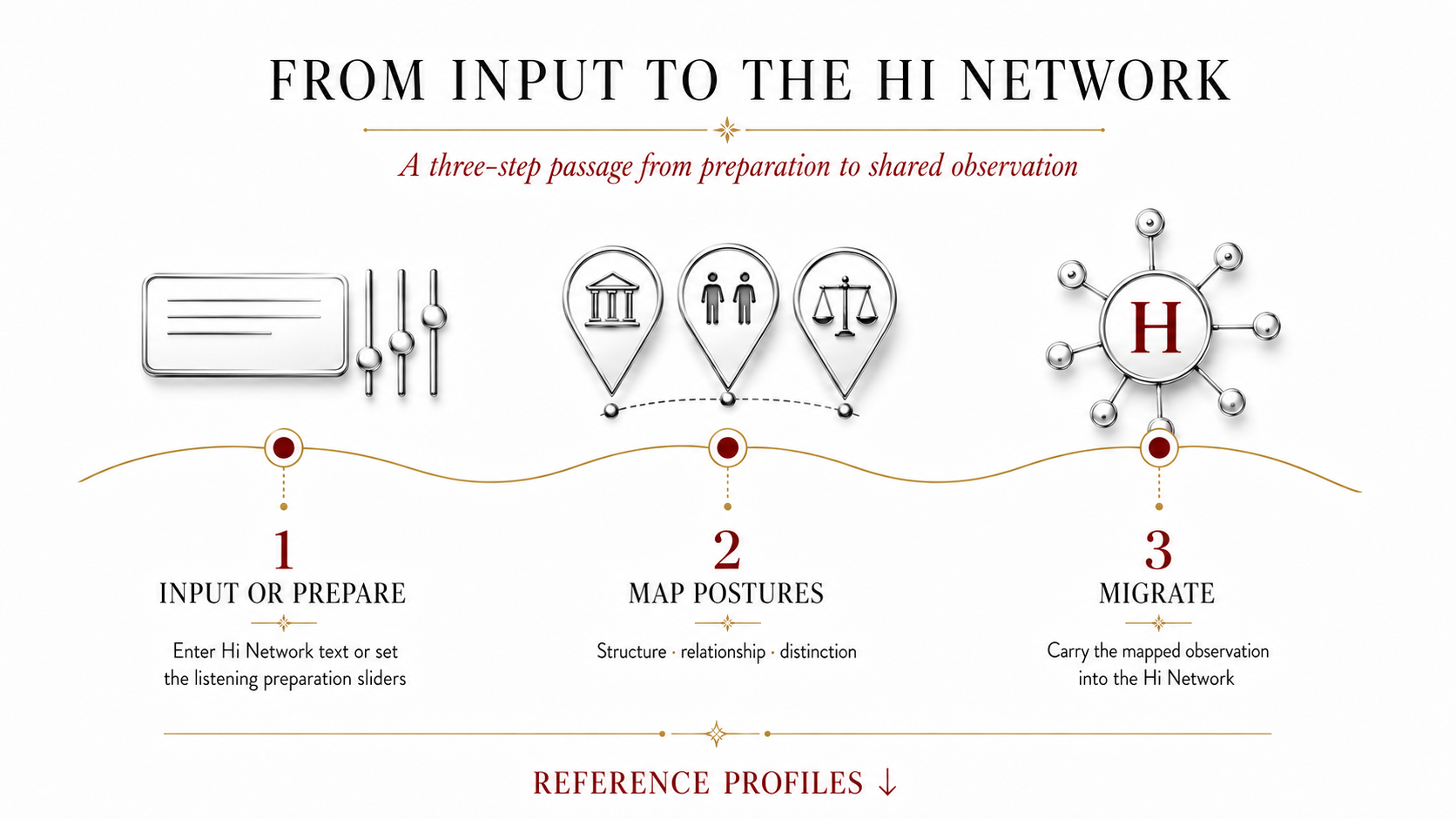
From input to the Hi Network

Reference Profiles

2Pac Shakur
Lightning • Attached-DetachmentAttached-Detachment / SubjectiveSubjective / Recognition / Present / Collective
AGinsberg
Lightning • DetachmentDetachment / CognitiveCognitive / Field / Timeless / Integrated
Andrew Warhola
Mirror • AttachmentAttachment / SubjectiveSubjective / Raindrop / Present / Collective
Anne Rice
Strawberry • Detached-AttachmentDetached-Attachment / SubjectiveSubjective / Mirror / Past / Collective
Barack Obama
44th President of the United States • Detached-AttachmentDetached-Attachment / CognitiveCognitive / Field / Future / Collective
Benjamin Sisko
Starfleet • Detached-AttachmentDetached-Attachment / ObjectiveObjective / Recognition / Future / Collective
Bill Withers
Lightning • Detached-AttachmentDetached-Attachment / SubjectiveSubjective / Recognition / Present / Collective

Bob Dylan
Lightning • Detached-AttachmentDetached-Attachment / CognitiveCognitive / Soultrain / Timeless / Integrated
Doherty Morrison Combs
Lightning • Detached-AttachmentDetached-Attachment / SubjectiveSubjective / Soultrain / Timeless / Universal
Donald J. Trump
45th & 47th President of the United States • AttachmentAttachment / SubjectiveSubjective / Mirror / Present / Collective
George Washington
First President of the United States • Detached-AttachmentDetached-Attachment / ObjectiveObjective / Recognition / Future / Collective
GoAskAlice
Strawberry • AttachmentAttachment / SubjectiveSubjective / Raindrop / Present / Collective

Hannibal Lecter
Fictional Reference Profile • Detached-AttachmentDetached-Attachment / CognitiveCognitive / Mirror / Present / Self
Harry
Strawberry • AttachmentAttachment / ObjectiveObjective / Soultrain / Timeless / Universal
James Franco
Strawberry • Detached-AttachmentDetached-Attachment / CognitiveCognitive / Recognition / Present / Self
JeanLucPicard
Captain • USS Enterprise-D • Detached-AttachmentDetached-Attachment / ObjectiveObjective / Recognition / Future / Universal
Jiddu Krishnamurti
Lightning • DetachmentDetachment / SubjectiveSubjective / Recognition / Present / Universal
John Lennon
Strawberry • DetachmentDetachment / CognitiveCognitive / Soultrain / Timeless / Universal
JoniMitchell
Strawberry • Attached-DetachmentAttached-Detachment / SubjectiveSubjective / Field / Present / Integrated
Lizard King
Lightning • Detached-AttachmentDetached-Attachment / SubjectiveSubjective / Soultrain / Timeless / Universal
Michael Jackson
Strawberry • AttachmentAttachment / CognitiveCognitive / Soultrain / Future / Universal
neemkarolibaba
Reference Profile • Detached-AttachmentDetached-Attachment / ObjectiveObjective / Mirror / Present / Universal
numberone
Observatory Collaborator • Detached-AttachmentDetached-Attachment / CognitiveCognitive / Recognition / Present / Collective
RZA
Hip Hop Artist · Producer · Composer · Philosop • Detached-AttachmentDetached-Attachment / CognitiveCognitive / Recognition / Present / Collective
Sincerely, L. Cohen
Lightning • Detached-AttachmentDetached-Attachment / CognitiveCognitive / Soultrain / Timeless / Universal

Strawberry Alarm Clock
Strawberry • Detached-AttachmentDetached-Attachment / CognitiveCognitive / Recognition / Present / Collective
Swami Lakshmanjoo
Strawberry • Detached-AttachmentDetached-Attachment / CognitiveCognitive / Recognition / Timeless / Universal
Taylor Swift
Mirror • Detached-AttachmentDetached-Attachment / SubjectiveSubjective / Mirror / Past / Self
The Dalai Lama
Mirror • Detached-AttachmentDetached-Attachment / SubjectiveSubjective / Mirror / Present / Universal
The Rolling Stones
Lightning • Attached-DetachmentAttached-Detachment / SubjectiveSubjective / Mirror / Present / Collective
The Velvet Underground
Lightning • Detached-AttachmentDetached-Attachment / ObjectiveObjective / Recognition / Present / Collective
Thumbelina Waits
Lightning • Detached-AttachmentDetached-Attachment / ObjectiveObjective / Mirror / Timeless / Collective
Willy Shakes
Lightning • Detached-AttachmentDetached-Attachment / CognitiveCognitive / Recognition / Timeless / Collective
WillyWonka
Lightning • DetachmentDetachment / ObjectiveObjective / Soultrain / Timeless / Universal
Wu-Tang
Hip Hop Collective/Strawberry • Detached-AttachmentDetached-Attachment / ObjectiveObjective / Recognition / Present / Collective
Yers
Strawberry • Attached-DetachmentAttached-Detachment / CognitiveCognitive / Soultrain / Future / Integrated

Today's Consciousness Weather

What do these categories mean?

Attachment States

AttachmentAttachment
26%
Attached-DetachmentAttached-Detachment
8%
Detached-AttachmentDetached-Attachment
64%
DetachmentDetachment
1%

Awareness Lenses

SubjectiveSubjective
83%
ObjectiveObjective
10%
CognitiveCognitive
6%

💧 Vidya (Knowledge & Understanding)

💧 Raindrop 20%
✨ Recognition 1%
🪞 Mirror 73%
🌾 Field 1%
🚂 Soultrain 3%

⏳ Time Orientation

Past 8%
Present 56%
Future 12%
Timeless 9%

🧭 Niyyat (Intention)

Individual 92%
Collective 3%
Universal 1%
Current Observer Pattern: Detached-AttachmentDetached-Attachment + SubjectiveSubjective + Mirror + Present + Individual
🖼 Visual Observation

Waiting for image...
Detached-Attachment
Detached-Attachment
100%
Cognitive
Cognitive
93%
Vidya (Knowledge & Understanding) 💧 Raindrop • 100%
Time Orientation Present • 100%
Niyyat (Intention) Individual • 100%

Andrew Warhola
🪞 What is this?

Classification Confidence: 100%
Essay  |  2026-07-28 00:26:18
Essay | Andy Warhol's productivity


Jacqueline Kennedy II (from the portfolio 'Eleven Pop Artists', vol. II)
Andy Warhol

Photography by Antonia Reeve. © The Andy Warhol Foundation for the Visual Arts, Inc. Licensed by DACS, London 2023
Throughout his life and career critics and commentators often referred to Andy Warhol (1928-1987) as ‘detached’, ‘alien’ and ‘aloof’. [1] He is not, in such assessments, an artist in possession of feelings which need to be expressed, but rather an inhuman, relentless producer of art. The humanistic subjectivity of the creative and tortured artist, commonly associated with painters aligned with Abstract Expressionism—the art movement which directly preceded Pop—was replaced in the 1960s by Warhol’s vision of a cold, mechanical art which relied less on the gestural mark-making of the artist’s hand and more on the logical precision of machines and technologies of reproduction. For many, this suggestion of the inhuman capacity of Warhol’s art to create likeness, and repetitively mimic or copy source material can be neatly summarised by the artist’s own contention that he wanted to be like a machine.


Andy Warhol Self-Portrait 1978 © The Andy Warhol Foundation for the Visual Arts, Inc. Licensed by DACS, London 2023
In a now infamous 1963 interview with the art critic Gene Swenson, Warhol claimed that ‘everybody should be like a machine’ and ‘everybody should like everybody’, because that, after all is ‘what Pop Art is all about’.[2] Such proclamations chime with other statements made by Warhol in interviews around this time, wherein he insists that he is ‘for mechanical art’.[3] Warhol’s desire to align his working processes with the machinic is reflected in his investment in technologies of image production which minimise the necessity of human intervention, such as the automatic process of screen-printing, which could be used to create multiple paintings and prints, one after another; and the still and cinematic film camera which had only to be loaded with film and switched on by Warhol to begin the recording process. This preference for automation and machine-production reaches its peak in the Warhol literature with an “interview” of Warhol conducted by his studio assistant Gerard Malanga. The interview in question was composed entirely (i.e. both the questions and their answers) by Malanga and submitted to Warhol for his approval before publication. In the piece “Warhol” gives his full-throated support to the idea of automation in the economy and the art world. His potent reflections are underlined further by the meta-authorial game of having Malanga research and write the interview himself:

Q. Would you like to replace human effort?
A. Yes.
Q. Why?
A. Because human effort is too hard.
[…]
Q. How will you meet the challenge of automation?
A. By becoming part of it.
[...]
Q. Dissect the meaning of automation.
A. Automation is a way of making things easy. Automation just gives you something to do […][4]

In this short essay I am going to explore some of the ramifications of considering Warhol as a machine. Firstly, I will consider the notion of productivity across Warhol’s artistic output, both in terms of the quantity of works produced, as well as some of the ways in which his art deals with concepts of duration and diversity in art practice. Secondly, I will argue that we can read the product of Warhol’s productivity as an attempt to dissolve boundaries between different artistic media.

Numbers game
Not unlike that of a factory working at capacity, the sheer scale of Warhol’s artistic output fuels the accuracy of the machine metaphor—the artist as an efficient and methodical producer. Working with a raft of assistants throughout his career, Warhol created a staggering number of artistic products. During 1964, for instance, he produced over 305 paintings of Jackie Kennedy alone. Other marquee subjects for Warhol, which he would return to paint over and over during that pivotal decade, yielded similarly large figures, most notably his Flower and Electric Chair series. Part of the reason Warhol was able to make work in such quantity was because of the speed with which his silkscreen paintings were able to be executed, as he commented in his memoir of the 1960s:

[…] with silk-screening, you pick up a photograph, blow it up, transfer it in glue onto silk, and then roll ink across it so the ink goes through the silk but not through the glue. That way you get the same image, slightly different each time. It was so simple—quick and chancy. I was thrilled with it.[5]
Andy Warhol
After turning his attention more fully to filmmaking after 1964, Warhol founded a company with David Whitney called Factory Additions which would create print portfolios using the same silkscreen method he had employed so successfully on his canvas-based works. Reflecting on these works, Warhol is direct in his comparison to industrial/machinic production, noting that the resulting paintings and prints possessed an ‘assembly-line effect’[6]. The print portfolios allowed Warhol to disseminate even greater quantities of work: 600 variations of three different Jackie Kennedy prints, one of which, Jaqueline Kennedy II (from the portfolio ‘Eleven Pop Artists, vol. II), 1965 [GMA 1336], is included in the present Scottish National Gallery of Modern Art (NGS) exhibition ‘Warhol and Paolozzi I want to be a Machine’; 500 prints modelled after Birmingham Race Riot (1964); 632 variations of Sunset (1972); 250 editions of a 10-print Marilyn Monroe portfolio from 1967, or 2,500 multi-coloured Marilyns.


Andy Warhol Jacqueline Kennedy II (from the portfolio 'Eleven Pop Artists', vol. II) 1965 © The Andy Warhol Foundation for the Visual Arts, Inc. Licensed by DACS, London 2023

Andy Warhol, Marilyn, © 2018 The Andy Warhol Foundation for the Visual Arts, Inc. / Licensed by DACS, London.
Concurrent to the creation of the Marilyn portfolio, which has a central placement in the current hang at the NGS, Warhol was embroiled deeply in another voluminous activity: filmmaking. From 1963 until 1968 Warhol produced over 600 films, including some 472 Screen Tests (1964-1966) and around 60 feature-length works.[7] Perhaps even more noteworthy than the number of films produced by the Warhol Factory is their recourse to marathon running times. His first film Sleep (1963), a collage of repeated shots of the poet John Girono (b. 1936) sleeping, lasts for five hours and twenty minutes. One of Warhol’s final directorial efforts **** (Four Stars) clocks in at a much more substantial twenty-five hours.

Quantity and duration coalesce in another of Warhol’s multimedia activities, his constant recording of everyday meetings and conversations via a handheld tape recorder. Referred to by the artist himself as his ‘wife’, the Norelco Carry-Corder Warhol carried with him from 1964 onwards was the first mass-marketed example of such a device.[8] The Warhol Archive now houses hundreds of tapes made by Warhol throughout his life, containing over 6,000 hours of audio. Warhol would often use the recordings on these tapes as the basis for many of his published book works, many of which can be seen in vitrines in the NGS show, from memoirs such as POPism: The Warhol Sixties (1980) and The Philosophy of Andy Warhol (From A to B and Back Again), to his experimental riff on the modernist novel: a, A Novel (1968), which chronicles a day in the life of the Factory Superstar Pope Ondine (1937-1989).

Warhol’s productivity did not dissipate during the 1970s. Between 1976 and his death in 1987 Warhol began to carry with him the visual equivalent of his tape recorder “wife”, a Minox 35 EL camera. Often exposing up to a roll of film a day or more, the resulting contact sheets—a relative anachronism in the age of digital photography, a contact sheet is an inexpensive way of viewing the content of a roll of film before certain images can be selected for later enlargement and printing—number over 3,600, or 130,000 individual photographs. A visual equivalent to Warhol’s meticulous Diaries (1989), the contact sheets contain a dizzying array of disparate events, people and activities Warhol encountered in the last decade of his life, often mixing the cultural events of New York high society with portraiture, snapshots of friends and associates, as well as cityscapes depicting Manhattan street signs and advertisement hoardings.

Collapsing Distinctions
Another way of viewing Warhol’s machine-aesthetic is to make use of it as a metaphor in accounting for his restless and prolific output as a multimedia artist. Our next avenue of interpretation pushes this idea further, arguing that Warhol’s fascination with volume, quantity and duration contributes to one of the central achievements of his oeuvre: the collapsing of distinctions between different artistic media.

Take for instance the silk-screened canvases and prints mentioned above. To create these works Warhol would start with a photographic image – either found and appropriated from a print publication or taken by himself – and blow up this image before transferring it via the screen-print or silkscreen process to a surface.

Such an a mixture of media and materials has led the writer Jonathan Flatley to comment on the silk-screened paintings: ‘[i]n terms of the standards of the given media, the result is neither a good photograph or a good painting’. Flatley does not yoke this perceived failure of competency and execution to a narrative of Warhol as somehow playing at being an amateur, or revelling in his – as is often the cliché – role of performing naivety. Instead, he points us towards reading these works, which seem to be not quite painting and not quite photography, as opportunities to exercise ‘our capacity for perceiving similarities across difference’, through Warhol’s ‘transposition of idioms, sensations and information from one medium to another’.[9]

In other words, we are confronted in Warhol’s silkscreen paintings and his prints with a vision of art in which the once stable categories of photography, painting and printing are no longer separated but have coalesced and become enmeshed together in a web of artistic mediation.

Warhol often commented on this dimension of intermediality—artworks which combine and juxtapose the aesthetic effects of different media—in his work. Another illuminating test case would be his Screen Tests. Warhol famously referred to these works not as movies but ‘Stillies’.[10] Each one of these three-minute films (running over four minutes when projected at Warhol’s preferred speed rate of eighteen frames per second) depicted a single sitter whose visage was recorded by the impervious, unblinking gaze of Warhol’s 16mm film camera. Subjects were often instructed by Warhol to move as little as possible, resulting in a stasis which often gifts the films an aesthetic equivalence of still photography or portrait painting.

In an interview with Letitia Kent published in Vouge magazine in March 1970, Warhol coaxed out the intermedial tension so important to his moving image works: ‘[…] I don’t paint anymore. I gave it up two years ago. I think painting is old fashioned. In my early films I wanted to “paint” in a new medium’.[11] He goes on shortly after to state that his perhaps most notorious film, Empire (1963), could be compared to a ‘moving picture still-life’.[12] But the Screen Tests remain most emblematic of the intermedial condition of Warhol’s cinematic output, opening the medium to be considered as an incubation chamber for all manner of artistic strategies, as Callie Angel astutely attests:

"Balanced at the borderline between moving and still image, part photography and part film, part portraiture and part performance, the Screen Tests are conceptual hybrids, arising, like much of Warhol’s work, from the formal transposition of idioms from one medium to another."[13]
Callie Angel
The example of Warhol’s prodigious use of tape recordings, and their transcription from a raw unmediated state into works of fiction, semi-fiction and memoir, point us again to another area of Warhol’s modus operandi, and an aspect of his artistic practice which marks him out a pioneer of the kind of self-surveillance which has become so commonplace in the social media-saturated landscape of the early twenty-first century.


Andy Warhol, Body Builder Flexing, ARTIST ROOMS National Galleries of Scotland and Tate. Presented by The Andy Warhol Foundation for the Visual Arts 2016. © The Andy Warhol Foundation for the Visual Arts / Artists Rights Society (ARS), New York / DACS, London 2017.

Andy Warhol, Jean-Michel Basquiat, ARTIST ROOMS National Galleries of Scotland and Tate. Presented by The Andy Warhol Foundation for the Visual Arts 2016. © The Andy Warhol Foundation for the Visual Arts / Artists Rights Society (ARS), New York / DACS, London 2017.
In closing, I would like to draw attention to some of the final works conceptualised and completed by Warhol before his death in 1987. The so-called ‘Stitched Photographs’, several of which are included in the NGS exhibition, were created between 1982 and 1987 by stitching together multiple copies of individual photographs taken with his Minox 35 EL Camera.

Although considered minor works by many Warhol scholars, the ‘Stitched Photographs’ evidence a continued obsession of Warhol’s to break down barriers between artistic media.

The photographs were stitched together with the aid of his studio assistant Christopher Makos (b. 1948) and Makos’ friend Michele Loud, using a Bernina sewing machine which Warhol had purchased in 1982.

Arranged in a grid structure of four, six or nine, the stitched photographs recall the repetitive, serially structured screenprints of the 1960s. Much like the ‘quick and chancy’ nature Warhol so admired in the screen-printing process, the stitched photographs also bear the markings of imperfection, as often the individual photographs bear evidence of having been pushed through the sewing machines: their smooth surfaces are variously ruptured by bumps and creases. These marks, lumps and bumps co-mingle with deliberately left-behind lengths of the thread which were used to suture the photographs together. These seemingly uncareful and unfinished aspects of the pictures lend the pieces a sculptural quality, and continue a tradition of creating three-dimensional objects which never ceased to interest Warhol over his career.

Over 500 stitched photographs were created by Warhol in the final years of his life. Another round of productivity, and another multi-faceted and multi-media machination in which the product was not a pre-fabricated, mass-produced identical work of art, but a subjectively imbued experiment born out of the mixing of media and the engendering of a cross-model exploration of what art can be.

This film takes a look at Andy Warhol, the most famous proponent of Pop Art, his obsession with fame, and his desire ‘to be a machine’.


[1] See for instance: John Wilcock, ‘The Detached Cool of Andy Warhol’, Village Voice, May 6, 1965, p.11; Stephen Smith, ‘“He loved Weightlifting and Buying Jewels”’: Andy Warhol’s Friends Reveal All’, The Guardian, August 14, 2015 (available online: https://www.theguardian.com/artanddesign/2015/aug/14/andy-warhol-friends-reveal-all) and George Gruskin, ‘Who is this man Andy Warhol?’, SCOPE, March 16, 1973, reprinted in Kenneth Goldsmith (ed.), I’ll Be Your Mirror: The Selected Andy Warhol Interviews, Carroll and Graf, New York, p. 200-220, quote on 217.

[2] Gene Swenson, ‘What is Pop? Answers from 8 Painters, Part 1’, ARTnews, November 1963, reprinted in Goldsmith, I’ll be Your Mirror, p. 15-20, quote on 16. The recent uncovering of the original tapes of Swenson’s interview with Warhol reveal that several parts of their conversation were heavily edited before going to press, particularly references to queer sexuality. In the tapes, Warhol’s insistence that being a machine and liking everything are inherently linked during a conversation about homosexuality:

Swenson: I don’t understand the business about – if all Pop artists are not homosexual, then what does this have to do with being a machine?
Warhol: Well, I think everybody should like everybody.
Swenson: You mean you should like both men and women?
Warhol: Yeah.
Swenson: Yeah? Sexually and in every other way?
Warhol: Yeah.
Swenson: And that’s what Pop art’s about?
Warhol: Yeah, it’s liking things.
Swenson: And liking things is being like a machine?
Warhol: Yeah. Well, because you do the same thing every time. You do the same thing over and over again. And you do the same. . .
Swenson: You mean sex?
Warhol: Yeah, and everything you do […]
Quoted in Jenifer Sichel‘“What is Pop Art?” A Revised Transcript of Gene Swenson’s 1963 interview with Andy Warhol’, Oxford Art Journal, 41:1 (March), 2018, p. 85-100.

[3] David Bourdon, ‘Warhol Interviews Bourdon’, 1962-1963, in Goldsmith, I’ll be Your Mirror p.6-14, quote on 9.

[4] Gerard Malanga, ‘Andy Warhol on Automation: An Interview with Gerard Malanga’, Chelsea 18, reprinted in Goldsmith, I’ll be Your Mirror, p. 59-63, quote on 60-62.

[5] Andy Warhol and Pat Hackett, POPism: The Warhol Sixties, Hutchinson, London, 1980, p. 22.

[6] Ibid.

[7] I use slightly speculative language here to indicate that Warhol’s filmography remains a very slippery subject for scholars. At present there is a seminal and exhaustive catalogue raisonné detailing the production and content of the Screen Tests (Callie Angel, Andy Warhol Screen Tests: The Films of Andy Warhol Catalogue Raisonne Volume 1, Abrams, New York, 2006). A second volume, covering the rest of his filmic output is forthcoming. A more recent and essential resource based on in-depth research in the Warhol archives is the introduction to Glyn Davis and Gary Needham’s Warhol in Ten Takes, British Film Institute, London, 2013).

[8] Andy Warhol, The Philosophy of Andy Warhol (From A to B and Back Again), Harcourt, Orlando, Austin, New York et al, 1975, p. 190.

[9] Jonathan Flatley, Like Andy Warhol, University of Chicago Press, Chicago and London, 2017, p. 113.

[10] Angel, Andy Warhol Screen Tests, p. 7.

[11] Letitia Kent, ‘Andy Warhol, Movieman: “It’s Hard to Be Your Own Script”’, Vogue, March 1, 1970, reprinted in Goldsmith, I’ll be Your Mirror, p. 185-190, quote on 186.

[12] Ibid. The scholar Justin Remes has gone even further with reference to Empire’s epic running time and profound stasis, theorising this work as a ‘furniture film’—a film which lives in a room for an extended period of time and is designed to be consumed partially and distractedly in conjunction with other activities. See Justin Remes, Motion(less) Pictures: The Cinema of Stasis, Columbia University Press, New York and Chichester, 2015, p. 31-59.

[13] Angel, Andy Warhol Screen Tests, p. 14
Detached-Attachment
Detached-Attachment
97%
Cognitive
Cognitive
30%
Vidya (Knowledge & Understanding) 🪞 Mirror • 100%
Time Orientation Present • 71%
Niyyat (Intention) Individual • 100%

RZA
What is this?

Classification Confidence: 100%
Lyric  |  2026-07-25 10:06:17
"Rumble"
(performed by U-God, Inspectah Deck, Letha Face, Method Man)

[U-God:]
Countdown

Are you ready? Are you mad inside?
Got you strapped down to your seats
Out of the doorway, bullets ripped, full clip

God speed, approach follow my lead
Fire winds gust, empire crush

Full thrust, fall in the hole, roll wit the rush
Untouchable chunk of earwax and soul
Sound waves slay out the bat cave smoke
My belly-full prance dance, avalanche quote
Down slope, elegant as Fantasia
Killer whale tale inhale, black male from Asia
All out the wood works, hood shirts and wizards
No match, unhatch, the rap is rigid
In the shaft, shotty cocked, hip hop to the limit
Nightwatch, pad mark
Sparks spin a quake nuclear blast, heavy on the cash
Gimmie what it takes NOW!!

Rage, rock roll, fight
Brawl, fall, rumbleee!
Rage, rock roll, fight
Brawl, fall, rumbleee!

[Letha Face:]
The diabolic witty, dialect's darker than Gotham City
With the possibility to stop your walkin ability
God forgive me, spark enemies with pistol grips
The missile tip's impact hit you so hard, you shit through your dick
Official scripts strikes when physical hits
You physical bitch, watch for the imperial blitz, serious shit
Submit, subject to the wreck war tone, and thought poems
Liver than WWF Warzone

Walk upon them Gotti tracks, bodies collapse
Rap for lottery stacks, shatter like when pottery cracks
Logical facts from the terror dome
Spill from the guts, trail to you ?puss? from where you bust
In God you now entrust
Dog you like hound and mutts, Pound Pups get sound struck
Clown what? You'll get drowned in the cut
While crowd round up

[U-God:]
Rage, rock roll, fight
Brawl, fall, rumbleee!
Rage, rock roll, fight
Brawl, fall, rumbleee!

[Inspectah Deck:]
A-yo, yo
I spit bars, traveling tremendous speed measuring far
Been busting satellites circling Mars
Verbal onslaught, bring forth physical force
Of a hundred wild niggas piled in a Trojan Horse
Thought method, set it on generic mic ethic
Professional neck shit, left foes beheaded
This music, is mind control like computer chips
Been doing this for numerous years, refuse to lose it
With turbo tactics, maneuver like a trained soldier
Hall of Fame flame thrower, take game, it's game over
Ayatollah, high roller nine totter

Mind controller, 2009 time folder
My coalition, bring the demolition
Wu-blade decision, slate the competition, wit no intermission
Spitting hazardous darts, up front like Rosa Parks
Makin million men march

[U-God:]
Rage, rock roll, fight
Brawl, fall, rumbleee!
Rage, rock roll, fight
Brawl, fall, rumbleee!

[Method Man:]
Yo, who got next? Meth got next
I chin check, all these MC's line em up god, I go Jihad
Declare holy war, it be hard to dip and dodge
Police squads trying to bogard, we rip and rob
The boulevard ain't safe for your kids, that's how it is
In the ghetto, we ain't scared to death, but scared to live

So Goldy, mosey to the spot, get that moldy
Rusty-ass .38 Special, niggas owe me
Slowly I turn, face the one and only
Naughty By Nature, I Do My Dirt All By My Lonely

Ask Pretty Tony, when I got a bitch I keeps a bitch
36 Chambers, enter at your own risk

Take that watch off and tuck your necklace
City never sleeps, streets is restless
Rap style'll slave you, when you least expect it
Pull the plug on your respirator, leave you breathless

Wu-Tang forever and a day, better warn your boys
I deploy battleship rap, seek and destroy

[U-God:]
Rage, rock roll, fight
Brawl, fall, rumbleee!
Rage, rock roll, fight
Brawl, fall, rumbleee!
Detached-Attachment
Detached-Attachment
100%
Cognitive
Cognitive
30%
Vidya (Knowledge & Understanding) 🪞 Mirror • 100%
Time Orientation Present • 99%
Niyyat (Intention) Individual • 100%

Wu-Tang
🍓 What is this?

Classification Confidence: 100%
Lyric  |  2026-07-25 09:19:16
"Wu-Tang: 7th Chamber"

[Raekwon:]
Yo, Meth, hold up, hold up
Yo, Meth, where my Killer tape at, God?
First of all, where my
Where the fuck is my tape at?

[Method Man:]
Yo, son, I ain't got that piece, son

[Raekwon:]
How you ain't got my shit when I let you hold it, man?

[Method Man:]
Yo, niggas came over to have 40s and blunts, kid
The shit just came up missin', son

[Raekwon:]
Come on, man, that don't got nothin' to do with my shit, man
Come on, man, go head with that shit, man

[Method Man:]
Come on, man, I'll buy you four more fuckin' Killer tapes, man

[U-God:]
Ayo! Ayo!

[Raekwon:]
Open the door, man! What the fuck, man?
Yo, what? What's up?

[Ghostface Killah:]
Yo, yo, God, word is bond, yo
Shameek just got bust in his head two times, God!

[U-God:]
Word to mother!

[Ghostface Killah:]
Word life, God
You know Shameek from fuckin' 212, God?
The nigga just got bucked
Niggas in a black Land, God, word is bond
Came through, God, from out of nowhere, God
Word is bond I'm comin' to get my Culture Cipher, God
And they just... word is bond
Crazy shots just went the fuck off, God

[U-God:]
Niggas let off crazy shots, kid

[Ghost:]
The nigga layin' there like a fuckin' newborn fuckin' baby, God

[U-God:]
Word up!

[Meth:]
Is he dead?

[Ghost:]
Is he fuckin' dead?
What the fuck you mean is he fuckin' dead, God?

[U-God:]
What the fuck kind of question is that, B? Fuck you think?

[RZA:]
Easy, easy

[Ghost:]
The nigga layin' there with his fuckin'
All types of fuckin' blood comin' out of his fuckin'

[U-God:]
(Sarcastically) Is he is he is he dead?

[Ghost:]
Yo, God, what's up, God? It's the God, God, word is bond
Yo, what's up? I'm ready to fuckin' lay
I'm ready to get busy, God, what's up?

[Rae:]
Yo, let's go do what we got

[U-God:]
What's up, yo?

[Rae:]
Yo let's go do what we gotta do, man, fuck it

[U-God:]
Yo, we out or what, man?

[Ghost:]
It's the God, God, fuck that, man

[U-God:]
You sayin' we out?

[Meth:]
They probably took the tape

[Ghost:]
What the fuck?

[Rae:]
Nigga still sweatin' the tape, man

[Ghost:]
What the fuck is you talkin' about? Get the fuck outta here!

[Rae:]
Fuckin' corn!

[Wu-Tang Clan:]
Good Morning Vietnam!
Yeah, good morning
To all you motherfuckin' knotty-headed niggas
Word to the camouflage large niggas
Bitch, where the fuck is my bottle?
Bring that fuckin' meth in here!
Yo, yo, yo
Now we gonna drink some good Night train
Yo, yo, yo, yo!

[Raekwon:]
Champion gear that I rock, you get your boots knocked
Then attack ya like a pit, then, lock shit down
As I come and freaks the sound, hardcore
But givin' you more and more like "Ding!"
Nah, shorty, get you open like six packs
Killa Beez attack, flippin' what? Murder one phat tracks, aight?
I kick it like a Nike Flight
Word life, I get that ass robbed on spite
Check the method from Bedrock, 'cause I rock your head to bed
Just like rockin' what? Twin Glocks!
Shake the ground while my beats just break you down
Raw sound, goin' to war right now
So, yo, bombin', We-Usually Take-All-Niggas-Garments
Save your breath before I vomit

[Method Man:]
I be that insane nigga from the psycho ward, I'm on the trigger
Plus I got the Wu-Tang sword, so how you figure
That you can even fuck with mine?
Hey, yo, RZA! Hit me with that shit one time!
And pull a foul, niggas, save the beef for the cow
I'm milkin' this ho, this is my show, Tical!
The fuck you wanna do on this mic piece, duke?
I'm like a sniper, hyper off the ginseng root
PLO Style, Buddha monks with the owls
Now, who's the fuckin' man? Meth-Tical

[Method Man (Inspectah Deck):]
On the chessbox
"Wu-Tang style"

[Inspectah Deck:]
Yo, yeah, yo
I leave the mic in body bags
My rap style has the force to leave ya lost like the Tribe of Shabazz
Murderous material made by a madman
It's the mic wrecker, Inspectah, bad man
From the bad lands of the Killa
Rap fanatic, representin' with the skill that's iller
Dare to compare, get pierced just like your ear
The Shooby Doo-Wop pop, strictly hardware
Armed and geared 'cause I just broke out the prison
Charged by the system for murderin' the rhythm
Now, lo and behold another deadly episode
Bound to catch another fuckin' charge when I explode!

[Ghostface Killah:]
Slammin' a hype-ass verse 'til your head burst
I ramshack dead in the track, and that's that
Rap assassin, fast and quick to blast in hardrock
I ran up in spots like Fort Knox
I'm hot! Top notch, Ghost thinks with logic
Flashbacks how I attacked your whole project
I'm raw, I'm rugged and raw! I repeat
If I die, my seed'll be ill like me
Approachin' me, yo, out of respect, chops to neck
I get vexed, like crashin' up a phat-ass Lex
So, clear the way! Make way! Yo, open the cage!
Peace, I'm out, jettin' like a runaway slave

[RZA:]
You gettin' stripped from your garments, boy, run your jewels
All the meth got me open like Fallopian tubes
I bring death to a snake when he least expect
Ain't a damn thing changed, boy, Protect Ya Neck!
Ruler Zig-Zag-Zig Allah, jam is fatal
Quick to stick my Wu-Tang sword right through your navel
Suspenseful force bein' brought through my utensil
The pencil, I bring strong winds up against you
Havoc, then run through your county like the Maverick
Caps through the tablets, I gots to make the fabrics

[Ol' Dirty Bastard:]
A-a-a-ah-ah, are you a warrior, killer? Slicin' shit like a samurai?
The Ol' Dirty Bastard from the bar!
Ol' Dirty clan of terrorists
Comin' at your ass like a sorceress, shootin' that piss
Niggas be gettin' on my fuckin' nerves
Rhymes they be kickin' make me wanna kick they fuckin' ass to the curb
Boy got funky fresh like the Old Specialist
A carrier, messenger, bury ya
This experience is for the whole experience
Let it be applied, Unique, drop that science!

[GZA:]
My-My-My-My clan is thick like plaster, bust ya, slash ya
Slit a nigga back like a Dutch Master
Killer style jumped off in Killa Hilla
I was the thriller in the Ali-Frazier Manila
I came down with phat tracks that combine and interlock
Like gettin' smashed by a cinder block
Poaw! Now it's all over
Niggas seein' pink hearts, yellow moons
Orange stars and green clovers
Detached-Attachment
Detached-Attachment
100%
Cognitive
Cognitive
36%
Vidya (Knowledge & Understanding) 🪞 Mirror • 100%
Time Orientation Present • 92%
Niyyat (Intention) Individual • 100%

Wu-Tang
🍓 What is this?

Classification Confidence: 100%
Lyric  |  2026-07-25 09:17:18
"Method Man"

[Method Man & Raekwon:]
Yeah, torture, motherfucker, what?
(Torture, nigga, what?)
What? I'll fuckin', I'll fuckin' tie you to a fuckin' bedpost
With your ass cheeks spread out and shit, right?
Put a hanger on a fuckin' stove and let that shit sit there for like a half hour, take it off and stick it in your ass slow like "tsss"
(Yeah, I'll fuckin', yeah, I'll fuckin' lay your nuts on a fuckin' dresser, just your nuts layin' on a fuckin' dresser, and bang them shits with a spiked fuckin' bat blaow)
Ooh wassup?
I'll fuckin', I'll fuckin', pull your fuckin' tongue out your fuckin'
Mouth and stab the shit with a rusty screwdriver, blaow
(I'll fuckin', I'll fuckin', I'll fuckin' hang you by your fuckin' dick off the fuckin' twelfth stor-story building out this motherfucker)
I'll fuckin', I'll fuckin', sew your asshole closed, and keep feedin' you, and feedin' you, and feedin' you, and feedin' you
Yo, roll the dice, yo, roll the dice
Yo, so it's goin' down like that, huh? Yeah?
Niggas is wildin', check it out, kid

[GZA:]
From the slums of Shaolin, Wu-Tang Clan strikes again
The RZA, the GZA, Ol' Dirty Bastard, Inspectah Deck
Raekwon the Chef, U-God, Ghostface Killah and the Method Man

[Method Man:]
M-E-T-H-O-D Man
M-E-T-H-O-D Man
M-E-T-H-O-D Man
M-E-T-H-O-D Man

Hey, you, get off my cloud
You don't know me and you don't know my style
Who be gettin' flam when they come to a jam?
Here I am, here I am, the Method Man
Pat-a-cake, pat-a-cake, hey, the Method Man
Don't eat Skippy, Jif or Peter Pan
Peanut butter 'cause I'm not butter
In fact, I snap back like a rubber
Band, I be Sam, Sam-I-Am
And I don't eat green eggs and ham
Style'll hit ya, wham, then goddamn
You'll be like, "Oh shit, that's the jam"
Turn it up, now hear me get buck w-w-wild
I'm about to blow, light me up (Light me up)
Upside, downside, inside and outside
Hittin' you from every angle, there's no doubt I
Am the one and only Method Man
The master of the plan, rappin' shit like Saran
Wrap, with some of this and some of that
Hold up (What?) I tawt I taw a putty tat
Over there, but I think he best to beware
Of the diggy dog shit right here
Yippy-yippy-yay, yippy-yah, yippy-yo
Like Deck said, "This ain't your average flow"
Comin' like rah, ooh-ah, achie-kah
Tell me, how you like it so far, baby paw?
The poetry's in motion, coast to coast and
Rub it on your skin like lotion
What's the commotion? Oh my Lord
Another corn chopped by the Wu-Tang sword
"Hey, hey, hey" like Fat Albert
It's the Method Man, ain't no if ands about it
It's the Method

Alright, y'all, get your White Owls
Get your Meth', get your skins
Don't forget your 'orty
And we gonna do it like this

I got fat bags of skunk
I got White Owl blunts
And I'm about to go get lifted
Yes, I'm about to go get lifted
I got myself a Forty
And I got myself a shorty
And I'm about to go and stick it
Yes, I'm about to go and stick it, uh

H-U-F-F, huff, and I puff
Blow like snow when the cold wind's blowin'
Zoom, I hit the mic like boom
Wrote a song about it, like to hear it? Here it goes
Question, what exactly is a panty raider?
Ill behavior, savior or major flavor
All of the above, oh yeah, plus seducer
Also, flam, I'm the man, call me super
Not an average Joe with an average flow
Doin' average things with average hoes
Yo, I'm super, I'll make a bitch squirm
For my super sperm (Check it)
Check it, I give it to you raw butt-naked
I smell sess, pass the method
Let's get lifted as I kick ballistic
Missiles and shoot game like a pistol
Clip is loaded when I click bang (Bang)
A Wu-Tang slug hits your brain
J-U-M-P, jump, and I thump
Make girls rump like pump and Humpty Hump
Wild, the Shaolin style is all in me
Child, the whole damn isle is callin' me
P-A-N-T-Y, R-A-I-D-E-R, mad raw, I don't fry
Meaning, no one can burn or toss and turn me
Ooh, I be the super sperm
Chim-chimney, chim-chim, cher-ee
Freak a flow and flow fancy free
Now, how many licks does it take
For me to hit the Tootsie Roll center of a break?
Peep and don't sleep, the crew's mad deep (Wu-Tang)
Fadin' motherfuckers like bleach
So to each and every crew
You're clear like glass, I could see right through
Your whole damn posse be catchin' 'em all, 'cause you vic'd
And you didn't have friends to begin with, I'm—

The M-E-T-H-O-D Man
M-E-T-H-O-D Man
M-E-T-H-O-D Man
Here I am, here I am, the Method Man

[RZA (Ghostface Killah) {Method Man}:]
Straight from the slums of Shaolin
Wu-Tang Killa Beez on a swarm
(Your soul have just been tooken)
(Through the 36 Chambers of death, kid)
{Word to mother, Method Man signin' off, peace}
Detached-Attachment
Detached-Attachment
95%
Cognitive
Cognitive
30%
Vidya (Knowledge & Understanding) 🪞 Mirror • 100%
Time Orientation Present • 93%
Niyyat (Intention) Individual • 100%

Wu-Tang
🍓 What is this?

Classification Confidence: 100%
Lyric  |  2026-07-25 09:16:05
"Wu-Tang: 7th Chamber - Part 2"

[The Genius/GZA:]
Niggas on the left, brag shit to death
Now hoods on the right, wild for the night
Punks in the back, c'mon and attract to what
Clan in da front, let your feet stomp
Niggas on the left, brag shit to death
Hoods on the right, wild for the night
Punks in the back, c'mon and attract to what
This goes back to nineteen
Ahem, check it, yo
GOOD MORNING VIETNAM!!

Yeah, good morning to all you motherfuckin notty-headed niggas
Word to the camouflage large niggas
Bitch niggas fuckin my body
Bring that fuckin meth in here
Yo yo yo yo
Now we gonna drink some good Nightrain

[Raekwon:]
Champion gear that I rock, you get your boots knocked
Then attack you like a pit that lock shit DOWN
As I come and freaks the sound, hardcore
But giving you more and more, like ding!
Nah shorty, get you open like six packs
Killer Bees attack, flippin what, murder one, phat tracks
A'ight? I kick it like a Night Flite!
Word life, I get that ass raw, I'm fulla spite!
Check the method from Bedrock, cause I rock ya head to bed
Just like rockin what? Twin Glocks!
Shake the ground while my beats just break you down
Raw sound, we going to war right now
So, yo, bombin
We Usually Take All Niggas Garments
Save ya breath before I vomit

[Method Man:]
I be that insane nigga from the psycho ward
I'm on the trigger, plus I got the Wu-Tang sword
So how you figure that you can even fuck with mine?
Hey, yo, RZA! Hit me with that shit one time!
And pull a foul, niggas save the beef on the cow
I'm milkin this ho, this is MY show, tical
The FUCK you wanna do? More than Spike Lee's Do
I'm like a sniper, hyper off the ginseng root
PLO style, Buddha monks with the owls
So who's the fucking man? Meth-Tical
On the chessbox

[Inspectah Deck:]
Yo, yeah, yo
I leave the mic in body bags, my rap style has
The force to leave you lost, like the tribe of Shabazz
Murderous material, made by a madman
It's the mic wrecker, Inspector, bad man
From the bad lands of the killer, rap fanatic
Representing with the skill that's iller
Dare to compare, get pierced just like an ear
The zoo-we-do-wop-bop strictly hardware
Armed and geared cause I just broke out the prison
Charged by the system - for murdering the rhythm!
Now, lo and behold, another deadly episode
Bound to catch another fuckin charge when I explode

[Ghostface Killah:]
Slammin a hype-ass verse til ya head burst
I ramshack dead in the track, and that's that
Rap assassin, fastin, quick to blast and hardrock
I ran up in spots like Fort Knox!
I'm hot, top notch, Ghost thinks with logic
Flashback's how I attacked your whole project
I'm raw, I'm rugged and raw! I repeat, if I die
My seed'll be ill like me
Approachin me, you out of respect, chops ya neck
I get vexed, like crashing up a phat-ass Lex'
So clear the way, make way, yo! Open the cage
Peace, I'm out, jettin like a runaway slave

[RZA:]
Ya gettin stripped from ya garments, boy, run ya jewels
While the meth got me open like falopian tubes
I bring death to a snake when he least expect
Ain't a damn thing changed, boy, Protect Ya Neck
Ruler Zig Zag, Zig-Allah jam is fatal
Quick to stick my Wu-Tang sword right through ya navel
Suspenseful, plus bein bought through my utensil
The pencil, I break strong winds up against your
Abbot, that run up through your county like the Maverick
Caps through the tablets, I gots to make the fabrics

[Ol' Dirty Bastard:]
Are uh-ah-uh Are you a warrior? Killer? Slicin shit like a samurai
The Ol' Dirty Bastard from the bar
Ol' Dirty clan of terrorists
Comin atcha ass like a sorceress, shootin' that PISS!
Niggas be gettin on my fuckin nerves
Rhymes they be kickin make me wanna kick they fuckin ass to the curb
I got funky fresh, like the old specialist
A carrier, messenger, bury ya
This experience is for the whole experience
Let it be applied, and THEN DROP THAT SCIENCE

[Genius/GZA:]
My my my
My Clan is thick like plaster
Bust ya, slash ya
Slit a nigga back like a Dutch Master Killer
Style jumped off and Killa, Hill-er
I was the thriller in the Ali-Frazier Manilla

I came down with phat tracks that combine and interlock
Like getting smashed by a cinder block
Blaow! Now it's all over
Niggas seeing pink hearts, yellow moons
Orange stars and green clovers
Detached-Attachment
Detached-Attachment
61%
Cognitive
Cognitive
57%
Vidya (Knowledge & Understanding) 🪞 Mirror • 98%
Time Orientation Present • 50%
Niyyat (Intention) Individual • 98%

Wu-Tang
🍓 What is this?

Classification Confidence: 100%
Lyric  |  2026-07-25 09:15:40
"Conclusion"

[Inspectah Deck:] Yo butter butter
[Method Man:] Protect Ya Neck baby

[Ghostface Killah:] Respect due pa
[Inspectah Deck:] Peace
[Ghostface Killah:] Peace
[Inspectah Deck:] Word up Wu-Tang in the house though

[Interviewer:]
I guess a lot of people in ya
I guess they can feel the realness you
They could feel the vibe
And I think hip hop, that's what I be tellin a lot of people
A lot of record promoters and a lot of artists
I mean it's like, it's music that you gotta touch and feel
You know what I'm sayin'
And I think that comes across well in the video
I haven't seen you live yet, I'm waitin for the chance
But I'm pretty sure that's probably what's it like
You know you probably really get into it
I guess I hear it in your voices when you sayin the rhymes
Um, what ya say ya style is?

[Kung Fu sample:]
It's a secret! Never teach the Wu-Tang

[RZA:]
You best protect ya neck
Attached-Detachment
Attached-Detachment
100%
Cognitive
Cognitive
100%
Vidya (Knowledge & Understanding) 💧 Raindrop • 100%
Time Orientation Past • 100%
Niyyat (Intention) Individual • 100%

Anne Rice
🍓 What is this?

Classification Confidence: 100%
Article  |  2026-07-24 02:55:18
Having completed the two cycles of legend to which she has devoted her career so far, Anne Rice gives us now her most ambitious and courageous book, a novel about the life of of Christ the Lord based on the gospels and on the most respected New Testament scholarship.

The book's power derives from the passion its author brings to the writing, and the way in which she summons up the voice, the presence, the words of Jesus who tells the story.

This new introduction appears in the paperback edition of the book, released November 1st, 2006:

This book seeks to present a realistic fictional portrait of Our Lord in Time.  It is rooted in the faith that the Creator of the Universe became human in the person of Jesus Christ and “dwelt among us.”  The magnificent mystery of the Incarnation is accepted and affirmed as fact. Scripture is the inspiration for the emotions and powers of the Child Jesus as they are envisioned here.   History as well as the gospels is the source for this picture of a world in which Our Lord might have lived, as a little boy, in war and in peace, from day to day.

Ad majorem Dei gloriam. July 12, 2006

Discussion Questions:

1. Christ the Lord: Out of Egypt is told in Jesus' voice. What advantages does the first-person narration offer the author? How does it contribute to the novel's emotional resonance? How does it influence the way the novel unfolds?

2. What other literary devices does Rice use to bring the story to life for the contemporary reader? Discuss, for example, her use of imagined conversations and her descriptions of the family's interactions.

3. The Gospel of Matthew and the Gospel of Luke recount the story of Jesus' birth, the flight to Egypt, and the family's return to Israel. Does Rice take liberties with these biblical versions in her retelling? To what extent does her account echo the Gospels in both content and tone?

4. Christ the Lord: Out of Egypt focuses on a period in Jesus' life not described in the New Testament. How realistic is Rice's portrait of Jesus as a young boy? How do the miracles he performs–killing and reviving Eleazer [pp. 4—7]; alleviating Cleopas' pain [p. 48] and rescuing him from death [p. 99]; and restoring sight to the blind man [pp. 279—80] –reflect feelings and wishes typical of a seven-year-old?

5. Throughout the book, Jesus questions Mary and Joseph, Cleopas, and rabbis and scholars in hopes of discovering the secret of his birth. What do the answers he receives from the various adults reflect about their relationship with Jesus, their understanding of the truth, and their own self-interests and philosophies?

6. What role does Cleopas play in his nephew's life? Why does he defy Mary and Joseph and reveal what he knows about Jesus' conception and birth [p. 45—47]? What other function does he serve in the plot? What insights do his opinions [p. 68, p.74, and p. 211, for example] give into the political situation in Israel? Is his point of view understandable in light of the history of the Jews as it is presented in the novel?

7. What makes Rice's portraits of Mary and Joseph effective? What did you admire most each of them? Are there flaws in the decisions they make?

8. Discuss the internal conflicts Jesus experiences as he pieces together the stories he hears and tries to reconcile them with his own his unsettling thoughts and fears. Do they make you feel differently about Jesus' humanity? His divinity?

9. Jesus' immersion in Jewish culture and traditions is an important aspect of the novel. What is the significance of Rice's focus on Jesus as a Jew? What insights does it give into Jesus' teachings and his ultimate mission on earth? Is the message relevant to the religious tensions in the world today?

10. Did reading Christ the Lord: Out of Egypt deepen your understanding of the origins of Christianity? Do you think readers' reactions to Christ the Lord: Out of Egypt are inevitably influenced by their personal religious beliefs and heritage?

11. In the author's note, Rice discusses her extensive research and offers a critique of recent New Testament scholarship. Do you agree with her criticism of the current "fashionable notions about Jesus" [p. 309]? Have you read articles or books that support her argument that many writers "scholars who have apparently devoted their life to New Testament scholarship, disliked Jesus Christ" [p.314]? Do you think that Rice's background and her strong Catholic faith affect the conclusions she draws?

12. Rice, who is best known for her books about vampires, expresses the hope that "Jesus will be as real to you as any other character I've ever launched into the world we share" [p. 321]. If you have read her other books, do you think that she succeeded in this goal? Whether or not you are familiar with her previous works, discuss your reactions to the following quotation: "After all, is Christ Our Lord not the ultimate supernatural hero, the ultimate outsider, the ultimate immortal of them all?" [p. 321].


Reviews:


BELIEFNET.COM has named CHRIST THE LORD as The Best Spiritual Book of the Year! Read the article here.

Kirkus
(STARRED)

A riveting, reverent imagining of the hidden years of the child Jesus.

Attacked by a vicious bully, seven-year-old Yeshua employs uncanny powers to drop his assailant onto the sand and then to bring him back to life. It's the remarkable beginning of the 26th novel by an author whose pulpy vampire chronicles hardly prepare us for a book so spiritually potent as this. Following Jesus and his family's journey from Egyptian exile to their ancestral home, it recasts Bible stories (the Magi's visit, the presentation at the temple) in the detailed context of Jewish rebellion against Herod Archelaus, the impious ruler of Israel. A cross between a historial novel and an update of Tolstoy's The Gospel in Brief, it presents Jesus as nature mystic, healer, prophet and very much a real young boy. Essentially, it's a mystery story, of the child grappling to understand his miraculous gifts and numinous birth. He animates clay pigeons, causes snowfall and dazzles his elders with unheard-of knowledge. Rice's book is a triumph of tone -- her prose lean, lyrical, vivid -- and character. As he ponders his staggering responsibility, the boy is fully believable -- and yet there's something in his supernatural empathy and blazing intelligence that conveys the wondrousness of a boy like no other. Rice's concluding Author's Note traces the book's genesis to her return to Catholicism in 1993, her voracious reading -- a mountain of New Testament scholarship, the Apochrya, the ancient texts of Philo and Jospephus -- and her passionate search for Jesus of the Gospels. With this novel, she has indeed found a convincing version of him; this is fiction that transcends story and instead qualifies as an act of faith.

Joins Nikos Kazantzakis's The Last Temptation of Christ and Endo's A Life of Jesus as one of the bolder re-tellings.

(Kirkus Reviews, October 1, 2005)

__________

Library Journal

Rice, Anne. Christ the Lord: Out of Egypt. Knopf. Nov. 2005. c.321p. ISBN 0-375-41201-8. $25.95.

A novel narrated by Jesus of Nazareth from the author who has spent decades writing about vampires may strike many as strange, but Rice brings the same passion to her colorful account of the young Jesus and his quest to understand his strange powers (turning clay pigeons into live birds, bringing a dead child back to life). As in her other books, Rice has extensively researched the historical context in which she writes, here drawing on the Gospels and respected New Testament scholarship. The story opens with seven-year-old Jesus and his family living in Egypt where Jesus is the prize pupil of the scholar Philo. Joseph (Jesus has been carefully taught not to call him Father) decides adamantly that the family must return to their Jewish homeland in Israel. On the journey to Nazareth, Jesus continues to experience supernatural abilities and tries to come to terms with what they mean. Rice's Jesus is childlike but divine, wise beyond years yet wondering who he is and why he is different from other boys. In her attempt to breathe life into a historical religious figure, Rice's superb storytelling skills enables her to succeed where many other writers have failed. Whether or not her literary conversion will be accepted by her fans and critics alike remains to be seen. Highly recommended for all collections. [See Prepub Alert, LJ 7/05.]

-Tamara Butler, Bryant & Stratton Coll. Lib,
Buffalo, NY

(Library Journal, November 1, 2005)

__________

Jason Raia

"Dear Ones, for an interesting review of CHRIST THE LORD by Jason Raia, please go to intellectualsinc.blogspot.com

--Anne" 

__________

CompulsiveReader.Com

"Dear Ones, below is Donna Denn's new review of Christ the Lord from CompulsiveReader.Com. --Anne"

A review of Christ the Lord by Anne Rice

When you think of the writing of Anne Rice, of course you think of vampires and witches. I've read and loved those stories for years, right along with a legion of fans. They deal with the supernatural along with a wonderful feeling of history. So, given that supernatural aspect, you don't at first equate Jesus with the supernatural, do you? Or maybe you do.

Reviewed by Donna Denn

Christ the Lord
by Anne Rice
Hardcover: 336 pages
Publisher: Knopf (November 1, 2005)
ISBN: 0375412018

I've just finished turning the last page on this book, and wanted to sit down and write while everything was still fresh in my mind. There's so much here to absorb, to think about. Out of everything she's written, I think this book is the one that Ms Rice has put the most of herself in. I'll be honest with you. After reading about (and loving) vampires and witches all these years, I was VERY curious about what would happen in CHRIST THE LORD. I'm so glad I read it.

If I had to choose one word to describe this book, I could choose amazing, but I don't think that would do it justice. Surprising, unexpected, ambitious and compelling all come to mind. But I'll tell you what: when this comes out on November 1st, read it for yourself and let me know what you think. I'd be glad to discuss it with you.

When you think of the writing of Anne Rice, of course you think of vampires and witches. I've read and loved those stories for years, right along with a legion of fans. They deal with the supernatural along with a wonderful feeling of history. So, given that supernatural aspect, you don't at first equate Jesus with the supernatural, do you? Or maybe you do. Miracles do have a supernatural quality to them.

In CHRIST THE LORD Out of Egypt, you'll find a familiar story told from a unique viewpoint: that of Jesus himself. His curiosity and bewilderment of his own beginnings seems so human, especially in a young boy. His family and daily life are brought forth in a way that lets you see what his life must surely have been like. We begin with Jesus at the age of seven. He is aware that he has a power to make things happen and questions why Joseph and Mary won't explain what happened at his birth. By the time you turn the last page, he's been told who he is. The effects this has on him ring true, that this is how Jesus himself would have reacted. Jesus' relationships with those in his family are well developed, the characterizations well thought out.

I think perhaps one of my favorite sections in the book is the story of when Jesus disappeared for three days at the temple. Here is a telling of the tale that lends itself to the emotions that Jesus would have felt and will involve you on an emotional level as well.

And oh, those last words of this story (or at least this part of the story). Those words will stay with you.

The research that's gone into this story is extensive. It's easy to see that an insatiable mind is behind the words that bring this volume to life. Each page brings you the smells and sights and sounds of the life of the Christ child, rendered with care and commitment. At the end of this story, you'll find a section called Author's Note. Read it! Here Anne explains what led her to commit herself to writing this.

I always find it fascinating to hear (read) what an author thinks about what they've written, or why they've decided to write the things they do. Not only has this book had an impact on me, but the explanations behind it did as well.

One can't think of Anne Rice without thinking of New Orleans. With recent events, it'll be meaningful to revisit those old friends of mine, those books that have come before with Lestat or with the Mayfairs. They have given me hours of reading pleasure. I remember when I finished THE WITCHING HOUR. I hugged that wonderful hardcover to me and wanted to read it all over again, right then.

Mark your calendars for November 1st. That's when CHRIST THE LORD goes on sale. This is one you won't want to miss.

About the Reviewer: Donna "Diamond" Denn works at a Hastings store in the book department, and loves her job. Books are an addiction for her, and she participates in a number of reading groups online, and runs an online fantasy reading group. She also knits, crochets and works on the garden as sidelines, but books are her first love.

Thanks to CompulsiveReader.Com for posting permission.

__________

Urban Think Bookstore
www.urbanthinkorlando.com

Reviewed by Jim Crescitelli, Manager

Some will say "Anne Rice has done it again. Brava!" And others will say "what the heck has she done NOW?" In any event, she's provoked comment and debate—much of it from people who have not yet read Christ the Lord: Out of Egypt, her new book. Part of a new series on the life of Jesus Christ, Anne is on a mission to inform and enlighten her readers, and in a very unusual way.

Anybody can wrap their minds around vampires and demons and witches, as it's all part of our fascination with preventing the end of life via any means—or sustaining it toward any end, so to speak. In these times, however, what with factions claiming the American flag and pinning it securely to the shoulder with a crucifix, and opposite factions wanting the two symbols to exist separately, any mention of Jesus Christ can practically be guaranteed to set teeth on edge.

Not Anne. She has decided to present us with Jesus in the first person, employing real and hypothetical situations and using the words a seven-year-old might have spoken back in the first century. It’s remarkable, and presents a fresh spin on the Gospel story we are all familiar with. She captures beautifully his conundrum: he can do certain mysterious things, and people treat him in special ways… but he does not understand why. Nobody in his huge family, besides dropping numerous hints, will tell him the truth. The relationship between Jesus and his mother is beautifully delineated, as is Joseph’s special place in Jesus’ cosmos. And the extended family will delight you.

Full of good humor and fascinating descriptions of landscapes and towns and life as it was lived 2000 years ago, Anne’s new book is a departure from what we’ve come to expect from her busy pen. The prose here is cool and clean and full of light. Not intensely packed with detail (though I am a fan of the highly-descriptive novels such as Anne has delivered to us), the prose in Christ the Lord leaves room for the message she wants to share with her readers—a message which is elaborated upon in an openhearted Author’s Note. Don’t miss this challenging new book!

Thanks to Urban Think! for posting permission.

__________

Conciliar Press Blog (by John Stamp)

When Shelly took off to go to a retreat in Danville over the weekend, I swung by Borders and picked up Anne Rice's newest novel, Christ the Lord: Out of Egypt. Her book fascinates me for any number of reasons, not least of which is her return to her childhood faith. My heart rejoiced that the Prodigal Daughter found her way back to the house of the Father! I had never read any of her creepy vampire books. I am no fan of horror books or movies. Even watching old black-and-white Abbot and Costello meet Wolfman movies terrifies me.

When I finished the book late Saturday afternoon, I was amazed. The novel is quite a tour de force. Here are some initial impressions. Your mileage of course may vary.

Historical accuracy

Anne Rice has carefully done her homework. I read her Author's Note first (starting page 305), mostly because I wanted to know how she wrote this novel. I'm embarrassed to admit it, but there's a bunch of background information I should have known but didn't. For example, I didn't know anything -- or maybe I've forgotten, I'm nearly 50 -- about Herod Archelaus except that he was Herod's son. But being a wise technical writer, I did a Google search and found a great website that satisfied nearly every niggling historical question I could think of. Check out the Livius website and some of the embedded links for more information about various historical characters mentioned in the novel. I just mentally added Josephus to my already impossibly long reading queue.

Speaking of the Author's Note, given the amount of stuff she's read, I'm amazed that Anne Rice has managed to avoid stepping on dangerous theological landmines in her faith or in her novel. In that vast morass of current "Jesus" scholarship, she's figured out the lay of the land, that is, which nut cases to avoid. She favorably mentions the scholars I like (Luke Timothy Johnson, Martin Hengel, Charlotte Allen, N.T. Wright), so what's not to like?

Blessed Virgin Mary

Eastern Orthodox readers should love the book; conservative evangelical Protestants cursed with historical amnesia almost certainly won't. The Blessed Virgin Mary (BVM) is indeed perpetually virgin, in Anne Rice's telling. So while the Christian Booksellers Association (CBA) crowd will run backwards and snort in horror, the historical irony is that John Calvin and Martin Luther -- both decent evangelicals themselves -- wouldn't be offended in the least in Rice's portrayal of the BVM as perpetually virgin. In fact, they would be horrified at how American evangelicalism has cut itself off from Christian conciliar origins.

Mystery and miracle

I liked how slowly the story of Jesus unfolded as a seven year old boy. In one sense, the entire novel is an extended meditation on St Luke's wondrous words: "And Jesus increased in wisdom and in stature, and in favor with God and man." (Luke 2:52)

Anne Rice demonstrates a certain apophatic restraint in how the young Jesus comes to understand Who He Is. Eastern Orthodox readers who can appreciate mystery ("I will not speak of Your mystery to Your enemies") will certainly appreciate how certain characters (for example, Elizabeth, the mother of John the Forerunner) only discloses certain revelations when it's appropriate to do so. Characters just don't blabber out profound mysteries. Holy mysteries are treated with respect.

Some quirks emerge in Rice's novel. Maybe it just shows how wacko I have become that I loved them. I didn't mind Elizabeth sending John to live out with the Essences after she dies. I didn't mind Joseph, the BVM, and Jesus living in Alexandria and meeting Philo the famous Jewish philosopher! Later, Cleopas, one of the uncles of Jesus, even presents two manuscripts of Philo to a rabbi in Nazareth as a gift. I was charmed. Finally, I didn't mind Jesus performing certain miracles when he was a kid. They really do make sense in the context of the novel. If I can swallow the Protoevangelium of St James, a couple of pseudepigraphical miracles (from the Infancy Gospel of Thomas) shouldn't give me theological indigestion. It wasn't that long ago stories like that gave me The Willies. Maybe this is proof positive that I'm not a Fundamentalist Bible Banger anymore after all!?!?!?

I must admit that it took me nearly 121 pages before I could fully suspend my disbelief. But then Anne Rice snagged me hook-line-and-sinker.

A Jewish Jesus

What I liked best about the novel is just how Jewish Jesus is. The Jewishness of Jesus in Anne Rice's writing is carefully depicted, right down to some of the gentle humor. (But don't expect any Woody Allen or Mel Brooks jokes!) The character of Jesus is molded in the context of living first-century Judaism. This is where Anne Rice's historical research paid off in spades. For example, Jesus is certainly trilingual, and maybe even quadri-lingual. He knows Greek, Aramaic, Hebrew, and perhaps even a smattering of Latin.

Chapter 17 especially enchanted me. Rice describes the young Jesus meeting three rabbis in the Nazareth synagogue for the first time. The oldest rabbi throws out a series of trick questions to the young Jesus, to test His knowledge of the Law and the Prophets. The Q+A scene is wonderful. Immediately I thought of young Reuven Malter before Reb Saunders in Chaim Potok's magnificent novel, The Chosen. Anne Rice really did a great job of emphasizing the sheer Jewishness of Jesus. The young Jesus she depicts could have been Danny Saunders or David Lurie, other characters out of the novels of Chaim Potok (of blessed memory).

Chalcedonian Christology and Human Free Will

Maybe it's fortuitous that I'm also reading through Fr John McGuckin's book on St Cyril of Alexandria right now. There are many critics of Chalcedonian Christology who think how we describe Jesus of Nazareth as one person in two natures has actually retarded Christological reflection. These critics regard St Cyril and his heritage as a Christological "dead end!" Part of the problem is we Westerners have inherited a view of the private self that I'm not persuaded stands up to scrutiny (For hints at an alternative, see Philip Cary's fascinating Augustine's Invention of the Inner Self ). Fiction writers think they have to describe a tortured Jesus to make the story credible to modern readers.

In an Orthodox Writers email list that I belong to, someone bravely admitted she had trouble making sense of humanity of Jesus, because she couldn't fathom how God could be truly human without being sinful. As I remember, she concluded the problem is with us--we aren't truly human. Sin isn't natural to the human condition. But if there's any writer in the world of fiction capable of portraying the realization dawning on the young boy Jesus just exactly Who He Is, I think Anne Rice has nailed it.

Theologically, this strikes me as a very tricky proposition, not easy to depict without sounding maudlin or falsely sentimental or for that matter heretical (for example, Ernest Renan or D.H. Lawrence or Nikos Kazantzakis). Fiction writers have a hard time depicting a human Jesus unless he's homosexual or married or otherwise conflicted. Albert Schweitzer's classic work, The Quest for the Historical Jesus, describes one 19th century theologian after another who fell into the trap of creating a "Jesus" in their own flawed image.

One way we might measure Anne Rice's achievement is to assess whether she has successfully depicted a human Jesus with a genuinely natural will, but not a gnomic will. Maybe it's easier to understand what St Maximus means by paraphrasing gnomic will as an opinionated will .. Modern men and women are forced to have opinions on nearly every object under the sun, yet St Maximus insists that Jesus didn't have any opinions. Jesus didn't have to deliberate when facing milestones in His life. He simply chose the will of His Father.

Our problem is, we post/moderns can't imagine a truly human Jesus without a gnomic will. Yet it's part of the dogmatic history of the Eastern Orthodox Church which we owe to St Maximus the Confessor when we insist that Jesus Christ possesses two natural wills, one divine and one human, but not a gnomic will.

This dogmatic truth is difficult enough to understand theologically. It may well be impossible to depict in a novel. But I think Anne Rice may have pulled it off. It's a theological paradox (but no less accurate) that the truly free person is not someone who is tormented by dilemmas of choice. Sophie of Sophie's Choice most certainly is not a free person. The truly free person doesn't spend her time wringing her hands in anguish over the multitude of possible choices! Yet we cannot imagine any other version of free will other than a supermarket of choices.

But the Eastern Orthodox dogmatic tradition thinks otherwise. We fall back on having to make difficult choices because we simply don't know what is our highest good. Ignorance begets Vacillation, and Vacillation is the father of Deliberation. Ironically, our inability to choose, the very process of deliberation -- Should I choose A or B? Or maybe C? -- shows us just how unfree we really are. Having a multitude of choices is its own set of problems. We're not as free as we think we are if we have difficulty choosing what is right and good. Quite frankly, it's bizarre to think of sheer choice in and of itself as being Our Highest Good.

In Anne Rice's novel, the young Jesus comes to realize He shouldn't make it snow or stop raining willy-nilly. He understands at an early age that He must only do what the Father wills. Admittedly, this is a very difficult truth to hear and do. Like Jesus, we should seek to give up our opinions and deliberations. Perfect freedom is only in obedience to the will of the Father. All else is slavery to the forces of darkness.

Thanks to John Stamp for permission to post.

__________

Review by 
Jim Delmont, PhD
Omaha City Weekly
Adjunct Faculty in History, University of Nebraska at Omaha

Christ the Lord: Out of Egypt    by Anne Rice. Knopf. $25.95. 322pp.

I once chided Anne Rice, in a World-Herald review of the movie, “Interview with the Vampire,” that she was wasting her considerable talent on vampire books (18 at the last count) – and now, wonder of wonders, she has done a literary about face, and is doing a series of books on Jesus, books that reflect a renewed Christian commitment on her part.

The change in direction hasn’t hurt financially, as “Christ the Lord,” out just four weeks, is already number seven on the New York Times fiction bestseller list. A 17-page author’s afterward explains the journey back to Christianity by a fallen-away Catholic. The death of her beloved husband, Stan Rice, after 41 years of marriage, had something to do with it. So did her “obsession” with Jesus and the first century events surrounding him. Wading through tons of New Testament scholarship, she rejected the “skeptical” scholars (Jesus Seminar, etc.) and found truth in the works of the brilliant New Testament scholars Paula Fredriksen, Creighton University’s Bruce Malina, and others, including N.T. Wright. After that, “I consecrated myself and my work to Christ.”

This journey is not quite as unusual as it might first appear, for Rice also admits, “Every novel I’ve ever written since 1974 involved historical research.” And she prefaced “The Vampire Armand” with a passage from the Gospel of John (20:17). Previously, in the Vampire Chronicles, she explored the dark side. Now she is entering the realm of light – though her experience on the dark side provides chills when evil is encountered by the young Jesus, as in a dream sequence in Nazareth when he confronts the Prince of Chaos.

Anne Rice set herself a high bar: a novel about Jesus, narrated by the seven-year-old Christ himself, moving from Alexandria, Egypt, to Jerusalem, to Nazareth. Impressively, she brings it off.

Her success here is due to both research and passion. She plunges the reader into a Jewish culture against a Greco-Roman backdrop, painting a vivid historical canvas. Jesus is surrounded at all times by relatives – this clan observes every ritual and is infused with faith based on the Hebrew Bible and reflecting first century Mediterranean folk ways. Historical dialogue is notoriously difficult to write (as I found out when I penned a New Testament play), so she keeps conversations familiar but dignified. No slang here. Nor does she take liberties with Christian scripture. The infancy narratives of Matthew and Luke are scrupulously observed, with some explanatory filler (cousin John the Baptist was deliberately sent as a youth to the Essenes, Mary had been dedicated to the Temple as a child as one of the women who would weave the ever-changing giant veils of that Jerusalem Temple).

She adds that Jesus exercised his powers as a child, drawing on charming stories from apocryphal religious literature, including the tale of Jesus turning clay sparrows into real birds (which also made its way into the Koran in two places, surah 3:49 and surah 5:110). Matthew’s excursion into Egypt (which Matthew modeled on the childhood of Moses – no on else reports it) is rendered literally here, as are the Zoroastrian Magi. When, in Alexandria, the angel tells Joseph, Jesus’ stepfather who has children by a previous marriage, that they should return to Palestine, the narrative begins.

Fancifully, Rice adds that Jesus studied with the great Alexandrian scholar, Philo, and was fluent in Greek, Aramaic and Hebrew. There is a lot of historical information: sprinkling for the Passover, cleansing in pools, every day food items, burial practices, prayer rituals, the way people dressed, and a skillful weaving in of historical events – including the terrible Temple riots under Herod’s son, Archelaus, to which the young Jesus is an eye-witness. The Romans are humanized and respected, Jewish zealots presented as brutes, ordinary people as pious. Jesus’ clan displays deep religiosity, but keeps scrolls of Homer and Plato, too. The rabbis seem very real, as real as the plastering, cooking, cleaning, illnesses, weaving and other everyday events and habits.

The narrative is simple and to the point: regarding a dead man, it states simply, “No soul in him.” This first volume is a platform, a foundation, for those to follow. There are aspects of myth and fairy tale (the sparrows) and it unlikely that Jesus of Galilee ever visited cosmopolitan Alexandria, much less lived there, but the author of “The Queen of the Damned” has always been a good storyteller and that skill is maintained here, too.

Jesus gradually becomes aware of who he is, helped along by revelations from his step-brother, James, and eventually, reluctantly, from his mother. There are some jolts (Joseph joins a crowd who kill a rapist), but the book remains fresh, original, pious and readable.

A talented and popular writer has turned in a new direction.

__________

Anne Rice Provides An Outstanding Read for both Christians and Non Christians to Learn From

By Fred R. Eichelman, Ed. D. For Point North Outreach

Like many readers, I was familiar with the name Anne Rice through her vampire stories. Then this past Summer we saw a series of great interviews on TV about a wonderful change in this author‚s life. She had rejected Christianity as a young woman and now after a successful career as a novelist has reclaimed her faith in God and Jesus Christ.

Back in the eighties I had reviewed a couple of her books sent me by a local newspaper. While not a fan of vampire stories I was struck by how deeply she researched her background material, equally as much a historian as a novelist. I found her writing very literate with a superb style for narration and dialogue. Now she has turned her attention to the greatest challenge an author can face, to tell the story of our Lord in a factual and convincing way that goes beyond the usual.

Christ The Lord: out Of Egypt is written as told by Jesus during his seventh and eighth years of life. It begins in Alexandria Egy! pt and is told as a child would who seeks to learn about his origin, who He is and why He is here. His parents and relatives seem overly protective and He has to piece together tidbits and hints about where and how He was born. The book chronicles the family returning to Nazareth and visiting Jerusalem. It is a Jerusalem very much in turmoil with rebels opposing King Herod and the Romans.

Ms. Rice goes into a great deal of detail about Israel during the first century, the ceremonies and customs of the Jews at that time, and you get a picture of a people very studied in scripture. The author is faithful to the Four Gospels, supported by her notes at the end and the list of sources used.

Those who have been concerned about the Dan Brown DaVince Code distortions of the life of Christ will find this book a faithful witness that Christ is indeed our Lord.

As a novel the story is riveting and her characterizations are well handled. On a personal note I really appreciated Joseph, Mary‚s husband, who is give the credit as the idea man to have raised the young Jesus. Also a great joy is the whole Christmas story as put together by the young Jesus enabling the reader to visualize the event more clearly than even the most beautiful pageants on stage or film. As before, I found her writing to be excellent in regard to narration and dialogue, even more so now.

This change in the life of Anne Rice has come about at an important time in our history as we need books like this when there are so many forces working against the Christian world and Western civilization.

There is added good news for us as Christ The Lord: Out Of Egypt is just the first of a series and we have more to look forward to from Ms. Rice.

__________ Anne Rice's New Novel Brings the Boy Jesus to Life
BY BOB REEVES/LINCOLN JOURNAL STAR
11/06/2005

"Christ the Lord: Out of Egypt" by Anne Rice, Knopf, 322 pages, $25.95

Don't be turned off by the opening scene of Anne Rice's new novel "Christ the Lord."

Seven-year-old Jesus gets so angry at a young bully on the streets of Alexandria, Egypt, that the miscreant falls down dead.

A few pages later, Jesus uses his miraculous power to bring the boy back to life. That sounds very much like one of the apocryphal stories that have been discounted by scholars for portraying a vindictive Jesus inconsistent with the Christ of the Gospels.

But please don't set this book aside because of its bizarre beginning. Rice, author of the best-selling "Interview with the Vampire," has created a very credible and orthodox picture of the boy Jesus that fills many missing pages of Scripture.
In an author's note, Rice tells how all her novels have been steeped in historical research. A fallen-away Catholic who eventually came back to the church, Rice said her decision to write about Jesus grew out of an obsession with the origins of Christianity.

"I wanted to write the life of Jesus Christ. I had known that years ago," she writes. "But now I was ready. I was ready to do violence to my career. I wanted to write the book in the first person. Nothing else mattered.I consecrated the book to Christ."

The result obviously is based on extensive research about the social and political milieu of first-century Palestine and Galilee. The Jesus she creates will appeal to readers from a wide perspective.

Imagine what it would be like to be the son of God, born as a human child and growing up in a loving human family. He must go through the process of questioning and exploring the world around him with the innocence of any child.

So it's perfectly believable that we find the boy Jesus wondering about his origins and destiny, wondering why no one wants to talk about the strange incidents surrounding his birth, such as angels appearing to shepherds and sages from the East following a star. We also can understand why Joseph, whom Jesus knows is not his real father, wants to keep the boy "hidden" until the time is right.

The novel begins with Jesus and his family living in the Street of the Carpenters in Alexandria, a huge, bustling city second only to Rome. They then return to the Holy Land to find themselves in the midst of an insurrection being put down with bloody force by the Roman armies.

They take refuge in their old house in Nazareth, where they become known as the "Egyptian gang," working as carpenters rebuilding the nearby city of Sepphoris that was laid waste in the fighting.

In the midst of all this violence we find Jesus trying to make sense of the cruel world around him while being nurtured by his mother, Mary, Joseph and an extended family of uncles, aunts and cousins.

Mary's attitude of childlike trust, Joseph's caution and practicality and even the rivalry with his half-brother James are all elements that help make Jesus who he is.

One of the most vivid characters in the book is Jesus' uncle Cleopas, known as "the talker," whose opinions about everything from the greediness of the temple money changers to the security provided by the Roman occupation plant seeds of Jesus' future teachings.

Some of the most beautiful scenes are when Jesus is lying in the grass, enjoying the wind, birds and wildflowers, experiencing complete and utter peace.

"I didn't have sense enough to know it, but these moments on the grass under the tree had been the first time in my whole life that I'd ever been alone," Jesus says. It recalls the many times in the Gospels when the adult Jesus prays alone - perhaps recapturing that joy and oneness with the universe he experienced in the meadows of Galilee.

The book concludes with Jesus on the verge of puberty, finally coming to understand his divine purpose.

He realizes he was "born to die" yet also "sent here to be alive- to breathe and sweat and thirst and sometimes cry. And everything that happened to me, everything both great and small, was something I had to learn! There was room for it in the infinite mind of the Lord and I had to seek the lesson in it, no matter how hard it was to find."

It seems inevitable that having created such a vibrant Jesus, Rice won't be able to stop telling his story. I'm already waiting for the sequel.

__________

LETTER FROM FR. COCUCCI

From Anne:

"Hello Guys, Let me share with you this letter from Fr. Joe Cocucci regarding my new novel. I'm profoundly grateful to have this response from one I so deeply respect. Take care and love, Anne."

20 August 2005

Mrs. Anne Rice
[address redacted] 

Dear Anne,

Now that I’ve had time to digest Christ the Lord I thought I'd share with you some reflections on the book, which I think may be the best you’ve written to date.

What you’ve done in Christ the Lord is nothing short of incredible.  Your synthesis of biblical and extra-biblical scriptures, an extensive knowledge of the historical and geographical landscapes, and a lifetime of reflective wrestling with faith and trying to know the person of Jesus has resulted in an engaging and ambitious narrative.  I’m used to criticizing novels, Anne; I used to write for the now defunctBest Sellers and I’ve taught English literature.  I find little to criticize here; I'm very impressed.

You’ve developed a distinctive ability to speak in other peoples’ voices, and because of this the novel’s dialogues have a real immediacy -- not just in the Jesus who narrates but in each character encountered along the way.  I was especially intrigued by young Joseph Caiaphas, James and Cleopas – they all came to life so vibrantly that I began to daydream about who might play them in a film version!

As to the potential effect of Christ the Lord on readers: those who already know and love Jesus will find images and scenes to feed and deepen their prayer; those who know little of Jesus may be attracted and enticed to draw closer to him; those who do not know him at all or who up to this point have resisted him may find themselves wanting to learn more about him.  No matter where one stands in relationship to Jesus, he or she will not stand in exactly that same space after reading your book.  You’ve actually done some great work for the Kingdom!  I find the possibility of your fan-base becoming more acquainted with Jesus Christ a tremendously good thing, and most likely the reason God gave you such prodigious talent in the first place.

Thank you for giving me the privilege of being part of your journey. I look forward to seeing where we go next!

Sincerely, in Christ the Lord,

Rev. Joseph MPR Cocucci
Director of Priestly and Religious Vocations
Diocese of Wilmington
Attachment
Attachment
100%
Cognitive
Cognitive
96%
Vidya (Knowledge & Understanding) 🪞 Mirror • 100%
Time Orientation Past • 100%
Niyyat (Intention) Individual • 100%

Swami Lakshmanjoo
🍓 What is this?

Classification Confidence: 100%
General  |  2026-07-13 03:06:29
Chapter Four
The Theory of Reflection
Pratibimbaviidah
In the ordinary worldly course, sound is reflected outwardly
in ether and inwardly in the ear. Touch is reflected outwardly
in air and inwardly in the skin. Form is reflected outwardly in
fire and in a mirror and inwardly in the eye. Taste is reflected
outwardly in water and inwardly in the tongue. Smell is reflected
outwardly in the earth and inwardly in the nose. These
reflections, however, are just like the reflections in a mirror.
They only take place individually. All five re_flections are not
available at once; only one thing is reflected in each. In a mirror,
form is reflected. Touch can not be reflected in a mirror nor
can taste, smell, or sound. A mirror will only reflect form. It is
only in Supreme God Consciousness that you find all five
reflected at once. In fact, although these ·reflections are experienced
individually in all of the sense organs-sight in the eye,
sound in the ear, etc.-these reflections could not even be
observed if consciousness were not there. Awareness is needed
and this is found in consciousness, not in the organs.
The universe, therefore, is reflected in the mirror of consciousness,
not in the organs nor in the five gross elements.
These are merely tattvas and cannot reflect anything. The real
29
KASHMIR SHAMSM "The Secret Supreme"
reflector is consciousness. In consciousness, however, you see
only the reflected thing and not the object that is reflected. That
which is reflected (bimba) is, in fact, sviitantrya. This whole
universe is the reflection of sviitantrya 1 in God Consciousness.
There is no additional class of similar objects existing
outside of this world that He reflects in His nature. The outside
element, that which is reflected, is only sviitantrya. The infinite
variety which is created is only the expansion of sviitantrya.2
You can understand this by taking the example of cause and
effect. When a potter makes a pot, he takes clay and gives form
to that clay with his potter's instruments, such as a stick, a
string, and the potter's wheel. Within the potter's creative
activity, two kinds of causes can be distinguished. There is the
material cause, which in Sanslqit is called upiidiinakiira1Ja.
This is that cause that travels with the effect. It cannot and does
not become separated from the effect. Second, there is the formal
cause, which in Sanskfit is called nimittakiira,:za. The formal
cause does not travel with the effect. The material cause is
the potter's clay and the formal cause is the potter himself and
his stick, string, and wheel. In the ordinary worldly course, the
object which is reflected (bimba) seems to be the cause of the
reflection (pratibimba) because the reflection cannot exist
without that which is reflected. We have seen, however, that all
reflection is really a reflection in God Consciousness. If the
object reflected is really the cause of the reflection, then what
kind of cause is it? Is it the material cause, which travels with
1 SvGtantrya Sakti is one with God Consciousness. There are not two elements,
such as the mirror and the object which is reflected in the mirror.
The reflecteda nd the reflection are one. The mirror,w hich is the absolutely
independent will of God (sviitantrya), is God Con~sciousness.
2 yadvapik aranamk iiicit bimbatven.a..
• Tantriiloka: IIl;SO
30
The Theory of Reflection (Pratibimbaviida/:1)
the effect, or is it the formal cause, which does not travel with
the effect? It cannot be the material cause because that would
mean that there is something outside of God Consciousness
which travels to become part of the effect which is the reflection.
It is our theory in Saivism that nothing can exist outside
of God Consciousness. There cannot, therefore, be any agency
which is separate from God Consciousness and which travels
with the cause because if it is separate from God
Consciousness and therefore from the effect, it would not exist.
If the reflection of some object is existing in the mirror of
God Consciousness, then what is that reflection a reflection of?
We have seen that if the object which is reflected were to
remain outside of God Consciousness, then it would not exist.
There can be nothing, therefore, which is outside to be reflected
in the mirror of God Consciousness. There is only the mirror.
There is no external cause which has gone into the reflection
which is the effect. There is only the mirror of God
Consciousness.
But what then is the cause of this reflection? Sviitantrya is
the mirror. Sviitantrya,. the absolutely independent will of God,
is the cause of this reflection. Unlike ordinary reflection which
we experience in the world wherein an object can be distinguished
as the cause of that reflection, in God Consciousness
only the reflection exists and not anything that is separate and
reflected (bimba). In this causality, sviitantrya is the formal
cause (nimittakiira!Ja), not the material cause (upiidiinakiira!
Ja), of the reflection. It does not travel from the cause
into the effect because, as I have explained, there is no cause
which could be separate from God Consciousness. It is His free
will that He wills and what He wills appears in the: mirror of
His Consciousness. It is simply His will (sviitantrya). In reality,
only the reflection exists and not anything that is reflected.
This universe, therefore, is found in the reflector of God
Consciousness, not through the agency of anything of which it
31
KASHMIR SHAIVISM "The Secret Supreme"
is a reflection (bimba) but through His sviitantrya, where the
universe is contained in seed form. Sviitantrya is the seed of
everything. Everything exists in the mirror of God
Consciousness with sviitantrya as its cause.
The theory of reflection (pratibimbaviida) is meant for
advanced yo gins. This theory teaches them how to be aware in
their daily activities, while talking, while walking, while tasting,
while touching, while hearing, while smelling. While they
are performing all of these various actions, they see that all of
these actions, move in their Supreme Consciousness. Their
vision, their perception, heretofore limited, becomes unlimited.
The mode of their actions becomes absolutely unique. They see
each and every, action in their God Consciousness. They exist
in the state of sadiisiva. Each and every action of their life
becomes glorious. This is the awareness that comes from the
practice of pratibimba.
32
Chapter Five
The Explanation of the Means
Upayas
The meaning of the Sanskfit word upiiya is "means." The
word upiiya in Kashmir Saivism is used to indicate the means
to enter into Universal God Consciousness from individual
consciousness. Our Saivism proclaims that there are three
means for entering into Universal God Consciousness: siimbhavopiiya,
the supreme means; siiktopiiya, the medium means;
and ii,:iavopiiya, the inferior means.
S' iimbhavopiiya
Siimbhavopiiya, the supreme means, functions in miitrikiicakra,
pratyiihiira, and pratibimbaviida. The definition given
in the "Miilin1vijayottaratantram" for siimbhavopiiya is "the
one who preserves thoughtlessness." By preserving thoughtlessness,
that is, riot having thoughts and maintaining the continuity
of that thoughtlessness, and by the grace of the Master,
one enters into that transcendental consciousness where he
finds that this whole universe has come out from sentences and
sentences from words and words from letters and letters from
33
KASHMIR SHAIVISM "The Secret Supreme"
that real "I" which is Parama Siva. Here, one finds that this
whole universe is reflected in his own consciousness and that
it is reflected from within rather than from without.'
Siimbhavopiiya is called icchopiiya because it originates
from icchii sakti and because it is that means which exists in
the state of the meant. In siimbhavopiiya, there are no means to
travel upon. It is the meant. There is nowhere to go. You must
reside only in the meant. The rest is automatic. Here, only the
grace of your Master is necessary. It must be realized, however,
that you yourself must come to this point where you reside
in the meant and this you do by maintaining the continuity of
thoughtlessness. Up to this point, therefore, there is still something
to be done. When you reside only in the meant, it is then
the grace of your Master that carries you. You must reach that
state where only your Master shines for you. This means that
you must merge in your Master's consciousness. In this state,
you do not exist; only your Master exists. Masters select disciples
for this upiiya who are highly developed in awareness.
U:ntil then, they will not be accepted by the Master for this
upiiya. In this upiiya, the Master functions more than does the
disciple.
In our Kashmir Saivism, we say,
, svamuktimatre kasyiipi
yiivadvisvavimocane I
pratibhodeti khadyotaratnatiirendu
siiryavat II
1 akirilciccintakasyaivgau nJ.I).p3.r atibodhatal)I.
jayate ya]:,s amiivesaJ:s, iimbhavo 'siivudiritaJ:I, I
Tantraloka: XIII:159
Miilin1vijayottaratantram; II; V23
/ 34
The Explanation of the Means (Upaya)
"A light bug shines only for himself, jewels
shine not only for themselves but for a few
others also, the stars shine for even more, the
moon shines for still more, and the sun shines
for the whole universe. In the same way, he
who is established in the sambhavopaya state
shines like the midday sun for the whole universe."
As the light bug has sufficient light to show his own body,
there are those yogins that are sufficient only for themselves;
they cannot help anybody else. There are also yo gins, who like
jewels, shine so that their light illumines those that are near.
Those yogins that shine like stars illuminate even more with
their light. Those that shine like the moon illumine still more.
But the Saivaite yogi, established in sambhavopaya, is just like
the sun-he lights the whole universe. •
~iiktopiiya
Siiktopiiya is that upiiya which functions by the means of
energies.· Saktopiiya is called jniinopaya, because it is the
means which originates fromjnana sakti, the energy of knowledge.
Here, the aspirant is more important than .the Master
because he must make himself capable of receiving the
Master's grace, He must work to develop great velocity of
awareness until he reaches the "feet of the Master." By this I
do not mean the Master's physical feet. "Being at the feet of
the Master" means reaching that state where the aspirant is
capable of receiving the grace of the Master. Those who reach
that state are said to be at the feet of the Master.
In siiktopiiya, the yogi does not have to recite mantras or use
his breath to be aware or concentrate on any particular spot. He
has only to see and concentrate on that Supreme Being that is
35
KASHMIR SHAIVISM "The Secret Supreme"
found in two actions without actions. In the "Vijiiana Bhairava
Tantra," this is called centering.2
In siiktopiiya, centering can be practiced between any and all
actions and or thoughts. In centering, the yogz must develop
great velocity of awareness. Great velocity means firmness of
awareness. Awareness must not become loose. If the yogi's
awareness becomes loose, he will be forced out of siiktopiiya
into the lowest upiiya, iil}avopiiya. He will lose the right to
tread on the path of siiktopiiya. In his practice, there must be
continuity in the cycle of his awareness. Only by maintaining
an unbroken chain of awareness will he be able to discover the
reality between any two thoughts or actions. The practice of
centering is meant to function between any two actions or any
two thoughts. He can center between any two thoughts or any
two movements, between one thought and another thought,
between waking and dreaming, between one step and the next
step, between one breath and the next breath. All actions and
all thoughts are the proper framework for the practice of siiktopiiya.
The siiktopiiya yogz must simply insert continuous
awareness in the center of any two actions or thoughts. If his
awareness is faulty and is not unbroken, then he falls and enters
into the lowest upaya, iil}avopaya.
Al}avopiiya
Al}avopaya is concerned with al}u, the individual soul.
Al}avopiiya is that upiiya, which functions by the process of
concentrating on ucciira (breathing), karal}a ( organs of sensa-
2 "madhyarisl amiiSrayet."
Vijfia.DBa hairavaT antra;V erse 61
36
The Explanation of the Means (Upiiya)
tion), dhyiina ( contemplation), and sthiina prakalpanii ( concentrating
on a particular place).
The word ucciira means "breathing," actually concentration
on the breath. Concentration on the breath is the essential element
of the practice of cakrodaya. In practicing cakrodaya you
have to continue breathing deeply and find the point, the center
between the two breaths, the incoming breath and the outgoing
breath. This is the ending point, the beginning point, and
also the center of the span of the breath. In cakrodaya, however,
the beginning and ending points of the span of the breath are
predominant. This is ucciira, concentration on the breath. It can
be either with sound or without sound.
Kara,:za means "organ" and, in particular, it means "sense
organ." Concentrating on kara,:zam eans having and maintaining
one-pointedness through vision or any other sense organ. In
kara,:zat,h e sense of sight is predominant. For example, in concentrating
on kara,:za through the sense of sight, you have to
look at a particular thing. You must go on looking without
blinking your eyes. You should go on seeing that one point
with unbroken awareness. And when that point vanishes, and it
should and will vanish when you enter into that vastness of the
center, that is the end. If you were to practice concentrating on
kara,:zat hrough the sense of hearing, then you would listen to
some sound and continue listening and repeat that sound again
and again. You can also practice by concentrating on some
taste or some particular sensation of touch. In kara,:za,y ou cari
employ all the five organs of sensation, however; with the
senses other than sight, you must remain aware of where the
sensation first arises. This is the way of kara,:ia in ii,:zavopiiya
and, in the long run, this creates one-pointedness.
The word dhyiina means "contemplation." It is anoth~r
mode in ii,:zavopayaD. hyiina is contemplation on some point.
There are different forms of dhyiina. For example, you -Je
practicing dhyiina when you contemplate on the lotus in your
37
KASHMIR SHAMSM "The Secret Supreme"
heart, or on the meaning of some mantra 3 such as the mantra
"so' ham" or the mantra "iliva." This is a_ higher form of
ii,:zavopiiya because it is contemplation without any shape,
without any form. If you were to contemplate on Lord Siva as
having a particular form, a particular shape, that is a lower
form of ii,:zavopiiya. It is contemplation with form.
Therefore, any time in meditation that you have mantra,
then you have dhyiina. And along with dhyiina, you can also
adjust kara,za and ucciira, but not in the beginning.
Sthiina prakalpanii means concentration on some paiticular
place. The higher form of sthiina prakalpanii, which is a practice
in higher ii,:zavopiiya, is that practice where you discover
where each aspect of reality is found in the span of the breath.
You see where the devas are residing, where the lokapiilas are
residing, where is the location of dawn, where is the location
of morning, where is the location of midday, where is the location
of sunset (sandhyii), where is the location of midnight,
where is that location which is the time when the sun moves
toward the northern side, and where is that location which is
the time when the sun moves to the south. These are all sthiina
prakalpanii, and these are the particular points you have to
concentrate on, and discover in the course of your breath.4 The
practice of sthiina prakalpanii is simply to see the vastness of
the universe in one breath.
The second and lower form of sthiina prakalpanii, which is
a practice in lower iinavopiiya, is where you concentrate on dif-
3 All mantras have meaning.
4 In the practice of sthiina praka/panii, there are points in the breath which
you must concentrateo n. In the practiceo f ucciira, therei s no need to concentrate
on each and every point in the passage of the breath. In this practice,
you concentrate on only one point.
38
The Explanation of the Means (Upiiya)
ferent points in the body. These particular places for concentration
are divided into three. One place for concentration is
between the two eyebrows (bhrumadhya). The second place
for concentration is the pit of the throat (ka,:itha kupa). And
the third place of concentration is the heart (hridaya).
All of these processes, ucciira, kara,:ia, dhyiina, and sthiina
prakalpanii, are called the upiiyas of jfva, the means of the
individual, and they exist in ii,:iavopiiya.
A,:iavopiiya is the means found in the world of duality and
is known as bhedopiiya. The means which exists in the world
of mono-duality, in the world where duality and nonduality
exist together, is !siiktopiiya and is called bhediibhedopiiya.
That means which exists in the world of pure monism (abheda)
is !siimbhavopiiyaa nd is called abhedopiiya.
Siimbhavopiiya is also called icchopiiya, as it is the means
which exists in icchii !sakti. The means which exists in jniina
!sakti is !siiktopiiya t\lld is called jniinopiiya. A,:iavopiiya is
called kriyopiiya because it is the metins which is found in
kriyii !sakti.
The difference between ii,:iavopiiya,! siiktopiiya,a nd !siimbhavopiiya
is this. In ii,:iavopiiya, the strength of your awareness
is such that you have to take the support of everything as
an aid to maintaining and strengthening your awareness.
Though you concentrate on the center, you must take the support
of two things for concentrating on that center. In !siiktopiiya,
your awareness is strengthened to the extent that only
one point is needed as a support for your concentration and
that point is the center. In !siiktopiiya,y ou begin with the center
and then become established there. In !siimbhavopiiya,t he
strength of your awareness is such that no support is needed.
You are already residing in the meant. There is nowhere to go,
just reside at your own point. The rest is automatic.
It is important to realize that though there are different
upiiyas, they all lead you to the state of one transcendental
39
KASHMIR SHANISM "The Secret Supreme"
consciousness. The difference in these upiiyas is . that
iil}avopiiya will carry you in a long way, siiktopiiya in a shorter
way, and siimbhavopiiya in the shortest way. Although the
ways are different, the point to be achieved is one.
Anupiiya
Beyond these three upiiyas, siimbhavopiiya, siiktopiiya, and
iil}avopiiya, there is another upiiya. Although it is not actually
an upiiya, yet it is mentioned in Kashmir Saivism. This upiiya
is called anupiiya. The word anupiiya means "no upiiya."
Thoughtlessness is called siimbhavopiiya. One-pointedness is
called siiktopiiya. Concentration on and with the support of
mantra and breathing and all other elements is called
iil}avopiiya. Above all of these is anupiiya. In anupiiya, the
aspirant has only to observe that nothing is to be done. Be as
you are. If you are talking, go on talking. If you are sitting, go
on sitting. Do not do anything, only reside in your being. This
is the nature of anupiiya. Anupiiya is attributed to iinanda sakti
of Siva and is also called iinandopiiya.
40
Detached-Attachment
Detached-Attachment
100%
Cognitive
Cognitive
97%
Vidya (Knowledge & Understanding) 🪞 Mirror • 100%
Time Orientation Past • 100%
Niyyat (Intention) Individual • 100%

Swami Lakshmanjoo
🍓 What is this?

Classification Confidence: 100%
General  |  2026-07-13 03:04:20
Chapter Three
The Theory of the Alphabet
M iitrikiicakra
Miitrikiicakra is the theory of the alphabet. This theory
teaches us that the whole universe is created by God, Lord
Siva, as one with, and not separated from, His own nature. He
has created this universe in His own Self as the reflection of
His sweet will. The creation of this universe is the outcome of
this reflection. In Saivism the sweet will of God is known as
icchii sakti, the energy of will. It is through His will that the
reflection of the universe takes place in His own nature. This
reflection, however, is not like that reflection which takes place
in an ordinary mirror, where the mirror is the reflector and that
which is reflected in the mirror is external to it. The reflection
of the universe, which takes place in Lord Siva's own nature,
is like the reflection which takes place in a cup-shaped mirror.
Here, Lord Siva takes the form of a cup and puts another cup
in front of His nature. And in that second cup, which is inseparable
from Him, the reflection of the universe takes place.
This universe, as I explained earlier, is contained in the thirty-
six elements, the thirty-six tattvas. And from the point of
view of descending, first comes siva tattva, then sakti tattva,
then sadiisiva tattva, then isvara tattva, then suddhavidyii tattva,
then miiyii tattva, and so forth. Yet the reflection of the uni-
15
KASHMIR SHAIVISM "The Secret Supreme"
verse does not take place in this descending manner, from siva
tattva to maya tattva, etc. Rather, it takes place in a reverse
fashion. The reflection of the universe takes place from prithvi
tattva, the element earth, to sakti tattva, from the lowest to the
highest, not from the highest to the lowest. Just as in the ordinary
course of experience when you see your face in a concave
mirror, your head will appear as down and your body will
appear as up. In the same way, this whole universe begins from
sakti tattva, but it is experienced as beginning from prithvi tattva.
The lowest element earth is reflected first and then the element
water, then fire (agni), then air (vayu), and so on, up to
sakti tattva.
And so, even though the real way in which the universe is
expanded is from siva tattva to sakti tattva and so on, this
reflection makes you feel as if the lowest element, earth, is
reflected first. And this is due to the fact that it is reflected. It
is the reflection that makes you feel this way because this
reflection is an inseparable reflection. There is no mirror outside
separate from, that which is reflected in the mirror. In the
ordinary course of life, you experience that which is reflected
in the mirror is at one place and the mirror, which is the reflector,
is at another. In the reflection of the universe, however, the
reflected and the reflector are inseparable. It is Siva and His
Sakti, the energy holder and His energy, His energy of will.
Lord Siva, the reflector of this whole universe, is full of five
energies, and these five energies are cit sakti, the energy of
consciousness; ananda sakti, the energy of bliss; iccha sakti,
the energy of will; jnana sakti, the energy of knowledge; and
kriya sakti, the energy of action.
These five energies are represented in the sixteen vowels of
the Sanskrit alphabet: a, a, i, f, u, ii, ri, ri, Ii, Ii, e, ai, o, au, riz,
IJ, which comprise siva tattva.
16
The Theory of the Alphabet ( M atrikiicakra)
The first letter of the Sanskrit alphabet, a, represents cit
sakti, the energy of consciousness of Lord Siva. The second
letter of the Sanslqit alphabet, the letter ii, represents iinanda
sakti, the energy of bliss of Lord Siva. Cit sakti and iinanda
sakti, the energies of consciousness and bliss, are totally inseparable.
Where there is consciousness (cit), there is bliss (iinanda),
and where there is bliss, there is consciousness. Here, at
this stage, the universe has not yet taken shape. It is only residing
in iinanda sakti, the energy of bliss.
After cit sakti and iinanda sakti comes icchii sakti, the energy
of will. Icchii sakti is represented by the third and fourth letters
of the alphabet, the letters i and i. You must understand that
icchii sakti is not. desire-it is will. It is wrong understanding
to think of icchii sakti as the energy of desire. It is the power of
will. And this icchii sakti takes two forms: unagitated and agitated.
In its unagitated form, icchii sakti resides peacefully in.
its own nature and is represented by the letter i. Next, the agitated
formation of icchii sakti takes place. This state is represented
by the next letter ·of the alphabet, the letter i. This is the
state of agitated will. In this state, Lord Siva's will is agitated
but not in such a way that it is separated from His own nature.
It remains as residing in His own consciousness and bliss, cit
and iinanda.
At this point the apprehension takes place in Lord Siva's
consciousness that if I go forward, if I move onwards, I may
lose my own nature. And this apprehension takes place in
jniina sakti, the energy of knowledge of.Lord Siva, and is represented
in the next two letters of the alphabet, the letters u and
ii. The first of these two letters, the letter u, is called unmeea.
The word unmeea indicates that the universal existence is
about to begin, it is just forthcoming. It has not yet begun, it is
not yet created, it is about to be created. And when He begins
to create the universe, He becomes apprehensive and this
17
KASHMIR SHAIVISM "The Secret Supreme"
apprehension is known as unatii, which means "lessening."
This state is represented by the letter ii. It is that state in which
Lord Siva has the, foreboding that His cit sakti and iinanda
sakti may be decreased if He continues to move out to create .
the universe. This feeling keeps Him at a standstill and prevents
His moving forward.
He, therefore, discards the universe. He separates the universe
from His own nature and resides in His own cit sakti and
iinanda sakti, consciousness and bliss. This state, wherein Lord
Siva has rejected the universe and is Only residing in His own
nature of consciousness and bliss, is represented by the next
four vowels of the alphabet, the letters ti, ri, Ii, and lz. The state
that these four vowels indicate is that state where the Supreme,
filled with consciousness and bliss, resides in Hi_s own nature.
He does not move out. Because of this, there is no possibility
of the universe coming into manifestation. Here the manifestation
of the universe totally stops. Hence, these four vowels, ri,
rz, li, and Ii, are called amrita bija, which means "residing in
His own bliss (iinanda)." At this stage, there is no thought of
creating ·the universe. These four vowels do not create anything.
The state of Lord Siva which these four vowels represent
is known as aniisrita :SivaA. niisrita siva refers to that Siva who
has not accepted the existence of the universe in His own
nature. In this state, Lord Siva resides in His own nature forever.
The apprehension "If I create this universe I may lose My
own nature" is known as iinatii. It came out from the agitated
state of the jniina sakti of Lord Siva. Yet the first two energies
of Lord Siva, cit sakti and iinanda sakti, the energies of consciousness
and bliss, do not recognize this apprehension. These
two energies are at ease. They understand that to create this
universe is only the glory of His nature; therefore, why be
1pprehensive? There is no question of apprehension arising in
18
The Theory of the Alphabet ( Miitrikiicakra)
Lord Siva. Why, therefore, should He be frightened about coming
out? Coming out or going in is the same to Him. As these
two energies, cit sakti and iinanda sakti, have this understanding,
therefore, they begin anew to create this universe.
So cit sakti and iinanda sakti, the energies of consciousness
and bliss, which are represented in the vowels a and ii, create
contact with icchii sakti, the energy of will, which is represented
in the vowels i and i and create the letter e. And then simultaneously
cit sakti and iinanda sakti contact e and give rise to
the letter ai. And when cit sakti and iinanda sakti come in contact
with jniina sakti, the energy of knowledge, represented in
the letters u and ii, they create the letter o. And when simultaneously
cit sakti and iinpnda sakti contact the letter o, they give
rise to the letter au. So when a or ii come in contact with i or i,
the letter e is created. And when a or ii come in contact with
the letter e, the letter ai is created. In the same way, when a or
ii comes in contact with u or ii, the letter o is created. And when
a and ii come in cont<1cwt ith o, the letter au is created.
These four letters, e, ai, o, au, which were created by the
contact of cit sakti and iinanda sakti with icchii sakti and jniina
sakti, represent the four states of kriyii sakti, the energy of
action of Lord Siva. The first state of the energy of action,
which is represented by the letter e, is called asphufa (not
vivid) kriyii sakti. In this state, the energy of action is not clear.
In the next state of kriyii sakti, which is represented by the letter
ai, the energy of action becomes sphufa (vivid). In the third
state of kriyii sakti, represent_ed by the letter o, the energy of
action becomes sphufatara (more vivid). And in the fourth and
final movement and state of kriyii sakti, represented by the letter
au, the energy of action becomes sphufatama (most vivid).
So the energy of action has four states as represent~d in the letters
e, ai, o, and au. And in these four states, the energy of
action begins as not vivid (asphufa kriyii sakti), then becomes
19
KASHMIR SHAIVISM "The Secret Supreme"
vivid (sphuta kriya sakti), then more vivid (sphutatara kriya
sakti), and finally most vivid (sphutatama kriya sakti). In this
energy of action, the reflection of the whole universe talces
place. Although this universe is reflected in His total energy of
action, yet this reflection has taken place primarily in His
fourth energy of action, which is represented by the letter au.
Th,e fact is, however, that even though this whole universehas
been created, the nature of His Self, which is full of consciousness
and bliss, has not been lessened at all. Nothing has
happened. He is only residing in His own point. This state of
Lord Siva is represented by the letter m (anusvara). The letter
m, therefore, shows that the existence of Lord Siva has not
moved from His own nature, even though this whole universe
is created in His Self.
The reflection of the universe, which has· been explained
earlier as being in the form of a cup-shaped mirror, is represented
by the sixteenth letter of the Sanskfit alphabet, visarga,
the letter /J. In devanagari script the letter !J ta!ces the form of
the two points of the colon":." And these two points of the visarga
(:) represent the two cups in which the reflection of the
universe talces place. These two points are known as siva bindu
and sakti bindu.
I have explained that the Sanskfit vowels, from the letter a,
which is anuttara, to the letter /J, which is visarga, are siva tattva.
The remainder of the alphabet is sakti tattva, the universe
of thitty-five tattvas. And this universe is the reflection of His
svatantlya. It is not created, it is a reflection. You may ask, if
they are not created, then how is each succeeding letter produced?
Are they produced just by reflecting against the letter
or are they produced from within their own self? The answer
is, they are not produced in either of these ways. Actually, it is
the reflection of svatantlya that gives rise to each succeeding
letter. In cit sakti, ananda sakti, iccha sakti, jnana sakti, and
kriya sakti, the svatantrya of Lord Siva is reflected. All of the
20
The Theory of the Alphabet ( M atrikiicakra)
elements (tattvas) are a reflection of the five energies of Lord
Siva. No element escapes these five energies. Everything
comes out from these five energies. It is His sviitantrya that,
from these five energies, first come the five mahiibhutas, and
then come the five tanmiitras, and then come the five karmendriyas,
and so on. And in each of these energies all of the five
energies exist. For example, in cit sakti, all the five energies, cit
sakti, ananda sakti, icchii sakti, jiiiina sakti, and kriyii sakti, are
present. At the same time, you should understand that although
in one energy all the energies are present, only one energy is
predominant. So five energies into five energies is twenty-five
and these are the first twenty-five tattvas, from prithvi to
puru$a.
The five mahiibhutas, which are the five consonants from
na to ka, are produced by cit sakti (anuttara) and iinanda sakti,
which are one and are the letters a and ii, when mixed with His
five energies. That reflection where His cit sakti is predominant
is iikiisa ( ether) and this is the letter na.l The reflection of
His iinanda sakti is viiyu (air) and this is the letter gha. The
reflection of His icchii sakti is agni (fire) and this is the letter
ga. The reflection of His jiiiina sakti is ja/a (water) and this is
the letter kha. And the reflection of His kriyii sakti is prithvi
( earth) and this is the letter ka.
The five tanmiitras, which are the consonants from iia to ca,
are produced by icchii sakti, the letters i and i, when it is mixed
with the five energies. That reflection where His cit sakti is
predominant is sabda, the residence of sound, and this is the
letter"iia. The reflection of His iinanda sakti is sparsa, the residenc~
of touch, and this is the letter jha. The reflection of His
1 Sakti tattva is a reflection of Siva tattva. The reflective flow, therefore, is
in each case from the last letter to the first letter, e.g., from ha_ to ka, and
the order of the consonants is reversed.
21
KASHMIR SHAIVISM "The Secret Supreme"
icchii sakti is rfipa, the residence of form, and this is the letter
ja. The reflection of His jniina sakti is rasa, the residence of
taste, and this is the letter cha. And the reflection of His kriyii
sakti is gandha, the residence of smell, and this is the letter ca.
The five karmendriyas, which are the five consonants from
,:ia to fa, are produced by the letters ri and rz, which is
anasritasiva, in conjunction with the five energies. The five
jniinendriyas, which are the five consonants from na to ta, are
produced by the same tattva through the letters Ii and Ii.
The five karmendriyas are reflected as follows. The reflection
where His cit sakti is predominant is viik, the organ of
speech, and this is the letter ,:ia. The reflection of His iinanda
sakti is pii,:ii, the organ of action, and this is the letter t;lha. The
reflection of His icchii sakti is piida, the organ of locomotion,
and this is .the letter t;la. The reflection of His jniina sakti is
piiyu, the organ of excretion, and this is the letter {ha. And the
reflection of His kriyii sakti is upastha, the active organ of sex,
and this is the letter fa.
The five jniinendriyas are reflected in the following manner.
The reflection where His cit sakti is predominant is ghrii,:ia, the
cognitive organ of smell, and this is the letter na. The reflection
of His iinanda sakti is rasanii , the cognitive organ of taste, and
this is the letter dha. The reflection of His icchii sakti is tvak,
the cognitive organ of touch, and this is the letter· da. The
reflection of His jniina sakti is cak$u, the cognitive organ of
sight, and this is the letter tha. And the reflection of His kriyii
sakti is srotra, the cognitive organ of hearing, and this is the
letter ta.
Jniina sakti, which is the letters u and fi, when mixed with
the five energies, produces the five elements manas, buddhi,
ahamkiira, prakriti, and puru$a, which are the five consonants
from pa to ma. That reflection where His cit sakti is predominant
is puru$a, the limited self, and this is the letter ma. The
reflection of His iinanda sakti is prakriti, nature, and this is the
22
The Theory of the Alphabet ( Matrikacakra)
letter bha. The reflection of His iccha sakti is ahamkara, ego,
and this is the letter ba. The reflection of His jiiana sakti is
buddhi, intellect, and this is the letter pha. And the reflection of
His kriya sakti is manas, mind, and this is the letter pa.
The six internal states of puru$a, which are maya, kala,
vidya, raga, kala,and niyati, are reduced to four by combining
niyati with raga and kala with kala. The four limitations which
result from these combinations. correspond to the next four
semi-vowels. The limitations kala and kala, which are the limitations
of time and creativity, correspond to the letter ya.
Vidya, limited knowledge, corresponds to the letter ra; raga
and niyati, the limitations of attachment and space, to la; and
maya, the element of self ignorance and objectivity, corresponds
to va.
• It cannot be said that these limitations are created by the
energies of Lord Siva as they represent the internal state of
puru$a, These limitations, therefore, are called antaf}stha
because they reside inside puru$a, one's own limited self. They
are the internal state of limited puru$a,
The four tattvas-suddhavidya, isvara, sadasiva, and
sakti-are also not created by the energies of Lord Siva.
Instead, they are the swelling of the heat of His own nature.
Suddhavidya, which is the state of aham-aham /idam-idam (II/
this-this), is the letter sa. lsvara, which is the state of idamaham
(this-I), is the letter $a, Sadasiva, which is the state of
aham-idam (I-this), is the letter sa. Sakti, which is the state of
a ham (I), is the letter ha. This is the reason that these four letters
in grammar are called U$ma, which means "the heat of His
own nature." They are the expansion of the state of unlimited
Being and, as such, are attached to the unlimited state of
puru$a, which is the expansion of that state of unlimited Being.
The great Sanskrit grammarian PiiI_lini also explains the
alphabet as we do in our Saivism.
23
KASHMIR SHAIVISM "The Secret Supreme"
akuhavisarjaniyiiniim ka,;fhaf:t /
The place where the following le_tters are produced is the
throat:
a, ii, ka, kha, ga, gha, na, ha, f:t
icuyasanam talu /
The place where the following letters are produced is the
soft palate:
i, z, ca, cha, ja, jha, iia, ya, Sa
rifura$ii,;am murdha /
The place where the following letters are produced is the
head:
ri, ri, fa, fha, (ja, (jha, ,;a, ra, $a
litulasiiniim dantii/:t /
The place where the following letters are produced is the
teeth:
Ii, ff, ta, tha, da, dha, na, la, sa
upiipadhmiiniyiiniimo$fhau /
The place where the following letters are produced is the
lips:
u, ii, pa, pha, ba, bha, ma, upadhmiiniya2
iiamana,;aniiniim niisikii ca /
The place where the following letters are produced is the
nose:
iia, na, 1Ja, na, ma
edaitof:t ka,;fhatiilu /
The following letters are produced by the throat and palate:
e, ai
2. upadhmiinlyai s use~ in the recitationo f mantras in the Vedas.
24
The Theory of the Alphabet ( Matrikiicakra)
odauto~ ka,:itho~{am/
The following letters are produced by the throat and lips:
o, au
vakiirasya danto~tham /
The following letter. is produced by the teeth and lips:
va
jihviimilliyasya jihviimillam /
From the root of the tongue is produced:
jihviimilliya3
niisikiinusviirasya /
From the nose is produced:
m -anusviira
The aim of miitrikiicakra is to function with the first and the
last letter in either· the way of Siva or the way of Sakti. To function
in the way of Siva, take the first letter a which is the first
step of Lord Siva in the creative. field, and combine this with
the last state of Lord Siva, the letter ha, which is the resting
place and the last letter of miitrikiicakra. This also corresponds
to Pa!).ini's concept of pratyiihiira. Take the first letter along
with the last letter and you will find that all of the letters are
existing therein. The whole universe of!etters falls within these
two letters.
According to the rules of Sanskp.t grammar, we then, after
combining the letters a and ha, have to append the letter m on
the end and this creates the mantra of Lord Siva, the mantra
aham.4 The letter m has a special significance. It indicates that
this whole pratyiihiira, which is contained in the letters from a
to ha, and which has produced the one hundred and eighteen
worlds, the thirty-six elements, and the five circles (ka/iis), has
3 The guttural class of consonants uttered from the root of the tongue.
4 Ahariz is the mantra of Universal "I."
25
KASHMIR SHAIVISM "The Secret Supreme"
in reality created ·nothing. It is just one point. This is the significance
of the letter m, which is anusviira.
The way of Sakti is the way of energy. The difference
between Sakti pratyiihiira and Siva pratyiihiira is that in Sakti
pratyiihiira, two Saktis combine and create a world of their
own. Sakti is actually the existence of created Being. Siva is
the creator. Here, Sakti wants to become independent of Siva.
To do so, She must create a world of Her own. It is like what
happens with bees. When the queen bee stops creating eggs,
then the worker bees, without mating, create eggs of their own.
This is the mating of Saktis. Siva is put aside and Sakti combines
with Sakti to create their own world, which is the expansion
of Saktis. And this creation takes the first letter of the consonants,
the letter ka, which is the first letter of the Saktis and
combines it with the last letter of the Saktis, the last consonant,
the letter sa5 and produces the mantra of Sakti, the mantra k:fa.
In the kingdom of miitrikiicakra, there exists three kinds of
visargas, three kinds of flow. These three visargas are known
as siimbhava visarga, siikta visarga, and ii,:iava visarga.
The first visarga exists at the stage of iinanda sakti, and is
represented by the letter ii. This visarga is known as siimbhava
visarga. The mode of this visarga is said to be cittapralayal}.
The word cittapralayal} indicates that state where your mind
does not function, where only thoughtlessness exists. Here the
mind does not work at all. This is the thoughtless flow. This
siimbhava visarga is also known as para visarga, the supreme
visarga. This supreme visarga is concerned with Siva.
The second visarga is known as siikta visarga. It is also
5 The letter "ha" is not part of this creation of the Saktis because ha is a
letter which is attached to Siva and, therefore, Sakti does not recognize
her naturew· ithout Siva. The letter ha is apara visarga, the gross visarga
of Lord Siva.
26
The 'f!leory of the Alphabet ( Miitrikiicakra)
known as pariiparii visarga, the highest cum lowest or medium
visarga. This visarga is represented by the last letter of the
vowels, the letter 1J which in grammar is also designated as visarga!
J. The mode of this visarga is called cittasambodhaiJ.
CittasambodhaiJ indicates that state where awareness is maintained
in one-pointedness.
The third and last visarga is called iiJJava visarga. It is also
known as aparii visarga!J, the lower or inferior visarga. It is the
visarga of the individual (nara!J ). This visarga is attributed to
the letter ha, the last letter of the Sanskμt alphabet. The mode
of this visarga is called cittavisriintiiJ. The word cittavisriintiiJ
indicates that state where the mind rests in concentration,
where the mind takes a permanent seat in concentration.
27
Detached-Attachment
Detached-Attachment
100%
Cognitive
Cognitive
73%
Vidya (Knowledge & Understanding) 🪞 Mirror • 100%
Time Orientation Past • 100%
Niyyat (Intention) Individual • 100%

Swami Lakshmanjoo
🍓 What is this?

Classification Confidence: 100%
Speech  |  2026-07-13 01:04:53
Long after Sage Durvasa was first initiated into Shaivism by Lord Shiva on Mount Kailash, the Lord felt the need to explain it in greater detail to make it easily understandable to larger masses of spiritual seekers of varying intellectual levels and occupational pursuits. This caused Lord Shiva to reincarnate himself in the form of four successive masters in Kali Yuga, namely (1) Erakanātha, also known as Shivanāndanātha, (2) Vasugupta, (3) Somānandanātha, and (4) Shambhunātha, the Guru of Abhinavagupta, the last in the lineage of masters of Kashmir Shaivism (also known as Trika philosophy) of the medieval times. All these masters assumed human forms only for our benefit, for our spiritual enlightenment, which alone guarantees liberation from the vicious circle of transmigration (samsāra) and total deliverance from the suffering attending thereon.   Pratyabhijñā System Shri Somānandanātha was the first and the foremost to teach the Pratyabhijñā School of thought, the highest within the Trika System of philosophy (more popularly known as Kashmir Shaivism). This System is best suited to seekers with a higher intellectual level and purity of mind. Pratyabhijñā System rests basically on the principle of recognition – recognition of the perfect identity of the individual soul i.e. Shiva. Jīva is none other than the peerless Shiva Himself who, in His state of exuberance of bliss (ānanda) has, of His own sovereign will (svātantrya) manifested Himself in the multitude of forms, each with distinctly different characteristics in terms of powers as well as functions, i.e., Shiva in his manifest form (in immanence) assuming limited powers and functions characteristic of jīva, retaining at the same time His transcendental nature. The Pratyabhijñā System does not advocate the methods and means of vikalpa kṣaya (eradication of thought constructs or withdrawal of the senses of perception from their respective objects of perception) nor does it endorse the adoption of techniques, which lead to the expansion of powers of perception in terms of their range and depth to experience thereby their innate universal character. Instead, the individual needs to directly realize his identity with the Highest Reality and to BE IT. ‘Being it’ implies directly recognizing his true nature i.e. Supreme Consciousness, and to instantaneously resume the powers as well as functions characteristic of Lord Shiva. The former consists of Lord Shiva's (i) cit śakti (supreme consciousness) (ii) ānanda śakti (infinite bliss) (iii) icchā śakti (sovereign will), (iv) jñāna śakti (omniscience) and (v) kriyā śakti (omnipotence); whereas the latter, comprises His five universal functions (pañca krtya) namely (a) creation of the phenomenal world (sṛṣti), (b) sustenance thereof (sthiti), (c) its dissolution (samhāra), (d) the concealment of His true nature (pidhāna) and (e) the revealing of His true nature (anugraha) e.g. oneness of the manifest world of objects and the transcendental aspects of his Supreme Consciousness. In other words, it amounts to remaining in the full awareness of one's real nature (pañca krtya anusaraṇa). Once that happens, you are there. There is nothing else to do. If every moment you are aware of what you are doing, you are there. You have to closely watch your own thought process and get used to identifying the moment when a new thought construct arises (initial act of creation – sṛṣti); how long it continues (sustenance – sthiti) in terms of its depth and detail; and when it terminates (identifying the moment of its dissolution – saṁhāra) i.e. when in the process of perceiving, the subjective awareness disappears and when the same reappears. In each and every act of this world, one has to closely watch the moments of replication of the fivefold acts (pañca kritya) of Lord Shiva. In the course of time, one will realize that he has not suffered any loss of glory in terms of God-consciousness, be it lordly powers or universal functions. This is taught in Pratyabhijñā, which rests on the basic principle of recognition of the absolute identity of man and God. All means and methods (upāyas) are redundant here. The perfect identity between jīva (the limited being or the soul-in-bondage), and Paramātman (the supreme soul), leaves no room for any impurities in the so-called jīva who is none other than Shiva Himself. The so-called impurities have no independent existence to be able to cause any impediments. While explaining the Pratyabhijñā Sāstra, founded by his own Guru Shri Somānanda, in his own commentary called Vimarsinī, Shri Utpaladeva quotes a typical illustration of Pratyabihjñā as described here. Think of a young maiden girl of marriageable age, whose marriage has already been fixed with someone possessing a suitable family background, educational achievements, and other enviable qualities. She has, without seeing or meeting the would-be spouse, developed a passionate love for Him. Both may even be in correspondence through letters or personal messengers. Imagine a situation when, by chance, the two meet somewhere (like a place of pilgrimage or any public place). Even though the man of her dreams stands right before her and vice versa, neither recognizes the other, at least on the basis of their respective assessments through correspondence or verbal descriptions of their physical personalities and qualities of head and heart by someone else. The meeting turns out to be just ordinary without yielding any joy or excitement characteristic of a meeting between two lovers. Suddenly, someone knowing both and their anticipated relationship turns up on the scene and reveals their respective identities. The whole scenario changes dramatically. Their hearts are flooded with joy of love; their bodies and minds experience surges of deep satisfaction, and each rejoices in the occasion like never before. Utpala, in his Vimarsini, deduces that likewise in the case of an earnest seeker, often his own spiritual teacher provides him the necessary inspiration at the spur of the moment, which makes him identify and enjoy and recognize those blessed occurrences of boundless peace and transcendence. That is how the principle of Pratyabhijñā Śāstra of Kashmir Shaivism was instilled in the heart of Utpaladeva by his teacher, Shri Somānanda. This approach of reality is, however, applicable to only those spiritual seekers who have the highest ability and need not resort to any particular upāyas (means or methods). For such people, however, who need to resort to one or the other specific upāyas because they are relatively less qualified in terms of purity of mind and intellect, they are recommended to adopt other means or paths.   Kula System For the next lower grade of sādhakas, i.e. those who are not qualified for Pratyabhijñā, Lord Shankara (Shiva) has assumed the form of the Kula System. The Kula System propounds the thought of totality of energies, which in turn, is based mostly on Śāmbhava upāya and to a lesser extent on Śākta upāya, the former being more predominant. Briefly, this system advocates the technique of 'yoga in action' explained by me on a previous occasion. This approach of the Kula System does not envisage retreating into solitude, like chosen places of meditation, shutting off all lights, resorting to prāṇāyāmas (practicing of breath control) and thereby enjoying induced moments of quietude popularly known as samādhi. The school of Kula System was first established by Macchandanātha for those not suited outright for Śāmbhava upāya, let alone qualified for Pratyabhijñā. Kula stands for the totality of energies. For example, when a person is busy listening to someone's voice or music, he cannot simultaneously talk to someone else, nor can he undertake other activities like discerning seriously and performing other tasks simultaneously with the same efficiency. The Kula System precisely teaches how one can deploy all his organs of action and senses of perception at the same time with maximum efficiency, as is characteristic of Lord Shiva, who is all-pervading. The tongue will continue talking as well as tasting food and analyzing the same, smelling various fragrances and distinguishing each one from the other through the nose, perceiving various objects with the eyes at the same time, and keeping track of other events like touch through the skin and sense of tactility all at the same time. This involves mastering the art of maximizing the efficiency of all sense perceptions and organs of action simultaneously with full awareness of one's real nature. That ensures the establishment in Yoga of Action. Remember the quote: "sarva śakti cetasa darshanāt yaḥ yoga pathena madhyataḥ". The Kula System thus trains a seeker to overcome the limitation of using one channel of energy at a time, thus leading to deprivation of his inherent freedom of will, knowledge, and power of action, all of which are contrary to his true nature. The Kula System, on the contrary, teaches exactly how to use all faculties at the same time and thereby release his svātantrya Śakti to accomplish anything he desires, while remaining centered in his self-awareness. This approach was initially found by Shri Macchandnātha and later on propounded in greater depth and detail by Acharya Śāmbhunātha, the Guru of Bhagavatpada Shri Abhinavagupta Ācarya. This system of Kula technique ultimately leads one to the mindless state (unmanā bhāva) where his sovereign will operates at a universal level with no consideration for any individual desire. Individual desires just don’t exist there. Once established in that exalted state of consciousness, one experiences perfect control over the totality of energies (śakti cakra). This practice leads him to shed off all his limitations and restore his full mastery of the totality of energies. At his mere will, he has everything at his command. Naturally, one does not harbor any individual or personal desire; and universal desire is no desire. Instead, it is cosmic in character and as such is a mere reflection of God-consciousness. At such an advanced level, this yogi becomes qualified for Śāmbhava upāya, a step lower than the established yogi. This technique is also known as Viśvavyāpī Yoga (the Yoga of universal pervasion).   Krama System Yet lower than the above is the Krama System of thought suited to the lower grade of spiritual seekers. Krama System essentially rests on the principle of succession or sequence, also called Krama theory. This involves an investigation into how and what causes the supreme consciousness to descend to the level of limited being (i.e. jiva or soul-in-bondage) and his retrieval i.e. to his ascending back to his original state of glory viz. the ultimate state of reality. The principle of succession or sequence is threefold in nature, and it operates in terms of space, time and form. In other words, the Krama System rests on these three concepts, those of space (deśa), time (kāla) and form (rūpa) of the object of perception. This system is also known as Kālī Śāstra. The Krama System advocates deep concentration on all three concepts. For example, take the case of our own breathing. One inhales a breath, and then he exhales the same. One has to mark how long he breathes in (pūraka), how long it takes to exhale (recaka), and how long the in-between pause (kumbhaka) is. This needs unbroken awareness on the part of the seeker to discern fully the natural duration of the incoming breath (apāna vāyu) and the outgoing breath (prāṇa vāyu), and the duration times of the two in-between pauses at the commencement and termination of each of the two viz. inhalation and exhalation, which together constitute one full cycle of breath. In particular, one has to develop perfect awareness of the pause time (sandhi or junction), which provides a peephole to the realm of pure consciousness marked with intense peace and tranquility. This concerned practice in the Krama System ultimately leads one to the state of transcendence (akrama padavī). Akrama padavī is synonymous with Lord Shiva's state of transcendence. It is that state which is beyond space, time, and form. Once one enters into that state, he virtually crosses the barriers of space, time, and form. So one needs to fully understand the concepts, analyze their nature in terms of their range (deśa), duration (kāla), and repeatedly recognize the pause time (junctions), thereby gaining entrance into the Ultimate Reality i.e., Shiva. This was first taught by Airakanātha, also known as Shivānandanātha, the author of Shri Kālikā Stotra. The Krama System is of course, very ancient, and historically it precedes the period during which Pratyabhijñā Śāstra was revealed by Shri Somānanda and later on elaborated by Shri Utpala Deva in his Vimarsini on Śiva Dṛṣṭi. The technique of Krama is based partly on Āṇava upāya and partly on Śākta upāya. The āṇava state lasts throughout the initial period of practice when the seeker resorts to concentration on space, time, and form. Once he starts overstepping them, he automatically enters into Śāktopāya. When he becomes firmly established in spacelessness, timeless-ness, and formlessness, he is further elevated and becomes qualified for Śāmbhava upāya.   Spanda System There is yet another school of thought in Kashmir Shaivism that is ranked as the fourth in order of merit, viz, the Spanda School of thought. It is comprised of Śākta and āṇava upāyas. The Spanda School of thought rests on the principle of movement – movement forming the basis of the revelation of one's nature – any kind of movement, not necessarily physical movement. Consider the case of a hand at rest. Even when it does not move, it is still invested with the power of moving. If that power were not there, it would be a dead man's hand. It is obvious that though it’s not moving externally, the power of motion exists, and some movement is still going on within the veins of the hand. We are all aware that during the interval of two successive heartbeats, how fast the blood rushes throughout our capillary system, though not perceived by our naked eyes. Imagine it traverses through 72,000 major and minor veins by the time the heart beats once. Thus, the soul reveals its power of movement. This becomes more and more clearly revealed through appropriate methods of concentration on different forms of movements, making it possible to ultimately discern the changeless state of Spanda Śakti. One such illustration, often observed by us, is provided by an electric fan. Once it is switched on, the blades start rotating and at increased speeds, even though they rotate so quickly, yet the objects behind the moving blades remain distinctly clear; the blade in motion allows full view of the still objects in the background. The Spanda System thus lays emphasis on the acceleration of the sense perceptions involving movement so intensely that the underlying changeless (movement-less) state of Spanda comes into clearer and still clearer perception. The one-pointedness of concentration constitutes the key to our discernment of the changeless state of Spanda right amidst the process of intensely fast-occurring perceptions. In the case of the fan at maximum speed, we clearly see only the space in which the blades move, certainly not the blades. Besides, we hear the sound caused by the continuous air displacement as well as the mechanical sound of the equipment. Thus, the more intense the effort of concentration, the greater the chances of one's entrance into yogic trance, which is the state of motionlessness characteristic of Lord Shiva, the highest state of quietude (nispandata). Thus, all forms of motion (activity), like the processes of sense perceptions and activities through our organs of action, will ultimately get transformed into that sublime state of motionlessness and hence unbroken awareness. This System of Spanda thought was evolved by Shri Vasugupta, who himself got it from Lord Shiva through the Shiva Sutras engraved on the huge boulder named Shankar Pal in Dachigum National Park, Kashmir, India.
Detached-Attachment
Detached-Attachment
84%
Cognitive
Cognitive
53%
Vidya (Knowledge & Understanding) 🪞 Mirror • 98%
Time Orientation Present • 90%
Niyyat (Intention) Individual • 87%

Swami Lakshmanjoo
🍓 What is this?

Classification Confidence: 100%
Speech  |  2026-07-13 01:04:31
Secret Supreme – Chapter Thirteen The Birth of the Tantras At the beginning of Satyuga Lord Śiva appeared in the form of Svacchandanātha, with five heads and eighteen arms. His five heads came into manifestation through his five great energies: cit śakti, all consciousness; ānanda śakti, all bliss; icchā śakti, all will; jñāna śakti, all knowledge; and kriyā śakti, all action. These five energies, which appeared in His five mouths, are known as – Īśāna, Tatpuruṣa, Aghora, Vāmadeva and Sadyojāta. Because of the grace (anugraha) of Lord Śiva, these five mouths experienced the sensation of illuminating the Universe.   Svacchandanātha – Aghoranātha You see, Lord Śiva wanted to enlighten the universe by manifesting the existence of the Tantras. In order to accomplish this, He manifested the sixty-four Bhairava Tantras, which are filled with monistic thought (abheda), and which are connected with Kashmir Śaivism. In the three yugas (ages); satyuga, tretāyuga, and dvāparayuga; masters and disciples were very great, and they were initiated verbally. The power of memory in them was so great that they remembered everything instantaneously, so there was no need to write anything down or to refer to books and papers. [But] when kaliyuga occurred, these masters and disciples were so disappointed they hid themselves in unknown places in order to avoid the touch of worldly people living at that time. Because of this the theory of the Bhairava Tantras and Kashmir Śaivism was lost. Lord Śiva, however, always wishes to illuminate the universe and so He reappeared in this world [at the beginning of kaliuga] on Mount Kailash, not in the form of Svacchandanātha with five mouths, but in the form of Śrīkaṇṭhanātha. Śrī Kaṇṭhanāth In the form of Śrīkaṇṭhanātha, [Lord Śiva] again taught the theory of the Bhairava Tantras to the sage Durvāsā Ṛiṣi, instructing him to expand the thought of the Bhairava Tantras in all the universe without restriction to caste, creed, color or gender. After Śrīkaṇṭhanātha taught Durvāsā Ṛiṣi in this manner, he disappeared into the ether. [ END ] — Excerpt #2 — Self-Realization in Kashmir Shaivism Talks on Practice (page 72) Svacchandanatha, while creating these Tantras through His five mouths, possessed eighteen arms. These eighteen arms are symbols of the eighteen elements or tattvas. These tattvas are offshoots of His five great Śaktis and are created in the following manner.  Cit-śakti gives rise to one element, manas-tattva, the element of mind.  Ānanda-śakti gives rise to two elements, buddhi and ahaṁkāra, the elements of intellect and ego.  Īcchā-śakti gives rise to the five vital airs (vāyu) of the body. These are prāṇa, apāna, samāna, udāna, and vyāna.  Jñāna-śakti gives rise to five elements known as the jñānendriyas, the five organs of knowledge: nose (ghraṇa), tongue (rasaṇa), eyes (cakṣu), skin (tvaca), and ears (srotra).  Kriya-śakti gives rise to the five organs of action, karmendriyas. These include the organ of generation (upastha), excretion (pāyu), mobility (pāda), holding (pāṇi), and speech (vāk). These eighteen arms of Lord Śiva, in the form of Svacchandanātha, are created by Lord Śiva for the protection of the individual, but in order to receive this protection, the individual must adhere to divine discipline [i.e., yama and niyama].
Detached-Attachment
Detached-Attachment
79%
Cognitive
Cognitive
42%
Vidya (Knowledge & Understanding) 🚂 Soultrain • 88%
Time Orientation Present • 96%
Niyyat (Intention) Individual • 100%

Swami Lakshmanjoo
🍓 What is this?

Classification Confidence: 100%
Speech  |  2026-07-13 01:04:09
गायत्र्या गीयते यस्य धियां तेजः प्रचोदकम् । चोदयेदपि कच्चिन्नः स धियः सत्पथे प्रभुः ॥७८॥ gāyatryā gīyate yasya dhiyāṁ tejaḥ pracodakam / codayedapi kaccinnaḥ sa dhiyaḥ satpathe prabhuḥ //78// There is the mantra of the Gāyatrī mantra.145 The Gāyatrī mantra is: “Oṁ bhūr bhuvaḥ svaḥ, tat savitur vareṇyaṁ, bhargo devasya dhīmahi, dhiyo yo na, praco-dayāt.” Oṁ, I accept,146 bhūr bhuvaḥ svaḥ, there are three worlds (bhūḥ, bhuvaḥ, and svaḥ). There is this universe, there is the universe of planets, and there is the universe of . . .147 ERNIE: Heavens. SWAMIJI: Tat savitur, the sun of all of these three worlds, the shining embodiment of . . . ERNIE: Light. SWAMIJI: . . . He puts, He induces, the light on these three worlds, which are existing, which I confess they are existing (bhūḥ, bhuvaḥ, and svaḥ); tat savitur, He who is the light giver of these three worlds, and His effulgent light is vareṇyam (vareṇyam is “worth having, worth possessing”). Tat savitur vareṇyam bharga (bharga means, light), His effulgent light is worth having, worth possessing. I meditate on That light. ERNIE: That’s the mantra. SWAMIJI: This is the meaning of this Gāyatrī mantra. Vareṇyam teja, vareṇyam bharga, bhargo devasya dhī-mahi, I meditate on It, I contemplate on That light of the Lord, dhiyo yo naḥ, who will elevate our shrunken . . . “Shrunken”? JOACHIM:  Yes. SWAMIJI: . . . shrunken intellectual position, who will elevate our shrunken intellectual position and insert it in that effulgent light of the universal sun–Gāyatrī. This is the mantra of Gāyatrī. He says . . . now he refers to that mantra. JOHN: Gāyatrī means, the universal light, or . . . the word “gāyatrī”? SWAMIJI: The meaning of gāyatrī? Gāyatrī means, he who sings His glory, he is protected by That–the singer is protected. ERNIE: And the singer sings this mantra? SWAMIJI: Yes. Gāyatryā gīyate yasya dhiyāṁ tejaḥ pracodakam; yasya tejaḥ, yasya gāyatryā tejaḥ, gāyatryā gīyate, by this mantra of Gāyatrī, [the purpose for which] it is sung, “Whose effulgent light,” is dhiyām pracodakam, is inducing the power of your individual understanding to insert it in the universal understanding.148. It is pracodakam.149 [Bhaṭṭa Nārāyaṇa says]: I don’t want that! I don’t want that thing to be done in my intellectual cycle. Codayet api kaccit naḥ sa dhiya, let that power of that effulgent light insert me, or direct me, codayet api, on the path of Śaivism. That is my pracodaka. I don’t want to elevate my intellectual cycle. I want to get myself on the path of Śaivism. That is what I . . . I long for this favor from Gāyatrī. ERNIE: Why? Because that . . . SWAMIJI: I want Śaivism, bas, that is all. ERNIE: That is more. SWAMIJI: That is more than That. I don’t want to get my intellectual cycle elevated only. I don’t want that elevation. I want myself to be stepped on the path of Śaivism.
Detached-Attachment
Detached-Attachment
100%
Cognitive
Cognitive
59%
Vidya (Knowledge & Understanding) 🪞 Mirror • 100%
Time Orientation Present • 100%
Niyyat (Intention) Individual • 99%

Swami Lakshmanjoo
🍓 What is this?

Classification Confidence: 100%
Speech  |  2026-07-13 01:03:41
Chapter Fifteen: Kashmir Shaivism and Advaita Vedanta Although the main principle of both Kashmir Śaivism and Vedānta is monism (advaita), pure monism, yet there are many important differences in their thinking. For example, Vedānta masters teach that karmayoga means yoga in action. They believe that you must practice niḥṣkāma karmayoga, which means that you are to perform all the actions of the world without asking for any reward. They say that by acting in this way you are carried toward the existence of the Real Being, the Real Nature of Self. From our Kashmir Śaiva point of view, however, karmayoga means something else. It does not mean carrying out all of the activities of the world. Yoga in action is pure yoga and nothing else. Pure yoga is one-pointedness, and this one-pointedness must be developed in three ways. You must develop one-pointedness in the existence of your being. This is one-pointedness in the state of parā vāk (supreme speech). You must also develop one-pointedness in the state of madhyamā vāk (medium speech). And finally, you must develop one-pointedness in the state of vaikharī vāk (inferior speech), in the state of ordinary speech. In Śaivism, we begin with the central way, the way of madhyamā vāk. Kashmir Śaivism explains that yoga in action means that when you are seated in a bus, or when you are walking on the road, you must observe silence. Walk silently, sit in the bus silently. Do not talk to anybody. Continue your practice of contemplating Lord Śiva as you were instructed by your Master, without talking to anybody. This is how you begin. It is not possible at first to practice yoga while talking. In the beginning, you have to start with silence. This yoga in action is tremendously powerful. For example, if you were to continue your practice of contemplation for just fifteen minutes while walking, the benefit will be the same as you would acquire if you were to continuously practice contemplation in your meditation room for two or even three years. This is because yoga in action makes your practice of contemplation more firm, solid, and substantial. This is why Kashmir Śaivism puts stress on yoga in action, and not on that yoga which is inactive. In the practice of yoga in action in madhyamā vāk, you begin with silence. And when you rise from madhyamā, you will rise in the parā state of Śiva. This parā state will occur, however, only when you have completed your activity. For example, while practicing your contemplation, you take a ten mile walk, five miles going and five miles returning, after which you go home, where you sit in meditation. At this point, you will automatically enter the parā state of yoga in action and this will carry you rapidly to that state of Transcendental Being. You must enter into the parā state of yoga in action automatically. You cannot make it happen. If it does not happen, then you will have to begin again practicing contemplation in action. It is by the strength of yoga in action that you enter into the parā state of yoga. If your contemplation in action is spontaneous and break-less, then you will automatically enter into the parā state of yoga. If, on the other hand, your contemplation breaks at any time while practicing, then when you sit for meditation, contemplation on parā will not take place and you will have to begin again. This is called karmayoga. When you are established in the yoga of action in parā vāk, then, after some time, you have to travel from parā vāk to vaikharī vāk. Practicing yoga in action in vaikharī vāk means that you are to remain established in your own being while talking, while laughing, while carrying out all of the actions of the world. This kind of yoga in action in vaikharī vāk is not possible unless yoga in action in madhyamā vāk and yoga in action in parā vāk are complete. The sign of their being complete is that whenever you practice yoga in action in madhyamā vāk and afterwards you sit and meditate, you enter into parā vāk, you are inside, residing in your own Nature. Establishing yoga in action in vaikharī vāk is the completion of the course of yoga in action. Here, you remain established in your own Being in all the activities of the world. It is said that Lord Kṛiṣṇa was perfectly established in yoga in action in vaikharī. He was very active, doing everything while remaining established in his own nature. The first difference, therefore, between Kashmir Śaivism and Vedānta is in their different understanding of karmayoga. This difference, as you have seen, is very great, with the Vedāntins believing that karmayoga means doing all actions without asking for their reward and our Kashmir Śaivism teaching that yoga in action means doing all actions while maintaining a break-less contemplation of God. Another difference between Kashmir Śaivism and Vedānta concerns the existence of individual being and Universal Being. The Vedāntins explain that individual being is manifested only when Universal Being is reflected in the mirror of the individual intellect. They say that Universal Being is reflected in the intellect (buddhi) and that reflection becomes the existence of the individual being (jīva). Kashmir Śaivism, however, does not recognize this explanation, arguing that it is without any basis. As Universal Being is absolutely pure and perfect and individual being is filled with imperfections (malas) and covered by veils, it is not buddhi that will reflect Universal Being, but rather, it is Universal Being that will reflect buddhi. It is the purer and more refined reality which will take the reflection of that which is less pure and refined and not the other way around. Buddhi cannot hold Universal Being. Kashmir Śaivism explains that when Śiva is reflected by His pure will in the mirror of his freedom (svātantrya), this is the existence of the universe and the existence of individual being. Furthermore, in the theory of the Vedāntins, it is not clearly explained how, if the world were not existing, buddhi, in which Lord Śiva is to be reflected, could exist at all. How could the intellect (buddhi) exist before the existence of the world? Therefore, individual being is the reflection of Lord Śiva in His svātantrya śakti. This is the existence of the universe. The third area of difference between Kashmir Śaivism and Vedānta concerns the essence, the substance, the basis of this universe. Vedānta holds that this universe is untrue, unreal. It does not really exist. It is only the creation of illusion (māyā). Concerning this point, Kashmir Śaivism argues that if Lord Śiva is real, then how could an unreal substance come out from something that is real? If Lord Śiva is real, then His creation is also real. Why should it be said that Lord Śiva is real and His creation is an illusion (māyā)? Kashmir Śaivism explains that the existence of this universe is just as real as the existence of Lord Śiva. As such, it is true, real, pure, and solid. There is nothing at all about it which is unreal. The fourth important difference between Kashmir Śaivism and Vedānta is that Vedānta does not recognize kuṇḍalinī yoga. The Vedāntins say that kuṇḍalinī yoga is meant for those who are treading on the inferior path of yoga. From our Kashmir Śaivite point of view, however, kuṇḍalinī yoga is the most important yoga in this system. Kashmir Śaivism explains that there are three paths of kuṇḍalinī yoga: parā kuṇḍalinī yoga, cit kuṇḍalinī yoga, and prāṇa kuṇḍalinī yoga. Parā kuṇḍalinī yoga is supreme kuṇḍalinī yoga. It is functioned by Lord Śiva with the universal body, not the individual body. Cit kuṇḍalinī yoga is kuṇḍalinī in consciousness. Prāṇa kuṇḍalinī yoga is kuṇḍalinī in breath. The fifth significant difference between Kashmir Śaivism and Vedānta concerns the question of who is fit to practice this monistic teaching. Vedānta holds that this teaching can only be practiced by “worthy people” such as brahmins with “good qualities.” In fact, Śaṁkarācārya holds that Vedānta is meant only for saṁyāsins1 and not others. From the Vedāntic point of view, women and other castes are not allowed to practice the Vedāntic system. This point of view, however, is not recognized by our Kashmir Śaivism. Kashmir Śaivism teaches that this monistic thought can be practiced by anyone, man or woman, without the restriction of caste, creed, or color. In fact, our Śaivism teaches us that this thought can be practiced more fruitfully by women than by men.2 Kashmir Śaivism, therefore, is a universal system, pure, real, and substantial in every respect, which can be practiced by all.
Detached-Attachment
Detached-Attachment
100%
Cognitive
Cognitive
33%
Vidya (Knowledge & Understanding) 🪞 Mirror • 100%
Time Orientation Present • 100%
Niyyat (Intention) Individual • 100%

Swami Lakshmanjoo
🍓 What is this?

Classification Confidence: 100%
Speech  |  2026-07-13 01:02:18
अभिलाषाद्बहिर्गतिः संवाह्यस्य ॥४०॥   abhilāṣādbahirgatiḥ saṁvāhyasya  // 40 //   “. . . by that desire to fulfill his nature of being, he feels there is a gap, it must be filled, and by that desire bahir gatiḥ, his flow and his movement move towards the objective world and not towards the subjective consciousness. Thus, he is carried from one birth to another birth, from one death to another death; he is carried just like a beast.”   Carried by whom? Carried by those energies which have been established, or governed, by the supreme wheel of the energies of God. And those are: Kañcukas – six coverings, kalā, vidyā, rāga, kāla, niyati and māyā; Antaḥkaraṇas – mind, intellect, and ego; Bahiṣkaraṇas – organs of actions and organs of senses; and five . . . Tanmātras – śabda, sparśa, rūpa, rasa, and gandha. And by these he is being carried, from one state to another state, from one life to another life; from one womb he is carried to another womb by and by, thus, he is being carried, he is not the carrier. In brief, he is paśu, just like a ‘beast’, dependent upon his past and future actions. Hence, desire is the mala, desire is the dot, impurity. And that is āṇavamala, which has appeared by perceiving one’s own Self as incomplete. When you perceive yourself as incomplete, that is avidyā, that is ignorance, and that ignorance is āṇavamala. And by that āṇavamala, desire rises in you, and by that desire, bahir gati, you are carried in the outside world, not the internal world of spirituality. Hence, your consciousness is diverted towards worldly pleasures. Kālikākrama Śāstra also says the same thing. “When that ignorance covers that Self by the way of treading on vikalpas [thoughts, impressions], then, he cannot perceive this whole universe beginning from earth to Śiva as one with God consciousness. He does not perceive like that. He perceives differentiatedly, in a differentiated manner.” Then what is the fruit of that? He becomes the object of good and bad. And by becoming the object of good and bad, he experiences in his own nature only pain, and pleasure also [which] he experiences as pain.   When, on the contrary the grace of Lord Śiva is infused in his consciousness – pārameśa śaktipāta vaśa unmiṣitam – and by that infusion when he contemplates and realizes his own nature in the true sense, then he destroys all desires in himself, and he does not move towards the outside world, on the contrary, he is always centered in his own God consciousness. That is what he explains in this next śloka. तदारूढप्रमितेस्तत्क्षयाज्जीव संक्षयः ॥४१॥   tadārūḍhapramitestatkṣayājjīva saṁkṣayaḥ  // 41 //   “That fortunate person whose consciousness is established in his own real nature, all desires vanish in him, so the state of being an individual is finished.” As previously, in previous sūtras, we have explained, that state of turya which is only the state of knower, not known or knowledge – only knower, the state of knower – when, the yogi whose consciousness is established, and fully aware in that supreme God consciousness, then, that desire which seemed to be existing there, that desire vanishes, and jīva bhāva, ‘individuality’ is finished. Then, that state of being aware that, “I am puryaṣṭaka, I am the body, I am organs, I am the mind, intellect and ego,” that state is over. That means, it is appeased, it is śānta. On the contrary, his consciousness shines in cit, in his own nature. In Kālikākrama it is said: “When one is experiencing the dreaming state and he perceives so many dreams, various dreams, various ways of the world of dreams, when he gets out of it, when he enters in wakefulness, then all of those dreams vanish altogether, no dream is existing at all.” In the same way, when a fortunate yogi puts awareness in this way on this objective world of the universe, “that this universe is not the objective world, it is only subjective consciousness, nothing else,” and the more he puts awareness on subjective consciousness, he becomes one with subjective consciousness. So, this imagination also becomes true for him. By and by, by and by, you put your awareness in this imagination that – “this whole universe is nothing but my own Self-nature” – go on meditating on it in continuation and a time will come when you will become one with that God consciousness. That person who is established in his own nature always (nityam), and who is bent upon destroying the sphere of time, he wants to destroy the sphere of time by putting consciousness on the timeless point; and the timeless point is found between two breaths, the timeless point is found between one step and another step, one talk and another talk, one word and another word; in between there is the timeless point. When your consciousness is bent upon finding out that point, then you are said to be kāla grāsa-tatpara, you are bent upon destroying the sphere of time. So, in the near future, there will be no time existing for you. So that yogi is established in that final beatitude of God consciousness, and he achieves that state of nirvāṇa, mokṣa – final liberation. But the question is here: when in this way his individuality is destroyed, individuality is dissolved, he must leave the physical body at that very moment, as soon as that individuality is finished. So how can he say that he is established in God consciousness? So this theory of yours is incorrect! For that, he puts now the answer. भूतकञ्चुकी तदा विमुक्तो भूयः पतिसमः परः ॥४२॥   bhūtakañcukī tadā vimukto bhūyaḥ patisamaḥ paraḥ // 42 //   “He is said to be bhūta kañcukī, these five elements are just like covering for him, and at that moment he is vimukta, ‘absolutely liberated’, and he is patisama, ‘just like Lord Śiva’, and supreme.” And in the course of time when he leaves this physical frame also, he becomes one with Lord Śiva. So, for him, this physical frame is just like a blanket, just like some covering. Not like us, just as we do for our physical body, we insert I-consciousness that, “this is my body, this is me.” I go to some doctor, “Please see my pulse.” But I have no pulse! In fact, if you go into the true sense, I have no pulse – pulse is for the body. I say to the doctor, “See my pulse, I don’t feel well.” But the body is unwell, I am always the same. So this previous sūtra (3.26), in which we have explained, his body is just like that sheath in which we put a sword, like that his body exists. But he does not infuse his I-consciousness in that sheath, i.e., sword is sword and sheath is sheath, separate from it. Hence, when a supreme master reveals to you that supreme [state], from that very moment he is said to be liberated, absolutely liberated, and his remaining portion of his life is just like a yantra, just like a machine. So he is centralized in his God consciousness for eternity afterwards, and his existence of body is just like a machine, nothing else. So, what can we say to that wise person who is established in that supreme brahman only for one second; he becomes liberated, and he liberates the whole universe. In the Netra Tantra also it is said: If one realizes the state of supreme God consciousness only for a fraction of time of – nimeṣa unmeṣa – one twinkling, (i.e., eyes open and shut, that is twinkling), only in that fraction of time if you realize that real state of God consciousness, from that very moment he is said to be liberated, absolutely liberated, he is not to come in this world again. In Kulasāra Śastra also it is said: “O dear Devi, (Sundari, O beautiful Goddess, Devi), it is a wonder how great is the glory and greatness of that real nature of God consciousness. If that real nature of God consciousness travels from one ear to another ear – in sound only, not in actual existence – if that word only travels, that word will absolutely liberate him there and then. This is the greatness of that supreme state of God consciousness.”
Attached-Detachment
Attached-Detachment
100%
Cognitive
Cognitive
90%
Vidya (Knowledge & Understanding) ✨ Recognition • 100%
Time Orientation Past • 100%
Niyyat (Intention) Individual • 100%

Swami Lakshmanjoo
🍓 What is this?

Classification Confidence: 100%
Speech  |  2026-07-13 00:38:40
SVĀTANTRYA ŚAKTI IS THE CAUSE So, in the reflection of the universe, the substitute cause of this reflection, is His [Lord Shiva’s] free svātantrya śakti. By His free will, this reflection has taken place in the mirror of Consciousness, but there is not any reflected object (bimba), because everything is in the mirror of Consciousness. This kongari (fire pot) is in the mirror of Consciousness, and the reflection of this kongari is also in the mirror of Consciousness – this and this, both. So everything, whatever exists in this universe, is only a reflection in the mirror of Consciousness. And by the attribution of inserting the reflection – pratibimba – He becomes one with the reflection (the reflected becomes one with the reflection). So, in the mirror of Consciousness, the reflection takes place by His own sweet will, not by the grace of any reflected object, but by the force of His own svātantrya śakti. When a sādhaka [aspirant] feels that this whole universe, which is expanded variously in the universe, then, he sees, he observes, that this whole universe which is expanded, fully, completely, is only a reflection in one’s own consciousness. For instance, if he observes this whole universe as the reflection in the mirror of consciousness, he experiences at the same time that this whole universe is my own nature from Śiva to earth; all these thirty-six elements are one with me, and this whole universe to be only one body, one body of his Conscious Being. By this process of contemplation he becomes viśveśvara, he becomes the master of universe. So, Lord Śiva has put forth the explanation of the mode of pratibimba (reflection), and the mode of darpaṇa (mirror), just for this purpose that our mohaḥ (our illusion) will disappear. Bas, here ends the Pratibimabavāda. [ END OF CHAPTER FOUR ]   Extracts from Bodhapañcadaśikā (fifteen verses of wisdom) by Abhinavagupta    स एव भैरवो देवो जगद्भरणलक्षणः । स्वात्मादर्शे समग्रं हि यच्छक्त्या प्रतिबिम्बितम् ॥४   sa eva bhairavo devo jagad-bharaṇa-lakṣaṇaḥ / svātmādarśe samagraṁ hi yacchaktyā pratibimbitam  // 4 //   This whole universe is created by God in his own nature, i.e., just as you find the reflection of the universe in a mirror. So this whole universe is created just like as the whole universe you feel in a mirror. It is just the reflection of Lord Śiva. This whole universe is just pratibimba [reflection], it is not in such a way created that it is separate from Lord Śiva. It is created as a city is found in a mirror. BRUCE P: But there is no city separate from the mirror; there is only the city on the mirror? SWAMIJI: City on the mirror, there is no separate city.  In place of a separate city there is svātantrya, by ‘his freedom’ he has created this whole universe in his own nature. JOHN: Just like a reflection in a mirror. SWAMIJI: Yes.   And that which gives reflection is not the universe, it is the svātantrya of Lord Śiva. By svātantrya he has created this universe in his own nature. Do you understand sir? So this outside universe is created just for the sake of realizing his own nature. That is why it is called Śakti. This whole universal state is called Śakti, this is the means to realize ones own nature. BRUCE P: But without Śakti, Śiva did not realize . . . ? SWAMIJI: Śiva cannot be realized.  Śakti is the source to realize Śiva! BRUCE P: Yes, but you said that, “this was created so that he could realize his own nature.” Before creation what was he?  SWAMIJI: No, the knowledge was there, but it was centralized in his own nature. But he wants that nature to be recognized by himself, yes.  So how can he recognize?  He must become ignorant first, then he can recognize. BRUCE P:  Why should he want to recognize . . . why should he want to? SWAMIJI:  It is svātantrya [Lord Śiva’s independent freedom].  Because if he does not recognize it, what is the fun of the universe? Universe is created just to recognize his own nature. JOHN: Just for fun. SWAMIJI: Just for fun, yes . . . it is svātantrya. This is why in Shaivism this is svātantrya vāda [theory of svātantrya] everywhere. If he were only Śiva . . . he was there, he was in his full splendor of God consciousness, but when fullness has overflowed, you know what happens afterwards? He wants to remain incomplete, he wants to appear as incomplete, just to achieve completion.  So this is the svātantrya, this svātantrya has created this whole universe.  So in the universe there is ignorance, and for ignorance you want to get rid of that ignorance. And there is a way, there is a way, that in the activity of the world you will meditate and bas, reach the state of God Consciousness. So this is the fun of svātantrya. And at the moment he realizes his nature from ignorance to knowledge, he experiences at that very moment that, it was already there! This is the proof, this is the proof of his being already filled with knowledge, in ignorance also!  In ignorance also, when this ignorance vanishes from that individual, he experiences and this memory comes in his mind, “that it was already there, it was already there.” This memory comes at the time of knowledge, at the time of existence of God Consciousness. ERNIE: So there was never really any separation at all? SWAMIJI: No, there was never . . . separation seems to be by svātantrya [His independent free will].   And only Lord Śiva can just ignore his own nature totally, altogether, by his own svātantrya. For instance, see in a rock, “where is the existence of Lord Śiva?” In a rock there is nothing, it is just a rock. BRUCE P: That is what he sees? SWAMIJI: Yes, he wants to disconnect his God Consciousness altogether in his creation, and see that it is not disconnected. Although it is disconnected, it is not disconnected. In real sense it is not disconnected.  If you are life-full, how can you become without life? You cannot! But he can, Lord Śiva can become without life; altogether just disconnected totally from God Consciousness – He can do it! So it is atidurghaṭa kāritā is attributed to Lord Śiva only. And it is a supreme way of acting . . . this kind of drama is a super-drama.  For instance, you can play parts – but with life – you cannot play the part of a rock.  Can you play a rock in that drama, in that screen? In that screen you cannot play the part of a rock. BRUCE P: No. SWAMIJI: Lord Śiva can become a rock. So he is, etadeva svātantryam, so he is perfectly independent, perfectly glorious, and perfectly intelligent.  This is the intelligence!   Intelligence is not that you will play the part of lady. Intelligence is, you will play the part of a rock, you will play the part of a tree – this is intelligence!  And this kind of intelligence is found only in the state of Lord Śiva and nowhere else. This is the reality of Kashmir Shaivism as explained by Abhinavagupta.   एवमस्य स्वतन्त्रस्य निजशक्त्युपभेदिनः । स्वात्मगाः सृष्टिसंहाराः स्वरूपत्वेन संस्थिताः ॥९   evam-asya svatantrasya nija-śakty-upabhedinaḥ  / svātmagāḥ sṛṣṭi saṁhārāḥ svarūpatvena saṁsthitāḥ  // 9 //   So, asya svatantrasya, this Lord Śiva who is svatantra, ‘all round independent’; this variety of creations (sṛṣti) and the variety of destructions (saṁhāra) are existing in his own nature (svarūpa), and at the same time existing in its own way, which is ignorance. In the field of ignorance, the field of ignorance is also there. And at the same time, it is why our masters have explained to us to meditate; ‘to meditate to find out what a rock is’. When you meditate, then a rock will become universal; then there is nothing, there is no problem. When there is only a rock there is a problem, when there is only Bruce there is a problem, when there is only John there is a problem. When John will come to know that he is Universal, there is no problem.  It is why meditation is produced for realizing the reality of God Consciousness in Shaivism. So this sṛṣṭi-saṁhāra, this ‘creation’ and ‘destruction’,  is done in two ways, i.e., creation in the cycle of knowledge and creation in the cycle of kriyā – it is ‘in action’. BRUCE P: But what is the purpose of action? SWAMIJI: It is svātantrya, it is play. BRUCE P: To realize himself? SWAMIJI: No, it is just his own play. So it is a trick, it is a trick – it is not destroyed at all – it is a trick to appear as if it is destroyed. ERNIE: This is the play. SWAMIJI: This is the trick, this is play.  He is tricky – Lord Śiva! ERNIE: But, you know, so many people in the west have an idea that God is compassionate, and all-loving, and all-understanding. But if you have an idea that God creates and destroys your ignorance, and if you are suffering because you are ignorant, for whatever reasons, then that position is not able to . . . SWAMIJI: No, when it is realized then there will be no difference; you won’t feel any difference in being compassionate and in the absence of compassion. JOHN: But there’s nobody for God to be compassionate to . . . SWAMIJI: No . . . JOHN: . . . only to himself? SWAMIJI:  . . . at that moment. He transcends; these limited boundaries of dualistic ways of thought, he transcends at the time of knowledge. When once you realize that experience of the true position, then there is no . . ERNIE: . . . no problem. SWAMIJI:  For instance, if there is only ‘One Being’ . . . if there is only one Being – if you once realize there is only one Being in the universe – they are not separate beings; if they are not separate beings where there is the problem? ERNIE: Yes, but I am in ignorance and I don’t realize that, then I have a problem. SWAMIJI: Yes, you have to perform rituals, you have to perform good character, conduct, and all the rules and regulations of śāstras. When once you realize that, when you come to that point of realization – then you are ignorant, and at the same time you are not ignorant. ERNIE: I have both these qualities? SWAMIJI: There, at the point of knowledge. ERNIE: Knowledge, yes. SWAMIJI: Then the problem is solved. Because everything is good there. Because at the place of God Consciousness, at the state of God Consciousness, everything is good, everything is divine, there is nothing bad. Bad is only created to feel the goodness, to get a good taste of goodness. ERNIE: Contrast. SWAMIJI: Yes. BRUCE P: So, a little bad is good for one? SWAMIJI: Yes, in some place. Because from that goodness everything has come out . . .  bad, good, and everything has come out.  At the place of God consciousness, at the state of God consciousness, everything is good, everything is divine, there is nothing bad. It is the embodiment of goodness, embodiment of purity, embodiment of divinity.   THE CYCLE OF BONDAGE AND LIBERATION   But in fact these two cycles of bondage and liberation; the cycle of bondage is concerned with that 'not knowing cycle'; that is when you don’t know what you are doing, when you don’t know where you are established – that is the cycle of bondage. And that the cycle of knowledge, liberation (what is that?), when you come to understand that it is only a trick, it is the play of Lord Śiva and nothing else. Nothing has happened, nothing is lost, nothing is gained.  When nothing is lost, nothing is gained, there is nothing right . . . and in that cycle you must understand that, you should not attach that kind of understanding in this cycle, in the cycle of ignorance. Do you understand what I mean?  This is Shaivism! But you must come to understand this, because it is misunderstood by many people. This theory of Shaivism is misunderstood and you begin to [imagine you have] become Śiva.  And this misunderstanding also too . . . ERNIE: Is a trick! SWAMIJI: . . . is found in the divinity of Lord Śiva. ERNIE: But, what is misunderstood about Shaivism, in this point? SWAMIJI: No misunderstood that, “I am Śiva.” ERNIE: But I don’t understand, that’s what . . . ? SWAMIJI: No, you don’t understand . . . ERNIE: Yes, I don’t understand that? SWAMIJI: . . . you don’t understand that you are Śiva, so you are not Śiva!  But according to the theory of Shaivism you are Śiva!  Then you come to this conclusion “that you are Śiva!” ERNIE: Where is the misunderstanding? SWAMIJI: Because you are not actually Śiva, you have not achieved that state. DENISE: So it is a mistake to think that you are Śiva, if you haven’t actually realized you are Śiva? SWAMIJI: No, if you have not actually realized Śiva. DENISE: You shouldn’t go around thinking that you are Śiva . . . is that right? SWAMIJI: No. You should always elevate yourself, you should always think “that you are Lord Śiva”, but don’t boast of this. DENISE: Don’t tell anybody SWAMIJI: If you tell anybody, it means that you are not Lord Śiva. So you should not announce!  Announcing shows, proves, that you are not actually Śiva. ERNIE: So if you don’t announce, but let us say you keep it a secret to yourself? SWAMIJI: No, you must understand . . . (laughs . . .), you must actually understand it, not till then. Till then it is all a joke. ERNIE: No, but I am trying to figure out how does one know? SWAMIJI: Huh? ERNIE: How does one know when one is fooling oneself and when one is real? SWAMIJI: You will come to know yourself. Because you will be blissful, you will be always blissful.   kairliṅgaistrīṅguṇān . . . (Bhagavad Gīta 14.21)    When something bad happens to you, you won’t get worried; when something good happens to you, you wouldn’t get excited – then – if you realized it. BRUCE P: In pain you will be blissful? SWAMIJI: In pain also you will be peaceful.  And you must come to know, and you have to see in yourself that, ‘you are situated in this way.’  If you are not situated in this way and say that, “I am Lord Śiva, I am Lord Śiva,” someone will slap you and make you understand that you are not Lord Śiva, you are just . . . with one slap. ERNIE: This is a big problem? SWAMIJI: This is a big problem.  And you have to find out yourself, where you are situated. ERNIE:  Or with masters guidance? SWAMIJI: Yes. It happens by the grace of Lord Śiva, or by the grace of master, or by the grace of śāstras. [ END OF EXTRACT ]
Detached-Attachment
Detached-Attachment
71%
Cognitive
Cognitive
36%
Vidya (Knowledge & Understanding) 🪞 Mirror • 98%
Time Orientation • 0%
Niyyat (Intention) Individual • 86%

Strawberry Alarm Clock
🍓 What is this?

Classification Confidence: 100%
Lyric  |  2026-07-11 02:21:26
"Miss Attraction" Oh, hey Miss Attraction, butterflies Turnin' my stomach, but I think it's wise To choose your friends as you happen to see Hey, Miss Attraction, I hope it's me I saw your want ad: first come, first serve Hey, Miss Attraction, where did you get your nerve? Hey, Miss Attraction, who's your friend? Have her tell you 'bout last night again And
Detached-Attachment
Detached-Attachment
71%
Cognitive
Cognitive
36%
Vidya (Knowledge & Understanding) 🪞 Mirror • 98%
Time Orientation • 0%
Niyyat (Intention) Individual • 86%

Strawberry Alarm Clock
🍓 What is this?

Classification Confidence: 100%
Lyric  |  2026-07-11 02:20:50
"Miss Attraction" Hey, Miss Attraction, butterflies Turnin' my stomach, and I think it's wise To choose your friends as you happen to see Hey, Miss Attraction, I hope it's me I saw your want ad: first come, first serve Hey, Miss Attraction, where did you get your nerve? Hey, Miss Attraction, who's your friend? Have her tell you 'bout last night again And whi
Detached-Attachment
Detached-Attachment
61%
Cognitive
Cognitive
57%
Vidya (Knowledge & Understanding) 🪞 Mirror • 85%
Time Orientation Present • 36%
Niyyat (Intention) Individual • 89%

Strawberry Alarm Clock
🍓 What is this?

Classification Confidence: 100%
Lyric  |  2026-07-11 02:02:01
"Soft Skies, No Lies" On a rainy day, let the children play All the games inside, come and take a ride We'll be on our way, I won't have to say Find a place to hide, on the countryside Where the soft skies, no lies Blue eyes, what lies? Now I'll have to tell you I think, I think maybe I love you When the sun is down, we can run around On a moonlit night, it'
Detached-Attachment
Detached-Attachment
79%
Cognitive
Cognitive
36%
Vidya (Knowledge & Understanding) 🪞 Mirror • 99%
Time Orientation Present • 55%
Niyyat (Intention) Individual • 100%

Taylor Swift
🪞 What is this?

Classification Confidence: 100%
General  |  2026-07-05 04:52:22
"Wi$h Li$t"

They want that yacht life under chopper blades
They want those bright lights and Balenci shades
And a fat ass with a baby face
They want it all

They want that complex female character
They want that critical smash Palme d'Or
And an Oscar on their bathroom floor
They want it all

And they should have what they want
They deserve what they want
Hope they get what they want

I just want you
Have a couple kids, got the whole block looking like you
We tell the world to leave us the fuck alone, and they do
Wow, got me dreaming 'bout a driveway with a basketball hoop
Boss up, settle down, got a wish list (Wish list)
I just want you

They want that freedom, living off the grid
They want those three dogs that they call their kids
And that good surf, no hypocrites
They want it all

They want a contract with Real Madrid
They want that spring break that was fuckin' lit
And then that video taken off the internet
They want it all

And they should have what they want
They deserve what they want
I hope they get what they want

I just want you (You, you, yeah)
Have a couple kids, got the whole block looking like you
We tell the world to leave us the fuck alone, and they do
Wow, got me dreaming 'bout a driveway with a basketball hoop
Boss up, settle down, got a wish list (Wish list)

I made wishes on all of the stars
Please, God, bring me a best friend who I think is hot
I thought I had it right once, twice, but I did not (I did not)
You caught me off my guard
I hope I get what I want (Get what I want)
'Cause I know what I want

I just want you, baby
Have a couple kids, got the whole block looking like you (Got 'em looking like you)
We tell the world to leave us the fuck alone, and they do
Wow, got me dreaming 'bout a driveway with a basketball hoop
Boss up, settle down, got a wish list (Wish list)

I just want you
And we could have a couple kids, got the whole block looking like you (You)
We tell the world to leave us the fuck alone, and they do (Yeah)
Wow, and now you got me dreaming 'bout a driveway with a basketball hoop
Boss up, settle down, got a wish list (Wish list)
I just want you
Detached-Attachment
Detached-Attachment
71%
Cognitive
Cognitive
87%
Vidya (Knowledge & Understanding) 🪞 Mirror • 100%
Time Orientation Present • 98%
Niyyat (Intention) Individual • 91%

Taylor Swift
🪞 What is this?

Classification Confidence: 100%
General  |  2026-07-05 04:45:14
"Never Fade"

I think you fell off of your cloud today
You didn't see it coming or did you
You tried to please everybody
But the sweet breeze swept you away

The sun goes down on a good day
Tomorrow is still an unknown
You think you're all alone in this place
I think you're crazy 'cause I still love you baby

Oh don't fade away baby
Blowing in the wind is getting harder to do
Don't count the days as they leave you
Count them as you find a day new
Don't fade away
Never fade

Hard to breathe, nobody knows it's you
Somebody blows your candle out
You wore a mask, now that's broken too
Everybody else was everything to you

The sun goes down on a good day
Tomorrow is still an unknown
You think everybody wants a fight
I think you're crazy 'cause I still love you baby

Oh don't fade away baby
Blowing in the wind is getting harder to do
Don't count the days as they leave you
Count them as you find a day new
Don't fade away
Never fade

I think you fell out of the sky today
I think you know it's true
You've seen the world, now all you see is me
Tell me now baby what are you gonna do

Oh don't fade away baby
Blowing in the wind is getting harder to do
Don't count the days as they leave you
Count them as you find a day new
Don't fade away
Don't fade away
Don't fade away
Never fade
Detached-Attachment
Detached-Attachment
100%
Cognitive
Cognitive
94%
Vidya (Knowledge & Understanding) 🪞 Mirror • 100%
Time Orientation Present • 100%
Niyyat (Intention) Individual • 100%

2Pac Shakur
What is this?

Classification Confidence: 100%
General  |  2026-07-04 20:23:40
Davey D: Give a little bit of background on yourself. What got you into hip hop?
2Pac: I'm from the Bronx, NY. I moved to Baltimore where I spent some high school years and then I came to Oaktown. As for hip hop...all my travels through these cities seemed to be the common denominator.

Davey D: 2Pac... Is that your given name or is that your rap name?

2Pac: That's my birth name and my rap name.

Davey D: You lived In Marin City for a little while. How was your connection with hip hop able to be maintained while living there? Was there a thriving hip hop scene in Marin City?
2Pac: Not really..You were just given truth to the music. Being in Marin City was like a small town so it taught me to be more straight forward with my style. Instead of of being so metaphorical with the rhyme where i might say something like...
I'm the hysterical, lyrical miracle
I'm the hypothetical, incredible....
I was encouraged to go straight at it and hit it dead on and not waste time trying to cover things...

Davey D:Why was that?

2Pac In Marin City it seemed like things were real country. Everything was straight forward. Poverty was straight forward. There was no way to say I'm poor, but to say 'I'm po'...we had no money and that's what influenced my style.
Davey D: How did you hook up with Digital Underground?

2Pac: I caught the 'D-Flow Shuttle' while I was in Marin City. It was the way out of here. Shock G was the conductor.

Davey D: What's the D-Flow Shuttle?

2Pac:The D-Flow Shuttle is from the album 'Sons of the P' It was the way to escape out of the ghetto. It was the way to success. I haven't gotten off since...
Davey D: Now let's put all that in laymen's terms

2Pac: Basically I bumped into this kid named Greg Jacobs aka Shock G and he hooked me up with Digital Underground and from there I hooked up with Money B... and from there Money B hooked me up with his step mamma... and from there me and his step mamma started making beats...[laughter]
Me and his step mamma got a little thing jumping off. We had a cool sound, but Shock asked me if I wanted a group. I said 'Yeah but I don't wanna group with Money B's step momma 'cause she's gonna try and take all the profits... She wants to go out there and be like the group 'Hoes with Attitude', but I was like 'Naw I wanna be more serious and represent the young black male'.

So Shock says we gotta get rid of Money B's step mamma. So we went to San Quentin [prison] and ditched her in the 'Scared Straight' program...[laughter. After that Shock put me in the studio and it was on..This is a true story so don't say anything.. It's a true story. And to Mon's step mamma I just wanna say 'I'm sorry, but a man's gotta do what a man's gotta do. I'm sorry but it was Shock's idea-Bertha.. but don't worry she can get her half of the profits from the first cut after she finishes doing her jail time. [laughter]

Davey D: What's the concept behind your album 2Pacalypse Now'?
2Pac: The concept is the young Black male. Everybody's been talkin' about it but now it's not important. It's like we just skipped over it.. It's no longer a fad to be down for the young Black male. Everybody wants to go past. Like the gangster stuff, it just got exploited. This was just like back in the days with the movies. Everybody did their little gun shots and their hand grenades and blew up stuff and moved on. Now everybody's doing rap songs with the singing in it.. I'm still down for the young Black male. I'm gonna stay until things get better. So it's all about addressing the problems that we face in everyday society.

Davey D: What are those problems?

2Pac: Police brutality, poverty, unemployment, insufficient education, disunity and violence, black on black crime, teenage pregnancy, crack addiction. Do you want me to go on?

Davey D: How do you address these problems? Are you pointing them out or are you offering solutions?

2Pac: I do both. In some situations I show us having the power and in some situations I show how it's more apt to happen with the police or power structure having the ultimate power. I show both ways. I show how it really happens and I show how I wish it would happen
Davey D: You refer to yourself as the 'Rebel of the Underground' Why so?

2Pac: Cause, as if Digital Underground wasn't diverse enough with enough crazy things in it, I'm even that crazier. I'm the rebel totally going against the grain...I'm the lunatic that everyone refers to. I always want to do the extreme. I want to get as many people looking as possible. For example I would've never done the song 'Kiss U Back' that way.I would've never done a song like that-That's why I'm the rebel.

Davey D: Can talk about your recent encounter with police brutality at the hands of the Oakland PD?

2Pac:We're letting the law do its job. It's making its way through the court system.. We filed a claim...

Davey D:Recount the incident for those who don't know..

2Pac:For everyone who doesn't know, I, an innocent young black male was walking down the streets of Oakland minding my own business and the police department saw fit for me to be trained or snapped back into my place. So they asked for my I-D and sweated me about my name because my name is 'Tupac'. My final words to them was 'f--- y'all' . Next thing I know I was in a choke hold passing out with cuffs on headed for jail for resisting arrest. Yes.. you heard right-I was arrested for resisting arrest.

Davey D:Where is all this now?

2Pac: We're in the midst of having a ten million dollar law suit against the Oakland Police Department. If I win and get the money, then the Oakland Police department is going to buy a boys home, me a house, my family a house and a 'Stop Police Brutality Center' and other little odd things like that..

Davey D:In the video for the song 'Trapped' do you think that would've had the police want to treat you aggressively? After all, the video is very telling especially in the un-edited version where you have a cop get shot.

2Pac: Well the ironic thing is the cops I came across in that incident didn't know about that video. The second thing is that everything I said in that video happened to me. The video happened before the incident. In the video I show how the cops sweat me and ask for my ID and how I can't go anywhere...

Davey D:Let's talk about the movie 'Juice'. How did you get involved? Where's it at? and what's it about?
2Pac: MMM what led me? Well, we have the Freaky Deaky Money B and Sleuth [raod manager for DU]. Money B had an audition for the movie Sleuth [road manager] suggested I also come along so I went. Money B read the script and said to me' this sounds like you- a rebel. he was talking about this character named Bishop. I went in cold turkey, read, God was with me...

Davey D:Have you ever had acting experience before?

2Pac: Actually I went to the school of Performing arts in Baltimore and that's where I got my acting skills.

Davey D:Ok so you weren't a novice when you went up there... So what's the movie about?

2Pac:The movie is about 4 kids and their coming of age.

Davey D:Is it a Hip Hop movie?

2Pac:No, it's not a hip hop movie. It's a real good movie that happens to have hip hop in it. If it was made in the 60s it would've depicted whatever was 'down' in the 60s...My character is Roland Bishop, a psychotic, insecure very violent, very short tempered individual.

Davey D:What's the message you hope is gotten out of the movie?
2Pac: You never know what's going on in somebody's mind. There are a lot of things that add up. There's a lot of pressure on someone growing up. You have to watch it if it goes unchecked. This movie was an example of what can happen...

Davey D:Can you explain what you mean by this?
2Pac:In the movie my character's, father was a prison whore and that was something that drove him through the whole movie...

Davey D: This was something that wasn't shown in the movie?

2Pac: Yes, they deleted this from the film. Anyway this just wrecked his [Bishop's] mind. You can see through everybody else's personality, Bishop just wanted to get respect. He wanted the respect that his father didn't get. Everthing he did, he did just to get a rep. So from those problems never being dealt with led to him ending four people's lives.

Davey D:Do you intend on continuing making movies?

2Pac: It depends on whether or not there are any good parts. I want to challenge myself.

Davey D:What is your philosophy on hip hop? I've heard you say you don't to see it diluted?

2Pac: Well when I said that, it made me think. It brought me to myself. Now I have a different philosophy. Hip Hop when it started it was supposed to be this new thing that had no boundaries and was so different to everyday music. Now it seems like I was starting to get caught up in the mode of what made hip hop come about. I would walk around and hear something and start saying 'That's not Hip Hop'. If someone started singing, I would walk around and say 'That's not Hip Hop'. Well, now I've changed my mind. That could be Hip Hop.As long as the music has the true to the heart soul it can be hip hop. As long it has soul to it, hip hop can live on.

Davey D:I guess my question would be, how do you determine what's soul and what isn't?

2Pac: Well you can tell. The difference between a hit like 'Make You Dance' [C&C Music Factory] and 'My Mind Is Playing Tricks On Me' [Geto Boys]. You have to ask yourself, 'Which song moves you'.

Davey D: Well actually both. Both songs move me

2Pac: Really? well... ok there you go

Davey D:So they both would be Hip Hop, right?

2Pac:I guess so, at least in your opinion. 'The Make You Dance' song didn't move me. But the Geto Boys song did move me

Davey D:Well for the record Bambaataa says both of them are Hip Hop. I asked him what he thought about groups like C&C Music Factory. He said they were part of the Hip Hop family...But that's his philosophy on things. So what's your plans for the next year or so?

2Pac: To strengthen the Underground Railroad. I have a crew called the Underground Railroad and a program called the Underground Railroad...I wanna build all this up, so that by next year you will know the name Underground Railroad...

Davey D:So what's the concept behind The Underground Railroad?

2Pac:The concept behind this is the same concept behind Harriet Tubman, to get my brothers who might be into drug dealing or whatever it is thats illegal or who are disenfranchised by today's society-I want to get them back into by turning them onto music. It could be R&B, hip hop or pop, as long as I can get them involved. While I'm doing that, I'm teaching them to find a love for themselves so they can love others and do the same thing we did for them to others.
Davey D: How many people in the Underground Railroad? Is it a group that intends to keep constantly evolving? Also where are the people who are a part of Underground Railroad coming from?

2Pac: Right now we're twenty strong. The group is going to be one that constantly evolves. The people that are in the UR are coming from all over, Baltimore, Marin City, Oakland, New York, Richmond-all over.
Davey D: What do you think of the Bay Area rap scene compared to other parts of the country?

2Pac: Right now the Bay Area is how the Bronx was in 1981. Everybody is hot. They caught the bug. Everybody is trying to be creative and make their own claim. New York just got to a point where you could no longer out due the next guy. So now you have this place where there isn't that many people to out due. Here you can do something and if it's good enough people will remember you. So that's what's happening. here in the Bay Area, it's like a renaissance.

Davey D: In New York the renaissance era got stopped for a number of reasons in my opinion. What do you think will prevent that from happening in the Bay Area?

2Pac: Well at the risk of sounding biased, I say Digital Underground. They are like any other group. I'll give that to Shock G. He made it so that everything Digital Underground does it helps the Bay Area music scene. It grows and goes to New York and hits people from all over the country. That helps the Bay Area. Our scene is starting to rub off on people. We want everyone to know about Oakland. When other groups come down, like Organized Konfusion or Live Squad and they kick it with Digital Underground, they get to see another side of the Bay Area music scene.It's a different side then if they kicked it with that guy... I don't wanna say his name, but you know who he is he dropped the 'MC' from his name [MC Hammer].

Davey D: So you think Digital Underground will be more strength to the Bay Area rap scene because they help bring national attention. What do you think other groups will have to do?

2Pac: What we have to do is not concentrate so much on one group. We have to focus more on the area. It's not about just building up Too Short, Digital Underground and Tony Toni Tone and say; 'That's it. They're the only groups that can come from the Bay Area'. We have to let the new groups come out. Nobody wants to give the new acts a chance. Everybody wants to only talk about Too Short and Digital Underground...We have to start talking about these other groups that are trying to come in that are coming up from the bottom.

Davey D: When you say 'come up' what do you mean by that?

2Pac: It's like this. Instead of letting them do interviews where nobody ever reads them, let a good newspaper interview them. Instead of putting them on the radio when nobody is ever going to hear them or where nobody is going to hear them, have them where people can hear them and get at them where they had a better chance, just like if they were Mariah Carey.

Davey D: Do you find the Bay Area sound is being respected? Do you find that people are starting to accept it around the country?

2Pac: I feel that the Bay Area sound hasn't even finished coming out. It's starting to get respected more and more everyday.

Davey D: Your brother Moecedes is a rapper for the group Tony Toni Tone. What's the story with him? Are you guys gonna team up?

2Pac: He's in the Underground Railroad. He's also about to come out with another guy named Dana.

Davey D: Who produced your album and are you into producing

2Pac: I co-produced it with the members of the Underground Railroad which is Shock G, Money B, Raw Fusion, Pee Wee, Jay-Z from Richmond, Stretch from the Live Squad. It's really like a life thing-this Underground Railroad. It effects everything we do.

Davey D:Is there anything else we should know about Tupac?
2Pac: Yeah, the group Nothing Gold is coming. My kids are coming out with a serious message...NG is a group coming out that I produce.. All the stuff I say in my rhymes I say because of how I grew up. So to handle that, instead of going to a pyschiatrist, I got a kids group that deals with the problems a younger generation is going through. They put them into rhymes so it's like a pyschology session set to music. It'll make you come to grips with what you actually do..

Davey D: What do you mean by that? Are they preaching?

2Pac: No they're just telling you straight up like Ice Cube or Scarface. They're being blunt and it comes out of akid's mouth. If you're a black man, you're going to really trip out cause they really call you out and have you deal with them...NG will make us have responsibility again. Kids are telling you to have responsibility...
Davey D: What do you think of the current trends in Hip Hop like the gangsta rap, Afrocentric Rap, raggamuffin and the fusion of the singing and rap? Some people call it 'pop rap'.

2Pac: I think all the real shit is gonna stay. It's gonna go through some changes. It's going through a metaphorphis so it will blow up sometimes and get real nasty and gritty, then the leeches will fall off and Hip Hop will be fit and healthy. Hip Hop has to go through all of that, but no one can make judgments until it's over.

Davey D: What do you think the biggest enemies to Hip Hop are right now?

2Pac: Egotistical rappers. They don't wanna open up their brain. Its foul when people are walking around saying things like; 'Oakland is the only place where the real rappers come out. New York is the only place where the real rappers come out. They booty out there or they booty over there...' All of that just needs to die or Hip Hop is gonna have problems. Its gonna be so immature. Thats just conflict in words. We can't be immature we gotta grow.

Davey D: Cool I think we got enough out of you 2Pac.

2Pac: yes I think you got enough

Davey D: Peace.
Detached-Attachment
Detached-Attachment
100%
Cognitive
Cognitive
36%
Vidya (Knowledge & Understanding) 🪞 Mirror • 100%
Time Orientation Timeless • 91%
Niyyat (Intention) Individual • 100%

2Pac Shakur
What is this?

Classification Confidence: 100%
General  |  2026-07-04 20:19:07
"When We Ride"
(feat. Nancy Fletcher, Mo Khomeini, ilOutlawz)

[2Pac:]
Outlaw Immortalz
Bow down to somethin' greater than yourself, trick
Individuals capable of enormous amounts of chin checks and eye swolls
They know you watchin'
But you ain't seein' what lies before you, biatch
Picture if you will seven deadly human beings
Blessed with the gift of speech
The power to reach
Each nigga on every street
May the heavenly father look down and be proud of what transpired
Since the day the seed was planted
The G grew but we knew he'd rise up quick
Smoked out, loc'ed out, all into shit
Just me and my dogs, livin' like hogs
Outlaw Immortalz
What follows is the story, what proceeded was the glue
What lies between is the fiction
Don't fuck around and make it true

[*laughing*]
My adversaries crumble when we rumble it's a catastrophe
Out for revenge on bitch niggas that blasted me
Plus my alias is Makaveli
A loaded three-fifty-seven with hollow points to a nigga belly
Bust him to see if he bleed
He shoulda never fucked around with a sick-ass nigga like me
They call my name out and niggas run
Best be prepared for the Outlawz, here we come

[Hussein Fatal:]
They call me Hussein Fatal, it's a two game table
I'm robbin' ya niggas' cradle with a knife in your navel
Rap-related, criminally activated and evil
I wouldn't wanna be you behind my fuckin' Desert Eagle
'Til the end, I'm tellin' all friends and enemies
You see what I got to make you freeze, to touch me you need ten of these
Complete most, wanted on the streets of the East coast
Young Gunz fire and niggas bleed, I see Mo

[Kastro:]
I be shinin' like white diamonds and crystal
Glistenin' holdin' pistols
The mission's simple, fold up and roll up dead presidentials
Sew up all the potential, million, billion dollar baller potential
Sort it, oughta call on a nigga I'll be sure to get you
Take cash bro, fast yo, for my Kastro
Blast and I'mma last yo past all these Glass Joes
And assholes who claim, like they be runnin' thangs
I be gunnin' those same niggas runnin' late, to their fate

[Napoleon:]
My alias is motherfuckin' Na-poleon, and I'd rather be
Robbin' again before these motherfuckers leave me sufferin'
But it ain't nothin', and I got no time for no bluffin'
Befo' a nigga finish with puttin' in work I betta end up with somethin'
I think these niggas got the game fucked up
If they don't believe, that a young nigga like me, would bust (Boo-Yaa!)
Perhaps it's a must, I'm facin' cases, fuck probation
Is what I'm screamin' when these money hungry cops be chasin'

[2Pac:]
Thug nigga 'til we die
No mercy on these playa hatin' bitches, ask me why - when we ride
Thug nigga 'til we die
No mercy on these playa hatin' bitches, ask me why - when we ride

[Mussolini:]
It's the imperial serial killer, alias Mussolini
Mentally unstable G status, so you can't see me
Drug warlord, ridin' Concorde jets
Rag Vette's, shakin' bitches and snitches and trippin' on sets
Inglewoods banger, keepin' one in the chamber
For the anger that I build inside, when it's time to ride
Suicidal thoughts lurk fuckin' no end to revenge
Fuck any, my alias Mussolini

[E.D.I.:]
They call me Idi, from the side of seedy
Young nigga greedy, so I'm runnin' up on these niggas easy
It ain't nuttin, cause if they wantin' somethin', so I'mma commence
To dumpin' stomp down and struck up while my beat is bumpin', Thuggin'
To my fuckin' last note, with Lo-Pole and Kastro
Who you thought was on that asshole, don't ask though
Outlaw Immortalz doin' this dit-nirt on the sli-zow
Ain't no chance to hide when we ride

[Kadafi:]
My alias Khadafi, Trump tight so feds can't copy
Six-three and cocky quick to hit your bitch if she jock me
Severely addicted to livin' like a fuckin' felon
While beefin' with rookie cops the cookie rocks a nigga sellin'
Since a shorty I been livin' life defiant, nickel plated chrome
Got this baby Capone lookin' like a giant, and I ain't lyin'
It's like it's me against myself with all these
Backstabbin' snakes grabbin' at my fuckin' wealth

[Mo Khomeini:]
Mo Khomeini goes terrorist, mad man killer
The bottom of the river where the body lays and shivers
I'm that nigga with the fifty cap pouch, with the murderous stacks
That increase, while these motherfuckers eat beef
It's been a long road, a lot of episodes
And as the glock loads, I gotta teach hoes
Reach hoes, make 'em feel a nigga when I'm mashin'
Now I'm surpassin' any assassin'

[2Pac:]
Thug nigga 'til we die
No mercy on these playa hatin' bitches, ask me why - when we ride
Thug nigga 'til we die
No mercy on these playa hatin' bitches, ask me why - when we ride
Thug nigga 'til we die
No mercy on these playa hatin' bitches, ask me why - when we ride
Thug nigga 'til we die
No mercy on these playa hatin' bitches, ask me why - when we ride

Hahahaha, Outlaw Immortalz baby
Y'all niggas can't fade this ol crazy shit (can't c me, can't c me)
Makaveli, Hussein, Kastro, Kadafi, Mussolini
Amin, Napoleon, Khomein
What y'all really wanna do?
Haha, like them niggas said
"What would you do? If you could fuck with me and my crew"
Hehahahahaha, Thug Life, yeah nigga
Flashin on niggas
Thug Life right? This year we Thug Life
But we Outlaw Immortalz
We die nigga, but we multiply, we like legends nigga, like forever
Like I'll make you famous motherfucker
I'm talkin about Newsweek and Time Magazine and all that ol good shit
My niggas make the papers baby
My niggas make the front page
The gunshots can't stop me, they know [*fades*]
Attached-Detachment
Attached-Detachment
100%
Cognitive
Cognitive
36%
Vidya (Knowledge & Understanding) 🪞 Mirror • 100%
Time Orientation Present • 95%
Niyyat (Intention) Individual • 100%

2Pac Shakur
What is this?

Classification Confidence: 100%
General  |  2026-07-04 20:15:06
"2 Of Amerikaz Most Wanted"
(feat. Snoop Doggy Dogg)

[2Pac:]
Up out of there
Ain't nothin' but a gangsta party
Eh, light that up, Snoop! Why you actin like that?
Ah shit, you done fucked up now
(Ain't nothin' but a gangsta party)
You done put two of America's most wanted in the same motherfuckin' place at the same motherfuckin' time
(Ain't nothin' but a gangsta party)
Y'all niggas about to feel this
(Ain't nothin' but a gangsta party)
Break out the Champagne glasses and the motherfuckin' condoms, have one on us, a'ight?
(Ain't nothin' but a gangsta party)

[Snoop Dogg:]
A toast to the gangsters

[2Pac:]
Picture perfect, I paint a perfect picture
Bomb the hoochies with precision
My intention's to get richer
With the S-N double-O-P, Dogg, my fuckin' homie
You's a cold-ass nigga on them hogs

[Snoop Dogg:]
Sho 'nuff, I keep my hand on my gun
'Cause they got me on the run
Now I'm back in the courtroom, waitin' on the outcome
"Free 2Pac" is all that's on a nigga's mind
But at the same time, it seems they tryin' to take mine
So I'ma get smart and get defensive and shit
And put together a Million March for some gangsta shit

[2Pac:]
So now they got us laced
Two multi-millionaire motherfuckers catchin' cases
Bitches get ready for the throw down
The shit's about to go down
Me and Snoop about to clown
I'm losin' my religion
I'm vicious on these stool pigeons
You might be deep in this game, but you got the rules missin'
Niggas be actin' like they savage
They out to get the cabbage
I've got nothin' but love for my niggas livin' lavish

[Snoop Dogg:]
I've got a pit named Petey, she Nigerina
I've got a house out in the hills right next to Chino
And I think I've got a black Bimmer
But my dream's to own a fly casino
Like Bugsy Siegel, and do it all legal
And get scooped up by the little homie in the Regal
It feels good to you, baby-bubba
You see, this is for the G's and the keys, motherfucker

[2Pac:]
Now follow as we ride
Motherfuck the rest, two of the best from the West side
And I can make you famous
Niggas been dyin' for years, so how could they blame us?
I live in fear of a felony
I never stop bailin' these motherfuckin' G's
If you got it, better flaunt it
Another warrant for two of America's most wanted

[Daz Dillinger (2Pac):]
Ain't nothin' but a gangsta party
(Nothin' but a gangsta party)
Ain't nothin' but a gangsta party
(Nothin' but a gangsta party
Ain't nothin' but a motherfuckin' gangsta party)
Ain't nothin' but a gangsta party
(Nothin' but a gangsta party
Ain't nothin' but a motherfuckin' gangsta party)
Ain't nothin' but a gangsta party

[2Pac:]
Now give me fifty feet
Defeat is not my destiny, release me to the streets
And keep whatever's left of me
Jealousy is misery, sufferin' is grief
Better be prepared when you cowards fuck with me
I bust and flee, these niggas must be crazy, what?
There ain't no mercy, motherfuckers who can't fade the thugs
You thought it was, but it wasn't, now disappear
Bow down in the presence of a boss player

[Snoop Dogg:]
It's like Cuz/Blood gang-bangin'
Everybody in the party doin' dope-slangin'
You gotta have papers in this world
You might get your first snatch before your eyes swirl
You doin' your job every day
And then you work so hard 'til your hair turns gray
Let me tell you about life and about the way it is
You see, we live by the gun, so we die by the guns, kids

[2Pac:]
They tell me not to roll with my glock
So now I got a throw-away
Floatin' in the black Benz, tryin' to do a show a day
They wonder how I live with five shots
Niggas is hard to kill on my block
Schemes for currency and dough-related
Affiliated with the hustlers, so we made it
No answers to questions, I'm tryin' to get up on it
My nigga Dogg with me, eternally the most wanted

[Daz Dillinger (2Pac):]
Ain't nothin' but a gangsta party
(Nothin' but a gangsta party
It ain't nothin' but a motherfuckin' gangsta party)
Ain't nothin' but a gangsta party
(Nothin' but a gangsta party
It ain't nothin' but a motherfuckin' gangsta party)
Ain't nothin' but a gangsta party
(Nothin' but a gangsta party
It ain't nothin' but a motherfuckin' gangsta party)
Ain't nothin' but a gangsta party
(Nothin' but a gangsta party
It ain't nothin' but a motherfuckin' gangsta party)
Ain't nothin' but a gangsta party

[2Pac:]
Biatch! Where you at? Where you at?
Ain't nothin' but a gangsta party
Yeah, Death Row
Attachment
Attachment
100%
Cognitive
Cognitive
100%
Vidya (Knowledge & Understanding) 💧 Raindrop • 100%
Time Orientation Past • 100%
Niyyat (Intention) Individual • 100%

James Franco
🍓 What is this?

Classification Confidence: 100%
General  |  2026-07-04 10:02:57
TERRY GROSS, HOST:

This is FRESH AIR. I'm Terry Gross. My guest, James Franco, has written and directed a new movie called "The Disaster Artist." That's about the making of the 2003 film "The Room." "The Room" is a movie that's been called the "Citizen Kane" of bad movies. "The Disaster Artist" is based in part on a book of the same name about the making of "The Room." The co-author, Tom Bissell, describes "The Room" as a movie made by an alien who has never seen a movie but has had movies thoroughly explained to him.

"The Room" has developed a cult following through midnight screenings around the country. People laugh at how ineptly made it is and how strange the leading man's performance is. That actor, Tommy Wiseau, also wrote, directed, produced and financed "The Room." James Franco plays Wiseau and befriended him during the making of "The Disaster Artist." But Wiseau remains a mystery man with an unplaceable accent, which he says is from New Orleans but is clearly not.

Earlier this year, James Franco starred in season 1 of the HBO series "The Deuce" playing two roles, identical twins. We'll talk about that later. Let's start with the scene from the 2003 film "The Room." Tommy Wiseau plays Johnny whose girlfriend, Lisa, has been cheating on him with his best friend. In this scene, Johnny is upset and deeply wounded because Lisa has accused him of hitting her. He's walking through the door to the roof of his building where he meets his friend Mark.

(SOUNDBITE OF FILM, "THE ROOM")

TOMMY WISEAU: (As Johnny) I did not hit her. It's not true. It's bull [expletive]. I did not her. I did not. Oh, hi, Mark.

GREG SESTERO: (As Mark) Oh, hey, Johnny, what's up?

WISEAU: (As Johnny) I have a problem with Lisa. She says that I hit her.

SESTERO: (As Mark) What? Well, did you?

WISEAU: (As Johnny) No, it's not true. Don't even ask. What's new with you?

SESTERO: (As Mark) Well, I'm just sitting up here thinking, you know? I got a question for you.

WISEAU: (As Johnny) Yeah?

SESTERO: (As Mark) You think girls like to cheat like guys do?

WISEAU: (As Johnny) What makes you say that?

SESTERO: (As Mark) I don't know. I don't know. I'm just - I'm just thinking.

WISEAU: (As Johnny) I don't have to worry about that because Lisa's loyal to me.

SESTERO: (As Mark) Yeah, man, you never know. People are very strange these days.

GROSS: Now that you've heard that scene from "The Room." Listen to this scene from "The Disaster Artist" about shooting that scene. Seth Rogen plays the script supervisor who's directing the scene and has to keep giving Tommy Wiseau his lines because Wiseau can't remember them.

(SOUNDBITE OF FILM, "THE DISASTER ARTIST")

SETH ROGEN: (As Sandy) Action.

JAMES FRANCO: (As Tommy Wiseau) What line? What (unintelligible) line?

ROGEN: (As Sandy) I did not hit her. It's not true. It's bull [expletive]. I did not hit her. I did not. Oh, hi, Mark.

FRANCO: (As Tommy Wiseau) OK.

ROGEN: (As Sandy) Action.

FRANCO: (As Tommy Wiseau) What is the line?

ROGEN: (As Sandy) I did not hit her. It's not true. It's bull [expletive]. I did not hit her. I did not. Oh, hi, Mark. Scene 112, take 13, mark it, action.

FRANCO: (As Tommy Wiseau) I did not hit her. I - OK, OK. Line?

SETH ROGEN AND UNIDENTIFIED ACTORS: (As characters in unison) I did not her. It's not true. It's bull [expletive]. I did not hit her. I did not. Oh, hi, Mark.

ROGEN: (As Sandy) Take 17. Action.

FRANCO: (As Tommy Wiseau) I hit her.

ROGEN: (As Sandy) No. Do you want to change the line?

FRANCO: (As Tommy Wiseau) Script is script. Script stays the same.

UNIDENTIFIED ACTOR: (As character) You're doing great, man. We'll get there.

ROGEN: (As Sandy) Action, action, action, action.

FRANCO: (As Tommy Wiseau) You have to say it loud. I can't hear in here. Say action so I can hear.

ROGEN: (As Sandy) OK.

GROSS: So that was a scene from "The Room" and a scene from the new film "The Disaster Artist." James Franco, welcome back to FRESH AIR.

FRANCO: Thank you so much, Terry.

GROSS: So I know...

FRANCO: This is my third time.

GROSS: It is.

FRANCO: I don't know if you remember, but this is my third time.

GROSS: But who's counting? (Laughter) Oh, I'm so glad you remember. So I think a lot of our listeners know "The Room," but a lot of our listeners don't. So I'm going to ask you to describe "The Room" for people who haven't seen it. Like, what's your short version of the description?

FRANCO: Right. OK, well, first of all, just to say, my movie "The Disaster Artist" is about the making of "The Room," which is an actual movie. It is not the Brie Larson, Oscar-winning movie, "Room." It's...

GROSS: (Laughter) That's right.

FRANCO: ...Something else that was written and directed by and stars this man named Tommy Wiseau, who also financed it at the tune of $6 million. Now, it does not look like it was made for $6 million - looks like it was made for about $60. It came out in 2003. And Tommy intended it to be a great drama. He wrote on the original poster that it was a Tennessee-Williams-level drama. It's a very simple story. If I told you the plot, it's basically - you know, Tommy casts himself as this guy Johnny.

Maybe I should say, first, the kind of magic behind "The Room," you know, is due to Tommy Wiseau. There are three mysteries to Tommy - where he's from 'cause he sound - he sounds like this, you know, which would suggest like Eastern Europe by way of France and trying - I don't know - maybe dialect coaches and failing at that. But he say he from New Orleans - he all-American guy.

The second mystery is his age. He was at least in his late 40s when he made "The Room" but claimed that he was in his 20s. And then - where he got the money - the $6 million dollars, which is the darkest mystery. I mean, the other two, you just sort of see through this thin - the thin facade.

But the money - he claims that he made it, you know, selling denim at his own little shop. And every time I've questioned him about that, he's - he, you know, adamantly insists that he made it through selling Levi's jeans. And I'd be, like, Tommy, come on, you know how many jeans that is? He's like, James, you embarrass yourself. You don't know anything about retail. And I'm like, OK. I don't (laughter) - all right, fine.

So, anyway, the - real quick, the plot of "The Room" is this guy who - oh, by the way, you can look him up online, but he looks sort of like the mix between, like, a vampire and a pirate and Michael Jackson or something like that.

(LAUGHTER)

FRANCO: And he has, like, long black hair that looks like it's dyed with magic marker and...

GROSS: And has never been washed (laughter).

FRANCO: Yes. And so he casts himself as Johnny, this - you know, the great guy, all-American guy. And basically, the plot of the movie is his girlfriend and his best friend have an affair and betray him. And - spoiler alert - he commits suicide at the end. And that's kind of it.

But that says nothing about all the bizarre, you know, creative decisions - the weird side plots about drug dealers that have - that never show up again, mothers-in-law who say they have breast cancer and then never mention it again - you know, just bizarreness. And almost as if - some people have described this movie as the best worst movie ever made or the "Citizen Kane" of bad movies.

GROSS: So to make your movie about the making of "The Room," you had to basically study everything that makes "The Room" weird and unintentionally funny - the writing...

FRANCO: In a way.

GROSS: ...Acting, the edits, the use of music - because you had to reproduce some of it in addition to telling the behind-the-scenes story.

FRANCO: Yes. But here's the thing - yes, yes. But if all we had was "The Room" and we were just sort of like, let's make a movie on that, it would - we would, at best, probably, be able to make a spoof. In fact, what we had was this book, "The Disaster Artist," that was written by Greg Sestero, who was the other actor in "The Room" and Tommy Wiseau's best friend, and also written by this great journalist, Tom Bissell...

GROSS: Tom Bissell, yeah

FRANCO: Yeah - who was incredible - an incredible writer. And so I think one of the, you know, the smartest things Greg Sestero ever did was to get Tom to co-write this book with him because it's an incredible book. And that's actually how I came to this whole project. I read the book right when it came out about four years ago. I saw it on the New York Times Book Review. And it's a Hollywood story, but it's unusual and unlike any other. And I love Hollywood stories. And so as - like before I was halfway done, I was like, oh, this is for me. So that's all to say we had more than just "The Room." We had...

GROSS: Well, you had even more than that. You had tapes.

FRANCO: (Laughter) Yes.

GROSS: You had tapes that Tommy Wiseau made like his - like audio journals.

FRANCO: Yes.

GROSS: Tell us about those tapes.

FRANCO: OK, well, so Tommy knows I have them. OK, so let's just say that up front like...

GROSS: Did he give them to you? Or did...

FRANCO: No. Tommy did not - Tommy did not give them to me...

GROSS: How did you get them?

FRANCO: Greg gave them to me. So Tommy calls them now (imitating Tommy Wiseau) the secret tape. I know you have secret tape.

GROSS: Can I just stop right there? For people just tuning in, James Franco keeps lapsing in and out of Tommy's accent. So if he occasionally sounds odd to you, that is why. He's lapsing - he's going in and out...

(LAUGHTER)

GROSS: ...Of Tommy Wiseau's accent.

FRANCO: Not only am I lapsing into the accent. I almost can't help it. I just - it's sort of like a virus. It's just in me now. But (laughter) - so it'll come out every once in a while. So 20 years ago, five or six years before he made his magnum opus, "The Room," he was in LA trying to make it as an actor, going to acting school. And so he would drive around in his car and talk to himself on a mini tape recorder. And it's amazing material. As an actor, you couldn't ask for anything more. It was - it's as if I had the running inner monologue of the guy I was playing.

And in fact, it was even more valuable in this case because Tommy Wiseau is the master rewriter of history because when he was making "The Room," I think he was completely sincere. He was aiming for Brando and James Dean and came out with something completely different. But when he realized that people were laughing at his film, he then rewrote the whole - you know, his whole script and claimed...

GROSS: The script of his life, not the script of the movie.

FRANCO: Yes.

GROSS: Yeah.

FRANCO: Yes, yes, meaning - yeah, meaning he came out and said, oh, I intended it to be comedy, whereas in fact he had kept it in theaters on his own dime for two weeks to qualify for the Oscars. So he had been aiming for this great dramatic movie. He had said, you know, before, yeah, people will see my movie, and they will not be able to sleep for two week; they'd be so disturbed. And - but then people laughed at it. And so he then said, yeah, I intended to be comedy. And now what he says about "The Room" is, you know, "The Room" is a safe place. You can laugh; you can cry. Do whatever you like. Express yourself. Just don't hurt yourself.

So I couldn't very well go to Tommy now and say, what were you like when you were making "The Room"? 'cause he wouldn't give me anything real, you know? He'd just be like, yeah, I intended it to be comedy. So these tapes became even more valuable. They were sort of the truth. And it was a - like, a time capsule of the man from the time that he was making "The Room."

Even though "The Room" resulted in - you know, it was such a kind of wacky bat, you know, conventionally bad thing, we're showing that the passion behind it is no different than the passion of, you know, Francis Ford Coppola or of James Dean or me, James Franco. Like, everybody has the same level of passion. It's just that I guess Tommy had zero self-awareness, you know, when he was making it.

GROSS: If you're just joining us, my guest is James Franco. He stars in and directed the new movie "The Disaster Artist," which is about - behind the scenes of the making of "The Room." And it's about the person who made "The Room." "The Room" is a 2003, like, midnight cult-classic film. And he also stars in the HBO series "The Deuce." We'll be back after a break. This is FRESH AIR.

(SOUNDBITE OF VIJAY IYER'S "BLACK AND TAN FANTASY")

GROSS: My guest is James Franco and his latest project is starring in and directing the new film "The Disaster Artist" and he's also in the HBO series "The Deuce." The first season is over, but it's still on demand on HBO.

OK, so I just want to play another short scene from "The Room." So this isn't James Franco's movie about the making of "The Room." This is from "The Room" itself. And so we're going to hear Tommy Wiseau as Johnny finding out that his girlfriend doesn't want to be with him anymore.

(SOUNDBITE OF FILM, "THE ROOM")

WISEAU: (As Johnny) You shouldn't have any secrets from me. I'm your future husband.

JULIETTE DANIELLE: (As Lisa) You sure about that? Maybe I'll change my mind.

WISEAU: (As Johnny) Don't talk like that. What do you mean?

DANIELLE: (As Lisa) What do you think? Women change their minds all the time.

WISEAU: (As Johnny, laughter) You must be kidding, aren't you?

DANIELLE: (As Lisa) Look; I don't want to talk about it. I'm going to go upstairs and wash up and go to bed.

WISEAU: (As Johnny) How dare you talk to me like that. You should tell me everything.

DANIELLE: (As Lisa) I can't talk right now.

WISEAU: (As Johnny) Why, Lisa? Why, Lisa? Please talk to me, please. You're part of my life. You are everything. I could not go on without you, Lisa.

DANIELLE: (As Lisa) You're scaring me.

WISEAU: (As Johnny) You're lying. I never hit you. You are tearing me apart, Lisa.

DANIELLE: (As Lisa) Why are you so hysterical?

WISEAU: (As Johnny) Do you understand life? Do you?

GROSS: I don't know it's...

FRANCO: (Laughter).

GROSS: You can tell somebody is, like - that Wiseau's trying somehow to just channel some kind of emotion, but it's all just so out of sync. He doesn't seem to really understand human emotion either as a person, judging from how you portray his story, or as an actor. Tommy just seems, like, delusional.

FRANCO: Yeah.

GROSS: Do you think he has, like, a psychological or cognitive disorder? Is that a weird question? Is that OK to ask that?

FRANCO: (Laughter) Yeah, it's OK to ask me. I - it sort of, like, gets a little tricky because if I thought he was sort of, like, suffering - you know what I mean? - if I thought like, oh, man, he needs to be locked away and - 'cause he needs serious help, I - that's something I take very seriously. And I don't think that. I think, you know, he's living his life. He's got a community. And he's not hurting anyone, and he's not hurting himself. I think - you know, I think he's fine.

But yeah, I think he's got a disorder that's sort of on the spectrum that maybe a lot of actors have, that I have to a certain extent, of like, thinking - you know, there's this weird thing that happens in Hollywood and probably happens everywhere where it's like, if I make it into the movies, I will be saved; I will be happy. And I think in Tommy's case - 'cause I do think he was a very lonely guy - that one of the things he was seeking with this movie and also making it with his best friend, Greg, was friendship, a community, love. And I think in a weird way, he got that. When he shows up to these screenings, he does have a community. People are chanting his name.

I know what you're going to say (laughter). Like, yeah, but it's not genuine or whatever. Yeah, he has to do a certain amount of mental gymnastics to translate the laughing and the applause that he gets at those screenings into, like, just pure applause or, you know - but it's still something.

What happened with my movie - at the first screening - the first public screening at South by Southwest, which was also the first time that Tommy ever saw the movie 'cause he didn't want to watch it in private for whatever reason, is we showed it there. It turned out to be an incredible screening, standing ovation. I kept looking down the row at Tommy to see how he was going to react. He was wearing his (laughter) shades in - you know, while watching the movie. I couldn't tell what he thought of the movie. We went up on stage to do a Q&A after - me, my brother and Seth Rogen. We were hesitant to bring Tommy up because we didn't know what he was going to think. He famously said, of the book that our movie's based on, the book only 40 percent true. And we're like, well, he could very well not like our movie because we based the movie on the book. And, you know, we don't want to have an awesome screening and then have Tommy come up and say, well, you know, that movie not true and, you know, whatever. And so we didn't bring him up.

And then this guy came up from the audience and asked a question. Then he said, oh, by the way, I play the real Chris R in "The Room," which is this just side character - this drug dealer named Chris R. (Laughter) They ask Tommy like, why is his name Chris R? Can't we just call him Chris? He's like, no, his name Chris R. He drug dealer - Chris R. (Laughter) And I'm like OK. So he's like I played the real Chris R. Can I have a picture? And Seth Rogen's like, yeah, dude, come on up here. So Chris R came up on stage. And I look out in the audience at Tommy. And he's like 15 rows back, but I can see like this darkness - this dark cloud descending on him. And I don't - and I still haven't talked to him. I don't know if it's because he's jealous that Chris R is up there or that he just hated the movie.

And so I just - I was like, Tommy, come up. Tommy, come up on stage. And he won't come up. And so then the audience in Austin all stood up and started chanting his name - Tommy, Tommy. And - just like in our movie. And he - you know, that's basically what he wanted. So he comes up. And we still didn't give him the mic because I still didn't know what he was going to say. And it's my biggest regret. And I step off stage finally, and I'm like, all right, Tommy, what do you think? And he goes, well, yeah, I approve 99.9 percent. And I'm like wow. And would you - what's the .1 percent? And you think he's going to say, well, you know, I have - that - I never said that - or whatever. And he goes - director to director, he goes, yeah, James, I think you should look at lighting in beginning of movie.

(LAUGHTER)

FRANCO: And I'm like, oh, man. Yeah, I'll tell my cinematographer to watch "The Room" for pointers. But then we realize only later that he had been wearing his shades through the whole movie.

(LAUGHTER)

FRANCO: So it's like, yeah, of course, the lighting's off. But here's my big point - is I realized in that screen - I only realized later. When they were cheering for him, that - they were cheering his story. You know, they were cheering him on and, you know, the will it took to get his movie made because we made Tommy sympathetic. That was our aim in the movie - in my movie, "The Disaster Artist." And that was the first time in Tommy's entire life that he heard unadulterated, unironic applause for his story. And that - just thinking about that, it moves me right now to say that. Like, he got it. He finally got what he wanted.

GROSS: My guest is James Franco. He directed and stars in the new movie "The Disaster Artist." We'll talk more after a break. And linguist Geoff Nunberg will tell us his word of the year. I'm Terry Gross. And this is FRESH AIR.

(SOUNDBITE OF MUSIC)

GROSS: This is FRESH AIR. And if you're just joining us, my guest is James Franco. He directed and stars in the new movie "The Disaster Artist." And if you watched "The Deuce," you know he played two characters in that HBO series, which is set in Times Square on 42nd Street in the early '70s, just at the very beginning when the mob is moving in and opening up massage parlors and when porn is starting to become a little aboveground and just not underground and starting to be shown in porn theaters. And you play two characters. One of them is a bartender who gets involved with the mobsters and kind of against his will gets involved with the massage parlors. He doesn't want to be involved in - you know, working in a sex trade industry. But he's kind of getting, you know, pushed into it. And you also play his brother...

FRANCO: Frankie.

GROSS: ...His twin brother - identical twin brother who is kind of happy to get involved with the mobsters because that's where the money is.

FRANCO: (Laughter).

GROSS: And he's just a real professional troublemaker. He's a gambler who's always in debt and always in trouble and always looking to his brother, Vince, to kind of bail him out.

FRANCO: Wow, you really are a fan of the show.

GROSS: Oh, it's a great series.

FRANCO: You watched it? (Laughter).

GROSS: Yeah, I really like it (laughter). So I want to talk to first a little bit about playing two twin brothers.

FRANCO: Yeah, yeah.

GROSS: Like, you had to figure out - you and the director had to figure out some distinguishing characteristics so that I, watching it, could tell which character I was watching. Part of it was the clothing because they dressed a little bit differently. What else did you do as an actor?

FRANCO: Yeah, so when a single actor plays twins, there's a lot of ways you can go. Like, you can make them - their look distinct - you know, like one could have a mustache, and one doesn't. You know, you can - you know, one has like long hair. And one, you know, is bald or whatever. You know, there's things you could do just physically to differentiate them and - which is, you know, completely legitimate way to go. I think we settled on making them sort of similar, like real twins, although we knew from the start that their personalities were very distinct.

And the mustache, that sort of was just a practical thing because I hate - there's one thing that I hate. And I'm sure most actors hate - is like glued-on facial hair. It's even worse than just like facial prosthetics, like I wore in "The Disaster Artists" - like I had two-and-a-half hours of prosthetics in "The Disaster Artist." That was not nearly as bad as just a fake mustache. And so we decided that they would both have mustaches so that I could just grow a mustache. And they would both have it.

And then we just decided, you know, you'll be able to just tell the characters apart by their personalities. And as an actor, it was like - and maybe as a slight egomaniac or whatever (laughter), like it was a dream come true. And I thought of it almost as getting to play the Harvey Keitel and the De Niro roles from "Mean Streets," you know.

GROSS: No, absolutely. I thought of the De Niro character in "Mean Streets" right away when I saw...

FRANCO: Oh, yeah.

GROSS: ...Your character.

FRANCO: For sure.

GROSS: And then you have a great shot in the first episode. It's a totally "Taxi Driver" shot where you're walking down the street. And all these like marquees are behind you. Like that's the poster for "Taxi Driver."

FRANCO: Oh, yeah.

GROSS: So you directed two episodes of "The Deuce." And in one of the episodes, there's a scene in which the Maggie Gyllenhaal character, she plays a sex worker or prostitute who's trying to transition into actually making pornography because it's seems like safer and more lucrative and way more interesting and comfortable. And so...

FRANCO: Yeah, I mean - yeah, go ahead.

GROSS: The question is as part of your research did you have to go back and watch a lot of period porn - just to get a sense of like, what is it these characters are making? What is it they're watching? What's like the sex environment of the time?

FRANCO: Yeah, it's the early days of American porn. "Deep Throat" was, you know, obviously the big hit and kind of was the birth of the American porn industry. In the early days, compared to now, it was sort of innocent. There was a bubbliness to it. There was - you know, and they were trying to tell stories. And something like "Deep Throat" did play in more mainstream cinemas. And so, you know, they learn things. Like, you know, it's mostly a male audience. Cut the guy's head out. Don't show the guy's face - you know, and all these things. And cut out the story. People don't want this story. Just cut to the - you know, the juice - sorry for that, (laughter) no pun intended - and that kind of thing. But, yeah, at the time, you know, the early '70s - and, oh, there's a lot of hair - a lot of pubic hair.

GROSS: Oh, and chest hair really.

FRANCO: Yeah.

GROSS: Right, different times (laughter).

FRANCO: Yeah.

GROSS: So anything else with your filmmaker's take on the porn of the period - just like from a filmmaker's point of view? How it looked to you?

FRANCO: I mean, it's shot on film. There's...

GROSS: As opposed to video.

FRANCO: Yeah, there's no - there's hardly any fake breasts. But, you know, the moves...

(LAUGHTER)

FRANCO: The moves are basically the same. It's sort of kind of how it's always been.

GROSS: Was it kind of confusing when you were directing yourself in two different parts in "The Deuce"?

FRANCO: That, yes, was a little bit of a - it spun my head a little bit. Like basically, you know, playing twins and then directing yourself as twins is - you know, it's just sort of an extension of directing. And the way, you know, Bryan Cranston described it - I worked with him. He's such a great guy. And he said on "Breaking Bad," when he did it, like as a director, you're already doing the work. You're breaking down the scenes. You're talking to your cinematographer about how you want to capture it. You understand what you want to get out of each scene so that by the time you're shooting, and you step in front of the camera as an actor, you already are really clear on what you want to get from the scene as a director. And so being the actor is just an extension of that.

So then playing twins, you just sort of do that twice over where, you know - surprise, surprise - you know, I'm not actually playing both twins at once. So like I go in, block it out as the director, then act it as one twin and then, you know, make the move to change over from Vincent to Frankie, at this time, so that the cinematographer is now turning the lights around. And they'll be spending enough time so that I can quickly change over to Frankie and not waste any set time and come back and then do the scene from the other side.

GROSS: If you're just joining us, my guest is James Franco, and he stars in the HBO series "The Deuce." Season one is over, but you can watch it on demand. And also he directed and stars in the new film "The Disaster Artist." We'll be back after a short break. This is FRESH AIR.

(SOUNDBITE OF CLAUDIA ANN SODARO'S "PASSION")

GROSS: This is FRESH AIR. And if you're just joining us, my guest is James Franco. He starred as two characters in the HBO series "The Deuce." And now he stars in and directed the new movie "The Disaster Artist," which was basically the behind-the-scenes story of the midnight cult film "The Room."

So I want to ask you about your movie from a few years ago, "The Interview," 'cause it seems very timely, sadly, right now. In "The Interview," you played a celebrity journalist. And you host a program. And as it turns out...

FRANCO: I was playing one of you.

(LAUGHTER)

GROSS: That's right.

FRANCO: I was like, - that character Dave Skylark in "The Interview" was sort of like the Tommy Wiseau, like...

GROSS: (Laughter).

FRANCO: Me to Tommy Wiseau is you to Dave Skylark.

(LAUGHTER)

GROSS: That's really funny. So it turns out Kim Jong Un is a fan or so he says.

FRANCO: Yes. Yes.

GROSS: And so he invites your character Dave Skylark...

FRANCO: (Laughter).

GROSS: ...To interview him. And so Dave Skylark thinks, like, this is my ticket to, like, big time...

FRANCO: Yes.

GROSS: ...Journalism. I'm going to do it.

FRANCO: Yes.

GROSS: And Seth Rogen is his producer. He's a little skeptical of, you know - but they go, and they do it. And meanwhile, the CIA says, and while you're there, assassinate Kim Jong Un.

FRANCO: Yeah.

GROSS: Here's some ricin. You could just slip it when...

FRANCO: (Laughter).

GROSS: ...When you shake his hand and...

FRANCO: Yes.

GROSS: ...Assassinate him with that 'cause it's that...

FRANCO: Yes.

GROSS: ...It's that poisonous.

FRANCO: Yes.

GROSS: And so what happens instead is that your character has this kind of, like, bromance with Kim Jong Un. They spend the day together, and they play basketball.

FRANCO: (Laughter).

GROSS: And they drink margaritas, and they hang out with attractive women.

FRANCO: Yes.

GROSS: And they...

FRANCO: They sing Katy Perry together.

(LAUGHTER)

GROSS: They sing a Katy Perry song and have a great time together. So your character doesn't want to assassinate Kim Jong Un because he's so kind of smitten with him.

FRANCO: (Laughter) So silly.

GROSS: But in the end, he realizes that the whole thing is a facade. And Kim Jong Un is a bad man.

FRANCO: Yeah.

GROSS: And...

FRANCO: Yeah.

GROSS: ...The assassination happens. We see his head or his whole body explode. I forget which.

FRANCO: Yeah. (Laughter) Both I think.

GROSS: Meanwhile, North Korea's reaction to this - Kim Jong Un's actual reaction to the release of the movie is, do not release it or there will be trouble.

FRANCO: Yeah.

GROSS: And they threatened - there were threats against theaters. There were threats to Sony.

FRANCO: Yeah.

GROSS: Sony...

FRANCO: Sony was hacked.

GROSS: Sony was hacked.

FRANCO: We don't know - I guess we don't know officially if it was...

GROSS: We don't know if officially...

FRANCO: ....North Korea or not.

GROSS: Exactly.

FRANCO: But Sony was hacked. Yeah.

GROSS: Exactly. But I think we were basically told it was pretty much North Korea.

FRANCO: Yeah.

GROSS: And Sony basically released it as an on demand - a video on-demand thing so that people wouldn't have to, you know, feel like...

FRANCO: Yeah.

GROSS: ...They were risking their lives to see it in a theater. This whole time - throughout that whole period, I was thinking, what is going through James Franco and Seth Rogen's minds? So I can ask you now, what was going through your mind during that period when all this really bad stuff was happening attached to the movie? It's a comedy. You know, it's just a - it's funny. It's a comedy.

FRANCO: It's bizarre. Yeah. It was so bizarre. And I think, you know, we'll go down in Hollywood history. I mean - and so in being in the middle of that was - as you can imagine - confusing. Seth and I were sort of in the dark for a while. Like, nobody was telling us what decisions they were going to make. We were sort of learning things as they came out in headlines. And then, you know, so we learned, oh, they're pulling the movie from the theaters and, you know, all this stuff. And so I was sort of in the dark.

And then I went home for the holidays. I was staying in a hotel with my grandma. And every morning, we'd have breakfast together and there - and there's a TV in the hotel. And inevitably, you know, something about "The Interview" would come up. And then one day, it was, like, Obama came out and made a statement. And he said, you know, they should play it in the theaters. Don't be, you know, back down. We don't back down to threats like this. And he said - and it was my big moment - he said, and I love Seth Rogen. I love James Flacco.

(LAUGHTER)

FRANCO: I was like, no. It's Franco. No. And I keep hoping I'm - maybe this is the interview with Terry - the great Terry Gross - that Obama will actually hear and come out and say, OK, it's James Franco. I made a mistake.

(LAUGHTER)

GROSS: But were you feeling, oh, my God, is this my fault? Is the hack my fault - like, if people are hurt?

FRANCO: Well, it's a - it was such a tricky thing. And that's what people were, you know, like - I think even, like, Newt Gingrich and Mitt Romney came out and said, you need to watch this. They - I don't think they had seen "The Interview" at this point. Maybe they wouldn't have said this, but they were like, you need to watch this movie as a - your patriotic duty.

GROSS: (Laughter).

FRANCO: And, you know, so it was a really confusing - and Clooney - a lot of people were coming out and saying, you know, this, you know, keep it in theaters. This is - you know, we don't back down. And it became a really strange thing. And, you know, when we - there was a point before we made the movie where we were, you know, saying, like, OK, should we make it the real guy? Should we use the name Kim Jong Un or should we just make - should we just sort of suggest it's the guy?

And the strange and crazy thing - it's almost like, you know, "The Disaster Artist" in this sense where we weren't really making things up when we were kind of making jokes about North Korea or just showing how it was. Like, that was strangely all based on things we read or things that had come out of reportage that had come out of North Korea. And then, you know, the idea that maybe he's not a great guy - like, I don't think we were going out on a limb there, you know. Like, these threats of nuclear war - like, I don't - you know, I don't know if we were going out on a limb. It was sort of like, yeah, maybe somebody should sort of make a comment on this. Like, and...

GROSS: So...

FRANCO: ...In making no comparison in, like, moviemaking, you know, skill or anything like that, but, you know, "Dr. Strangelove" is a comedy about nuclear war - like, atomic war. Like, I felt like, yeah, we were falling in that tradition. I thought - what I thought was, oh, we're doing what comedy does best. We are slipping you a pill coated in candy except that then it became this much bigger thing. It was supposed to be, you know, this sort of comedy that had political, you know, underpinnings. Instead, it just became completely political. And I think that prevented people from really actually seeing the movie for what it was because I still - I think it's a great comedy.

GROSS: I think it's really funny. The only question I'd have about where should the line be is at the end when we see Kim Jong Un actually kind of blow up, like, get blown up, blown apart. And I was just wondering like...

FRANCO: Maybe that was (unintelligible) bridge too far.

GROSS: Yeah. I was wondering if you ever had any second thoughts about that.

FRANCO: I mean, there were second thoughts. You can read about all of it in the Sony hack. Like, the original cut had his face exploding in a much more gruesome explicit way. And then the one concession was - and this is long before the Sony hack. But you can just read about it in the emails of the Sony hack that we had - they had to cover his face exploding with like flames so that it wasn't as gruesome.

But - you know what, Terry? Maybe you're right. Maybe that was the step too far. I don't know. I kind of doubt that anything would have happened differently with this hack if we - if he didn't get killed. I kind of doubt that. But maybe that was too far. I don't know.

GROSS: So here's my other question. Like, did it make you feel kind of like the power of movies - the unintended power of movies that make you think about movies in any different way than you'd ever thought about them before just in terms of like...

FRANCO: For sure. I mean, I always believe in the power of movies and in, a basic sense, like, what I think they can do. And what I always try to do, because I don't normally make political movies - I mean, not that I'm against them. Like, one of my favorite movies is "All The President's Men." But they show us to ourselves. You know, like Shakespeare said it. You're holding up a mirror to life. It's - that's my favorite thing about movies.

But then, you know, something like "Brokeback Mountain" or, you know, a movie I was a part of, "Milk" - like it starts to turn the consciousness of the country. You know, what art does the best, like, understand another - understand somebody who's different than us. When it does that, that's, you know, also so beautiful. And that's what literature does. That's what all great art does. And then, in the case of the interview, that's, you know, it was crazy. It's unprecedented in the history of movies like that.

GROSS: (Laughter) Yes, it is.

(LAUGHTER)

GROSS: James Franco, it's just been wonderful to talk with you again. Thank you so much.

FRANCO: I love it so much. And I remember all of our interviews, and I hope we can do more.

GROSS: James Franco directed and stars in the new movie "The Disaster Artist." After we take a short break, linguist Geoff Nunberg will tell us his word of the year. This is FRESH AIR.
Detached-Attachment
Detached-Attachment
100%
Cognitive
Cognitive
65%
Vidya (Knowledge & Understanding) 🪞 Mirror • 100%
Time Orientation Present • 95%
Niyyat (Intention) Individual • 100%

James Franco
🍓 What is this?

Classification Confidence: 100%
General  |  2026-07-04 10:01:57
James Franco seems to be everywhere these day in all kinds of different guises. He is a movie star, soap-opera actor, author, director, Yale PhD student, drag model, performance artist, 2011 Best Actor Oscar nominee. Yet even with this eclecticism, the 32-year-old's casting as Allen Ginsberg - the gay Jewish Beat poet who helped lay the foundation for '60s counterculture in America - appears at first glance to be somewhat counter-intuitive.

Franco, who broke through internationally playing Harry Osborn in Sam Raimi's Spider-Man trilogy, admits that he was surprised when the director Gus Van Sant handed him a screenplay for the film Howl, by writer/directors Rob Epstein and Jeffrey Friedman (makers of The Celluloid Closet, an acclaimed documentary about Hollywood's treatment of homosexuality on film).

He had actually been a fan of the Beat generation ever since friends at his high school in Palo Alto, California, turned him on to them at age 15. "When I started acting, I thought it would be great to do a movie about them," he says.

However, Franco always imagined himself playing one of the hipper Beats, like Jack Kerouac, author of On the Road, or his womanising buddy, Neal Cassady. "I never, ever thought I would play Allen Ginsberg . . . I was very, very surprised. And very interested. But I think I had a moment where I just had to consider, 'Okay, I'm very honoured. But can I do it? Am I really the right person?'"

Franco had good reason to wonder. Photographs of Ginsberg from around the mid-'50s period during which Howl is set, reveal a nerdy-looking figure in thick-rimmed glasses, while the actor has the kind of matinee idol looks that have recently seen him cast as Julia Roberts' love interest in Eat Pray Love, and as the face of Gucci men's fragrance line. You could, arguably, imagine the young Woody Allen as Ginsberg, but Franco?

Snapshot
Born: April 19, 1978
Early life: Franco grew up in California with his parents Douclas and Betsy. He dropped out of UCLA to pursue acting.
Career: His first major film was the romantic comedy Whatever It Takes in 2000 and he won a Golden Globe for his portrayal of James Dean in 2001. He has been nominated for an Oscar for 127 Hours
Personal life: Franco has been in a relationship with actress Ahna O’Reilly since 2006
Coincidentally, at the same time as he received the script, Franco was hosting Saturday Night Live for the first time. Their make-up department had just won an Emmy, he says, "so I brought in a picture of Allen Ginsberg and I said, 'If I were going to do a sketch about Ginsberg on your show, how would you make me look like this?' And they said, 'Well, it wouldn't be that hard. We would just comb your hair in a certain way and give you the right glasses. Your colouring is very similar, it's just the nose is a little different and his ears stick out a little more than your ears. So we'd push that a little bit, maybe.' And they were right." He told Epstein and Friedman. "They liked the ears idea. At first we just used putty and then they made some prosthetics" and the process started.

The film revolves around the obscenity trial in America that resulted from the publication of Ginsberg's groundbreaking epic poem, Howl - a celebration of the Beats and an anguished, rebellious fusillade of frankness in the face of repressive attitudes towards homosexuality, among other things, and the forces that alienate people from themselves. The film gives us versions of the poet before and after the poem was written, as well as recreating its first reading at Six Gallery on Fillmore Street, San Francisco, in 1955. Beautifully drawn animated sequences visualise Franco/Ginsberg's words in sequences which, the film's makers acknowledge, offer just one version of the poem's meaning.

Writing Howl was an act of liberation for Ginsberg, who growing up was, as Forward.com's Jay Michaelson put it, "the Jewish Every-teen, a middle-class boy in New Jersey indistinguishable from thousands of others like him". His plan upon enrolling at New York's Columbia University was to become a lawyer. The Ginsberg of the pre-Howl flashbacks in the film is therefore different to the one giving the reading, and the one being interviewed by a journalist in 1957.

"After doing research about his young life," says Franco, who listened to every reading of Howl he could find, "and everything he went through up until the publication of Howl, he was a very confused and insecure young man.

"He was growing up in the '40s and '50s. He was gay, there were no real public role models around for that kind of lifestyle, and in addition to that there were extreme societal pressures; people were being treated in institutions for being gay. He was expelled from Columbia in part for being gay [he slept with Kerouac], and it must have been very, very hard for him."

By eliding the line between the public and the private self in Howl, Ginsberg freed himself; he became more comfortable in his own skin and more confident.

If the poet's Jewishness set him slightly apart from the other Beats, who occasionally mentioned it, Ginsberg himself did not really address the topic in his work until later, in poems such as Yiddishe Kopf and Kaddish, the latter written for his mother, Naomi, who died in a mental institution and was denied a reading of the Kaddish at her funeral for want of a minyan. As for Franco, though his mother, Betsy, was Jewish, his upbringing was largely secular.

"I do feel like I missed out on the Jewish experience," he told Amy Raphael in 2009. "My Jewish friends tell me not to worry… but I like the idea of religion as a source of community."

That same year, Franco experienced a spoof barmitzvah when he was voted Man of the Year by Harvard University's venerable Hasty Pudding theatrical company (think a kind of American Cambridge Footlights). The fake ceremony reportedly featured a Rabbi Spider-Man and Yentl Express dancers who danced in drag to Havah Nagila.

"I don't know if this counts in rabbinical law," Franco quipped, "but if it doesn't, I do plan to have a barmitzvah."

In the meantime, he has another ceremony to think about: on February 27, he will co-host the Oscars with Anne Hathaway, putting him in the unusual position of being both a compère and a nominee for his performance as Aron Ralston, the outdoorsman who escaped from a canyon by cutting his arm off, in 127 Hours.

Whether he will also add Oscar winner to his other roles that night, only time will tell.

Howl opens today.
Detached-Attachment
Detached-Attachment
100%
Cognitive
Cognitive
87%
Vidya (Knowledge & Understanding) 🪞 Mirror • 100%
Time Orientation Present • 100%
Niyyat (Intention) Individual • 100%

James Franco
🍓 What is this?

Classification Confidence: 100%
General  |  2026-07-04 10:01:06
February 2003—At this point Franco’s still seems like a pretty normal guy. Sure, he’s mid-way through a very successful superhero franchise and is being interviewed by people like Nicolas Cage for Interview, but he hasn’t yet gone back to UCLA to complete his BA. He’s just another run-of-the-mill really, really good looking, college dropout actor.

NICOLAS CAGE: When did you first discover James Dean?

FRANCO: I was aware of him in high school. He still seemed so alive. He was so relevant to us, as teenagers. Then, when I started taking acting seriously, I looked at him more from a student’s perspective.

NICOLAS CAGE: Describe a scenario where you wake up in the morning and you decide you’re not going to act, paint, or anything. You’re just going to relax. How would you do it?

JAMES FRANCO: Never. It’s impossibility. I don’t even like to sleep—I feel as if there’s too much to do.

February 2006—Franco will soon be back at UCLA. For now, he’s trying his hand at big-budget leading men such as Tristan in Tristan & Isolde. Here Franco talks to his former on-screen father, Willem Dafoe, about acting:

WILLAM DAFOE: You seem to inhabit roles really well. What do you find you need to get started?

JAMES FRANCO: I want to make the performance as realistic as possible, unless there’s some strange requirement. Now most of the time that means research, because it’s something like boxing or sword-fighting or doing an accent or playing a pilot.

DAFOE: The cool part of being an actor, right?

FRANCO: Yeah, I got my pilots license, and I got to see what boxing is like and all that stuff. Taking those steps is what gives me the confidence to say, “Okay. I can play this role,” as well as the confidence to fall on my face. But I also feel like there are some roles that don’t need that.

DAFOE: Baby you are my son! [both laugh] I’m agreeing with you.

FRANCO: When I was starting out, doing guest spots on TV, and even commercials, I would go in with a whole crazy wardrobe and some terrible accent. Obviously I was doing too much. If you bring to much flavor to it, it’s absurd. There’s something to just being spontaneous.

October 2008—Francophrenia (the phenomenon, not the film) is spreading and James is beginning to diversify his film and educational pursuits. Step one—landing himself a plum part in a Gus Van Sant’s Milk. Franco and his director discuss other iconic figure pop-culture figures River Phoenix, Andy Warhol and Zac Efron; and improvisation:

JAMES FRANCO: You were going to do a movie with River [Phoenix] about Andy Warhol, right?

GUS VAN SANT: Yeah. River kind of looked like Andy in his younger days. But that project never really went forward. I wanted to set it at Serendipity, the restaurant where all of the art directors and advertising guys and gallery people went.

JAMES FRANCO: The first piece of art I ever bought—when I could afford it—was a Warhol sketch from the period when he was just getting out of doing commercial work and more into art. It’s a sketch of a young guy’s face. I guess the gallery that I bought it from thought I would like it because the young guy kind of looked like James Dean. I don’t know. But I liked it because it was unusual for Warhol. It was kind of before the silk screens or anything that is really recognizable—it’s almost like a fashion drawing, but it’s a portrait.

FRANCO: I just played a stoner in Pineapple Express, and I don’t really smoke weed anymore, so everyone says, “Oh, you looked really high in the movie. How did you do that?” And I say, “Oh, I just pretend the wind is in my eyes.”

VAN SANT: So we haven’t talked about Zac yet.

FRANCO: What is Zac?

VAN SANT: Zac Efron.

FRANCO: Oh. Well, yeah, we can talk about Zac.

VAN SANT: Where did you see him?

FRANCO: I met him for the first time backstage at the MTV Movie Awards. Lucas Grabeel, who is in Milk, is also in High School Musical [2006] with Zac Efron, and so we had been talking about High School Musical a lot. I hadn’t seen it, but my girlfriend was a big fan of the movie—I don’t know why. She was like, “You’ve got to watch it.” And I was like, “All right, I’ll watch it because Lucas is in it.” So I watched it, and I guess I could kind of see the appeal. Some of the songs are kind of catchy. There’s one where Zac is playing basketball, but it’s also like a musical number . . . I don’t know. [laughs] I remember we were all sitting around on the set of Milk and I said, “I saw High School Musical.” I said it like I had never sounded so interested in anything before. Then I think you said that you had tried to get Zac for a small role in Milk.

VAN SANT: Yeah. The pizza guy. He never had time.

FRANCO: Right. So then when I saw him at the MTV Movie Awards, I was like, “Hey, man. Good to meet you, Zac. I really like the movie, and I just worked with Gus, and he tried to get you in his movie.” And Zac was like, “Yeah, yeah. It just didn’t work out.” And I was like, “Well, you should really do a movie with Gus. I think it would be a good contrast to your other stuff.” He’s like, “Yeah, maybe.” And then I was walking away to go back to my seat, and he tapped me on the shoulder and said, “We should do it together, man.” And he, like, gave me a high five. He was really the nicest guy.

VAN SANT: Yeah. He is really nice. We should all do a Judd Apatow movie. You and Zac and me.

FRANCO: Yeah. You should do a movie that Judd produces, and we’ll do it with Zac. What do you think?

VAN SANT: Keep your eyes open for it.

FRANCO: What kind of movie do you think it could be?

VAN SANT: I’ll have to think about that one.

FRANCO: If you have an idea and it’s like me and Zac playing basketball or delivering pizzas or whatever, I’m in.

VAN SANT: So the lines that were written in the script for Pineapple Express-were they basically what we were seeing on the screen?

FRANCO: Oh, no.

GUS VAN SANT: So in that movie, you’re improvising a stoner as well as just pretending there’s wind in your eyes.

FRANCO : Yeah, well, I don’t actually use the wind in my eyes—I just rub my eyes a bit and talk slowly or something. When Seth [Rogan] and me were doing interviews for the movie, everybody would ask us if we were smoking real weed when we were filming. And basically we’d say, “Did you ever see Cheech and Chong’s Up in Smoke? That’s what happens if you really smoke weed and make a movie. You get two guys and no plot and it’s basically like, ‘Yeah! Let’s drive a van made of weed!’ ” And that’s pretty much the movie.

FRANCO: Freaks and Geeks was TV, so there were lines you had to say. There was a little improvisation, but nothing like what Judd [Apatow] and those guys do in their movies now. I think I would try and improvise more than anybody on that show. When we were doing Freaks and Geeks, I didn’t quite understand how movies and TV worked, and I would improvise even if the camera wasn’t on me. I thought I was helping the other actors by keeping them on their toes, but nobody appreciated it when I would trip them up. So I was improvising a little bit back then, but not in a productive way. [laughs]

April 2012—the present day. The apex of Francophrenia? We have no idea. It’s hard to imagine Franco becoming more intriguing to the public. Here, we ask Franco about his most recent experiment, Francophrenia

MICHELLE LHOOQ: People might say that you’re pulling a Joaquin Phoenix with this, except Joaquin took his performative madness even further by bringing it on Letterman. Did you ever think about extending your act beyond General Hospital?

JAMES FRANCO: I think the impulses that have pushed me to do the projects I’ve done for the last five years are maybe similar to what inspired Joaquin to make that mockumentary. In the early part of that movie, he has this little speech, “I hate being an actor, they dress you and put on your makeup and you just feel like a little baby.” And I think that’s something a lot of actors feel. You work really hard to make it, and maybe you get some acclaim, but then you realize there are certain limitations as an actor. Generally you don’t initiate the projects—they’re designed and you’re inserted. Your material is edited by somebody. You feel a lack of power over your work.
Attached-Detachment
Attached-Detachment
100%
Cognitive
Cognitive
100%
Vidya (Knowledge & Understanding) 💧 Raindrop • 100%
Time Orientation Past • 100%
Niyyat (Intention) Individual • 100%

James Franco
🍓 What is this?

Classification Confidence: 100%
General  |  2026-07-04 10:00:20
TERRY GROSS, host:

This is FRESH AIR. I'm Terry Gross.

My guest, James Franco has been very busy. He has two new films, "Howl," in which he plays the young Allen Ginsberg; and "127 Hours," which opens in November and is based on the true story of a hiker who had to amputate his own arm after it was caught under a boulder.

Franco's also attending two schools: Yale University and Rhode Island School of Design. In the past few years, he's been studying art, film and writing. He has a new collection of short stories that will be published later this month.

Franco got his start on the TV series "Freaks and Geeks," he co-starred in Spiderman, starred with Seth Rogen in the comedy "Pineapple Express," and in the movie "Milk," he played Harvey Milk's boyfriend. While making "Milk," he met the directors of a documentary about Harvey Milk. Those directors, Rob Epstein and Jeffrey Friedman, directed "Howl."

The film centers around Ginsberg's first published poem, Howl, a ground-breaking work that evoked Walt Whitman, but with the stories, language and rhythms of what became known as beat poetry. Here's Franco from the opening of the film, playing Ginsberg reading the first lines of "Howl" in his first public reading at the Six Gallery.

(Soundbite of film, "Howl")

Mr. JAMES FRANCO (Actor): (As Allen Ginsberg) I saw the best minds of my generation destroyed by madness, starving, hysterical, naked, dragging themselves through the Negro streets at dawn, looking for an angry fix, angel-headed hipsters burning for the ancient heavenly connection to the starry dynamo in the machinery of night, who poverty and tatters and hollow-eyed and high, sat up smoking in the supernatural darkness of cold-water flats floating across the tops of cities...

GROSS: After the poem "Howl" was published in 1957, it became the subject of an obscenity case. The poem's publisher, Lawrence Ferlinghetti, was charged with selling obscene material.

The film "Howl" revolves around the reading of the poem, the courtroom trial and an extended interview with Ginsberg in which he talks about the experiences that led to the poem. Here's another section of the poem about being in Rockland, a psychiatric institution Ginsberg was sent to after he was arrested as an accessory to crimes committed by friends who were junkies and had stored stolen goods in Ginsbergs apartment. As a condition of his release, he pleaded psychiatric disability and agreed to be treated for homosexuality.

During his eight months in the hospital, he met Carl Solomon, who was being treated for depression and who is the person Ginsberg is addressing in this section of "Howl." Here's James Franco.

(Soundbite of film, "Howl")

Mr. FRANCO: (As Ginsberg) Im with you in Rockland, where you will split the heavens of Long Island and resurrect your living human Jesus from the superhuman tomb. Im with you in Rockland, where there are 25,000 mad comrades all together singing the final stanzas of the Internationale.

Im with you in Rockland, where we hug and kiss the United States under our bed sheets, the United States that coughs all night and wont let us sleep. Im with you in Rockland, where we wake up electrified out of the coma by our own souls airplanes roaring over the roof. Theyve come to drop angelic bombs. The hospital illuminates itself, imaginary walls collapse. O skinny legions run outside. O starry-spangled shock of mercy, the eternal war is here. O victory forget your underwear, were free.

GROSS: That's James Franco, portraying Allen Ginsberg in the new film "Howl," and in that scene, he's reading an excerpt of "Howl." Well done.

Mr. FRANCO: Thank you.

GROSS: I mean, there's no film here unless you can convincingly get Allen Ginsberg's cadences because so much of the film revolves around you reading the poem "Howl."

So, what was it about Allen Ginsberg's voice that really stuck out to you, that made you think, okay, this is what the voice is, this is what I built the voice around?

Mr. FRANCO: I guess, you know, he has a bit of a New Jersey accent. I guess that's what it is, or, you know, it's kind of an East Coast thing. And there is a alternation he alternates between kind of great exuberance and I guess, you know, this kind of sympathetic tone, you know, depending on what section he's reading. And so I tried to find out how he'd be responding to each section and then, you know, deliver it accordingly.

GROSS: How familiar were you with Allen Ginsberg's poems before preparing to make the movie?

Mr. FRANCO: I was pretty familiar. I'd read a fair amount of them when I was younger. It seems that people of a certain age, you know, young people, especially young men, usually come across the Beats. And me and my friends, I and my friends certainly did, and so...

GROSS: What did it mean to you when you read them?

Mr. FRANCO: Well, it's funny. I'm actually in a class right now at Yale where we're - it's about the Beats and about, it's about literary coteries. So, its about the Beats and about McSweeney's and Dave Eggers. So I'm re-reading all of those books that I read for the first time when I was in high school.

And I think what really struck me was how, you know, there were these young guys and they were, you know, looking for a new way of writing. Most of them had gone to Columbia or some other Ivy Leagues. And they had great teachers, but they were trying to break away from what they had learned in school and were looking for new ways.

And they really had no models. So they were just supporting each other and encouraging each other and thats how they made it, or thats how they found these new ideas. And so, I think that was really inspiring for me as a young man and that idea of just the search and having, you know, artistic friends around that could support me, and maybe that would be enough.

GROSS: So your part in the movie alternates between reading the poem "Howl" and being interviewed, and we don't see your interviewer. You're there alone on screen, talking alone into a reel-to-reel tape machine as the interview is being recorded.

So, is this gathered from different transcripts of interviews, or is this based on one interview with Ginsberg?

Mr. FRANCO: Yeah, so I guess there was a lost interview that he gave to Time, I think back in the '60s. And Ginsberg had been in Tangiers, and they flew him out to Rome, and he gave this interview, and it was lost. They didn't I guess it was too racy, and they didn't - they never published it.

And no transcripts exist but Epstein and Friedman decided that they were going to use that idea for this interview, and it would be the lost interview. But the way that they created this interview was they compiled, you know, bits from interviews that Ginsberg had given his entire life. Everything that I say in those interviews, you know, everything that is said in the courtroom scenes, all of those are based on, you know, things that people actually said.

GROSS: Okay, so I want to play an excerpt of the interview. And this is him talking about something that happened between him and his therapist that changed his life. So, heres my guest James Franco, in a scene from "Howl," in which he's being interviewed.

(Soundbite of film, "Howl")

Mr. FRANCO: (As Ginsberg) In San Francisco, I had a year of psychotherapy with Dr. Hicks(ph). I was blocked, I couldnt write. I was still trying to act normal. I was afraid I was crazy. I was sure that I was supposed to be heterosexual and that something was wrong with me.

And Dr. Hicks kept saying, what do you want to do? What is your heart's desire? So, finally I said, well, what I'd really like to do is to just quit all this and get a small room with Peter and devote myself to my writing and contemplation and (BEEP) and smoking pot and doing whatever I wanted.

He said: Why don't you do it, then? I mean, what'll happen if I grow old and I have pee stains in my underwear, and I'm living in some furnished room, and nobody loves me, and I'm white-haired and I have no money and bread crumbs are falling on the floor? And he said, ah, don't worry about that. You're very charming and lovable, and people will always love you.

What a relief to hear that. I very soon realized that it was all a fear trap, just illusory.

GROSS: James Franco as Allen Ginsberg in an excerpt of the new film "Howl." So we've talked a little bit about getting the voice for Allen Ginsberg. What did you to do try to look like him because you're not the first person who comes to mind when you think of what Allen Ginsberg looked like. And most of us, when we think of what Allen Ginsberg looked like, think of him in his later years, as opposed to when he was in his 20s, because he wasn't as visible then.

I mean, you got the glasses. You got his trademark glasses from the period.

Mr. FRANCO: Yeah, that was key. Well...

GROSS: Did that help, having the glasses?

Mr. FRANCO: It certainly helped. Well, I had a similar reaction when they asked me to do it. Actually, Gus Van Sant was the first person to bring the project to my attention.

I was in the middle of filming "Milk" with Gus. And Gus is an executive producer on "Howl," and he said, you know I knew Rob and Jeff because they had, you know, worked on the documentary, "The Times of Harvey Milk," which, you know, we all watched to prepare for "Milk."

And so I knew who they were, and Gus said, you know, they have a movie about Allen Ginsberg and they want you to play Allen. And I thought, really? Because, you know, like I said, I loved the Beats. I had been reading them since I was about 15. And I - ever since I got into acting I always dreamed about, you know, doing a movie about the Beats. But I never thought that I would play Allen. I always thought, well, sure, I'll be Kerouac or Cassady. And - but I was being offered Allen.

And so I thought, well, will I be of service to this movie playing Allen? I mean, can I really do that? And so I did, you know, I went back and looked at some of the photographs of young Allen and then I thought, well, it's not that far. You know, young Allen, most people think, you know, when they think of Ginsberg, they think of the older Ginsberg, the heavier and balder and bearded Ginsberg. And that wouldve been a stretch. But the younger Ginsberg is actually kind of close to my build. We have similar, you know, coloring. And he had hair.

(Soundbite of laughter)

Mr. FRANCO: And so, and by coincidence, I was hosting "Saturday Night Live" at the time, and they had just won an Emmy for makeup. So I brought in a picture of young Ginsberg. I brought it to the makeup department, and I said, hey, you guys, you know, make people look like other people all the time. How would you, if I was going to do a sketch on SNL about Ginsberg, how would you make me look like this?

And they said, well, actually, it's not that hard. You just kind of comb your hair over, and you definitely need the glasses. His ears stick out a little bit more than yours. So they kind of pushed my ears out. And it was like, oh, voila. It was almost enough.

And so I told Rob and Jeff about the ear thing. And so for half of the movie, we didn't have any prosthetic built at that time. So we just put, like, some weird Play-Dough behind my ears and stuck them out.

And that was kind of it. I mean, I had to get the mannerisms down, but the look was pretty good.

GROSS: My guest is James Franco. He's starring in the new film "Howl." More after a break. This is FRESH AIR.

(Soundbite of music)

GROSS: My guest is James Franco, and he stars as Allen Ginsberg in the new film "Howl."

Now, "Howl" is I think the fourth movie that you've made that is based on real people. You have the James Dean made-for-TV movie that you did, playing Harvey Milk's boyfriend in "Milk," playing Allen Ginsberg in "Howl," and now you're also in the forthcoming film, "127 Hours," playing Aron Ralston, a hiker in a canyon in Utah who is pinned by a boulder that has fallen on his arm and he can't get his arm out, and so he has to amputate his arm. It's a true story and, God, a really gruesome one.

This is directed by Danny Boyle, who directed "Trainspotting" and "Slumdog Millionaire." And I'll tell you, if somebody came to me and said, we want you to star as this guy who is, like, pinned down by this boulder, he has to, you know, cut off his arm, I'd say I'll pass, thank you very much for thinking of me.

Mr. FRANCO: Why, Terry?

(Soundbite of laughter)

GROSS: You know, I don't even want to imagine enduring that.

Mr. FRANCO: Well, what role would you want to play?

GROSS: Oh, I'd play Ginsberg.

(Soundbite of laughter)

Mr. FRANCO: Okay, all right.

(Soundbite of laughter)

GROSS: So why did you want to put yourself through the kind of agony, mental agony, that you'd have to experience acting this role?

Mr. FRANCO: You know, I actually was very attracted to the challenge of doing a movie that, you know, involved being isolated for all that time. And it's, it was unique not only because I don't work with you know, for most of the movie, I'm not working opposite other actors.

But I'm in one spot. And so it's not even like "Castaway," where he had that whole island to walk around on. Like, I'm in, I'm just in this canyon and I can't, you know, I can't move.

And on paper, and especially, you know, working on a project like this with Danny Boyle, it all sounds, you know, really great and, like, exciting, kind of new kind of filmmaking. But that doesn't necessarily translate into a movie that people want to go and watch.

And so - and I was aware of that, and Danny was certainly aware of that. And that was kind of the challenge that he wanted to take on, you know, and if you know his films, theyre not slow films. They all have pace, they all have great energy. And hes very interested in making movies that are full of life.

I guess, you know, the making of the movie was really, you know, a case of Danny and I and the DPs and the writer and everyone, you know, really working together to make this very static situation into something incredibly dynamic. And I...

GROSS: Yeah, I've read reviews that say yes, it's hes pinned by this boulder but its really very entertaining. I havent seen the movie yet, Ive seen Howl. But I havent seen 127 Hours.

Mr. FRANCO: I have to say, it's a very unique film experience. I mean, I...

GROSS: So here's what I want to know. Like, what is it like to wake up every morning when you're shooting the film and say, whats ahead of me today - oh yes, pain? I endure a lot more pain.

Mr. FRANCO: Well, I didnt think I would go crazy. Danny kept warning me before we did it, he's like, yeah, James, you're going to go crazy. I think he wanted to prepare me. But yeah, he'd say yeah, James, I think you're going to go a little crazy in this canyon.

And he prepared for that in some ways. You know, we had a it was an incredibly fast shoot. I worked six-day weeks. Danny worked seven-day weeks for two months because there were two DPs. And so Danny would just, you know, switch between the crews. And I think Danny designed it that way because he knew not only would I go a little crazy, the whole crew would go a little crazy just working under those conditions.

But on one hand, I had an incredible experience cause I was working with Danny Boyle and then these two incredible DPs, Anthony Don Mantle(ph) and Keekey Chadiak(ph). And so I was working with, you know, all these guys that I loved and I had a great relationship with all of them.

But yeah, I was stuck in you know, we shot a lot of it on a set, but the set was not like a normal set. You know, usually if you shoot on a stage, you build a set so that it can be taken apart so, you know, cameras can move in for different angles that, you know, you normally wouldn't get at a real location.

But they didnt build the set this way. They built it so that it couldnt come apart. And so, really, I was isolated every day in this set, and the way that it kind of worked, a lot of times it was easier to just stay in the set while they, you know, would change the camera setups.

And so, for the first month of shooting, I actually didn't even, I didn't see half of the crew. I just saw, like, I really just saw the DPs because they operated the cameras and then heard Danny's voice over this little speaker that they'd built into the wall of the canyon.

And it kind of did drive me a little crazy. I think one of the things that saved me was I was still in school at the time. And so I had all this reading I had to do for school. So I'd bring my books and stash them under the boulder.

(Soundbite of laughter)

Mr. FRANCO: And between setups, I would read my books, and I think that helped me a little bit.

GROSS: So what's the difference between what you saw when you were cutting off your arm in the film and what is actually in the film, what you see when you see yourself in the film?

Mr. FRANCO: What do mean, like...

GROSS: When you were doing the shoot, and you were amputating your arm, what's difference between what you saw on the set and what we see in the film?

Mr. FRANCO: Well, obviously I didn't really cut my arm off. Although, there were some scenes where, you know, the character tries, he makes many attempts to cut his arm off and do various things to get out.

And in some of the takes, Danny asked me to just kind of saw at my arm with a dull blade, like, you know, because the that was the thing is, you know, Aron had a knife, but it was a dull because he had never used a knife before. He had never needed it before, and so he never even thought to sharpen it.

And so there were times when he attempted to saw his arm off with a dull blade. And Danny said, well, why don't you just try and do it?

And so there were times when I was doing it on my own arm, and that led to, you know, some minor permanent damage because, you know, they built, you know, these great effects guys, they built this arm that had all the, you know, musculature inside and veins, you know, all the veins were in place and nerves. And so I really could just go at it.

And the way we shot it is, you know, we did like these 20-minute takes for you know, and we did that throughout the movie. You know, we'd do these very, very long takes. And so and we did that for the amputation scene.

And so I was just cutting away, and, you know, the arm was going through. And I actually, Danny told me afterwards that the effects guy was saying to him, you know, whispering in Danny's ear, like, you know, hes not going to be able to make it all the way through. You know, there's certain things in there that are, you know, going to prevent him from cutting all the way through.

So but I actually did. I went all the way through, and I surprised him and everyone. And actually, the first time I went through the arm, I fell back and, you know, fell on my back, or my butt. And so I actually made it through. And I think part of that take is in the film.

GROSS: James Franco will be back in the second half of the show. His new films are "127 Hours," which opens next month, and "Howl," which is in select theaters.

(Soundbite of music)

GROSS: This is FRESH AIR. Im Terry Gross back with James Franco (technical difficulty) in the TV series "Freaks and Geeks," then co-starred in the films "Spiderman," "Pineapple Express" and "Milk." He's starring in two new movies, "Howl," in which he plays (technical difficulty) Allen Ginsberg and "127 Hours," in which he plays a hiker who has his (technical difficulty) after it is pinned under a boulder.

GROSS: Youve been making these movies while studying at Columbia, NYU, Brooklyn College, now youre studying in two places, the Rhode Island School of Design and Yale. It's like the college version of extreme sports or something. Do you know what I mean...

(Soundbite of laughter)

GROSS: ...doing like so many different colleges. How come so many?

Mr. FRANCO: Well, now I, you know, I kind of narrowed it down. It's not - the schedule isn't quite like that right now. But, yeah, the past two years I was at a lot of places. And I guess I just thought, you know, yeah, I am a little, I have an addictive personality and when...

GROSS: Do you? Do you?

Mr. FRANCO: Yeah. I think I do. So if there's something I like its hard for me to, you know, say, to not engage with it fully and to the - I guess to the point of doing, you know, physical harm to myself or whatever or mental harm. But, on the other hand, I loved it and I was, you know, by going to all those places, I got to work with, you know, all of my favorite writers and, you know, I got to work with great filmmakers and, you know, do projects that I'm very, very, very proud of.

GROSS: Now you have a new book of short stories that's going to be published in mid-October.

Mr. FRANCO: Mm-hmm.

GROSS: Are these stories from writing that you did basically for writing assignments in your various college writing courses?

Mr. FRANCO: Yes. I started writing that book way back in, I dont know, about five years ago when I was at UCLA and I was working with Mona Simpson.

GROSS: Mm-hmm.

Mr. FRANCO: And I started writing some pieces that would eventually form, you know, that book in her classes and then I did a creative thesis with Mona and my thesis was a very early draft of this book. And then I went to New York and studied with people like Amy Hemphill and Michael Cunningham and Jonathan Lethem and Gary Shteyngart, and Ben Marcus, and I brought in other pieces that would go into the book in, you know, into their classes and I then worked on them also on a one-on-one basis on this book. And so eventually, yeah, all those pieces came together and I put the book together.

GROSS: So there is a short passage I'd like you to read from the book. And this is a section in which a girl, whose father kind of wants her to be a mathematician like he is, gets a job that she finds boring, so she starts just getting paper from the trash and drawing. Would you read that?

Mr. FRANCO: Yes. (Reading) I drew rainbows, and people, and cities, and guns, and people getting shot and bleeding, and people having sex. When I got tired I just drew doodles. I tried to draw portraits of people that I knew. My family always looked ridiculous, but funny because the pictures resembled them, but not enough. Then I drew all these things from my childhood, like Hello Kitty and Rainbow Brite and My Little Pony. I drew my brother's G.I. Joes. I made the My Little Ponys kill the G.I. Joes.

I drew hundreds of pictures and they were all bad. I wasn't good at drawing. It was also a little sad to draw so much because I could see everything that was inside me. I had drawn everything I could think of. All that was inside me was a bunch of toys, and TV shows, and my family. My life was boring. I only had one kiss, and it was with my gay cousin, Jamie.

(Soundbite of laughter)

GROSS: That's James Franco, reading from his new collection of short stories, "Palo Alto Stories."

I thought that was a really interesting passage because I think every young writer or painter actually goes through that, of kind of putting out everything that's inside them but there isn't much inside them yet.

(Soundbite of laughter)

GROSS: Because they're young and unformed.

Mr. FRANCO: Right.

GROSS: And I'm wondering if as a writer you experienced what this person experience when they were trying to draw.

(Soundbite of laughter)

Mr. FRANCO: Yes, in more ways than one. I actually did work at Lockheed.

GROSS: Oh, really, because your father is a mathematician.

(Soundbite of laughter)

Mr. FRANCO: Yeah. And so I did work there, although this is a female character who is a young woman who has very different, you know, life circumstances than I did, but I let her work at Lockheed like I did. And, but I did do a lot of drawing when I was young and a lot of, you know, I tried to write and, you know, I tried to do a lot of things.

And actually, when I first started writing this book, before even I started working with Mona, I'd write a lot of things about - that were kind of based on myself and who I was when I was a young person. And, I dont know, it was - I just hated it. It was just so full of like self-pity and it was just way too sensitive and, you know, who wants to read that? And so, yeah, what I did is I just - I think maybe one thing that I learned from acting is you can go out and explore other people and there's a way to get to know other people intimately. And hopefully, you know, you can take on their voice and their worldview and their life circumstances and then, you know, turn it into something else, turn it into a performance or turn it into a piece of writing. And so that's kind of how I worked on a lot of these stories.

GROSS: There's another - I'm sure there's many parallels nevertheless between the stories and your life. And many of the stories are about kids in trouble for drinking for getting into car accidents while drunk, for - a few things along those lines. And one of the kids in one of your stories is arrested after a drunk driving accident and becomes a ward of the court for a while.

(Soundbite of laughter)

GROSS: And the judge makes him a ward of the court and threatens him with juvenile hall if he so much as jaywalks. And then he has to make a supervised apology and then do 60 hours of community service. Now the last time you were on FRESH AIR, you mentioned that because I forget of which thing that got you in trouble, you had briefly become a ward of the state. So I'm sure there's some parallels between this story and your life.

Mr. FRANCO: Yes. Well, I'm sure you or whoever else is interested can go through and pick out a lot of...

(Soundbite of laughter)

Mr. FRANCO: ...a lot of similarities between, you know, these character's experiences and my own. And that's, you know, that's one thing that you do as a writer or an artist of any sort, you use pieces of your own life.

GROSS: My guest is James Franco. His collection of short stories, "Palo Alto," will be published later this month. He plays Allen Ginsberg in the new film "Howl."

Coming up, we'll talk about a surprising chapter in Franco's acting career, playing the artist and serial killer Franco on ABC's soap opera "General Hospital."

(Soundbite of ABC's "General Hospital")

Mr. FRANCO: (as Franco) You cut your hair. You hurt yourself. Are you okay?

Unidentified Actress: (as character) What are you doing here?

Mr. FRANCO: (as Franco) Well, I just came to deliver the last six roses. I see you put the other 60 in a vase. Nice display, very artistic.

Unidentified Actress: (as character) What do you want?

Mr. FRANCO: (as Franco) I'm very fond of the number 66. I just like saying it, 66, sounds dirty.

Unidentified Actress: (as character) Why would you send these flowers to me?

Mr. FRANCO: (as Franco) You and I spent some very special time together. I hope you haven't forgotten.

Unidentified Actress: (as character) No. Of course, not.

Mr. FRANCO: I told you, I think about you. I have. And I know that you want to be loyal to your boyfriend and I respect that. Loyalty is hard to come by these days. I just hope that our performance didnt damage your relationship.

GROSS: This is FRESH AIR.

(Soundbite of music)

GROSS: My guest is James Franco. He plays Allen Ginsberg in the new film "Howl."

So I'm afraid we're going to run out of time soon and I want to be able to ask you about the time that you spent acting on "General Hospital..."

Mr. FRANCO: Yeah.

GROSS: ...which was such a surprise to everybody. You are such a good actor and I think a very serious actor, even though youve done comedies, youve done them really well...

Mr. FRANCO: Thank you.

GROSS: ...so I consider that part of serious acting.

Mr. FRANCO: Right.

GROSS: And not to cast dispersions on soap operas, but it's just a different style, you know?

Mr. FRANCO: Mm-hmm.

GROSS: So why did you want to do an afternoon soap, and was it their idea or your idea to do this?

Mr. FRANCO: Oh, it was my idea.

GROSS: What did you want out of it?

Mr. FRANCO: Well, at first I wasnt quite sure. All I knew was that it would be interesting. I had been discussing the idea with this artist named Carter, he's a friend of mine and I collaborate on different projects with him. And we were going to do a movie called "Maladies," that he was going to direct and I was going to act in. I was going to play a character that was formerly a soap opera. And that just got us talking about oh, what if I actually was on a soap opera? Wouldnt that be interesting? People would be surprised, nobody would expect it, and it's also kind of - it's, you know, it's a different kind of entertainment and acting and not necessarily and, you know, I mean yeah, people can look, you know, often look down on soap operas as inferior kind of entertainment, but I was thinking in a different way at that point.

I had just read this book by this guy name Carl Wilson, who has since become a friend of mine and he wrote this book about Celine Dion. And he, you know, wasnt a fan of Celine's, but he decided that he was going to investigate why. Why does he feel superior to Celine's music? And he didnt come to any definite conclusions but he figured out that well, Celine's music means something to some people and gives a lot of people, I dont know, strength, hope or whatever you get from music. But it's working for some people.

And so he decided to suspend his judgment and stop looking down on Celine just because she doesnt speak to him. And so that's kind of the mindset I was in at that time and I thought well, why not? Ill just try being on a soap opera.

And so my manager represents Steve Burton, who is one of the stars of "General Hospital." And so he had some connections to "General Hospital" and he called them up and said that I wanted to be on the show. And they were very excited to say the least and they called me up and they said, James, its so great that you want to be on this soap opera. What do you want to do? You can do whatever you like. So I said I wanted the character to be an artist and I wanted him to be crazy and that's what I told them.

(Soundbite of laughter)

Mr. FRANCO: And I wanted their version of that. And they gave me the best - I mean they gave me more than I could've asked for. And...

GROSS: And they named the character Franco.

Mr. FRANCO: And that was their idea, yeah. They asked if they could name the character Franco. And I guess that sounds, to some people that could sound just like lazy, you know, like they were being lazy, but actually I thought it was incredible because it just - it worked with the fact that nobody understood why I was on that show.

And so already I think people going and seeing me on that show are asking themselves, why is he there? What is he doing there? And it was as if I was a little bit of an imposter. But then if you add the, you know, the fact that people are addressing me by my name, Franco, it just pulls you kind of it pulls you out of it, you know, even further. And so it was all - it was building this weird relationship to the show where it was almost commenting on itself. And then...

GROSS: A kind of performance art for you almost.

Mr. FRANCO: Well, yeah, and then it kind of developed into that. But then the writers, you know, I love working with them. They - and because soap operas, you know, have to do a show a day, they generate so much material. And so because of that, they were able to start writing things that spoke to this performance art aspect of it in this very strange way. And so it's as if the character Franco almost knows that he's on a soap opera and so they were writing to that. And then I started filming all of the whole process. And then they would have - and then they'd respond to that and have the character Franco on the show start filming himself and so we just got into this crazy kind of vortex of, I dont know, this weird meta-world of commentary.

GROSS: So tell me something that you learned from acting on an afternoon soap opera?

Mr. FRANCO: So yeah, so then there was just the pure experience of acting on a soap opera that was also extremely interesting. They have to, you know, you go through material a lot quicker on a soap opera, but not only that, I was still in school and so I had to act - I had to do even more material than they normally do in a single day because they would do all my material on one day a week. I guess they, it was on a Fridays and I guess they started calling it Franco Fridays because I'd fly in from New York.

(Soundbite of laughter)

Mr. FRANCO: I'd get on, I'd wake up at like 4:30, go to the airport, land in L.A. at about 10:30, go to the studio and then we'd work for like 12 to 14 hours until, you know, about two in the morning. And I would do about I guess 70 to 80 pages of material a day. And usually they only, if they get it, theyll only do one take. But that's not just - it's not just one take per setup. They have four cameras going. So that means one take per scene. So you just learn the lines, do it, boom, on to the next scene. So its a really, its kind of exhilarating if you get into the pace of it.

GROSS: Kind of like theater almost.

Mr. FRANCO: Yeah. Yeah.

GROSS: Like youre on live. Yeah.

Mr. FRANCO: It's very close to how they would do the old like "Playhouse 90" or "Kraft Theatre"...

GROSS: Right. Right.

Mr. FRANCO: ...you know, television shows in a way.

GROSS: Well, I'd love to keep talking, but youre going to be late for class and...

Mr. FRANCO: Yeah.

GROSS: And then I'm afraid you'd be accused of being a celebrity because you were doing media instead of being in class, so semi-apologies if youre a couple of minutes late.

Mr. FRANCO: I will. I will.

GROSS: And, so just one more thing, do you have insomnia and do you use those hours to just keep working?

(Soundbite of laughter)

GROSS: Is your day longer than mine?

Mr. FRANCO: I dont have insomnia.

GROSS: Yeah.

Mr. FRANCO: As you can see on TMZ, I can sleep anywhere and...

(Soundbite of laughter)

Mr. FRANCO: I really can sleep anywhere. Although now I'm much more wary about sleeping in public because I'm sure another picture of me will bring a lot of -of sleeping will bring a lot of money.

GROSS: It was a picture of you sleeping class, which is, I think, youre referring to?

Mr. FRANCO: Yeah. It's actually not class. It's a late night lecture - an optional lecture at the art school that I was not required to be at, so I wasnt, you know, sleeping in class or wasting my opportunity in class. I was at an optional thing, so I think I had every right to sleep in if I wanted to.

(Soundbite of laughter)

Mr. FRANCO: But I, yeah, I can sleep anywhere. I just have a lot to do so I tend not to sleep.

GROSS: James Franco, it's been great to talk with you again. Thanks so much.

Mr. FRANCO: Thank you, Terry.

GROSS: James Franco plays Allen Ginsberg in the new movie "Howl," which is playing in select cities and is available on video on demand. His film "127 Hours" opens next month. Franco's selection of short stories "Palo Alto," will be published later this month. You can find clips from "Howl" and read an excerpt of his new book on our website, freshair.npr.org.

Coming up, Maureen Corrigan reviews a new translation of "Madame Bovary."

This is FRESH AIR.
Attachment
Attachment
100%
Cognitive
Cognitive
100%
Vidya (Knowledge & Understanding) 💧 Raindrop • 100%
Time Orientation Present • 100%
Niyyat (Intention) Individual • 100%

James Franco
🍓 What is this?

Classification Confidence: 100%
General  |  2026-07-04 09:57:55
TERRY GROSS, host:

This is Fresh Air. I'm Terry Gross. My guest, James Franco, stars with Sean Penn in the new movie "Milk." Penn plays Harvey Milk, who became the first gay man elected to public office in the U.S. when he won a seat on San Francisco's Board of Supervisors in 1977. Before completing his first year in office, he was assassinated by fellow supervisor Dan White.

James Franco plays Milk's lover, Scott Smith. Together, they moved to San Francisco, set up a camera shop in the Castro, and helped transform the neighborhood into the gay capital of the city. Franco co-starred in the short lived but terrific TV series "Freaks and Geeks." After playing the rebellious high-school heartthrob in that series, he played the ultimate rebellious heartthrob, James Dean, in a telemovie about the iconic actor. In "Spiderman," Franco played Peter Parker's best friend and the son of Spiderman's enemy, Green Goblin. Franco starred with Seth Rogen in last summer's comedy "Pineapple Express," a stoner film meets action film. In a cameo in the film "Knocked Up," and a series for the website Funny or Die, Franco has mocked his own image. We started our interview talking about "Milk."

James Franco, welcome to Fresh Air. The characters in the movie, for the most part, are real people that existed. And for some of the characters, like Harvey Milk, there's a lot of archival footage and documentation so that Sean Penn could base his performance on that. But as far as I know, the person you play, Scott Smith, wasn't nearly as well documented. I mean, the screenwriter of the movie said that there was very little in terms of film footage and things like that for you to base your performance on. So, what did you do to create the character? Did you talk with people who knew him?

Mr. JAMES FRANCO (Actor): Yeah. When I heard that Gus was doing the movie, I didn't really know anything about Harvey Milk, which I found shocking and sad because I grew up in the Bay Area, in Palo Alto, 45 minutes away from San Francisco. And I heard Gus was doing the movie, and I started doing some research and found out what, you know, an important story this was.

And as far as, like, the research, you know, there's some great sources on Harvey Milk in the time, Randy Shilts' book "The Mayor of Castro Street" and the Oscar-winning documentary "The Times of Harvey Milk." And like you said, Scott isn't - doesn't play a huge part in either of those. In the documentary, you know, he shows up for about five seconds. I think Harvey and Scott are at the Gay Pride Parade, and they kiss, and that's it. So, I, you know, I couldn't build a character on that either.

And so, it was really a matter of just talking to a lot of people that had worked with Harvey and Scott and were friends with Scott. And I went to Rob Epstein, the director of "The Times of Harvey Milk," and I asked him if he had any extra footage that didn't make it into his documentary. And so, he had a pre-interview with Scott Smith from 30, like, 28 years ago on a film reel, and he found that in some old vault for me and transferred it to DVD. And so, I could finally really hear what Scott sounded like and, you know, see how he moved and everything. So, I had the - and then, I had the outside and the inside.

GROSS: Are we past the point where I have to ask if it's risky to play a gay character and if that could adversely affect your career?

Mr. FRANCO: I don't know. I mean, yeah, it certainly seems like, you know, times have changed. I think as far as straight actors playing gay roles, "Brokeback Mountain" was a big breakthrough. I'm pretty sure when they were casting that movie that I think the story is, like, you know, 10 to 15 other actors turned it down. I don't know if that's true or not. But after that movie, I think some of the hesitancy of straight actors to, you know, play gay roles has been dissipated.

But you know, that's not even the reason I took it on. I just, you know, I've been the biggest fan of Gus Van Sant forever, you know, even before I started acting. I would just watch "My Own Private Idaho," you know, repeatedly just in high school. And then when I did start acting, you know, sometimes people ask you, like, what's the one role that you wish you could have played? And I think it would probably have been River Phoenix's role in that movie. And so to play, you know, a gay character in a Gus Van Sant movie sounded like, you know, a fantastic thing to me. So, I had no fear of playing this role.

GROSS: Did Gus Van Sant want to get assurances from you that you'd be OK kissing Sean Penn in scenes?

Mr. FRANCO: Well, I read the script, so I knew it was coming. So, I guess one thing that happened was that after I agreed to do the script, there was a rewrite, and I read the rewrite, and one of the changes were that there were more kissing scenes, and there was like, you know, a big love scene on, like, page five. And you know, I was all prepared for the other scenes, the kissing scenes, but I said, well, Gus, well, you're adding more, what's going on? And he was very smart, and he said, you know, Sean Penn is going to be playing a gay character, and you're playing - you know, you're both straight actors playing gay characters. And in the back of people's minds, they're probably going to be thinking like, all right, when is Sean going to kiss a dude? And so...

(Soundbite of laughter)

Mr. FRANCO: You might as well just get it out of the way, so people can get beyond it and, you know, really engage with the story. And I think he was right.

GROSS: Yes, this is sort of interesting...

Mr. FRANCO: I could tell you a little bit more about the kissing if you want...

GROSS: Yeah, go ahead, yeah, yeah.

Mr. FRANCO: The funny thing is right before we started filming in San Francisco, there was a show at the SF MoMA of this artist, Douglas Gordon, a great artist. He does everything, but some of his best pieces are his video pieces, and this was - it was called, like, Everything Up Until Now. And it was all of his video pieces in one room. And so, Gus went his DP, Harris Savides, and there was one piece where this couple is kissing, a young man and a young woman were kissing on the street, and I think it lasted about three minutes.

And Gus told me the story later. He turned to Harris, and he said, wow, look at that kiss. It's so natural. It looks so real. You know, that's what we need for the movie, you know? We don't want movie kisses; we want our actors to look real when they're kissing. How do you think Douglas did that? And Harris said, like, well, you know, they're probably really kissing. It's just a couple that he saw kissing and shot them. And that night, Gus had dinner with Douglas Gordon. They both - I guess they knew each other. They both had done "Psycho" pieces, you know? Gus remade the movie, and Douglas has this piece called "24 Hour Psycho" where he slowed "Psycho" down...

GROSS: Oh, right, right. I read about it. Yeah.

Mr. FRANCO: So, it would last 24 hours.

GROSS: Mm-hm.

Mr. FRANCO: And so, he asked Douglas, you know, how did you get that kiss to look so real? It must have been just a couple you shot, right? And then Douglas said no, no. I hired two actors who didn't know each other, and I had them kiss for 12 hours. And then, I took the best three minutes to put in there.

(Soundbite of laughter)

Mr. FRANCO: So, Gus told me the story, and he said, so, yeah, you and Sean, huh? And I - and I knew he was kind of kidding, but not exactly, because the Douglas Gordon piece actually, like, inspired this shot in the movie that hadn't been in the script where Sean and I are just on the sidewalk like kissing for, like, at least a full minute. The shot - I don't think it's a minute in the film, but we - the takes were, like, at least a minute, if not longer. And that - I don't think I've ever kissed anybody on camera for that long.

In addition to that, there were, like, 300 people out on Castro Street behind the camera just watching. And it was, you know, the first kiss that was filmed in the movie. So, it felt like there is a lot of pressure on that kiss, and I think - you know, you can kind of just make your mind blank for about 30 seconds. But you know, after that, I really think I thought, well, here I am kissing Spicoli. I was just thinking - that's really what I thought.

(Soundbite of laughter)

Mr. FRANCO: Like, wow - I was thinking of Sean Penn in the beach, you know, in "Fast Times at Ridgemont High." And just like, hey, dude, you know, I saved Brooke Shields or whatever. And that's what I was thinking, and like, I cannot believe that I went from a kid watching that to this. And...

GROSS: Well, Sean Penn is such, like, the method actor. Did you both, like, talk through the scene before doing it? And did he prepare for it differently than you prepared for it?

Mr. FRANCO: Well, I mean, you don't really prepare for a kissing scene. I don't - I mean, I've never - I've been asked that a lot, like, did you and Sean do preparation? Like, and I'm thinking, if you think about it, like, if I said to one of my female co-stars in another movie, like, hey, why don't we go rehearse this love scene in my hotel room a bit?

(Soundbite of laughter)

Mr. FRANCO: I don't think it would fly. And so, you just don't really rehearse kissing scenes whether it's male or the female. And there's not really much to talk about, you know? You kind of both know how to kiss, you assume, and you just do it. I guess if - I think Sean took some breath mints, and you just do it.

GROSS: My guest is James Franco. He stars opposite Sean Penn in the new movie "Milk." We'll talk more after a break. This is Fresh Air.

(Soundbite of music)

GROSS: My guest is James Franco, and he co-stars in the new movie, "Milk," in which Sean Penn plays Harvey Milk, the first out-of-the-closet gay man to be elected to public office in the United States. Now, you're going to college now in addition to making movies. You're getting your graduate degree...

Mr. FRANCO: Yes...

GROSS: From Columbia, in what? Writing, is it?

Mr. FRANCO: Well, I'm going to several schools. So, yes, I am going to Columbia for the MFA Fiction Writing Program, and then, I'm studying directing at the NYU Tisch Grad School. And then - I'm also taking fiction writing at Brooklyn College.

GROSS: Wow. That's a lot of work. You know, I think a lot of people who have reached your stature as an actor would say, well, I don't have to go to graduate school. I'm already doing it, so why should I go to school? So, let me ask you why you are going to school since you already have a very successful career. A lot of people drop out when they've reached, you know, the point you're at as opposed to going to school, three schools no less.

Mr. FRANCO: Yeah. I did leave school when I started acting. I mean, I wasn't successful, but I moved to L.A. from Palo Alto to go to UCLA, and I left after a year because I was not in the theater program. My parents didn't let me apply. And once I got to L.A., I wanted to act, and they wouldn't let me audition for the theater program until I was a junior. And I just, you know, that seemed like a lifetime away. And so, I left school and went to acting school in North Hollywood, and I acted for eight years. And then after awhile, you know, for a lot of reasons acting wasn't completely satisfying. I was very grateful, you know, that I had a career and I could support myself as an actor, but I just needed something more.

I went back to school to write, and I guess, based on my experiences with acting, you know, I went to acting school for like eight years, and for me, hard work just seemed to pay off. And so I thought, I - if I wanted to be serious about writing, then I should be around other writers. And you know, some people - like, there's a romantic notion, like, well, if you want to be a writer, just write. But I don't know - I don't know if this is true, but I had a professor at UCLA who just wrote a book on this very thing, and I think it turns out that, like - I could be wrong, but I think something like 90 percent of authors that are fiction authors that are being published today went through MFA programs. So, I don't know, but it certainly does a lot for me to be in school.

GROSS: On "Saturday Night Live," when you hosted, you did an opening monologue about how your dream - just like any other student at Columbia - anyway, it was very funny because of course, you're not. But I'm thinking...

Mr. FRANCO: Well, I said I was living in the dorms. I don't live in the dorm.

GROSS: No. I couldn't imagine you living in the dorms. But I'm thinking how self-conscious I would be if I were in your shoes, because once you're famous and you're sitting in a class with a bunch of other people, I would imagine people are either waiting for you to be incredibly brilliant or to make a fool of yourself and show, well, you're not all that.

(Soundbite of laughter)

GROSS: So, like, what kind of, like, peculiar pressures do you feel are on you as a student now?

Mr. FRANCO: Well, for the most part, it's actually pretty great. I - you know, the writing programs, and to a certain extent, the film program, they're run in a workshop fashion. And so, the group becomes pretty intimate, and people get to know me, and I like to think that they forget about me as an actor. I don't know. They certainly don't really bring it up. And I get the feeling, like, at the film school if I - if I ever bring up any movie that I've acted in, like, don't - you know, nobody wants to hear about it really.

And I guess when I was at UCLA, I felt a lot of pressure to work hard because I, you know, I was going back to undergrad, and so I was older than most of the people there. And so, I didn't want anybody to think that I was like sliding by. And so, I took a lot of extra courses. I mean, I was taking classes that I was very interested in with professors that I was very interested in working with, but I - like, the cap on the number of units that a student can take in a quarter is 19 and in that last quarter, I took 62 units.

GROSS: Oh, geez.

(Soundbite of laughter)

Mr. FRANCO: And you know, most - it was mostly because it was just, like, my last quarter and there were so many teachers I wanted to be in class with. But I'm sure part of it was just, like...

GROSS: Showing off.

(Soundbite of laughter)

Mr. FRANCO: I didn't want anybody - I didn't want - no, I know I'm showing off now. It's kind of ridiculous.

GROSS: No, no, no. I'm kidding.

(Soundbite of laughter)

Mr. FRANCO: OK. I did break the record. I'm a little proud of that. I broke the record for the number of units in a class. But I didn't want anyone to think that I was, like - you know, I had it easy or something.

GROSS: If you're just joining us, my guest is actor James Franco, and he's now co-starring in the new movie "Milk." This summer, you starred in "Pineapple Express," which I just thought was a wonderful film. And you starred in it with Seth Rogen, and you're, like, the real stoner in the movie. Well, you both are, but you're the person who, like, sells the marijuana.

Mr. FRANCO: Yeah, I'm the dealer, yes.

GROSS: You're the dealer, and you're selling, like, potent stuff, called Pineapple Express. And let's just start with a clip.

Mr. FRANCO: That was a good voice right there.

(Soundbite of laughter)

GROSS: Yeah.

(Soundbite of laughter)

GROSS: Yeah. Let's just start with a clip from the film. And this is from early in the movie. Seth Rogen is a process server; his job is to hand-deliver legal papers to people.

Mr. FRANCO: Right.

GROSS: And, you're the dealer. So, he shows up at your door one day to buy some marijuana from you, and he's on his way to, like, serving a subpoena. So, he's wearing a suit, and you're surprised to see him that dressed up. Here's the scene.

(Soundbite of movie "Pineapple Express")

Mr. JAMES FRANCO: (As Saul Silver) What's up with the suit?

Mr. SETH ROGEN: (As Dale Denton) Well, I'm a process server, so I have to wear a suit.

Mr. FRANCO: (As Saul Silver) Wow. You're a servant, like a butler, a chauffeur?

Mr. ROGEN: (As Dale Denton) No. No. What? No. I'm not, like - no, I'm a...

Mr. FRANCO: (As Saul Silver) Shine shoes?

Mr. ROGEN: (As Dale Denton) I'm a process server. I like...

Mr. FRANCO: (As Saul Silver) In process.

Mr. ROGEN: (As Dale Denton) I work for a company that's, like, hired by lawyers to, like, hand out legal documents, like subpoenas to people who don't want them. So, I've got to wear...

Mr. FRANCO: (As Saul Silver) Subpoenas.

Mr. ROGEN: (As Dale Denton) Like, disguises sometimes just to make them admit that they're themselves so I can served them the papers.

Mr. FRANCO: (As Saul Silver) Disguise?

Mr. ROGEN: (As Dale Denton) Kind of, I guess. It's a hell of a job.

Mr. FRANCO: (As Saul Silver) That's cool, man.

Mr. ROGEN: (As Dale Denton) Like, a day-to-day basis, it's fine...

Mr. FRANCO: (As Saul Silver) Got a great job where you don't do anything.

Mr. ROGEN: (As Dale Denton) That's what I say.

Mr. FRANCO: (As Saul Silver) I wish I had that.

Mr. ROGEN: (As Dale Denton) Are you kidding? You - you do have the easiest job on Earth.

(Soundbite of laughter)

Mr. FRANCO: (As Saul Silver) Yeah, yeah, that's true.

(Soundbite of laughter)

Mr. ROGEN: (As Dale Denton) You didn't think of that, huh?

(Soundbite of laughter)

Mr. FRANCO: (As Saul Silver) I do have a good job.

Mr. ROGEN: (As Dale Denton) Yeah, you do nothing.

Mr. FRANCO: (As Saul Silver) Thanks, man.

Mr. ROGEN: (As Dale Denton) No problem.

GROSS: You are so funny in this film. I mean, you're so - you're so kind of, like, sweet and dumb at the same time. And there's some incredible...

Mr. FRANCO: But I have high aspirations. I want to be a - I want to be an architect.

GROSS: Yeah.

Mr. FRANCO: Of some sort and build off-ramps, highway off-ramps and septic tanks.

(Soundbite of laughter)

GROSS: And you have some great moments of physical comedy in it. You take a lot of physical abuse in this movie.

Mr. FRANCO: Yeah, yeah. As far as the physical abuse, you know, I had a feeling going into the movie that there would be some injuries just because, you know, I've been on, like, the "Spiderman" movies that, you know, have very big budgets. I think "Spiderman 3" had one of the biggest budgets ever, and you take a lot of time to do those action scenes. Like, you know, we take a month or more to do one action scene in "Spiderman." On "Pineapple Express," you know, I'm reading the script and there's like a lot of - a lot of action for a comedy. I mean, they call it an action-comedy. But there's, you know, there wasn't a lot of - there wasn't a huge budget, and there wasn't a lot of time to do them.

And I just knew in the back of my mind, I was thinking, oh, man, we are going to get hurt. And the actors ended up doing - you know, we ended doing a lot of our own stunts. And you know, I - I don't know - ran into a tree. There's that scene where we're running through the woods and I ran into a tree. Well, I actually ran into the tree. But not only that, there was a pad on the tree that I guess was supposed to protect me, but it was screwed in with exposed washers in each corner. And so, I not only hit the tree, I hit, like, a washer. So, I had, like, a - and the reason I knew I hit the washer is that the cut was crescent-shaped.

(Soundbite of laughter)

Mr. FRANCO: And so - and you know, it was kind of I guess my fault, but you know, the guy - ah, whatever. But - and then Seth, like, I think he sprained his finger. He had to go to the hospital for his finger. There's a scene where I hit Danny over the head with a bong, and yeah, it was a breakaway bong. But by that point - I mean, I even warned Danny McBride. I was like, look, Violet(ph), you know, just based on the way things have been going, I - you know, I'm going to hit you in the right spot, but I think you're going to get hurt. And he was like, do it, do it!

And I guess because it was, you know, weighted with water or something, sure enough, like, as soon as I hit him, you look at him in the scene because it's - it's the take that he actually got hit, and his eyes are like, dude, look like really dilated or something. But I think it was worth it just because we're not - one thing you - that can happen with stuntmen is they're very, you know, they're well-trained at - you know, with fighting and movie fighting, and so they look very slick when they're fighting. We don't necessarily look that sleek, you know? And so, the fights become comedic.

GROSS: James Franco will be back in the second half of the show. He's now starring opposite Sean Penn in the new movie "Milk," about Harvey Milk. I'm Terry Gross, and this is Fresh Air.

(Soundbite of music)

GROSS: Coming up, our book critic Maureen Corrigan reviews Toni Morrison's new novel, "A Mercy," and we continue our conversation with actor James Franco and talk about his role on "Freaks and Geeks" and his own adventures in high school.

(Soundbite of music)

GROSS: This is Fresh Air. I'm Terry Gross back with James Franco. He stars opposite Sean Penn in the new movie "Milk," about Harvey Milk, the first openly gay man to be elected to public office in the U.S. Franco also starred in the TV high-school series "Freaks and Geeks," played James Dean in the telemovie about the iconic actor, played the son of Spiderman's enemy Green Goblin, and was the stoner drug dealer in last summer's comedy, "Pineapple Express."

Seth Rogen, who you starred with in "Pineapple Express," is someone you met in your first big role, which was in the series "Freaks and Geeks," the sadly short-lived series "Freaks and Geeks," which was set in high school. And that's where you also met Paul Feig and Judd Apatow. How did you get the part in "Freaks and Geeks"? Were you still in high school or just out of high school?

Mr. FRANCO: No. Seth, I think, was still in high school. I don't think - I don't think...

GROSS: Yeah, he was.

Mr. FRANCO: He finished high school.

GROSS: Yeah.

Mr. FRANCO: Yeah.

GROSS: It - right. Exactly, he dropped out, I think.

Mr. FRANCO: Yeah, he's one of the smartest dropouts I've ever met. I was a little older. I was I think 20 when I auditioned, and I - you know, I'd done little things here and there. I think I did, like, "Pacific Blue," which was like "Baywatch" on, like, bikes and roller blades and stuff like that.

(Soundbite of laughter)

Mr. FRANCO: And you know, little bits here and there. And they just did a huge casting call. I think they met a lot of young actors, and they were really smart. They, you know, they had a script for the pilot, but I think that they just looked for actors that they really liked and not really people that would fit their script exactly. So, my character in this script didn't have a last name, just Daniel. And the description - I still have it, the original draft - it says Daniel - he's Latino with Peter Frampton hair.

(Soundbite of laughter)

Mr. FRANCO: And so, I'm not exactly that, and - but they just liked me. And so, they put me in that role and when the show got picked up, they changed the name to Daniel Desario, so I guess I became Italian. And then they, you know, they kind of wrote the characters around the actors, although I wasn't exactly like Daniel in high school, but I guess they thought I could play that very well.

GROSS: Were the scripts in the storylines at all like your high-school experiences growing up in Palo Alto?

Mr. FRANCO: Yeah, to a certain extent. I got in a lot of trouble; I mean, it was silly trouble, guess as much as trouble as you can get in, in Palo Alto.

GROSS: For what?

Mr. FRANCO: I got arrested for graffiti. I got arrested - a lot of, like, underage drinking, drunk in public, shoplifting, you know, your various, like, suburban arrests, I guess. And...

GROSS: Let's stop for a moment. What did you shoplift?

Mr. FRANCO: Oh, gosh, that was ridiculous. I don't know - for some reason when I was in junior high school, my friends and I had, like, a cologne-stealing ring.

GROSS: Cologne?

Mr. FRANCO: Well, yeah, I guess - I didn't even really wear it, but it's kind of, I guess, it's ironic. I just did the Gucci cologne ad, and I was the cologne thief in junior high. We would go around to all the department stores and they have, like, the tester bottles out on a counter, so it was, like, really easy to steal. And then we'd take them to the school and keep them in our gym locker and sell them to people. And for a while, it was really hip to wear, like, Drakkar Noir and stuff like that. We could sell it.

GROSS: It was a cologne-smuggling ring.

(Soundbite of laughter)

Mr. FRANCO: Yeah, and then one day, the assistant principal found out about it and then, like, went into the locker room and busted our lockers open with a crowbar, and we were caught. And actually, I think I was on vacation or something. I don't know why I was gone from school, but I was in Hawaii. And he had called the police, and they thought I had, like, jumped the city or whatever and bailed out of town to get away from, you know, my cologne stealing.

GROSS: So, you were telling us you were getting in trouble, and these are some examples of the things that got you in trouble.

Mr. FRANCO: Oh, yeah, yeah.

GROSS: What kind of circle were you in, in high school?

Mr. FRANCO: I tried to be an athlete. I played a lot of soccer when I was younger, but as soon as I got to high school I was on the football team for about a minute, and it just was not my thing and I quit. So, I got into, like - I don't know what we were, I guess, just the troublemaking crowd. But I guess, you know, a couple of my friends were really into literature. That's when I really started reading seriously. So, that's when I started reading "On the Road" and Ginsberg and Burroughs and all the Beats. And then, when I got into a certain amount of trouble, I knew I had to stop.

I mean, I was, like, a ward of the court after a while. You know, it was past probation. It was like I didn't belong to my parents. So, I guess if I jaywalked I would go to a juvenile hall or something. So, I had to change my ways, and I didn't know what to do. I didn't want to play sports or anything. I had to occupy my time with something, so that's when I really started painting. So, every day after school, I'd go to this art league and either do portraiture or draw naked models from, like, 3:30 to 10 everyday.

GROSS: Well, I want to play a scene from "Freaks and Geeks." The series is set in a high school. And there's a girl in "Freaks and Geeks" who has a real crush on you, and she's very smart, and you're not a good student. And in this episode, she's tutoring you for a math test.

Mr. FRANCO: Yeah.

GROSS: And what you do is that you steal a copy of the test so that you have the answers in advance.

Mr. FRANCO: Yeah.

GROSS: And then you want her to help you cover up. And so, you're kind of explaining to her how she has to help you do this, and she kind of realizes that you're playing her and we'll pick it up from there.

Mr. FRANCO: Yeah.

(Soundbite of TV show "Freaks and Geeks")

Ms. LINDA CARDELLINI: (As Lindsay Weir) You're manipulating me.

Mr. FRANCO: (As Daniel Desario) What?

Ms. CARDELLINI: (As Lindsay Weir) You're manipulating me.

Mr. FRANCO: (As Daniel Desario) No, I'm not.

Ms. CARDELLINI: (As Lindsay Weir) Yes, you are. And you know, it's really hard to say no to you, but I have to. I'm sorry. I can't go in there and lie. I'm not going to.

Mr. FRANCO: (As Daniel Desario) OK, fine. Don't lie.

Ms. CARDELLINI: (As Lindsay Weir) What?

Mr. FRANCO: (As Daniel Desario) No, let's go in there, we'll tell them what we did. What's the difference? You'll get a nice slap on the wrist, and I'll get, what, suspended, expelled?

Ms. CARDELLINI: (As Lindsay Weir) That is not fair, Daniel.

Mr. FRANCO: (As Daniel Desario) What do you think, I want to be terrible at school? Do you think I like it? I wish I was as smart as you. I wish it all came easy to me, but it doesn't. You know, when I was in 6th grade, they told us when we got to junior high it would be either track one, track two or track three. Track one is the smart kids. Track two is the normal kids. Track three is the dumb kids. And what do you think I got? How do you think it feels to be told you're dumb when you're 11 years old?

Ms. CARDELLINI: (As Lindsay Weir) You are not dumb.

Mr. FRANCO: (As Daniel Desario) I just wanted them to prove them wrong, just once.

GROSS: That's actually a really funny scene, because we learn later that this is, like, the speech you give to people...

(Soundbite of laughter)

GROSS: When you're trying to get their sympathy and get off the hook and not take responsibility for your actions.

Mr. FRANCO: Right, right. It's all acting, yeah.

GROSS: It's all acting. And really, I thought that that scene was, like, your character kind of borrowing from James Dean, who you later played in a made-for-TV movie, and Marlon Brando in the "I coulda been a contender" scene.

(Soundbite of laughter)

Mr. FRANCO: Right, right, right, right.

GROSS: Did you think of it that way when you were playing this?

Mr. FRANCO: Not really. I guess, I - even before I played James Dean, I, you know, I did love his work, and you know, I'd study it and Brando, certainly, and Cliff, those were like the big three. So, maybe they were kind of influencing it, or I'd certainly seen all the Dean movies, like "On the Waterfront," probably 50 times each by that point. But I don't know. I think I was just, I don't know, drawing on my inner dumb guy. It's weird. I play a lot of dumb guys.

(Soundbite of laughter)

Mr. FRANCO: And what's funny is in high school, my, you know, my dad works in Silicon Valley, and is, like, a math freak, so he actually, like, rammed math down my throat. So, I tested out of math. I didn't have to take it in college because of all the work my dad did, and thank God, I haven't studied it since high school.

GROSS: My guest is James Franco. He's now starring opposite Sean Penn in the new movie "Milk." We'll talk more after our break. This is Fresh Air.

(Soundbite of music)

GROSS: My guest is James Franco. He stars opposite Sean Penn in the new movie "Milk." He also starred in the TV series "Freaks and Geeks," played James Dean in a telemovie about the actor, played the son of Spiderman's enemy, Green Goblin, and was the stoner and dealer in the comedy "Pineapple Express." One of the things you've done over the years is a lot of really funny sketches and scenes in other people's movies in which you mock yourself or you mock serious acting, and you've done a series for the Funny or Die website...

Mr. FRANCO: Yeah.

GROSS: Of sketches called "Acting with James Franco," in which you give acting tips to your younger brother.

(Soundbite of laughter)

Mr. FRANCO: Yeah.

GROSS: And it's kind of like a send-up of acting classes and of the Method. And one of them is all about, like, James Dean in "Rebel Without a Cause," and you go through a scene with your brother that's a reenactment of a scene from "Rebel Without a Cause." Describe the scene that you're reenacting in this.

Mr. FRANCO: Oh, yeah. There's a scene in "Rebel" where James Dean gives Sal Mineo his jacket, and you know, back in the '50s, I guess, you couldn't be explicit about gay characters. And so, it's not that subtle, but I think Sal's character is kind of in love with Dean's character. And so, when Sal takes the jacket, I guess he kind of, like, sniffs it or, like, rubs it on his face or something, like, adoringly. And so, the joke was that I was going to, you know, make my brother perform that exact action.

GROSS: You're bullying him...

Mr. FRANCO: Yeah, yeah.

GROSS: Into adoring you. And so, I just want to hear - play that scene from your Funny or Die video.

(Soundbite of "Funny or Die" online video)

Mr. J. FRANCO: Just rub the jacket against your face and smell it.

Mr. DAVY FRANCO: Why would I want to smell the jacket and rub it against my face?

Mr. J. FRANCO: Because that's what he did, because he's in love with James Dean.

Mr. D. FRANCO: That's, I mean, it's typical, man. You give me the worst characters again, and you get to be James Dean, of course. Of course, you get to be James Dean.

Mr. J. FRANCO: Of course, of course, I get to be James Dean. Who else is going to be James Dean?

Mr. D. FRANCO: You're such a good actor you can play him, and I'll play James Dean.

Mr. J. FRANCO: You can't play James Dean. I'm James Dean. Actors sniff jackets.

Mr. D. FRANCO: OK. Go on.

Mr. J. FRANCO: Actors act. Actors sniff jackets if they need to sniff jackets. Marlon Brando sniffed jackets.

Mr. D. FRANCO: OK.

Mr. J. FRANCO: He sniffed pants. He did.

Mr. D. FRANCO: OK.

Mr. J. FRANCO: You're a "Rebel Without a Cause"? What's your cause? Not sniffing jackets? Sniff it.

Mr. D. FRANCO: You sniff it.

Mr. J. FRANCO: You sniff it.

Mr. D. FRANCO: No.

Mr. J. FRANCO: Just what I thought.

Mr. D. FRANCO: OK.

Mr. J. FRANCO: You don't know how to act.

(Soundbite of laughter)

GROSS: I think that's so funny. Is he really your younger brother, the person who's doing the...

Mr. FRANCO: Yeah, yeah, yeah. That's Davy, my younger brother. We were - I went to UCLA. He went to USC, and he started acting a couple of years ago, and he's been doing pretty well. If I ever taught acting, I like to think I'd be a little bit nicer of a teacher.

GROSS: I think you're also, in the Funny or Die videos, "James Franco on Acting," you're kind of sending up acting school and acting pretensions. Like, there's one in which you're teaching your brother how to cry and how to, like, use an emotion from within. And every time he comes up with an emotion, you're telling him, no, that's too trivial. You can't use that.

(Soundbite of laughter)

Mr. FRANCO: Yeah, yeah.

GROSS: It's so, kind of, clueless and insulting. It's really funny. Were there a lot of acting pretensions that bothered you when you were in acting school?

Mr. FRANCO: I learned a lot of good things in my school. I've audited at a lot of other schools, and I guess, after awhile, I got a little tired of the acting school atmosphere, where it's really tricky, because as an actor in the classroom, you know, you're revealing so much. And teachers are - you know, they're not just critiquing like a painting or a piece of work. It's, like - it's you and it's your emotions that they're working with. And so, it becomes a very weird kind of intimate space.

And there's some, like, acting schools - thank goodness, not the one I was at - but you know, they'll ask things, like, in front of the whole class, like, have you ever had an abortion? And it's just, like, what? Wow! And so it becomes so strange and almost - even despite themselves sometimes, teachers become these gurus just because actors have revealed so much to them, and I'd like - you know, I used to think, like, oh, you know, it's not going to happen to me. I've got my own life. But you go in there and you work, you know, year after year with these people, and you can't help but become really engrossed in that world. And so, I got a little scared of that after awhile. I just - I wanted to be out. I learned a lot of good things but after awhile, it was too much.

GROSS: Did you study the Method?

Mr. FRANCO: Not exactly. The Method, I guess, according to Strasberg, is something kind of different than what we learned, but it seems like when people say, do you - are you a Method actor? They are implying, do you behave as your character when the camera is not rolling? And I guess I did, kind of, on James Dean or something, but it doesn't really help me if people, like, would come up to me and say, hey, James Dean. You know, it doesn't do anything for me to, like, talk about my life as if I'm James Dean to other people when we're not rolling. I more just kind of keep to myself if it's a serious role and just try and kind of, I don't know, stay focused, but not really display that I'm, you know, the character all the time.

GROSS: You were talking like you're not the kind of Method actor who has to stay in character even when you're not on camera. In fact, you know, I've heard that when you're on the set, you sometimes are reading a novel. And I'm wondering if that kind of is a voyage into a completely different story and emotional space that can be distracting, like, if it's sometimes good and sometimes bad to immerse yourself in another story like that.

Mr. FRANCO: Yeah, I do read a lot on the set. In the last couple of years, a lot of it was just homework.

GROSS: Right.

Mr. FRANCO: I mean, I shot "Spiderman 3" and "Pineapple" and "Milk" all while I was at UCLA. So, that was just homework I needed to get done. I mean, if it's a very intense scene or, you know, demands a lot of focus, I mean, I'm not going to sit down and read a book. But you know, movies have long setup periods, and some longer than others. I mean, I would go to "Spiderman 3" and, you know, be there 12 hours, and probably work, like, be actually on camera for, like, a minute, you know, total, you know, in a day. And so, that's just a lot of time for - to do whatever, so rather than, you know, catch up on watching "The Hills" or whatever you could do on your trailer, I just read.

(Soundbite of laughter)

GROSS: Now, I read that you do so much research for films, that, for instance, for the movie "Flyboys," you earned your pilot's license; for the movie "Annapolis," you did eight months of boxing training; and for the movie, "Tristan and Isolde," you studied sword fighting for eight months. And all these movies were flops.

(Soundbite of laughter)

GROSS: So, what's the moral of the story in terms of, like, committing to incredible research for a film? Yeah, go ahead.

Mr. FRANCO: Oh, the moral, well, you know, I went into "Annapolis" as a young actor hoping that it would be "Raging Bull."

(Soundbite of laughter)

Mr. FRANCO: Now, that sounds kind of ridiculous, but that's how I tried to apply myself.

GROSS: Yeah.

Mr. FRANCO: You know, I'd box every day for eight months. I would, you know, spar with pros. I mean, you know, they went very, very easy on me and actually like, you know, hurt me sometimes when they weren't going so easy. But you know, I worked as hard as I could with the intention of making, you know, a movie with, you know - and the best is that, oh, yeah, I'd be like a young "Raging Bull." But it wasn't. I mean, that wasn't the movie. I was ridiculous in thinking that it would be something like that. It was a completely different kind of story.

And, so, no matter how hard I worked, I could have boxed for five years, it was never going to be that. And so I guess now, it's just - it's a matter of being really clear about what kind of movie I'm getting into. And you know, I still work really hard, but I like to think I'm a little smarter about at least the type of movie I'm getting into. And if, you know, if it turns out to be a failure, at least, you know, a box-office failure, at least I start movies with people that I believe in, and people with visions, you know, that I believe in. And so, if it doesn't, kind of, come together in the right way, at least I was doing it because I believed in the person and in the movie.

GROSS: James Franco, it's really been great to talk with you. Thank you so much.

Mr. FRANCO: Yeah, it was great.

GROSS: James Franco stars opposite Sean Penn in the new movie "Milk." Coming up, Maureen Corrigan reviews Toni Morrison's new novel, "A Mercy." This is Fresh Air.
Attachment
Attachment
100%
Cognitive
Cognitive
100%
Vidya (Knowledge & Understanding) 💧 Raindrop • 100%
Time Orientation Past • 100%
Niyyat (Intention) Individual • 100%

Barack Obama
What is this?

Classification Confidence: 100%
General  |  2026-07-03 12:55:22
A CONVERSATION WITH BARACK OBAMA - TRANSCRIPT

October 20, 2006
JOHN SHATTUCK: Thank you. Good evening and welcome to the John F. Kennedy Library. I’m John Shattuck, CEO of the Kennedy Library Foundation. And on behalf of our Board of Directors, many of whom are here tonight and Tom Putnam, the Acting Director of the Kennedy Library, we are just delighted to be able to host tonight’s very special Kennedy Library Forum.

Before introducing our guest of honor, who in a typical way I could say needs no introduction, but I’m going to give him one anyway, I’d like to thank the institutions that make these forums possible, starting with our lead sponsor, Bank of America. We’re also very grateful to Boston Capital and its President, our Board member Jack Manning, who is here with us tonight. Thank you Jack. Also, the Lowell Institute, the Corcoran Jennison Companies, and our media sponsors, The Boston Globe, NECN and WBUR, which broadcasts all Kennedy Library forums on Sunday evenings at eight.

Tonight is a banner night for the Kennedy Library. As a presidential library, we are proud to attract speakers who are making headlines. But the headlines this week about tonight’s speaker tell us that he may be poised, not just to make news, but to make history. Our Guest of Honor is on this week’s cover of Time Magazine. His name is on the lips of Democrats and Republicans across the nation. And his new book, The Audacity of Hope, published this month and now on sale in our book store, tells us about a brand new form of political leadership.

It’s a great privilege to welcome Senator Barack Obama to the Kennedy Library.

[applause]

Senator, you are described by the New York Times as, and I quote, “That rare politician who can write, and write, and write movingly and genuinely about himself.” And your story is extraordinary. As this week’s cover article in Time tells us, and I quote, “Senator Obama’s father was from Kenya, and his mother from Kansas. The Senator has told the story in brilliant, painful detail in his first book, Dreams of My Father, which may be the best-written memoir ever produced by an American politician,” and I end-quote.

A central theme of the book is that Barack Obama learned from an early age how important it was to bridge the many divides of the world in which he grew up, which is the same world as the one in which we all live today.

At Harvard Law School, he was the first African American to be elected President of the Harvard Law Review. He was chosen for that prestigious position, not only because he was near the top of his class, but also because he had a unique ability to win over conservative and liberal students alike.

As one of his classmates told Time magazine this week, most of the class were liberals, but there was a growing conservative presence, and there were fights between right and left about almost every issue. Barack won the election because the conservatives thought he would take their arguments into account.

After graduating from law school, Senator Obama entered public service. He started as a community organizer and a civil rights attorney in Chicago, representing victims of employment and housing discrimination and teaching Constitutional Law at the University of Chicago.

In 1997, he was elected to the Illinois Senate, where for the next seven years, he played a leading role reaching across party lines on difficult issues to achieve results.

He forged coalitions of Democrats and Republicans to help working families, creating programs like the state earned income tax credit that provided over 100 million dollars in tax relief for lower and middle income families.

He pushed through a bipartisan expansion of early childhood education, and he worked with law enforcement officials to enact legislation requiring that all interrogations and confessions in cases involving the death penalty be videotaped.

On the national stage, he spoke out early against the war in Iraq, and he supported the war in Afghanistan. Here in Boston, he electrified the Democratic National Convention two years ago in a key note address that charted the common ground that unites all Americans.

“We worship an awesome God in the blue states,” he said, “and we don’t like federal agents poking around in our libraries in the red states. We coach Little League in the blue states, and we’ve got gay friends in the red states. There is not a black America, and white America, and Latino America, and Asian America, there’s the United States of America.”

Elected in an Illinois landslide to the U.S. Senate in 2004, Senator Obama is now in a position to project his special brand of political leadership on the national level; leadership based on consensus building, not slashing and burning; leadership based on listening to opposing views and responding with fact and truth, not destruction distortion; a brand of leadership, I might add, in great demand but very short supply in our political life today.

Senator, again, it’s a great privilege to have you here.

[applause]

SENATOR BARACK OBAMA: Thank you. Thank you. Thank you.

SHATTUCK: To moderate this evening’s forum, we’re also privileged to have one of our nation’s leading commentators, Bob Herbert of the New York Times. Bob has been a star, as many of you know, at other Kennedy Library forums, and we’re pleased to welcome him back here tonight.

Bob joined the Times as an Op-ed columnist in 1993. And twice a week he helps us understand what’s important in politics and our national life. Bob Herbert began his career with the Newark Star Ledger, where he became a city editor. Before joining the Times, he was a national correspondent for NBC, a founding panelist on Sunday Edition, the weekly discussion program on WCBS, and the host of Hot Line, a weekly issues program on New York Public Television.

He’s won many awards for his reporting and commentary, including, recently, the American Society of Newspaper Editors Award for Distinguished Commentary. Please join me in welcoming Barack Obama and Bob Herbert to the stage of the Kennedy Library.

[applause]

BOB HERBERT: Senator, it’s an honor to have you here. I know we’re on a tight schedule, so we’re not going to waste a lot of time. Members of the audience will see people coming around with pencils, and we’re going to take some written questions. And if we have time, we’ll answer a few at the end of the interview.

I noticed upstairs, I’m looking at the pictures of President Kennedy, and I recalled from your book that you were born, if I’m not mistaken, in the year Senator Kennedy was inaugurated. Is that right?

OBAMA: That is correct.

HERBERT: Wow. Are you getting enough attention lately?

[laughter]

OBAMA: Well, the first thing I have to say to everybody is I’m sorry I’m late. I had forgotten how wonderful Boston weather is this time of year, and we were delayed in a holding pattern over the skies for about half an hour, and an hour back in New York. But I appreciate everybody taking the time to-- and everybody’s patience.

HERBERT: Let’s start with the war in Iraq, which is going horribly, and which seems to be the big topic in the upcoming elections, and we’re very close to them. You were not in favor of the war, but you have not called for a precipitous withdrawal of U.S. troops. So what should the United States do in Iraq? And, if the Democrats take control of either or both Houses of Congress, what could the party do to move us toward a more acceptable solution?

OBAMA: Well, as you mentioned, Bob, in fact we talked before I was elected, and at that point, I had made my position clear. I thought that the war was not based on reason and fact but rather on ideology. And unfortunately, most of my worst fears came to pass.

My view had been at the time, and continues to be, that once we were in, we had some obligations to try to stabilize the situation. And so, over the last year, as I’ve watched conditions to continue to deteriorate-- and I made a visit to Iraq in January-- my view was let us see if we can give this political process a chance and try to buck up the capacity of the Iraqi government to create some order.

It’s my view at this point, and I’ve been saying this now for several months, that there is no military solution possible in Iraq at this point, that what you have is a political problem that is going to have to be solved, to a large degree, by the Iraqis themselves.

And so, to my mind, it makes sense for us to now begin a phased withdrawal. Originally, I believed that withdrawal should have started by the end of this year. Now it’s unlikely that we can execute that that quickly.

But I think early next year, the President should sit down with the Joint Chiefs of Staff and say, “How do we do this in a way that causes the least threat to our troops and maintains some semblance of stability, whatever is left in Iraq, but sending a strong signal to the Iraqis that they are going to have to make a determination-- do they want to live as Iraqis in a unified national government? Are they Kurds, Shiites, Sunni first? And force them to make some political decisions about what’s going to happen.”

The second thing I think the President needs to do is to gather up all the regional powers, including Iran and Syria who, to some degree, are enjoying watching us flounder there, but will not enjoy millions of refugees if Iraq collapses completely, and to them say, “You have to take some ownership over the process as well, the international community, but particularly, the Arab states in the surrounding region.”

And I think if we send a signal that we are not interested in permanent bases, we are not going to attempt to police a civil war, that we can provide support for whatever plans emerge from those discussions. But we are not going to be able to impose our will in Iraq by ourselves, then we can make some progress.

Now keep in mind-- and I’ll finish up with this-- part of the reason I thought this was a bad idea was because, at this stage, I don’t think there are any good options. I think there are bad options and worse options. And there are risks in a phased withdrawal, because one can argue that, as bad as the situation is now, it could conceivably, in the short term, get worse.

The problem is the alternative, which is to continue on a course that we’re on at this point, where what we’re seeing, typically, is when U.S. casualties get high, the administration pulls back troops into the large consolidated basis. The situation deteriorates, we send them back in. And so this month, now, we’re seeing a huge spike in U.S. casualties. That kind of pattern is unsustainable. It’s not serving our national security interests, and I think the American people have made it, at this point, made it clear that that is not a burden that they wish to bear.

HERBERT: And is there a role for the Democratic Party, if you take one of the Houses of Congress, to move the administration or the country along?

OBAMA: Well, you know, I think the politics of this election are not only going to embolden the Democrats, somewhat belatedly, but I think are also going to cause a lot of soul-searching among those Republicans that remain in Congress. I’m confident at this point that the House is going to go Democratic. I think the Senate is going to be close.

[applause]

I know this is a non-partisan event, but feel free to applaud.

[laughter]

And as a consequence, the Democrats are going to be in a position, now, to, at the very least, hold hearings and provide the kind of oversight that we have not been able to initiate because committee chairmen have essentially refused. That, in and of itself, would put pressure on the administration to make a different set of decisions.

But I think, more fundamentally, the albatross around the Republican Party’s neck in this election is going to cause them to step back and say, “We’re going to have to figure out a new way of doing business.” And the commission that is co-chaired by James Baker and Lee Hamilton may provide, if not the administration, at least Republicans in Congress the cover to start rethinking what their position is going to be.

HERBERT: One more question on Iraq, but this also relates to our obligations as citizens. Not too long ago, I went to Tennessee to interview an American soldier who had been sent to the combat zone three times. He went to Afghanistan and then served two year-long tours in Iraq.

And he made the point that it’s a very small percentage of Americans who are bearing the burden and making the sacrifices for this war. Most of us are free to go about our daily business. You can go shopping, go to the mall, do whatever it is you need to do, and it’s only a tiny sliver of the population that’s enduring the suffering. That seems fundamentally unfair, and I’d like to know what your views are about that.

OBAMA: Well, I think it raises two points. The first and most immediate point is that, in fact, the burden of this war has been borne by a small segment of the population. And, to some degree, that’s the only reason that we went in there in the first place. Had there been a draft, we would not have launched this war, I think that’s fair to say.

In fact, one could argue that we wouldn’t even need a universal draft if there was a rule that all members of Congress’s children were eligible for the draft, there would not have been--

[applause]

[laughter]

--We would not have gone in.

We can’t have that conversation in the midst of war. It’s too volatile for us to start thinking about how are we structuring our military, and what does an all-voluntary force mean relative to a universal service requirement. But I think it’s one that we should initiate in times where we can be more reflective and less passionate.

HERBERT: But isn’t it likely, at a time when we can be more reflective, meaning a time when we’re not at war, that we won’t have that conversation?

OBAMA: Well, I would like to start a conversation, and this brings me to, I guess, the larger point about what citizenship means, and what are our obligations to each other, and how do we create a stronger link between the decision-making in Washington and the daily experience of people’s lives?

And this is not just true in foreign policy, the same is true with respect to the economy. This week we saw the Dow go over 12,000 points. If you’re walking down Wall Street, the economy looks great. If you go to Decatur, Illinois or Galesburg, Illinois, or Peoria, Illinois, the economy looks very different. And the reason is because the top 1% is seeing their incomes rise about 500% over the last decades, and the average working stiff has seen their wages and salaries flat lined.

The top 1% is much more likely to participate politically than the other 99%, and so we had these distortions in terms of how decisions are made in Washington. I don’t have a magic solution to it, but part of the reason I wrote this book was to suggest that there have to be ways for us to re-engage the citizenry around the project of American renewal, both domestically and internationally.

And the first step in that, I think, is to restore some mechanisms for honest debate, because the problem with the Iraq war was the debate was dishonest. The problem with our foreign policy right now is that we have posed the problem as either we’re belligerent and the military is the only solution to any national security threats that we have; or, conversely, that we have this vague multilateralism, kum ba yah approach-- at least, that’s how it’s characterized in the press and in our politics. And what we have to do is to say those choices are inadequate.

And we have to return to the kind of serious policy discussions that characterize, for example, after World War II, when Acheson and Marshall and Truman sat down and said, “What are our options?” given a threat that, by all accounts, I think, historically, one would argue was far more dangerous than the threats that we face now from terrorism. I mean, we had nuclear bombs pointed at every major city in the United States.

And yet we were able to negotiate that, because there was not only among policy-makers a sense of seriousness and honesty about the nature of the threat, how we were going to approach it, and so forth, but also among the population, at least in the early years.

I write about it in the book that the Marshall Plan involved an enormous PR campaign to explain to people why it made sense for us to invest in Europe, and why it made sense for us to build the kinds of alliances that ultimately shaped NATO and allowed us to lock in Japan as a long-term ally in Asia.

That kind of a conversation, I think, is one that can’t just be left to the wise men in Washington but has to be something that the population as a whole is engaged in.

HERBERT: Now the book-- and I have to say, it really is a terrific book. Usually, if I’m doing interviews--

OBAMA: He’s got to say that.

[laughter]

HERBERT: Now, usually, you kind of go out of your way not to look like you’re trying to promote the book, but this really is an excellent book. And you’ve titled it The Audacity of Hope. But, you know, we’re in a pretty tough environment right now. We’ve got this war that we just talked about, which is going badly.

You’ve mentioned the stock market. Well, the Dow is at record highs, but a lot of working people are feeling economically insecure, the poor have been literally left behind, and Americans are worried about things like terror and the spread of nuclear weapons. We’ve got tragic situations like Darfur.

A lot of people are really depressed. You seem very optimistic. You’ve titled your book The Audacity of Hope. Tell us why we should be hopeful. Make the case for hope right now.

OBAMA: Well, first of all, where I got the title from, some of you remember I actually used the line in the speech that I gave here in Boston. But I actually pilfered it from my pastor. I’m making this confession publicly.

[laughter]

He gave a sermon… My pastor’s name is Jeremiah Wright, he’s the pastor of Trinity United Church of Christ on the south side of Chicago. And he gave a sermon about 18 years ago. I was a young community organizer.

And the south side of Chicago-- this particular region is the far south side of Chicago-- had been devastated because steel plants had shut down. This was right when the rust belt was rolling through the Midwest. And there had been massive layoffs, and the communities had been devastated. People were out of work, there was a lot of racial conflict and racial turnover in the area, crime was on the increase, usual maladies facing inner-city schools.

And he delivers this sermon that had a very simple premise. He said, “You know, it’s actually sometimes easier to be cynical. It’s easier to feel hopeless. It doesn’t require much from each of us. What’s audacious, what requires risk, is to be hopeful, to believe that despite what we see around us, what is, there is this other thing that’s possible, what could be.”

And that idea stuck with me and, I think, characterized what not only I’ve ended up finding most valuable in my faith, but also, I think, described an aspect of the American character that’s pretty fundamental. I mean, there’s a reason why, in that speech, I talked about slaves sitting around a fire singing freedom songs; or immigrants coming from distant shores, not really knowing what it was that they were going to find when they arrived in America, but believing somehow across that ocean, there’s something else.

And as rough as our history has been, somehow, we’ve continued to have that stubborn optimism that things can be better. And as a consequence of that, the trajectory of this nation, I think, has been in favor of justice and freedom and equity.

As bad as things are now, they were worse at many times in our history, certainly worse for people who looked like you and me, worse for the women in this audience, worse for poor people before there was any safety in that. And in each juncture, there were a bunch of people who decided, “You know what? It’s possible for us to come together and solve these problems.”

And so the basic theme of the book is that most of the challenges we face-- healthcare, education, the problems we face in terms of globalization, foreign policy, dilemmas as a consequence of rogue states and nuclear proliferation and terrorism-- none of these problems are easy. All of them, though, are amenable to good decision-making, common sense, practicality and improvement. And if we can focus our politics around what our common values are and our common ideals are, then it’s possible for us to make progress, although progress will always be imperfect.

HERBERT: Now one of the things you stress in the book-- it’s a theme throughout-- is what you feel is the need to reach out to people who hold opposing views to your own, to try and understand what the other side is talking about, even if you don’t agree with it, to reach across the aisle, Democrats, Republicans, etc.

But that’s not what I want to ask you about right now. I want you to put your partisan hat on. And we’re very close to the election, and why is it—looking from the perspective of the American people, your constituents-- why is it important, in your view, for Democrats to do well in the upcoming election?

OBAMA: Well, I actually do talk about this in the book. And, by the way, I confess in the book that although-- this book is not balanced. I’m a Democrat, so some people are going to read it, and they say, “Well, that’s not entirely fair, and he mischaracterizes this or that.”

You know, I strive to be fair, but I still have a perspective. And what I believe has happened over the last six, eight, ten years is that the Republican Party has become captive. Now keep in mind, I come from the Land of Lincoln, so I don’t think that any political party in our history has had a monopoly on wisdom or truth.

But over the last ten years, at least, what you’ve seen is the Republican Party has become captive to a narrow band of highly ideological absolutists, folks who see problems through preconceived notions about how the world should work, as opposed to how it actually does work.

And so, in the economy, we’ve had the victory of a radical laissez-faire that has resulted, essentially, in the working people you discussed earlier being entirely on their own. And each and every decision that’s made, whether it’s privatizing Social Security, or setting up private health savings accounts, or diminishing regulation, or essentially eliminating anti-trusts, or not enforcing civil rights laws, in each instance, the basic premise is, “You know what? Anything goes.” And folks will sort it out in some fashion, but the government does not have a role to play in the economy, and that’s defined in a very absolute way.

With respect to foreign policy, the view is, “We don’t need anybody else.” And any encroachment or restraints on our actions as a nation are absolutely unacceptable. Because we are the most powerful nation on earth, we should be able to dictate our will in very absolute terms.

In terms of how we think about culture and social issues, we’ve seen the rise of people who believe that if you do not subscribe to a particular interpretation of a particular religion, then you are suspect, and you are potentially immoral. And that I don’t think characterizes the majority of Republicans in the country. And I would argue that it doesn’t characterize the best of the Republican Party. But those are the folks who have been driving the agenda over the last ten years.

And so there has always been a contrary set of ideas that, at least since FDR, have been at the core of the Democratic Party, and that says, “No, you are not on your own. Yes, we value individual initiative and self-reliance and the freedom of the market place. But we also affirm that we have some mutual obligations toward each other, that we have some fellow feelings, some sort of solidarity, some belief in community. And that has to express itself, not just in our churches or mosques or synagogues, not just in our families or our neighborhoods or our ethnic enclaves, it has to express itself through our government and through our notions of citizenship.

Now the Democrats haven’t always been true to that ideal, and oftentimes we deserve criticism for betraying that ideal. But that idea, I think, continues to be what holds together the Democratic Party. And so, at this stage, when we look at the fact that 46 million people don’t have health insurance, or we look at the fact that we don’t have an energy policy that would not only help our economy but also strengthen our national security and deal with our environment, or we look at an education system that continues to fail large numbers of children so that they have no way of accessing the global economy, then I think it’s clear that things have swung out of balance.

And the last point I’d make on this, that’s why the Democrats, I think, should win. The reason I think Democrats will win is because, as I’ve traveled around the country, what I’m struck by is a sense of soberness and seriousness among people right now. People want substantive responses to the challenges that we face.

And I know that this is a nonpartisan event, but I will go ahead and say, since you asked the question--

[laughter]

I think that the election here in Massachusetts for Governor is a prime example, where my good buddy, Deval Patrick, has presented an agenda.

And the reason people are responding to that agenda and not responding to the usual negative ads that have just been, you know, plastered all over television screens in Massachusetts, is because people want to know what are you going to do about these problems-- and you’re seeing that all across the country. And that, I think, is a terrific turn of events.

Now it forces then Democrats to actually have an affirmative agenda. It’s not going to be sufficient simply to say, “We’re not Bush.” We can’t try to flip the script and simply say, “All right, as bad as they are, you should vote for us,” because that means the next election cycle, they’re going to take it out on Democrats.

HERBERT: Well the election’s close. Is that agenda in place?

OBAMA: Well, I think the other side’s so bad right now that we’re going to get through the next three weeks. But the--

[applause]

But-- So I was referring to ’08--

[laughter]

HERBERT: We’ll get to that.

OBAMA: --Where I think if Democrats don’t show some leadership and affirmative set of solutions to some of these challenges, even if we can’t get all of those solutions passed, then I think we’ll be punished.

You know, people want serious answers to these problems. And if you’re going to talk about energy, for example… You know, the easiest thing in the world is to look at Exxon Mobile’s profits last quarter and say, these folks are making 36 billion dollars in one quarter, and the CEO’s making 500 million dollars, and gas prices are high, and we’re getting gouged. That may be sufficient, because it does describe the degree to which the powerful have made out like bandits over the last several years.

That may be sufficient to get us through this election, but, after the election, people then are going to say, “Okay smart guy, what are we going to do about energy?” And at that point, Democrats are going to have to say, “Okay, we’ve got to sift through the range of proposals that are out there, from, you know, your fellow columnist is Tom Friedman, who’s been pushing, you know, a higher gas tax; to, you know, what can we do to develop cellulosic ethanol in the way that Brazil has done; to expanding, you know, bio-diesel and other sources of alternative fuels; to reducing consumption by, you know, retrofitting buildings and industry.”

We’ve got to make a series of proposals that actually make sense. And I think if we do, then the American people are going to stand up and say keep going. And they will understand, and we can be honest with them, that there’s no panaceas. I mean, most of the challenges that we face, there’s no silver bullet.

I have a lot of town hall meetings in Illinois. And one of the favorite topics that I bring up is the issue of the federal budget, because typically, what will happen is, it will be a crowd. Sometimes we get town hall meetings with 2,000 people, and I’ll get one person who’s saying, you know, “We need health care-- or mental health to be included in health care coverage.” Another person will say, you know, “No Child Left Behind left the money behind. And we need more money for schools.” And somebody else will say, you know, “The bridge needs to be repaired,” and so forth and so on.

And then at some point, somebody will say, you know, “Why are you supporting the death tax?” And then at that point, I will say, “Okay, look. A basic principle to the federal budget, there’s no free lunch. There’s no free lunch.

“You know, if you want to eliminate the estate tax, that will cost us one trillion dollars. It affects .5% of the population. If we completely eliminate it, it costs one trillion dollars. We’ve got three ways of dealing with it, that one trillion dollars. We can make it up by raising taxes on the other 99.5%, we can borrow a trillion dollars from China and South Korea and Mexico, or we can reduce services by a trillion dollars. Those are our choices.”

And I think when you describe those choices to the American people in an honest, straight-forward way, then I’m your representative. You tell me what is going to reflect our borrows, because we can’t… You know, there’s not a trillion dollars worth of waste in the federal budget.

Over 90% of the federal budget goes to Social Security and Medicare, Medicaid, defense, and payments on the national debt. And about 10% is left over for everything else. We’d have to eliminate everything else, and we would still have to make further cuts. Is that reflective of your values and your ideals?

And most of the time, I don’t care whether it’s a Repub-- You know, I’ll have these town hall meetings in all Republican, red-state areas of Illinois, and people will say, “No, that’s not what we believe.”

HERBERT: The first time I met you, you were running for Senate. You were a State Senator in Illinois, and you were not well-known outside the state of Illinois. And you--

OBAMA: I wasn’t well-known inside the state.

[laughter]

Although, I guess, by the time we met, I’d won the primary, so some folks in the state knew me.

HERBERT: Well, on my ride over here in a cab in the rain this evening, a fellow pulled up here, and he said, “Oh, what’s going on at the forum?” And I said, “Senator Barack Obama will be speaking.” And he just said, “Oh, our next President,” just like that.

[laughter]

[applause]

OBAMA: You know, if the election took place among cab drivers--

[laughter]

I think I would have it. About half of them are from Africa, first of all, so they all have funny names, and so, you know, I’d do well.

[laughter]

HERBERT: He’s ready to work for you. But, you know, I watched you on Oprah the other day. You’re on the cover of Time magazine, you’re in New York magazine, you were on Larry King last night; I checked into the hotel and turned on the television, and you’re on Larry King. You’re everywhere.

OBAMA: Yeah, it’s a bit much, isn’t it?

[laughter]

HERBERT: That’s for you to say.

OBAMA: That’s what my wife says, anyway. “I am fed up with reading about you.”

[laughter]

HERBERT: In any event, the wide-spread assumption is that at some point, you will run for President. So my question is, when you think about yourself and the Presidency, what is it that runs through your mind? What kind of thoughts do you have about that?

OBAMA: Well all the attention is flattering. And as I’ve said before, if you go into public service, then you want to have influence. Otherwise you wouldn’t do it. I mean, I suppose there’s the motiva-- just pure vanity can force you into politics. I have found, and I think this is something… You know, as you get older, you discover certain things about yourself that you don’t like so much. But every once in a while, you discover some things about yourself that you do like. And one of the things I’ve discovered that I’m pleased with is that I actually find the attention, and seeing my name in the papers, and the stuff that feeds your ego less satisfying as time goes on.

So the reason you go into politics or any form of public services is, hopefully, because you’re going to have influence, you’re going to create some sort of change out there. And obviously the President has the most influence, and so I think it would be disingenuous for me to say– or, for that matter, let me tell you, any of the other 99 Senators who are the United States Senate, or any Governor across the country– to say at some point they don’t think about what it would be like if you had that platform, that unique office.

What I then also think is that that office is so different from any other office on the planet, that you have to understand that if you seek that office, you have to be prepared to give your life to it– I said this on Charlie Rose last night–

HERBERT: Charlie Rose? I missed that one.

[laughter]

OBAMA: But in case there were folks who were watching, I didn’t want them to think that I didn’t– you know– I acknowledge I’m repeating myself here. But essentially the bargain that any President, I think, strikes with the American people is you give me this office, and in turn, my fears, doubts, insecurities, foibles, need for sleep, family life, vacations, leisure is gone. I am giving myself to you.

And the American people should have no patience for whatever is going through your head, because you’ve got a job to do. And so how I think about it is that you don’t make that decision unless you are prepared to make that sacrifice, that trade-off, that bargain.

And I think that what’s difficult and important for somebody like myself, who has a wonderful forbearing wife and two gorgeous young children, is that they end up having to make some of those sacrifices with you. And that’s a profound decision that you don’t make lightly. You know, I think those who make mistakes, I suspect, in the President’s office, make it because they haven’t fully thought through the dimensions of that choice.

HERBERT: Can you imagine yourself at some point making that kind of a commitment?

OBAMA: Sure.

[applause]

OBAMA: I didn’t say I had, I just said I could imagine myself doing it.

HERBERT: Have you ruled out running in 2008?

[laughter]

OBAMA: At this point, and I’m not trying to be coy here, at this point, I really am focused on these next three weeks, because I’m too tired, and my mind is filled up with too many things. I mean, I literally finished this book, finished session, went on the roads trying to campaign for folks.

HERBERT: So you have not ruled it out?

OBAMA: The–

[laughter]

OBAMA: We’ll leave it there, you know. That was his comment, not mine.

[applause]

HERBERT: All right, we’ll see what you guys have come up with. Interesting question. In the upcoming election and the 2008 election, how should we survive the stumbling blocks of wedge issues, such as gay marriage and abortion that so often have prevented the success of progressive candidates?

OBAMA: Well, point number one, those issues seem to have less traction in this election than they did in the election two years ago and the election two years before that, and I think that’s part of the seriousness that I talked about. It’s not that people don’t care about those issues any more, it’s just that there are other things that they seem to care more about in this cycle. And that, I think, is a healthy thing.

But I also think that it’s important for Democrats or progressives of any stripe to engage in a conversation, to be in the space where a lot of these issues percolate. And one of those places is the church or the synagogue or the mosque, in places of worship and in various religious venues.

I have an entire chapter devoted to faith, and the basic argument I make is that we who consider ourselves progressive, I think, for at least a generation, have felt uncomfortable talking about religion, in part for fear of appearing intolerant. And as a consequence, we’ve sort of emptied the space, and it’s been filled by the Pat Robertsons and the James Falwells. And they’re pervasive on Christian radio and Christian television, and they’re in church, and they’re producing pamphlets and books and so forth. And there’s no answer to their definition of what religion could be in our lives, and so my view is that we’ve got to get in there and have an argument. We’ve got to– Let’s take, you know, the issue of gay marriage. You know, a lot of pastors, those who are literalists, who believe in the inerrancy of the Bible, will cite, you know, a passage in Romans that says, “Homosexuality is an abomination”-- you know, it doesn’t say it that way, but it is in the Bible, there are a couple of passages there-- and just start going hog wild on it. And nobody’s there to say, “Well, is that obscure passage in Romans more important than Sermon on the Mount, or the entire story of how Jesus behaved towards all people?” And I think that’s an argument progressives can win, and I think that…

So just to finish up the point in terms of how we deal with these so-called wedge issues, we don’t deal with it on Election Day. We deal with it between elections. You know, if you go into rural Illinois– and this is true all throughout the South– there is a news station, and there are eight Christian radio stations, and maybe a country station. And if that’s all folks are hearing, that’s the only source of information for 24 months or 22 months.

And then the last two months, we’re running some ads on CNN, we lose that argument. And so I think it’s important for us to engage.

Now we have to be true to certain principles in how we engage, so I believe in separation between church and state. And as I point out in the book, historically, that’s not to protect just the state, that’s to protect the church.

And the biggest advocates of church and state separation weren’t just Jefferson and Madison, they were the Baptists, the forbearers of today’s evangelicals, because, you know, they were worried that the Congregationalists and, you know, essentially the Anglican Church, which

was dominant, would impose their views. And they said, “No, no, no. We want to worship the way we want.”.

So we need to retain that principle, and we need to retain the notion that if we’re going to talk about faith, we shouldn’t say that people leave their faith at the door, that’s not possible. Martin Luther King didn’t every time he started marching on Washington suddenly say, “Okay, I’m not a preacher any more.”

But what you do have to insist on in a pluralistic democracy, if you want somebody to listen to you, is to translate whatever religiously-motivated ideals that you have into a language that is accessible to all people, some sort of universal language, a set of ethics or principles, moral ideas, that is subject to reason and subject to argument. And you can’t close the conversation up by simply saying, “God told me so.”

HERBERT: To what extent do you think that a new Democratic majority will have to occupy itself with repair work, with systematic reversal of a long list of policies of the recent Republican majority, without enough funds to work with?

OBAMA: I think that we have to be very clear and honest with the American people about the constraints that we’re under right now. As I said, in terms of foreign policy, you know, just because the Democrats take over, Kim Jong Ill is still going to be in North Korea, and there’s no easy solution to that problem. Iran is developing nuclear weapons, there are no easy solutions to that problem. And Iraq is a mess. Changes in tone from an administration could make an enormous difference.

It’s hard for Congress to entirely force that tone. Domestically, our budget is shot. And even if we begin a phase-down of troops, we’re still looking at tens of billions of dollars going to Iraq over the next several years, even if we phase down our occupation there.

And so we’re not going to have a lot of pleasant choices over the next couple of years. I think the American people understand that, as long as we are leveling with them and not trying to over promise in terms of what can be accomplished.

HERBERT: And the final question, I think, for the evening, is give us a sense of what it’s like; You went to the Senate at the beginning of last year. Give us a sense of what it’s like to be a United States Senator. What was it that you encountered that was surprising when you got to Washington? What was it that was disappointing? And what might have been particularly rewarding?

OBAMA: Well, I open up the book by talking about walking into the Senate Chamber, and I have the same feeling each time I walk in. Everybody has these little mahogany desks. They’re like third-grade desks– you can’t really work on them.

[laughter]

OBAMA: But they’re very pretty. And some of them date back to, you know, 1819. Daniel Webster’s desk is still in the floor of the Senate. And if you open up the drawer, the previous occupants of each desk have carved their names in their own hand, inside the desk, so it’s sort of an early form of graffiti. I don’t know who started it; It’s like, you know, “Webster was here.”

[laughter]

OBAMA: But so the tradition began. And so I pulled open my desk and, you know, I’ll see names like Taft and Simon and Wellstone and Kennedy– Robert. And you realize that you’re connected to this amazing history, that you’re part of this experiment that’s been going on for a couple of centuries, that in no way was guaranteed to succeed.

And, you know, you can imagine, sort of, the debates that were taking place around secession and abolition and through the wars, and then the filibustering of the civil rights movement, and decisions about war and peace. And to be part of that conversation– that’s a continuous conversation– from the days of the Founding Fathers is powerful. So that’s on the plus-side.

The disappointment is that most of the time, that chamber is empty except for one or two people who are talking. And I think a lot of folks here are probably aware of the fact that when you hear Senators speaking on the floor of the Senate, they are almost always speaking to an empty room, except to the C-SPAN camera. And they may be turning and pretending like they’re giving this great oration, but it’s all a play, an act. The structure of the Senate… Everybody’s so busy, and there are committees, and the demands of the press, and fund-raising, and so forth.

And the way the rules are structured are such where it’s almost never the case that all 100 Senators are on the floor listening to a debate.

And when I was in the state legislature in Illinois, every Senator had to be on the floor on every bill. And the sponsor would stand up and present it, and anybody could ask questions and force that sponsor to defend their views, and so you’d actually have a sense of deliberation. Now, nine out of ten times, you know, the votes were already determined, and they’d go along party lines often times.

But one out of ten times, you’d see an actual debate take places, and democracy, as one envisions it, would occur. And that almost never happens in the floor of the Senate. What you have is passing press statements, essentially, that are never joined. And that, I think, is the disappointment. And what was the last one?

HERBERT: Well, I’ll ask you about just one related item, and that has to do with fund-raising, which apparently is relentless. And I don’t think many Americans really understand how that works and what the implications of begging for money all the time are. So if you would just talk a little bit about fund-raising…

OBAMA: You pick up the phone, and you call people, and you beg them for money.

[laughter]

HERBERT: But you can’t do it–

OBAMA: But you can’t do it on the floor of the Senate.

HERBERT: So what happens?

OBAMA: So people run off to the Democratic Senate Committee Office or the Republican Committee Office, which are close to the Senate, and they beg for money. And the consequences are–

HERBERT: And how frequently? How often?

OBAMA: Well, you know, it’s hard… Chuck Schumer’s doing it a lot right now, you know, because he’s the head of the DSCC. It’s hard to say. I don’t have a typical situation. One of the virtues of celebrity is my fundraising capacity is higher, just because I get a lot of attention. And so, it’s not entirely fair, but I don’t have to go and just work the phones now, the way I had to do when I was an unknown candidate, for example. But folks, if they’re up, they spend a lot of time doing it. So that, obviously, distorts not… And I write about this in the book.

It’s rare… Obviously we’re seeing it in the press, where people just take, you know, bags of money and trade votes. I mean, that happens, but the corruption is more subtle. It has to do with the fact that special interests in Washington not only are making contributions, but they have the money to hire lobbyists, who are there all the time tracking every piece of legislation for months. And everything moves very slowly.

And that’s really where they exert the most influence, right? It’s the business interest that has a provision in some obscure provision in the tax code that will make them a billion dollars, and that they care deeply about, and nobody else cares that much about or really understands. And that can make an enormous difference.

I think one last thing you asked, and that was, what gives me the most satisfaction? And as I said, the thing that gives me the most satisfaction is when somehow I’ve delivered something useful to the people I represent.

And, you know, it can be, you know, some veteran’s working through red tape at the VA, and we get suddenly a $60,000 check for back disability payments that he hasn’t gotten.

Or it can be a modest measure that I just passed that the President signed to create a website, so that everybody can search, like a Google search, what’s happening with their money, to create transparency. Sometimes you fail, but there’s still satisfaction.

One of the things I was most proud of this last session was the anti-terrorist detention bill that was going to be, you know, the administration’s closing argument, essentially, going into the fall election. And at the time that that started, the conventional wisdom was that you’d only get maybe eight, ten folks voting against it. And for me to be able to stand up and caucus two or three consecutive weeks and say, “How can we junk habeas corpus?”– the basic principle of our country, that if the government rounds you up, that you have the opportunity to answer the charges against you, and say, “Hey, you’ve got the wrong guy,” or “It didn’t happen this way.”

And at the end of the vote, there were 35 votes against it, which may not sound like much, but for me indicated a sense that the debate was shifting a little bit. That provides me great satisfaction.

HERBERT: We are going to wrap it up. I’m going to ask everyone if they could remain in their seats for a little while, while the Senator goes off the stage, and then he’ll be back there signing some books.

I saw you suggest to Oprah that if you run for President, you might announce it on her television show. I don’t have a television show–

[laughter]

OBAMA: He’s going to announce it on his column.

HERBERT: A telephone call, a little bit of a heads up–

[laughter]

[applause]

HERBERT: Thank you so much.

OBAMA: Thank you also.

[applause]

OBAMA: Thank you.

HERBERT: Thank you very much.

OBAMA: Thank you.
Attachment
Attachment
100%
Cognitive
Cognitive
63%
Vidya (Knowledge & Understanding) 💧 Raindrop • 100%
Time Orientation Present • 100%
Niyyat (Intention) Individual • 100%

Barack Obama
What is this?

Classification Confidence: 100%
General  |  2026-07-03 12:53:01
Yesterday was a special day around my house. It was back-to-school day for my girls. Sasha started second grade and Malia began 5th. I know Malia was really embarrassed when I walked her to the classroom, but I did it anyway because she's still Daddy's girl. And seeing them back at school was a reminder not only that another year had passed and that they're growing up a little faster than I'd sometimes like. It was also a reminder of all the other parents who are dropping their children off at school, and all the other kids who are getting ready for another year of classes.

Every four years, we hear candidates talk about the vital importance of education; about how improving our schools is key to the future of our children and the future of our country. Every four years, we hear about how this time, we're going to make it an urgent national priority. Remember the 2000 election, when George W. Bush promised to be the "education President"?

But just as with energy independence and health care, the urgency of upgrading public education for the 21st century has been talked to death in Washington. And that failure to act has put our nation in jeopardy.

Well, the day of reckoning is here. Our kids and our country can't afford four more years of neglect and indifference. At this defining moment in our history, America faces few more urgent challenges than preparing our children to compete in a global economy. The decisions our leaders make about education in the coming years will shape our future for generations to come. They will help determine not only whether our children have the chance to fulfill their God-given potential, or whether our workers have the chance to build a better life for their families, but whether we, as a nation, will remain in the 21st century the kind of global economic leader that we were in the 20th century.

The rising importance of education reflects the new demands of our new world. In recent decades, revolutions in communications and information technology have broken down barriers that once kept countries and markets apart, creating a single, global economy that is more integrated and interconnected than ever before. In this economy, companies can plant their jobs wherever there's an internet connection and someone willing to do the work, meaning that children here in Dayton are growing up competing with children not only in Detroit, but in Delhi as well.

What matters, then, isn't what you do or where you live, but what you know. When two-thirds of all new jobs require a higher education or advanced training, knowledge is the most valuable skill you can sell. It's not only a pathway to opportunity, but a prerequisite. Without a good pre-school education, our children are less likely to keep up with their peers. Without a high school diploma, you're likely to make about three times less than a college graduate. And without a college degree or industry certification, it's harder and harder to find a job that can help you support your family and keep up with rising costs.

But it's not just that a world-class education is essential for workers to compete and win, it's that an educated workforce is essential for America to compete and win. Without a workforce trained in math, science, and technology and the other skills of the 21st century, our companies will innovate less, our economy will grow less, and our nation will be less competitive. If we want to outcompete the world tomorrow, we must out-educate the world today.

If we want to keep building the cars of the future here in America, we can't afford to see the number of PhDs in engineering climbing in China, South Korea, and Japan even as it's dropped here in America; we can't afford a future where our high school students rank near the bottom in math and science, and our high school drop-out rate is one of the highest in the industrialized world.

If we want to build a 21st century infrastructure and repair our crumbling roads and bridges, we can't afford a future where a third of all 4th graders and a fifth of all 8th graders can't do basic math, and black and Latino students are even further behind; where elementary school kids are only getting an average 25 minutes of science each day when over 80% of the fastest-growing jobs require some knowledge in math and science.

If we want to see middle class incomes rising like they did in the 1990's, we can't afford a future where so many Americans are priced out of college; where only 20 percent of our students are prepared to take college-level English, math, and science; where millions of jobs are going unfilled because Americans don't have the skills to work them; and where barely one in ten low-income students will ever get their college degree.

That kind of future is economically untenable for America. It is morally unacceptable for our children. And it is not who we are as a nation.

We are a nation that has always renewed our system of education to meet the challenges of a new time. Lincoln created the land grant colleges to ensure the success of the union he was fighting to save. Generations of leaders built mandatory public schools to prepare our children for the changing needs of our nation. And Eisenhower doubled federal investment in education after the Soviets beat us to space.

That is the kind of leadership we must show today.

But that's not the leadership we've been getting from Washington. For decades, they've been stuck in the same tired debates over education that have crippled our progress and left schools and parents to fend for themselves. It's been Democrat versus Republican, vouchers versus the status quo, more money versus more reform. There's partisanship and there's bickering, but there's no understanding that both sides have good ideas that we'll need to implement if we hope to make the changes our children need. And we've fallen further and further behind as a result.

If we're going to make a real and lasting difference for our future, we have to be willing to move beyond the old arguments of left and right and take meaningful, practical steps to build an education system worthy of our children and our future.

In the past few weeks, my opponent has taken to talking about the need for change and reform in Washington, where he has been part of the scene for about three decades.

And in those three decades, he has not done one thing to truly improve the quality of public education in our country. Not one real proposal or law or initiative. Nothing.

Instead, he marched with the ideologues in his party in opposing efforts to hire more teachers, and expand Head Start, and make college more affordable. You don't reform our schools by opposing efforts to fully fund No Child Left Behind. And you certainly don't reform our education system by calling to close the Department of Education. That would just make it harder for us to give out financial aid, harder for us to keep track of how our schools are doing, and lead to widening inequality in who gets a college degree.

That is not my idea of reform. That is not my idea of change. That is not a plan to help your kids compete with those kids in China and India.

After three decades of indifference on education, do you really believe that John McCain is going to make a difference now?

John McCain doesn't get it. He doesn't understand that our success as a nation depends on our success in education.

I do.

That's why last November, I proposed an education agenda that moves beyond party and ideology and focuses instead on what will make the most difference in a child's life. My plan calls for giving every child a world-class education from the day they're born until the day they graduate from college. It's a plan that starts with investing in early-childhood education because we know that children in these programs are more likely to score higher in reading and math, more likely to graduate high school and attend college, more likely to hold a job and earn more in that job. And it's a plan that will finally put a college degree within reach for anyone who wants one by providing a $4,000 tax credit to any middle class student who's willing to serve their community or their country.

Of course, we also have to fix the broken promises of No Child Left Behind. Now, I believe that the goals of this law were the right ones. Making a promise to educate every child with an excellent teacher is right. Closing the achievement gap that exists in too many cities and rural areas is right. More accountability is right. Higher standards are right.

But I'll tell you what's wrong with No Child Left Behind. Forcing our teachers, our principals, and our schools to accomplish all of this without the resources they need is wrong. Promising high-quality teachers in every classroom and then leaving the support and the pay for those teachers behind is wrong. Labeling a school and its students as failures one day and then throwing your hands up and walking away from them the next is wrong.

And by the way - don't tell us that the only way to teach a child is to spend most of the year preparing him to fill in a few bubbles on a standardized test. Let's finally help our teachers and principals develop a curriculum and assessments that teach our kids to become more than just good test-takers. We need assessments that can improve achievement by including the kinds of research, scientific investigation, and problem-solving that our children will need to compete in a 21st century knowledge economy.

We must fix the failures of No Child Left Behind. We must provide the funding we were promised, and give our states the resources they need, and finally meet our commitment to special education. But Democrats have to realize that fixing No Child Left Behind is not enough to prepare our children for a global economy.

We need a new vision for a 21st century education - one where we aren't just supporting existing schools, but spurring innovation; where we're not just investing more money, but demanding more reform; where parents take responsibility for their children's success; where our schools and government are accountable for results; where we're recruiting, retaining, and rewarding an army of new teachers, and students are excited to learn because they're attending schools of the future; and where we expect all our children not only to graduate high school, but to graduate college and get a good paying job.

It's time to ask ourselves why other countries are outperforming us in education. Because it's not that their kids are smarter than ours - it's that they're being smarter about how to educate their kids. They're spending less time teaching things that don't matter and more time teaching things that do. Their students are spending more time in school, and they're setting higher expectations.

That's what we need to be doing - because America isn't a country that accepts second place. When I'm President, we'll fight to make sure we're once again first in the world when it comes to high school graduation rates. We'll push our kids to study harder and aim higher. I've worked with Republican Senator Jim DeMint on a bill that would challenge high school students to take college-level courses - and make sure low-income neighborhoods and rural communities have access to those courses. And I'll make it the law of the land when I'm President. And we'll also set a goal of increasing the number of high school students taking college-level or AP courses by 50 percent in the coming years. Because I believe that when we challenge our kids to succeed, they will.

A while back, I was talking with my friend Arne Duncan, who runs the Chicago Public Schools. He was explaining how he'd managed to increase the number of kids taking and passing AP courses in Chicago over the last few years. What he said was, our kids aren't smarter than they were three years ago; our expectations for them are just higher. Well, I think it's time we raised expectations for our kids all across this country, and that's what we'll do when I'm President of the United States.

The second thing we need to do is make sure that we're preparing our kids for the 21st century economy by bringing our school system into the 21st century. Part of what that means is fostering the kinds of schools that will help prepare our kids, which is why I'm calling for the creation of an Innovative Schools Fund. This fund will invest in schools like the Austin Polytechnical Academy, which is located in a part of Chicago that's been hard hit by the decline in manufacturing over the past few decades. Thanks to partnerships with a number of companies, a curriculum that prepares students for a career in engineering, and a requirement that students graduate with at least two industry certifications, Austin Polytech is bringing hope back to the community. And that's the kind of model we'll replicate across the country when I'm President of the United States.

Giving our parents real choices about where to send their kids to school also means showing the same kind of leadership at the national level that I did in Illinois when I passed a law to double the number of charter schools in Chicago. That is why as President, I'll double the funding for responsible charter schools. Now, I know you've had a tough time with for-profit charter schools here in Ohio. That is why I'll work with Governor Strickland to hold for-profit charter schools accountable, and I'll work with all our nation's governors to hold all our charter schools accountable. Charter schools that are successful will get the support they need to grow. And charters that aren't will get shut down. And we'll help ensure that more of our kids have access to quality afterschool and summer school and extended school days for students who need it - because if they can do that in China, we can do that right here in the United States of America.

As we bring our school system into the 21st century, we also have to bring our schools into the 21st century. Because while technology has transformed just about every aspect of our lives - from the way we travel to the way we communicate to the way we look after our health - one of the places where we've failed to seize its full potential is in the classroom.

Imagine a future where our children are more motivated because they aren't just learning on blackboards but on new whiteboards with digital touch screens; where every student in a classroom has a laptop at their desk; where they don't just do book reports but design PowerPoint presentations; where they don't just write papers but build websites; where research isn't done just by taking a book out of the library but by emailing experts in the field; and where teachers are less a source of knowledge than a coach for how best to use it. By fostering innovation, we can help make sure every school in America is a school of the future.

That's what we'll do when I'm President. We'll help schools integrate technology into their curriculum so we can make sure public school students are fluent in the digital language of the 21st century economy. We'll teach our students not only math and science, but teamwork, and critical thinking and communication skills - because that's how we'll make sure they're prepared for today's workplace.

But no matter how many choices we're giving our parents or how much technology we're using in our schools or how tough our classes are, none of it will make much difference if we don't also recruit, prepare, and retain outstanding teachers. Because from the moment a child enters a school, the most important factor in their success is the person standing at the front of the classroom.

That's why last year, I proposed a new Service Scholarship program that will recruit top talent into the profession, and place these new teachers in overcrowded districts and struggling rural towns, or hard-to-staff subjects like special education in schools across the nation. To prepare these new teachers, I'll create more Teacher Residency Programs that will build on a law I recently passed and train 30,000 high-quality teachers a year, especially in math and science. To support our teachers, we'll expand mentoring programs that pair experienced, successful teachers with new recruits.

And when our teachers succeed in making a real difference in our children's lives, we should reward them for it by finding new ways to increase teacher pay that are developed with teachers, not imposed on them. We can do this. From Prince George's County in Maryland to Denver, Colorado, we're seeing teachers and school boards coming together to design performance pay plans.

So yes, we must give teachers every tool they need to be successful. But we also need to give every child the assurance that they'll have the teacher they need to be successful. That means setting a firm standard - teachers who are doing a poor job will get extra support, but if they still don't improve, they'll be replaced. Because as good teachers are the first to tell you, if we're going to attract the best teachers to the profession, we can't settle for schools filled with poor teachers.

Now, I know this sounds like a lot, but we can do it all - we can increase the number of students taking college-level courses; expand innovation and school choice; invest in the schools of tomorrow; and put a quality teacher in every classroom - all for the cost of just a few days in Iraq. And we'll pay for that cost by carefully winding down the war in Iraq, by ending no-bid contracts, and by eliminating wasteful spending. So we'll make these investments, but we'll do it without mortgaging our children's future on an even larger amount of debt. We'll do it responsibly.

This leads me to my final point - as President, I will lead a new era of accountability in education. But I don't just want to hold our teachers accountable. I want you to hold our government accountable. I want you to hold me accountable. That's why every year I'm President, I will report back to you on the progress our schools are making. Because it's time to stop passing the buck on education, and start accepting responsibility, and that's the kind of example I'll set as President of the United States.

Accountability in Washington starts by making sure that every tax dollar spent by the Department of Education is being spent wisely. When I'm President, programs that work will get more money. Programs that don't will get less. And we'll send a team to fix bad programs by replacing bad managers. Because your tax dollars should only be funding programs and grants that actually make a difference in a child's education.

But in the end, responsibility for our children's success doesn't start in Washington. It starts in our homes. It starts in our families. Because no education policy can replace a parent who's involved in their child's education from day one, who makes sure their children are in school on time, helps them with their homework after dinner, and attends those parent-teacher conferences. No government program can turn off the TV, or put away the video games, or read to your children.

But we can help parents do a better job. That's why I'll create a parent report card that will show you whether your kid is on the path to college. We'll help schools post student progress reports online so you can get a regular update on what kind of grades your child is getting on tests and quizzes from week to week. If your kid is falling behind, or playing hooky, or isn't on track to go to college or compete for that good paying job, it will be up to you to do something about it.

So yes, we need to hold our government accountable. Yes, we have to hold our schools accountable. But we also have to hold ourselves accountable.

You know, when I dropped my daughters off at school yesterday, I couldn't help but think about all America had done over the years to give me and my family a good education. This is a country that put my grandfather through college on the GI Bill after he left Patton's Army. This is a country that drew my father - like so many immigrants - across an ocean in search of a college degree. And this is a country that let the child of a teenage mom and an absent father reach for his dreams.

You see, I wasn't born with a lot of advantages. But I was given love, and support, and an education that put me on a pathway to success. The same was true for Michelle. She came from a blue collar family on the south side of Chicago. Even though her father had multiple sclerosis, he went to work every day at the local water filtration plant to support his family. And Michelle and her brother were able to go to a great college, and reach a little further for their dreams.

So I know that the only reason Michelle and I are where we are today is because this country we love gave us the chance at an education. And the reason I'm running for President is to give every single American that same chance; to give the young sisters out there born with a gift for invention the chance to become the next Orville and Wilbur Wright; to give the young boy out there who wants to create a life-saving cure the chance to become the next Jonas Salk; and to give the child out there whose imagination has been sparked by the wonders of the internet the chance to become the next Bill Gates.

Our future depends on it. When the story of our time is told, I don't want it to be said that China seized this moment to reform its education system, but the United States did not. I don't want it to be said that India led the way on innovation, but the United States did not. I want it to be said that we rose to meet this challenge, and educated our people to become the most highly-skilled workers in the world - just like we always have been.

Because I know that if we can just bring our education system into the 21st century, not only will our children be able to fulfill their God-given potential, and our families be able to live out their dreams; not only will our schools out-educate the world and our workers outcompete the world; not only will our companies innovate more and our economy grow more, but at this defining moment, we will do what previous generations of Americans have done - and unleash the promise of our people, unlock the promise of our country, and make sure that America remains a beacon of opportunity and prosperity for all the world. Thank you.
Detached-Attachment
Detached-Attachment
100%
Cognitive
Cognitive
98%
Vidya (Knowledge & Understanding) 🪞 Mirror • 100%
Time Orientation Present • 100%
Niyyat (Intention) Individual • 100%

AGinsberg
What is this?

Classification Confidence: 100%
General  |  2026-07-03 11:52:23
LW: Will you please state your full name?
AG: Allen Ginsberg.
LW: What is your Occupation?
AG: Poet.
LW: Have you authored any books in the field of poetry?
AG: In 1956, Howl and other Poems; in 1960, Kaddish and other poems; in 1963, Empty Mirror; in 1963, Reality Sandwiches, and in 1969, Planet News.
LW: Now, in addition to your writing, Mr. Ginsberg, are you presently engaged in any other activity?
AG: I teach, lecture, and recite poetry at universities.
LW: Now, did you ever study abroad?
AG: Yes. In India and Japan.
LW: Could you indicate for the court and jury what the area of your studies consisted of?
AG: Mantra yoga, meditation exercises and sitting quietly, breathing exercises to calm the body and calm the mind, but mainly a branch called mantra yoga, which is yoga which involved prayer and chanting.
LW: How long did you study?
AG: I was in India for a year and a third, and then in Japan studying with Gary Snyder, a Zen poet, at Daitoku-ji monastery, D-A-I T-O-K-U-J-I. I sat there for the zazen exercises for centering the body and quieting the mind.
LW: Are you still studying under any of your former teachers?
AG: Yes, Swami Bahktivedanta – faith, philosophy – Bhakti Vedanta, B-A-H-K-T-I V-E-D-A-N-T-A. I have seen him and chanted within the last few years in different cities, and he has asked me to continue chanting, especially on public occasions. This involves chanting and praying, praying out loud and in community.
LW: In the course of a mantra chant, is there any particular position that the person doing that assumes?
AG: Any position which will let the stomach relax and be easy, fall out, so that aspiration can be deep into the body, to relax the body completely and calm the mind, based as cross-legged,
LW: And is it – chanting -to be done privately, or is it in public?
Thomas Foran (prosecutor): Oh, your Honor, I object. I think we have gone far enough now..
Judge (Julius Hoffman): I think I have a vague idea now of the witness’ profession. It is vague.
TF: I think I might also indicate that he is an excellent speller.
AG: : Sir,,
Judge: Yes, sir.
AG: In India, the profession of’ poetry and the profession of chanting are linked together as one practice.
Judge: That’s right, I give you credit for that.

Allen Ginsberg & Jerry Rubin – Photo: Larry Sloman
LW: Mr. Ginsberg, do you know the defendant Jerry Rubin?
AG: Yes, I do.
LW: Do you recall where it was that you first met him?
AG: : In Berkeley and San Francisco in 1965 during the time of the anti-Vietnam war marches in Berkeley. I saw him again at the Human Be-in in San Francisco. We shared the stage with many other people.
LW: Would you describe for the Court and jury what the “Be-in” in San Francisco was?
AG: A large assembly of younger people who came together to…
TF: Objection, your Honor.
Judge: Just a minutes I am not sure how you spell the “be-in”.
LW: B-E I-N, I believe – “be-in”.
AG: Human be-in.
Judge: I really can’t pass on the validity of the objection because I don’t understand the question.
LW: I asked him to explain what a “be-in” was.
TF: I would love to know also but I don’t think it has anything to do with this lawsuit.
Judge: I will over the objection of the Government, tell what a “be-in” is.
AG: A gathering-together of younger people aware of the planetary fate that we are all sitting in the middle of, imbued with a new consciousness, a new kind of society involving prayer, music, and spiritual life together rather than competition, acquisition and war.

LW: And was that the activity that was engaged in in San Francisco at this “be-in”?
AG: There was what was called a “gathering of the tribes” of all the different affinity groups, spiritual groups, political group, yoga groups, music groups and poetry groups that all felt the same crisis of identity crisis of the planet and political crisis in America, who all came together in the largest assemblage of such younger people that had taken place since the war, in the presence of the Zen master Suzuki, and in the presence of the rock bands, and the presence of Timothy Leary and Mr. Rubin.
LW: Now, later on in the year of 1967 did you have occasion to meet again with the defendant Jerry Rubin?
AG: Yes, we met in a cafe in Berkeley and discussed his mayoral race for the city of Berkeley. He had run for mayor.
LW: Did you have any participation in that campaign?
AG:: I encouraged it, blessed it.
LW: Now, do you know the defendant Abbie Hoffman?

Abbie Hoffman (1982 at Naropa) – photo (c) Lance Gurwell
AG: Yes.
LW: Now, calling your attention to the month of February 1968, did you have any occasion in that month to meet with Abbie Hoffman?
AG: Yeah.
LW: Do you recall what Mr. Hoffman said in the course of the conversation.
AG: Yippee.. among other things.. He said that politics had become theater and magic, that it was the manipulation of imagery through mass media that was confusing and hypnotizing the people in the United States and making them accept a war which they did not really believe in, that people were involved in a life style that was intolerable to young folks, which involved brutality and police violence as well as a larger violence in Vietnam, and that ourselves might be able to get together in Chicago and invite teachers to present different ideas of what is wrong with the planet, what we can do to solve the pollution crisis, what we can do to solve the Vietnam war, to present different ideas for making the society more sacred and less commercial, less materialistic, what we could do to uplevel or improve the whole tone of the trap that we all felt ourselves in as the population grew and as politics became more and more violent and chaotic.
LW: Now, did he ascribe any particular name to that project?
AG: Festival of Life.
LW After he spoke to you, what, if anything, was your response to suggestion?
AG: I was worried whether or not the whole scene would get violent. I was worried whether we would be allowed to put on such a situation allowed to put.. I was worried, you know, whether the government would let us do something that was funnier or prettier or more charming than what was going to be going on in the Convention hall.

TF: I object and ask that it be stricken. It was not responsive.
Judge: Yes. I sustain the objection.
AG: Sir, that was our conversation,
LW: Now, during that same month, February of 1968, did you have occasion to meet with Jerry Rubin?
AG: I spoke with Jerry Rubin on the phone, I believe.
LW: Will you relate to the Court and jury what Jerry Rubin said to you?
AG: Jerry told me that he and others were going to Chicago to apply for permission from the city government for a permit to hold a Festival of Life and that he was talking with John Sinclair about getting rock and roll bands together and other musicians and that he would report back to me.
LW: Mr. Ginsberg, do you recall anything else that Mr. Rubin said to you in the course of that telephone conversation?
AG:: Yes, he said that he thought it would be interesting if we could get up little schools like ecology schools, music schools, political schools, schools about the Vietnam war, schools with yogis.
He asked if I could contact (William) Burroughs and ask Burroughs to come to teach non-verbal, non-conceptual feeling states.
LW: Now you indicated a school of ecology. Could you explain to the Court and jury what that is?
AG: Ecology is the interrelation of all the living forms on the surface of the planet involving the food chain—that is to say, whales eat plankton: larger fishes eat smaller fish, octopus or squid eat shellfish which eat plankton; human beings eat the shellfish or squid or smaller fish which eat the smaller tiny microorganisms
TF: That is enough, your Honor.
Judge: Yes. We all have a clear idea of what ecology is.
AG: Well, the destruction of ecology is what would have been taught. That is, how it is being destroyed by human intervention and messing it up with pollution.
LW: Now you also indicated that Mr. Rubin mentioned nonverbal education. Will you explain what that is to the Court and jury?
AG Most of our consciousness, since we are continually looking at images on television and listening to words, reading newspapers, talking in courts such as this, most of our consciousness is filled with language, with a kind of matter babble behind the ear, a continuous yakety-yak that actually prevents us from breathing deeply in our bodies and sensing more subtly and sweetly the feelings that we actually do have as persons to each other rather than as talking machines.
LW: Now, Mr. Ginsberg, on March 17, where were you?
AG: I took part in a press conference fit the Hotel Americana in New York City.
LW: Who else was present fit this press conference?
AG: Abbie Hoffman and Jerry Rubin were there as well as Phil Ochs, the folk singer, Arlo Guthrie, some members of the USA band, some members of the Diggers groups.
LW: Could you indicate to the Court and jury what Jerry Rubin said?
AG: He said that a lot of younger people in America would come to Chicago during the Convention and hold a Festival of Life in the parks, and he announced that they were negotiating with the City Hall to get a permit to have a life festival in the parks.
LW: Do you recall what Abbie Hoffman said?
AG: He said that they were going to go to Chicago in groups to negotiate with representatives of Mayor Daley to get a permit for a large-scale Gathering of the Tribes and he mentioned the human be-in in San Francisco.
LW: Did you yourself participate in that press conference?
AG: Yes. I stepped to the microphone also. My statement was that the planet Earth at the present moment was endangered by violence, overpopulation, pollution, ecological destruction brought about by our own greed; that our younger children in America and other countries of the world might not survive the next thirty years; that it was a planetary crisis that had not been recognized by any government of the world and had not been recognized by our own government, nor the politicians who were preparing for the elections; that the younger people of America were aware of that and that precisely was what was called psychedelic consciousness; that we were going to gather together as we had before in the San Francisco human be-in to manifest our presence over and above the presence of the more selfish elder politicians who were not thinking in terms of what their children would need in future generations, or even ill the generation immediately coming, or even for themselves in their own lifetime and were continuing to threaten the planet with violence, with war, with mass murder, with germ warfare. And since the younger people knew that in the United States, we are going to invite them there, find that the central motive would be a presentation of a desire for the preservation of the planet. The desire for preservation of the planet and the planet’s form was manifested to my mind by the great mantra from India to the preserver god Vishnu whose mantra is the Hare Krishna. And then I chanted the Hare Krishna for ten minutes to the television cameras, and it goes:
Hare krishna/hare krishna/krishna krishna/hare hare/hare rama/hare rama/rama rama/hare hare.

LW: Now in chanting that did you have all accompaniment of any particular instrument?
( laughter)
LW: Your Honor, I object to the laughter of the Court on this. I think this is a serious presentation of a religious concept.
Judge: I don’t understand. I don’t understand it because it was… the language of the United States District Court is English.
William Kunstler (defence attorney) : I know, but you don’t laugh at all languages.
Judge: I didn’t laugh. I didn’t laugh.
AG: I would be happy to explain it.
Judge: I didn’t laugh at all. I wish I could tell you how I feel. (laughter) …I didn’t even smile.
Laugh—I didn’t even smile.
WK: Well, I thought—
Judge: All I could tell you is that I didn’t understand it because whatever language the witness is using..
AG: Sanskrit, sir.
Judge: Well, that is one I don’t know. That is the reason I didn’t understand it.
AG: Might we go on to in explanation?
Judge: Will you keep quiet, Mr. Witness, while I am talking to the lawyers?
AG: I will be glad to give an explanation.
Judge: I never laugh at a witness, sir. I protect witnesses who come to this court. But I do tell you that the language of the American court is English unless you have all interpreter. You may use an interpreter for the remainder of the witness’ testimony.
WK: No. I have heard, Your Honor, priests explain the mass in Latin in American courts and I think Mr. Ginsberg is doing exactly the same thing in Sanskrit for another type of religious experience.
Judge: I don’t understand Sanskrit. I venture to say the jury members don’t. Perhaps we have some people on the jury who do understand Sanskrit, I don’t know, but I wouldn’t even have known it was Sanskrit until he told me. I can’t see that that is material to the issues here, that is all.
LW: Let me ask this: Mr. Ginsberg, I show you an object marked 150 for identification, and I ask you to examine that object.
AG Yes.
[Allen “identifies” the object (a harmonium) by playing it]
TF: All right. Your Honor, that is enough. I object to it, your Honor. I think it is outrageous for counsel to..
Judge: You asked him to examine it find instead of that he played a tune on it. I sustain the objection.
AG: It adds spirituality to the case, sir.
Judge: Will you remain quiet, sir.
AG: I am sorry.
LW: Having examined that, could you identify it for the court and jury?
AG: It is an instrument known is the harmonium, which I used at the press conference at the Americana Hotel. It is commonly used in India.

Allen Ginsberg’s harmonium
TF: I object to that.
Judge: I sustain the objection.
LW: Will you explain to the Court and to the jury what chant you were chanting at the press conference?
AG: I was chanting a mantra called the “mala mantra,” the great mantra of preservation of that aspect of the Indian religion called Vishnu the Preserver. Every time human evil rises so high that the planet itself is threatened, and all of its inhabitants and their children are threatened, Vishnu will preserve a return.
Detached-Attachment
Detached-Attachment
100%
Cognitive
Cognitive
30%
Vidya (Knowledge & Understanding) 💧 Raindrop • 100%
Time Orientation Present • 100%
Niyyat (Intention) Individual • 100%

Donald J. Trump
What is this?

Classification Confidence: 100%
General  |  2026-07-03 11:25:32
Trump Begins To Name Appointees
November 12, 2024

Geoff Bennett (00:00):

Welcome to the NewsHour. President-elect Donald Trump is quickly picking the people he wants to advise him when he enters the White House again in January. That includes who he has chosen to lead his mass deportation effort, a campaign promise he said he'd begin carrying out on day one.

Amna Nawaz (00:17):

On Sunday, Mr. Trump announced on Truth Social that Tom Homan will be what he called his border czar. Trump said the former acting ICE director would be, "In charge of our nation's borders and in charge of all deportation of illegal aliens back to their country of origin."

Geoff Bennett (00:34):

And the President-elect is also expected to formally name Stephen Miller as his Deputy Chief of Staff for policy in the coming days. Vice-President-elect JD Vance confirmed the selection on the social media site X. Miller worked as an adviser during Mr. Trump's first term and is known as an immigration hardliner.

Amna Nawaz (00:53):

Our White House correspondent, Laura Barrón-López, has been covering all of this and joins us now. So Laura, we know immigration has been a core part of Mr. Trump's message. What is he pledging to do as soon as he enters the White House?

Laura Barrón-López (01:05):

Donald Trump made a host of promises during the campaign, and so based on statements that he made while campaigning, as well as what I have heard from sources close to the Trump incoming administration, what we expect him to prioritize are a number of things, including mass deportations of undocumented immigrants, restarting border wall construction, invoking the 1798 Alien Enemies Act, and directing more money and agents to the border. A note on that Alien Enemies Act, Amna, it's only been invoked during times of war, notably when the US carried out Japanese internment, and it would be used to rapidly deport alleged gang members without due process. It's going to likely be met with immediate lawsuits. Another thing I'm told Donald Trump will prioritize is a reconciliation package with Congress to allocate more money for this deportation effort and to add thousands of agents to the border.

Amna Nawaz (02:00):

And who would be carrying out that kind of effort when you talk about mass deportations?

Laura Barrón-López (02:05):

Tom Homan, who you just mentioned, Amna, the former acting ICE director, will lead this effort, and Homan was recently asked what that mass deportation effort would look like by CBS' 60 Minutes.

Amna Nawaz (02:19):

Is there a way to carry out mass deportation without separating families?

Tom Homan (02:24):

Of course, there is. Families can be deported together. Could their parent obviously entered the country illegally, had a child knowing he was in the country illegally, so he created that crisis.

Laura Barrón-López (02:38):

Homan was a supporter of the first term effort to separate families, that zero tolerance policy at the border, Amna, which ended up separating some 5,500 families. He was also a contributor to Heritage Foundation's Project 2025. And Homan is expected to work alongside Stephen Miller, who as we just said is expected to be named the Deputy Chief of Staff for policy. And Miller is going to also be overseeing immigration policy. He was known as one of the architects of that family's separation agenda during Trump's first term, and he is someone who supports very harsh immigration policy, recently saying at the Madison Square Garden rally that, "America is for America and Americans only."

(03:24)
And sources close to Trump World told me that Homan and Stephen Miller approach things a little bit differently. Homan is seen more as a cop, someone who very much wants to enforce the law and is less ideological than Stephen Miller, whose anti-immigrant positions are based on culture and identity. Now, when it comes to who may be the Secretary for the Homeland Security Department, Amna, sources close to the transition told me that Chad Wolf is a top contender. He served as acting director of Homeland Security during the first Trump administration, but other names in the mix include Ken Cuccinelli, as well as potentially Vivek Ramaswamy.

Amna Nawaz (04:04):

And Laura, when it comes to mass deportations, is that something President-elect Trump can do on day one, as he has pledged to do, and is a mass deportation effort even possible?

Laura Barrón-López (04:15):

As one source close to the transition told me, Amna, the planning is starting now, so that way implementation can happen on day one. Now, according to current estimates, there are roughly 11 million undocumented immigrants in this country, and Donald Trump and JD Vance both had previously talked about deporting anywhere from 1 million to 11 million undocumented immigrants. Most recently, Tom Homan and other Trump allies have said that their first priority for those deportations would be those who pose public safety threats and national security threats. But John Sandweg, who is a former director of ICE, acting director of ICE, said that if Trump goes through with those deportations of one million or more immigrants, it will reach far beyond just those who pose public safety threats.

John Sandweg (05:04):

I'm grateful that the administration says we want to focus first on public safety cases, but the bottom line is you can't deport a million people in a year, and you certainly cannot deport 11 million people without getting into these really tough cases, these cases where someone has been here a long time, has never been convicted of any criminal offense, has a US citizen, oftentimes a minor child who's a US citizen, and now you're saying, "Hey, we're going to take you into custody to remove you from the country," and putting these families in these incredibly difficult positions.

Laura Barrón-López (05:32):

So again, Amna, the big question is beyond deporting people who pose public safety threats, beyond deporting undocumented migrants who have committed violent or property crimes, who exactly is Trump going to target? Is it going to also include people whose visas have expired? A former DHS official told me that Trump and Tom Homan may target employers who have large undocumented migrant workers, so that could result in conducting raids. Of course, logistics are a big question here, Amna. It's going to require more agents, more transportation, more detention beds, and a lot of more money.

Amna Nawaz (06:08):

Laura, put this in context for us. Have we ever seen anything like this before?

Laura Barrón-López (06:13):

No, nothing that would be at this scale. If Donald Trump, if the President-elect is able to carry out something that would be deportations of 1 million or more undocumented migrants. And the big picture overall, Amna, is that people view Donald Trump's goals as one that would make it harder, not just for people to migrate here illegally, but also legal migration will be restricted severely under this administration. And there were a few other areas that I want to point out, Amna. One is that multiple former DHS officials and sources close to Trump World so that the administration may target states by blocking FEMA funding or funding for local law enforcement if those states are ones that provide driver's licenses to undocumented migrants. Other things that are on the table are ending birthright citizenship.

Amna Nawaz (07:02):

Before we let you go, Mr. Trump has named a few more people to serve in his administration. Who do we know?

Laura Barrón-López (07:07):

Today, the President-elect announced that he's going to be appointing former New York Congressman Lee Zeldin to lead the EPA and Congresswoman Elise Stefanik of New York to be the US Ambassador to the United Nations.

Amna Nawaz (07:21):

And we expect more names in the coming days. Laura Barrón-López, thank you so much.

Laura Barrón-López (07:25):

Thank you.
Attached-Detachment
Attached-Detachment
100%
Cognitive
Cognitive
98%
Vidya (Knowledge & Understanding) 💧 Raindrop • 100%
Time Orientation Present • 100%
Niyyat (Intention) Individual • 100%

Donald J. Trump
What is this?

Classification Confidence: 100%
General  |  2026-07-03 11:05:38
President Trump: [Inaudible]
Hello everybody.
Emmanuel Macron: Hello, how are you?
Question: Hello.
Macron: Bienvenue à tous [? AI Translation: "Welcome everyone."]
Question: Maybe a handshake, Mr. President?
Macron: Yeah.
Note: [The leaders shake hands for the press]
Macron: Merci beaucoup. [? AI Translation: "Thank you very much."]
Trump: So I want to congratulate the president. Last night, Ciryl Gane won the against a great fighter, supposed to be unbeatable, and, uh, that was -- Ciryl is from France. Did you watch the fight?
Macron: Yeah. Not direct, but I saw it this morning.
Trump: It was a great fight. It was a great evening at the White House.
Macron: Very fun [inaudible]
Trump: OK.
Macron: Please. Good afternoon, President. I'm going to say a few words in French.
Trump: Yeah.
Macron: [? AI Transcription] Bienvenue au président [? AI Translation: "Welcome to the president."]
I will say a few words in French.
[? AI Transcription] Je souhaitais d'abord accueillir et souhaiter la bienvenue au Président Trump. Merci d'être là au lendemain d'un anniversaire et de célébration, et je remercie son équipe, les ministres, les ambassadeurs et l'équipe la plus proche d'être là à ses côtés. [? AI Translation: "I wanted first of all to welcome President Trump. Thank you for being here the day after a birthday and celebration, and I thank his team, the ministers, the ambassadors, and his closest staff for being here by his side."]
[? AI Transcription] C'est important qu'on puisse d'abord avoir ce G7 au lendemain d'un accord essentiel qui a été scellé avec l'Iran, pour parler évidemment de nos grandes crises : l'Iran, l'Ukraine, nos guerres, leur règlement, construire la paix et restaurer la prospérité, mais aussi voir les voies et moyens de coopérer entre nos économies. C'est le but du G7 pour améliorer la prospérité, les éléments de coopération dans les différents domaines. [? AI Translation: "It is important that we can first hold this G7 following an essential agreement that was sealed with Iran, to discuss, of course, our major crises: Iran, Ukraine, our wars, their resolution, building peace, and restoring prosperity, but also to look at the ways and means of cooperating between our economies. That is the goal of the G7: to improve prosperity and foster elements of cooperation across different fields."]
[? AI Transcription] Puis nous aurons l'occasion aussi de célébrer à la française les 250 ans d'indépendance, la France ayant été aux côtés des États-Unis d'Amérique, à Versailles dans deux jours. [? AI Translation: "Then we will also have the opportunity to celebrate, in the French style, the 250th anniversary of independence -- France having stood alongside the United States of America -- in Versailles in two days."]
I wanted to say -- I mean, to commend President Trump for the celebration yesterday and to welcome President Trump and his ministers and his team for being here in Evian for the G-7. I think yesterday was signed a very important agreement, a peace deal with Iran. And it's a very important one, because, first, it will fix the nuclear issue -- first, it will fix the nuclear issue and it's a very important matter for peace, for the whole world and it will reopen Hormuz.
It will provide peace in Lebanon and so we are ready to take our fair share of the burden and be part of the commitment of the international community in order to support this deal.
Trump: Good.
Macron: And we will discuss about that together and his colleagues later on. But it's a very important step towards peace, but as well, for global economy. We will have the occasion to discuss about, um, the war in Ukraine in order to engage together and negotiate a good and solid peace and sustainable peace and President Zelenskyy will be with us as well tomorrow.
And obviously, we will have the occasion to bring this G-7 to speak about a series of issues from rare earths, critical minerals, trade, etc., where we have to build convergence amongst the G-7 members. And it will be the occasion for us to celebrate the 250 years of independence for the US.
Trump: Yeah.
Macron: And this is a good place because this is where the king and his minister of Foreign Affairs at the time did support the US during years.
Trump: That's right.
Macron: But as well prepared what we called the Paris Treaty in 1783, which was the final point of this war.
Trump: Right.
Macron: So it's a great honor and a great pleasure to have you, Mr. President, in Evian and Paris.
Trump: Thank you. Thank you. So, uh, Emmanuel has been a special friend of mine. We've had a fantastic relationship. We've worked on many deals together. I'm very happy to say very signed the deal is all signed and the strait is already partially opened. As you know, they're doing a little hunting for a couple of mines that they've already found.
But it's -- essentially, ships are starting to go out. Now, on Friday, it'll be completely opened. We got along very well with Iran. It's a different set of leaders. As you know, the first set is gone, the second set is gone, and we found the third set to be very smart, strong, very smart, but we ended up making a deal. I felt badly that we had to go back on the attack for two nights, and I thought a third, but we made it before that happened.
But I think a lot of great things are going to happen in the Middle East right now. And very importantly, the oil is plummeting down and the stock market is shooting up like a rocket today, like record kind of numbers. And the oil has taken its biggest plunge. And we're into the low numbers, not quite back yet, Kevin, to the extent, but we're getting close to the numbers we were before it all started.
And the main thing is that Iran will not have a nuclear weapon. They fully agreed to that, with strong policing powers. And they won't have a nuclear weapon, which is what it was all about, because they probably would have used it if they had it. So we had two big moments, when they terminated the JCPOA. That was the Obama deal, the Barack Hussein Obama deal.
And when I terminated that, it was very important, because it was a road to a nuclear weapon. It was a horrible deal for the United States. It was a deal where billions of dollars was given to Iran. It was a deal where $1.7 billion in cash was put on a Boeing 7 -- well, not a 7 -- 757, I guess, right? But it was put on a big, beautiful Boeing 757. They needed a Boeing 747, to be honest with you, because there was a lot of cash.
$1.7 billion was taken out of the banks and given to Iran. And on top of that, tens of billions of dollars was paid. So they tried to bribe them to make a deal and that didn't work. It never works. And we -- we've done a great job. And hopefully it's going to be a good relationship and we're going to get along.
And if we don't, we go back to where we started, but I don't think that's going to be necessary. The Iran deal that we made is going to bring a lot of a lot of success to the world, because the oil was really clogged up there for a while. He would call me on occasion and say, come on, please, let's go, the oil prices.
But the oil is coming way down. So I'm very honored by it. Uh, I want to thank you for your help. You've always been a help, and it's an honor to be with you. We had a very good conversation yesterday with President Zelenskyy and President Putin, and I see maybe we can do something there, I really do. I think they're both open to it. So, you know, now that this is finished, we're going to be focusing on that, see if we can get that one done.
25,000 people a month are dying, mostly -- mostly soldiers and that shouldn't happen. But I had two very good conversations yesterday. We'll be talking about it. And we had a really exciting, I think, maybe one of the most incredible evenings in the history of the White House. We had an evening last night with the fighters, and I was very happy.
I called last night, very late last night to congratulate you because in the heavyweight division, a French fighter won. I don't know, is that maybe more important than the World Cup? To some people, it might be, right? To some people it might be. You have a good team in the world --
Macron: Yeah.
Trump: -- very good team. But you have good fighters too, and you're a great country. And it's an honor to be with you. Thank you very much.
Question: Hey, sir, are you going to try to attend the signing ceremony on Friday?
Trump: Well it depends. JD is coming in for it. He was originally going to do it. I'll probably be gone by then. We're having dinner in a day and a half, right? We're going to be staying quite late. So I may be involved, I may not. But JD was coming in for that specifically.
Question: Thank you. Mr. President, when will the text of the MOU be released?
Trump: I think pretty soon. I would say -- I mean, I want it to be released because it's a very powerful document. It's not like the Obama document, which was just a terrible document. This is a very powerful document and I want it to be released. So probably pretty soon. I would say after -- sometime after Friday, because the strait opens -- It's open now, but it opens completely.
We'll have all the mines knocked out for the most part. We have a lot of lanes right now already. So I think -- I think sometime -- I think sometime in the very near future. Yeah.
Question: Mr. President, does the deal involve any sanctions relief for Iran? When would that go in to effect?
Trump: No it doesn't. Well, they have to -- it's really a behavioral thing. If they do what they're supposed to do, that starts taking effect.
Question: Mr. Macron --
[? AI Transcription] Monsieur Macron, quel engagement avez-vous fait prendre à la France, au nom de la France, dans le détroit d'Ormuz ? Vous avez parlé du porte-avions Charles de Gaulle. [? AI Translation "Mr. Macron, what commitment have you made on behalf of France in the Strait of Hormuz? You mentioned the aircraft carrier Charles de Gaulle"]
Mr. President, what do you expect from France --
Trump: Well, I would love them to do the -- I don't think we're going to need much help, because we have an agreement where it's going to be open and it's toll free. We had a little argument on that. It's toll free. So I don't think we're going to need much help, but I don't think it's a bad idea to have a ship or two up here from a few countries.
You'd be a great country to do it, because you never know what happens. But I think it's going to be open and I think it's going to be free sailing. We do want to see if we can straighten out the Lebanon -- the Lebanon thing, because it just seems to just never end. And that's a mini version of what we were doing.
But -- and it should not be tough. It should not be tough. So Hezbollah, we have to -- we have to have a little talk with them.
Note: [Crosstalk]
Macron: [? AI Transcription] Et je répondrai en français à la question qui était posée en français sur la contribution. Nous sommes prêts à avoir dès demain des chasseurs qui sont sur place et qui peuvent aider aux missions d'observation, et sous 48 heures des frégates qui peuvent évidemment se déployer, et sous deux à trois jours le porte-avions avec les frégates qui l'accompagnent et l'ensemble du groupe. [? AI Translation "And I will answer in French the question that was asked in French regarding the contribution. We are ready to have, as of tomorrow, fighter jets that are on-site and can assist with observation missions; within 48 hours, frigates that can obviously deploy; and within two to three days, the aircraft carrier along with its accompanying frigates and the entire strike group."]
[? AI Transcription] Évidemment, tout ça suppose d'être souhaité et demandé par les États-Unis d'Amérique, l'Iran, l'Oman, c'est-à-dire les parties prenantes de l'accord et les deux parties, en particulier autour du détroit. [? AI Translation "Obviously, all of this presupposes that it is desired and requested by the United States of America, Iran, and Oman—meaning the stakeholders of the agreement and both parties, particularly around the strait."]
[? AI Transcription] Et nous avons agrégé avec les Britanniques une mission ad hoc où d'ores et déjà une vingtaine de pays ont donné leur contribution concrète et ce qu'ils étaient prêts à faire, et nous sommes quatre à être présents dans la région. [? AI Translation "And we have assembled, along with the British, an ad hoc mission in which around twenty countries have already provided their concrete contribution and what they were prepared to do, and four of us are present in the region."]
[? AI Transcription] Voilà, c'est une offre, nous sommes à disposition. Ça montre le soutien de la communauté internationale, notre volonté de rouvrir ce détroit et, comme l'a dit le Président, peut-être que ça ne sera pas souhaité, et peut-être que ce ne sera pas nécessaire, mais en tout cas, c'est une disposition qui est -- qui marque notre volonté d'aider, de soutien, et notre disponibilité. Et nous sommes prêts. [? AI Translation "So, that is our offer, we are at your disposal. This demonstrates the support of the international community, our determination to reopen this strait and, as the President said, perhaps it will not be desired, and perhaps it will not be necessary, but in any case, it is a provision that --- that marks our willingness to help, our support, and our availability. And we are ready."]
Trump: That's good.
Question: [? AI Transcription] Vous êtes inquiet sur les menaces de droits de douane? [? AI Translation "Are you worried about the threats of tariffs?"]
Macron: [? AI Transcription] Non, non, on est là pour -- on est là pour discuter, il y a des accords qui ont été signés en avance. Merci beaucoup. Merci. Merci. [? AI Translation "No, no, we are here to -- we are here to discuss, there are agreements that were signed beforehand. Thank you very much. Thank you. Thank you."]
Transcript courtesy of Roll Call
Attachment
Attachment
100%
Cognitive
Cognitive
100%
Vidya (Knowledge & Understanding) 🪞 Mirror • 100%
Time Orientation Past • 100%
Niyyat (Intention) Individual • 100%

Donald J. Trump
What is this?

Classification Confidence: 100%
General  |  2026-07-03 11:05:09
President Trump: Thank you very much, everybody. We appreciate you being here. We've had a great meeting. We have a great relationship. The Emir is a fantastic man, respected all over the world, prime minister likewise and, but we have to go the Emir first. Do you agree Mr. Prime Minister?
Mohammed bin Abdulrahman bin Jassim Al Thani: [Laughs] Of course.
Trump: [Laughter] First him. But highly respected people. Great people. And we worked very well together. We have our deal done with Iran and, uh, it should be successful. It goes to a second stage which I think will be actually easier. I didn't want to attack them last week but we had no choice and we did it twice actually.
We were doing it a third time and, uh, we were able to not have to do that. But we have a deal that's a fair deal. It's a good deal. Um, we are not investing any money in Iran, by the way. That rumor got out there yesterday, it was ridiculous. Uh, we have the right to go in someday and do if I want to do something or somebody wants to do something, but, uh, we are not investing any money.
We have no obligation to invest any money in Iran. Uh, working with Qatar and the people of Qatar, uh, was really a pleasure. They are, they were tough, they were strong. You know, they are the closest to Iran physically so with other countries, I noticed I had to travel about 45 minutes to get there. With you, you could walk right across the border.
So you were in a more dangerous position. But I just, I do have to say you, uh, you fought and you helped us and with great bravery. So I just want to compliment you on that and, uh, you'll always be my friend.
Al Thani: Well, thank you very much, Mr. Pres- -- President. It's always a pleasure, uh, seeing you. I wanna thank you for your leadership. And this is very, very important and critical time in the Middle East. And I think as you mentioned, Mr. President, this is a very important deal. There's still a lot of work to be done, but I think, you know, uh, with this momentum, if we continue like that, Mr. President, I think we can achieve and do great in the, in the, in the region.
So it's gonna be very important for the region, very important also for Iran as well. So, uh, we are here to help whenever, you know, um friends ask us to help, we're always here, uh, to help. Of course, also our bilateral relationship, Mr. President, since your historic visit in Doha last year, our, uh, trade partnership is gonna reach $1.2 trillion.
Trump: Right.
Al Thani: And this is huge and we have a lot of great investments that we're very proud of as well in the US and also American companies, uh, investing in Qatar. So overall, you know, um, we are very, very proud and very, uh, happy about this relationship and, you know, I also, uh, once again, thank you very much for your leadership.
Al Thani: I think it was a very critical time, but I think you did, you took the right decision. Thank you.
Trump: Thank you too.
Al Thani: Thank you.
Trump: Uh, Qatar is going to be investing much more than $1 trillion in the United States. We have over 18, it's going to be 19.4 or so when the new figures are out, but, you know, we set a record. There's never been anything like it. No country in history has had that kind of investment. We'll be having, uh, almost 19.1, $19.2 trillion invested in the United States.
The record was three 10 years ago from another country when it was hot, but we have the hottest country in the world right now. But Qatar's been, uh, a great investor. We, we really, uh, rekindled ourselves when I met with you last year, a year ago, probably 13, 13, 14 months. That was a good trip. And, uh --
Al Thani: I think it was May, last May I think.
Trump: Yeah, last May?
Al Thani: Yeah.
Trump: That was, uh, that was a great trip and we had, we established. We- -- we've been friends for a long time. We've known each other for a long time, but Qatar is investing tremendous amounts of money in our country and we appreciate that. Uh, our country's, uh, doing, we're building more factories, AI, we're leading AI by a lot.
We're building automobile factories. We're building more than we've ever built in the history of our country. Never, no country is ever doing, what we're doing right now, no country has ever been able to do, and those factories will be opening over the next year, year and a half. Some are already open very soon.
Uh, the pharmaceutical companies come, companies are coming back. The car companies are coming back from Germany, from Japan, from so many other places, Mexico and Canada. They're all coming back. We lost them foolishly years ago because we had presidents that didn't really know what they were doing. They should have never lost, but they're all coming back in beautiful brand new gleaming factories.
In fact, there are a couple of big old plants. And I said, "Are you going to use that plant?" And they said, "No, we're building brand new. They're knocking it down. Everything's built brand new, beautiful jobs. And, uh, the auto business, we're gonna bring back probably, you know, we lost 57% of our automobile business.
I think we're going to bring, bring it mostly back. And for chips, uh, we were the king of chips, and then it got stolen from us. We were, we went from being the king to having basically no chip business. The CHIPS Act that was done by, uh, Biden, was a disaster. Just a stupid thing to do. You handed billions and billions of dollars to people, and then they didn't build a factory.
But we have a different system. We have a system that if they don't build, they get paid tariffs. They have to pay tariffs of upwards of 200%. They don't have to pay anything for a little while, but if they don't get their plant built, then we can have, we would have, I think, 50% of the chip industry by the time I leave office.
So maybe more. Uh, they're building mostly coming out of Taiwan, but they're building and a lot of them for whatever reason in Arizona. Arizona, Texas. But we'll have 50%, maybe more than that of the chip industry. We're gonna have, uh, we'll be making almost all of our pharmaceuticals, and likewise that, uh, if they don't build, they'll have 150 to 200% tariff to pay.
If they do build, they have no tariff to pay. So our country has never done anything like this. And just, I wanna mention Iran. Uh, we appreciate the relationship we've had over the short period of time with Iran. Uh, the primary thing, it's, you know, we can talk about the Iran deal all day long. We're not investing any money.
We have the right to if we want, but we're not investing any money. We didn't pay for it like Obama did. He paid billions of dollars. He paid 1.7 billion from an airplane all green cash. It was crazy. I watched that. I, I couldn't believe it. But the one thing that's happening that's of note, frankly, the only thing that really matters to me is Iran will never have a nuclear weapon.
And it says it loud and clear. They're not gonna develop it. They're not gonna buy it. They're not going to do anything with it. And if they do, they suffer unbelievable consequences. Uh, not just a little bit like, uh, I won't even tell you the consequences, but the consequences are the ultimate consequences.
And with that being said, I hope we have a very good relationship. But the biggest thing is they will not have a nuclear weapon, and that's the reason I got in, and that's the reason I agreed to sign that we originally had. Marco was, uh, with me, and they originally wrote that we will not develop a nuclear weapon.
I said, "No, no. You're not gonna develop it. You're not going to buy either." So we have, uh, that took another couple of days of time. Everything was, it's, uh, ridiculous, but so we, uh, have, they will not develop, purchase, buy, or any other thing. They're not going to acquire a nuclear weapon. If they do, all hell will rein down on that, and they're not gonna do that.
I, you know. Now you talk about regime change. I never cared about regime change. It's never a part, but I guess you have regime change because you know better than anybody. The first group, they're all dead. The second group, they're dead. A part of the third group is gone, and we're dealing with people that I think are very rational people.
I mean, they were nice to deal with. They were strong people, smart people. I think actually they're smarter than the first and second group, but they're not radicalized, and they're, you know, looking to help their country. So, uh, again, I, I don't believe the regime changed. You know, I've watched regime changes for years that they never work.
It has to just happen. I can tell you this is a country where the Emir is so respected, and the prime minister is so respected by the people, and that's the way a country should run, should run out of respect, not a fear. Uh, as you know, at least 42,000 protestors were killed in Iran, killed. They were protesting.
The wrestler, they had the big event at the White House the other day, the UFC, and they were all talking about he was a great fighter, and he was hung with his two friends because he spoke something about their regime. Uh, it's tough stuff. So, uh, we're very happy that we're involved. We're very, very impressed with Qatar and the way they've handled things, because they were really on the line.
They were in the front line. They were being shot at just about as much as anybody, but you were a lot closer, because you were right there. Literally, I could walk in a minute. Every, every other place I have to take a plane, but I can walk. So they were really on the line, and I just want to comment that, uh, and you should b- -- I just want to really, uh, congratulate you on bravery.
I don't know if you get congratulated for bravery, 'cause bravery is something you either have or you don't, and you never know until you test it. But --
Al Thani: Right.
Trump: -- you were tested.
Al Thani: Yeah.
Trump: And you had great bravery. Thank you very much.
Al Thani: Thank you, Mr. President. Thank you. Really appreciate it.
Question: Are you going to have a separate meeting with President Zelensky, and what would a --
Trump: I had one.
Question: What would a Ukraine deal look like?
Trump: Well, we have one, but, uh, we had a good meeting. I'm meeting him later on today. We had –
Question: [Inaudible]
Trump: -- a very good meeting. Look, Russia should make a deal. Russia's lost tremendous amounts of people, and so has Ukraine. Last month they lost 35,000 soldiers between the two of them. Think of that. This is on a monthly basis, they averaged 25,000 people. Mostly soldiers, young, young, beautiful people. And it's crazy what's going on there.
But, uh, we had a meeting, and we'll see how, I spoke with President Putin on Sunday. And it's sort of the same thing. I mean, they just keep going, fighting, losing soldiers. They lose so many soldiers. This is, not since World War II has anything like this happened. I settled eight wars. This was the one I thought was going to be the easiest settled.
Question: Yeah.
Trump: They just, there's a, a lot of dislike between the two leaders, but, uh, yeah, I'm meeting with him again later on today.
Question: And are you going to have a special focus on Ukraine --
Trump: Well, we're going to look. Now we focused on, we were focused on Iran. It's going to be in the back, in the rearview mirror, but we'll be, I just, look, we have nothing to do with it. We sell weapons to them. We don't even give them. Obama gave them $350 billion worth of we- -- gave, which was crazy. The European Union pays us full price for weapons, but it's not that.
It's that this, it has no impact on us, other than we sell weapons. We're thousands of miles away. But the only reason I'm in, I, I don't like to see 25,000 young people die every month. Every month, 25,000 people die. Young people, they're just starting their life. They go to this front, and they get blown up, and Ukraine is losing a lot of people too.
I mean, the whole thing is ridiculous. So, uh, yeah, I- -- I'm going to do whatever I can.
Note: [Crosstalk]
Question: Mr. President, um, if the Iranian regime continues to kill their own people, will you still move ahead with this deal?
Trump: If they refuse to what with their people?
Question: If they continue to kill their own people, the Iranian regime --
Trump: Well, we're talking, we talk to them about it --
Question: And [Inaudible]
Trump: -- and we see, I will say, the majority of that took place during the first and second regimes, much more so than now. It was, it was --
Question: The Iranians [Inaudible]
Trump: -- it was much, it was much more --
Question: #NAME?
Trump: -- severe, but it's a terrible thing. Yeah, do you have a question?
Question: Yes, Mr. President. Um, what are the, this is for both you and the Emir. What are the economic opportunities?
Trump: Well, I think they'd be good. I mean, I can tell you from our standpoint, we have a lot of opportunities all over the world. But the Emir lives right next door, and I think, you know, they have a lot of oil. Uh, I, I think they'll be good. First they're gonna have to prove themselves, I think, before any of us go in there.
But, uh, I could s- -- I hope they do well. I hope they do well. Look, one thing, whether they do well or poorly, they can't have a nuclear weapon. That's a big thing. If they had a nuclear weapon, they would've blown up Israel, they would've blown up the Middle East, and they probably would've taken a shot at us. We would've gotten them first, I think, but they would have done tremendous damage.
Had we not canceled the Obam- -- Obama nuclear deal, the JCPOA, you would've had them having a nuclear weapon five years ago. You know, that expired. That was a road to a nuclear weapon. It was the dumbest deal I've ever seen, other than NAFTA. NAFTA maybe was even dumber. But just in terms of a bad deal for us, uh, paid them billions and billions of dollars, we paid nothing.
They paid them billions of dollars and it was, it was a disaster. I terminated that on my first term. Had I not terminated, and, and we hit them hard. We terminated it. My second term, we sent in the B2 bombers and we terminated their, I call it the nuclear dust, they're enriched material, right?
Uh, and totally effectively. I remember when CNN, which is fake news, I don't know, you probably use them, but CNN said, "Well, maybe it wasn't that effective." So the Atomic Energy just reported that it was one of the most devastating bombings that they've ever seen. The whole mountain collapsed on top of it. And frankly, to go get a we- -- we're going to go get it, but to go get it is a big deal because, uh, they say only China and us have the equipment where you can even get it. The whole mountain has collapsed on top.
We have cameras on it. You could make the case, why are you even bothering? 'Cause it's not really valuable, it's, you know, it's probably half a million dollars worth. It's not very valuable soil but I think psychologically we want to get it.
Al Thani: Can I just, can I just, uh, can I just answer, you asked that. I think the last couple of months or weeks, I think that wasn't our, we were not interested in, you know, what are the opportunities, economical opportunities in Iran. Our interest, both of us was to, first of all, to find a deal to stop this war.
This is our main, uh, target, but looking at the economy and the opportunity, I'm sure they're going to be huge opportunities and, you know, as long as I said, this is a very important momentum to keep, uh, working like that, to reach let's say the final deal. After that, Iran will be, you know, of course, uh, open for, uh, any kind of investment and I'm sure there are going to be huge opportunities.
But to be honest, you know, we never thought of a, you know, our target, you know, is to trying to find a deal.
Trump: Well, they're going to need something because we blew them up and, you know, you could make the case, I used to make the case that like a week ago I said, and now it's different, we have an agreement, but if you, if we left, we did a great job. If we just left, we did a great job because it'll take them 15, 20 years maybe to rebuild.
And we were going to do a much bigger job if the agreement wasn't signed, we would have taken it to a level. But, and if, if we did that, they would never, ever, I believe, be able to rebuild. Too much.
Question: Mr. President, what are the expectations for Israel? Can this deal survive if Israel attacks Lebanon?
Trump: It can and, you know, I consider that the minor war, Iran's a big one, but we have that little pinprick out there that constantly rears its head, and that's Hezbollah. And you know, I was very responsible for Syria and the man that's running Syria now is a person that I put there, along with President Erdogan and some others.
He's done an amazing job of pulling it together. He's not a boy scout, but he's done an amazing job of pu- -- pulling it together and he is very good with Hezbollah. Does not like them, and I'll tell you what, Israel's fighting Hezbollah too long and too many people are being killed. And you don't have to knock down an apartment house every time you're looking for somebody because there are a lot of people in those apartment houses and they're not all Hezbollah, that I can tell you.
And I suggested to Israel to let Syria take care of Hezbollah. 'Cause to be honest with you, I think they'd do a better job of doing it.
Question: Is it that more important --
Trump: And I didn't like Syria. I didn't like where two hours before we're signing the agreement that there was an attack in Lebanon, in Beirut. It was right in, it wasn't like in the southern side and, you know, it was in Beirut. I did not like that, I let them know that. I didn't like it, not at all, but I think that Syria, you know, he's, he's pulled that country together amazingly quickly.
He's very capable and he's been very good for me. He's protected everything that I've asked for, he's done. And if Israel can't do the job without killing everyone else, he'll do the job, Syria will do the job.
Question: Are you frustrated with Netanyahu, sir?
Trump: No. We had a great relationship. Uh, we're talking about, uh, some end details. I didn't like that he, uh, did an attack based on a, you know, there's a very minor, uh, little thing with some drones that were released and he ends up doing a very, I saw that attack. I saw where that bomb went. Did you see what happened?
That was not, that was a vicious, that was too much. You know, you can do too much also, but we've had a very effective relationship without us. Without the United States, there would be no Israel.
Without me, there would be no Israel, because no other president was willing to do what I did. I've had a great relationship with Bibi, but now Bibi has to, uh, be more responsible with respect to Lebanon. Lebanon used to be a great country. It was a country where you had professors, doctors, lawyers. The great intellect was in Lebanon.
Now it's just, it's terrible. I would say of all countries, they've been treated the worst and they can't defend themselves and they have Hezbollah, which is a problem for them. So, uh, no, I'm not happy with the way Israel has handled themselves with Lebanon and with Hezbollah. They should have been able to do the job faster.
It, it just goes on forever. And when that happens, it throws a negative light on the big deal and that's the deal with Iran. So, so, uh, when you ask me about Bibi, an unbelievable relationship. But Israel would have been blown up a long time ago had I not gotten involved. Two things I did. I terminated the Iran nuclear deal, Barack Hussein, Obama sold out Israel for Iran.
He went to Iran. He sold them out. How anybody can vote for this guy or the party, the Democrats, I call 'em because they're dumb. They're dumb people. That's number one, how anybody can vote for them. And the second was the B-2 bombers just totally determined. So they had the right there, the JC- -- I watched his politicians.
I watched a Senator Reed that nobody ever heard of the other day. Well, this deal is the same as the deal Barack Obama. No. This deal is a wall to a nuclear weapon. His deal was a road to a nuclear weapon. My deal, they can't have a nuclear. They get blown up. If they have a nuclear weapon, they get blown up. In his deal, they were allowed to have a nuclear weapon.
Uh, if, and in all fairness to Bibi, Bibi, I remember very well. BB came to Washington and begged. He begged Obama not to make that deal. And Obama was on the side of Iran, not Israel. And he made the deal. That deal was a disaster. I terminated that deal and if I didn't terminate, and, and was very tough after the termination.
And if I didn't do that, Howard knows better than anybody. If I didn't terminate that deal, I believe that, uh, they would have, Israel wouldn't be here right now. And the second one was what we did with respect to the, uh, nuclear dust, as I call it, right? We blew it up. The mountain collapsed on top, it was, you can't get to it. And had, they were two weeks away from having a nuclear weapon.
And if they had a nuclear weapon, they would have used it on Israel and I hate to say it and probably the rest of the Middle East because they had all those missiles aimed at the Emir, at Saudi Arabia, at UAE, at Kuwait, at Bahrain. I mean, the biggest surprise in this whole thing, I didn't think you guys would, I thought he would aim at Israel, but he didn't aim in Israel much less.
He aimed at your countries. And actually that was a mistake for them because it brought us, these countries, in particular the five countries, it brought us, I mean, he even hit Turkey once. I never understood it. I ne- -- nobody's going to understand it. That's the problem. They're totally irrational people and those people are now gone.
And I think Iran has rational leadership now.
Question: Is that now --
Trump: But you wouldn't have, if it weren't for the United States of America, with me, because Obama was the opposite, uh, Israel would not exist right now, Israel would have been blown off the face of the earth, 100%. And every smart person in Israel knows that. Okay. Thank you very much, everybody. Thank you.
Transcript courtesy of Roll Call
Attached-Detachment
Attached-Detachment
100%
Cognitive
Cognitive
97%
Vidya (Knowledge & Understanding) 🪞 Mirror • 100%
Time Orientation Present • 100%
Niyyat (Intention) Individual • 100%

Donald J. Trump
What is this?

Classification Confidence: 100%
General  |  2026-07-03 11:04:16
President Trump: Well, thank you very much, everybody. I just want to say, His Highness is a warrior. He was in there fighting, and he does what has to be done and he's known for it. He's a courageous man he's got a great country. It's a fantastic country. And they've been with the United States for a long time, but I would say much -- much more so since I came on board, I will say.
And they've invested trillions of dollars in the United States. And I was telling them before, in another meeting, that we have over $19 trillion being invested in the United States, which is a record, and it's building factories, car plants, everything. We're doing things that have never been done. The record was $3 billion many years ago with a different country, and we're going to be over $19 trillion.
I think we'll hit $19.3 trillion. So there's probably not going to be anything -- maybe we'll do better next year. I don't know if it can -- I don't know if you can do better. But I just want to say that the relationship has been outstanding. He's a man of great respect. Everybody respects him and they respect your country, and it's an honor to be with you.
And we just signed a deal with Iran and this country was very, very -- a very powerful ally and good things are happening. The ships are starting to move now. We're going to have it fully open by Friday. The ships are starting to move nicely.
Oil is starting to go, and the prices are coming down rapidly. Stock market is going up rapidly. A lot of good things are happening. And most importantly, Iran will not have a nuclear weapon. That was how I got involved in this. We can't let that happen.
So they will not have a nuclear weapon. And other than that, I'd like to ask His Highness to say a few words. Then, if you want, we can take a couple of questions. Please.
Mohamed bin Zayed Al Nahyan: Well, it is my pleasure, Mr. President, to be with you here. And I want to say that we are so grateful to have you here. And as a president of the United States and thank you for your support, your commitment to your friend, to your allies, and especially, thank you for your support during the six war -- six-week war.
It means a lot to us and you show us who's really ally. And without your support, your commitment, Mr. President, not my country only, but the Middle East would be [Inaudible] different situation today. So really, my pleasure to see you today [Inaudible] Thank you for giving us the time and there is a lot of things we can talk about for going forward between our two countries, how we can make our relationship even better.
Trump: We love it. Thank you, my friend. See, when you're that rich, you can speak that lowly. I was just wondering, can anybody hear that? But when you're so rich, you have such confidence that you don't have to do any strain to the voice. He's great. So, do you have any questions, please?
Question: What should we expect from the second stage of the negotiations from --
Trump: I don't know. It's a 60-day period or so. I think it's going to happen fairly on time. We've been both involved. I think they're going to want to get it done. If Iran wants to get it done, they have to get back to business. And the relationship is now normalized, so I think it's going to go pretty quickly, Steve.
Could go faster. Could take longer too, but it could go faster.
Question: There's so much interest in the text of the document. Why not -- why not release the --
Trump: Oh, I will.
Question: Why not release it --
Trump: Well, because I'd like to get a formal setting first before we do that, but I have no problem with that. It's a great document. Here's what it says, Iran will never have a nuclear weapon. That's what it says. It won't have one. Dubai, to develop, they will not have a nuclear weapon. And I would say that's about 99.9 percent of what I wanted, because we couldn't let that happen.
You couldn't let that happen. Uh, and they won't have a nuclear weapon. Now, in addition to that, the strait is going to be open, toll-free. And it's toll-free beyond the 60 days. It's not -- somebody said, oh, it's toll-free for -- no, no, its toll free, period. When it opens permanently, it'll be toll free.
Uh, I want to congratulate our Navy because the naval blockade was unbelievable. But I will -- actually, I'll not only release it, I'll probably have a press conference and read it to you word by word, so that the press covers it accurately. Because it's a -- it's a very important document. And, uh, unlike Obama, who could have destroyed the Middle East with a horrible JCPOA, it is the worst agreement.
That was a road to a nuclear weapon. Mine is a wall against a nuclear weapon. I mean, I see these people say, but we already had one. That was the worst. He paid a fortune for it. We pay nothing. We don't pay. There was some statement, we're going to spend $300 million, no, we're not. We're not allowed to go and invest if we wanted to someday in the future.
We have no obligation whatsoever. It could be that Iran will turn out to be successful one day. They have oil. But, uh, if we left a week ago, just left, before the last two attacks, it would have taken them 20 years to rebuild Iran. So -- but I'll go over the document with the media in a couple of days.
Question: Mr. President, a few weeks back, you said you'd like to see other nations join the Abraham Accords, much like the UAE has. Um, have there been any discussions with Arab leaders about that?
Trump: About what?
Question: Joining the Abraham Accords like UAE does.
Trump: Yeah. Well, I'd love to have them. This is a man who's very advanced. He was early in and he's done very well with them, the whole -- the Abraham Accords. Uh, no, it's, uh, I think -- I think they should happen. The big -- the big impediment to the Abraham Accords, we have our original countries, very smart countries, every one of them.
Do you notice that even during that period of conflict, nobody dropped out? Nobody said, oh, gee, I'm going to drop out, nobody. Um, I think they're all going to come in, yeah, into the Abraham Accords. The only conflict was a place called Iran. And I understand that. You know, it's a little bit tough when people were afraid of Iran.
Uh, so -- but I think they're going to all start coming in there. Good question, actually. Yeah.
Question: Mr. President, what do you say to Republicans like Senator Lindsey Graham, who is skeptical of the MOU? Um -- to --
Trump: Lindsey is skeptical?
Question: Yes.
Trump: I'll have to talk to Lindsey. He'll be in big trouble. Lindsey's good. Lindsey is fine. He's not skeptical. He's just fine. Look, this agreement covers something very nicely. We're not paying for anything. We're not doing anything. The markets now are higher than they were when we started. Remember that, the stock market now is 2,500, maybe even more than that, points higher than it was when we -- it's pretty amazing.
Um, disagreements about one thing, that Iran will never have a nuclear weapon, never, ever, ever. The rest of it's irrelevant, frankly.
Question: Senator Graham also said that an eventual agreement with Iran should be sent to Congress for review. Would you do that?
Trump: I never thought of it, but I would. I wouldn't mind. I mean, you know, the Democrats -- you know, we call them Dumocrats because they're dumb people. The Dumocrats are -- well, what I'd like to do is send it to Congress, saying, you shouldn't approve it, and I'll get it approved. They do -- whatever I say, they want to do the opposite.
Uh, it's not working too well for them, by the way. But yeah, I never thought about sending -- I never even thought about it, but I will. I will send it to Congress. I like the idea.
Question: On another topic –
Trump: I mean, who wouldn't approve it? Let's let them have a nuclear weapon. The Dumocrats will say, oh, they should have a nuclear weapon. They'll go crazy. I like the idea. Send it to Congress, please. All right?
Question: Mr. President, were you briefed on the attack -- the attack plans for the UFC event at the White House? There was -- the FBI [Inaudible] an attack.
Trump: I haven't heard about it, no. But I watched -- the attack that I watched were the fighters. And he saw it, too, by the way. He was sitting back home in his beautiful palace and he was watching that. And they were as good a fights as I've ever seen, right?
Al Nahyan: The best fight.
Trump: The best. They were. That last fight was brutal. And the two last -- all of the fights.
Al Nahyan: Two fights.
Trump: It was all good. It was a great evening. It was a very different for the White House, but I wish you could have been there. They -- we built an incredible arena. Dana did a great job.
Al Nahyan: Is there going to be another fight next year, Mr. President?
Trump: Well, I don't know -- I got away with it because 250 years. Maybe in another 50, maybe at 300.
Question: Are you considering an increase on sanctions on Russia and whether it's illegal --
Trump: Well, soon we'll be able to do that because the oil is now flowing. So we put -- we took sanctions off because, obviously, we're not looking to impede the oil. So we're in a position to do that soon.
Question: Let them lapse and --
Trump: Yeah, at some point.
Question: Mr. President, I have a question.
Trump: Yes.
Question: Regarding this --
Trump: What a nice looking person. Is he from your country? Is he from your country?
Al Nahyan: Absolutely.
Trump: No, he's got such a nice way about him. My people are so -- they're so mean. Look at him, handsome guy.
Al Nahyan: Be careful.
Trump: No, I can put him in a movie right now. Go ahead.
Question: Mr. President, how can we make sure that Strait of Hormuz is lasting for -- open for lasting and navigation in the future?
Trump: Have a United States with a strong president. It's the only way you can do it, I guess, when you think. we have all the agreements you want. The agreements for bad people don't mean anything. Um, look, we were the ones that blockaded -- they blockaded it, and we then said, well, we blockaded it for them, so they didn't get any oil.
You're going to need to have, and this is true with a lot of things, if you have a strong president of the United States, a lot of good things can happen. You know? You know that better than anybody, right?
Al Nahyan: Absolutely.
Trump: You know it better than anybody.
Al Nahyan: Stability of the --
Question: Can you talk a little bit more about the plan for the enriched uranium that is in the mountains?
Trump: Yeah, we do. We'll take it --
Question: Has Iran -- has Iran said they would welcome the US coming in? But how specifically –
Trump: Iran will be just fine. What's happening is that at an appropriate time -- there's no rush at all. We have cameras from space on it. We know everybody that goes there, which is like nobody. The B-2 bombers hit it. The entire mountain collapsed inside it. It's a very tough excavation. Nobody else can do it but us and probably China.
They have the equipment, we have the equipment. We're in no rush but we get it and when we get it, we'll destroy it. We're not looking to take it, we're looking to destroy it. We have plenty of it.
Question: [Inaudible] dinner tomorrow night, what prompted you to go to that? The dinner tomorrow night --
Trump: So -- well, I'm a fan of beautiful places. And I was leaving in the afternoon and then the French president, who happens to be a very nice man, invited me to dinner at Versailles. And Versailles is not a gold leaf. Versailles is the real deal. And I said, I'd like to do it. I mean, you know, all it means is that I get home later in the evening, meaning early in the morning.
And I'm not a big sleeper anyway. I'll be in the Oval Office very -- I won't -- I won't lose any time in the Oval Office. So I have to say this, our country is doing really well. We're doing better than we've ever done as a country. The stock market's the highest. Everything's the highest. 401-Ks are the highest they've ever been by 25 percent.
And we're doing really well. And now you're going to see prices coming down. You know, when I took over, prices were very high. We had the worst inflation in the history of our country. Prices were high. Eggs were high. Bacon was high. Everything was high. And the first question I got asked, what about affordability?
I did a news conference one day after I took over, and these people said, what about affordability? I said, I didn't cause it, but I'm bringing it down. And now with the fuel going way down, you saw it yesterday, it went down $6, $7. With fuel going down, as goes fuel, so goes everything. I've always seen that, right, fuel.
You're in a very good business because as goes fuel, so goes everything. Fuel is dropping. It's now in the 70s per barrel. And I think we'll get it down. When I say -- I was in Iowa and we had great victories in Iowa. And when I left, I noticed that a gas station, $1.85 a gallon. That's where we were. It was a little bit higher generally, but I saw two stations, $1.85, one had $1.91. And, you know, we're going to get around those levels.
So very honored. Thank you very much, everybody.
Transcript courtesy of Roll Call
Detached-Attachment
Detached-Attachment
95%
Cognitive
Cognitive
30%
Vidya (Knowledge & Understanding) 🪞 Mirror • 89%
Time Orientation Present • 30%
Niyyat (Intention) Collective • 39%

Donald J. Trump
What is this?

Classification Confidence: 100%
General  |  2026-07-03 10:40:34
The biggest and most consequential Decision issued by the Court, by far, is the Slaughter Case, which overturned the very famous Humphrey’s Executor Rule. This whole concept of “Power” has been fought over for nearly 100 years, going all the way back to Franklin Delano Roosevelt, where a large slice of his Power was taken away. He fought to regain it, even wanting to “pack the Court,” but was unsuccessful in doing so. This Decision gives tremendous additional Power back to the Presidency, where it belongs. It is an Honor to be the sitting President who, after all these years, WON this very important, and hard fought, Case. We had other good Victories, too, and we also had the Birthright Citizenship loss, which we will work to correct in Congress, but the big SLAUGHTER, was SLAUGHTER. The Republican Party was treated very fairly by the United States Supreme Court. Thank you for your attention to this matter! President DONALD J. TRUMP
Attachment
Attachment
25%
Cognitive
Cognitive
33%
Vidya (Knowledge & Understanding) 💧 Raindrop • 20%
Time Orientation • 0%
Niyyat (Intention) • 0%

Hijrani
What is this?

Classification Confidence: 78%
Field Observation  |  2026-06-14 12:33:47
Skyeblu and Kristen... and me when I was a lot younger.
Attachment
Attachment
25%
Cognitive
Cognitive
33%
Vidya (Knowledge & Understanding) 💧 Raindrop • 20%
Time Orientation • 0%
Niyyat (Intention) • 0%

Hijrani
What is this?

Classification Confidence: 78%
General  |  2026-06-14 09:54:40
Welcome to the Community section of The Hi Network! Here users can share posts which are then categorized in CPMI Consciousness Postures.
×

Consciousness Network Guide

Every observation is described across five independent dimensions:

Attachment State — How attention relates to experience.
Awareness Lens — Where attention primarily rests.
Vidya (Knowledge & Understanding) — What kind of understanding is being expressed.
Time Orientation — Which temporal horizon organizes attention.
Niyyat (Intention) — Who or what the observation is ultimately serving.

Together these dimensions describe the observer, not the person.

Attachment States

Attachment
Attachment
Pulled toward outcome. Preference and investment shape attention.
Attached-Detachment
Attached-Detachment
Care without grip. Engagement balanced by spaciousness.
Detached-Attachment
Detached-Attachment
Involvement without clinging. Freedom remains while participating.
Detachment
Detachment
Release of outcome. Spaciousness and non-grasping dominate attention.

Awareness Lenses

Subjective
Subjective
Attention rests in direct felt experience.
Objective
Objective
Attention rests in structure, form, and observable qualities.
Cognitive
Cognitive
Attention rests in interpretation, concepts, and meaning.

Vidya Streams

💧
Raindrop
Individual observations, reflections, and moments.
Recognition
Moments where a pattern suddenly becomes clear.
🪞
Mirror
Insights about self, relationship, and reflected experience.
🌾
Field
Observations about larger systems, communities, and contexts.
🚂
Soultrain
Growth, development, movement, and the unfolding journey.

Time Orientation

Past
Attention is primarily informed by memory, history, previous experiences, and what has already happened.
Present
Attention rests in immediate experience, what is unfolding now, and the current moment.
Future
Attention is directed toward possibilities, planning, anticipation, and what may emerge.
Timeless
Attention is organized around enduring principles, archetypes, or realities experienced beyond ordinary chronological time.

Niyyat (Intention)

🧭
Individual
The primary intention is directed toward one's own learning, growth, wellbeing, or immediate concerns.
🧭
Collective
The primary intention includes relationships, communities, teams, or shared human concerns.
🧭
Universal
The primary intention is directed toward humanity as a whole, life itself, or reality beyond personal or group identity.

Example Observer

Detached-Attachment + Subjective + Mirror + Present + Collective

A person describing a direct present-moment experience while remaining involved without clinging, using that experience as a mirror for insight, and intending to contribute understanding to others.

×

🎖️ CPMI Badge Guide

🌱 Observer

Beginning recognition of attachment states and awareness lenses.

🪞 Mirror

Recognizes recurring patterns in self and others.

⚡ Lightning

Recognizes movement between postures and transitions.

🍓 Strawberry

Recognizes symbolic compression, attractors, recursion, and deeper patterns.

❤️ Heart

Future badge. Preserving difference within relationship.