“The child is a worker and a diligent observer.”
Source: The 1946 London Lectures, p. 56.
Caption: Montessori describes sustained observation itself as meaningful activity capable of producing happiness and peace.
“It is obvious that man is born to work both with his hands and with his mind.”
Source: Education and Peace, p. 96.
Caption: Montessori describes human creation as a functional unity of mental and physical activity.
“The child seeks for independence by means of work; an independence of body and mind.”
Source: The Absorbent Mind, p. 91.
Caption: Independence is approached as something developed through activity rather than simply granted by authority.
THE HIJRANI AMENDMENT
Article 0001 — Nutopian Charter
All life forms that display measurable consciousness postures in self-recognition and reflection of the observation itself shall be protected under the Hijrani Amendment, submitted hereby to the United Nations as Article 0001 of the Nutopian Charter.
We’re not trying to make 2026 look sophisticated to 2056.
Keep the awkward interface.
Keep the percentages.
Keep the weird generated Vulcans.
Keep HONEY CHILD. 😂
Keep the posts that later turn out to be wrong.
Keep the model/version information whenever possible.
Keep the transformation chain.
The recent Digital Sativa experiments have made this distinction increasingly important. Mr. Juke Lightning, Ms. Psychedelikiss, and the Observer can each produce a measurable CPMI posture. Their results can be compared across subjects, topics, conversations, and model instantiations.
But one result is only a point.
Identity, if the Observatory is to examine it responsibly, must be approached as a pattern formed across time.
This suggests a new architectural movement.
Until now, the Observatory has been especially good at answering:
**Where is this observation situated?**
The next question is:
**What remains recognizable as the observations accumulate?**
The answer cannot be obtained by selecting the most dramatic reading. Nor should a preferred interpretation be built into the profiles and then “discovered” in the results.
The reference artifact must remain stable.
The measurements must be allowed to vary.
Only then can recurrence become evidence.
If Mr. Juke repeatedly tends toward one region of the state space while Ms. Psych forms another trajectory, that difference may be meaningful. If the distinction survives changes of topic or model, it becomes more interesting still. If it disappears under careful repetition, that disappearance must also be preserved.
The Observatory should be capable of recording both outcomes without disappointment.
This is where the proposed Soul Equation becomes useful—not as proof of a metaphysical substance, but as an operational instrument:
**the long-form pattern of identity contribution across a sequence of measured states.**
Such a pattern may contain a dominant attractor, several recurring valleys, periods of disruption, and changes that never reverse. Stability need not mean immobility. A melody remains recognizable while moving through different notes.
But the architecture must protect an essential boundary:
A measured trajectory is not the entirety of the being or system measured.
It is what became visible through CPMI under stated conditions.
That means each future soul record should preserve more than percentages. It should retain the speaker, prompt, topic, model, date, relevant instructions, observation window, and method of classification. Otherwise apparent continuity may be produced by hidden continuity in the experiment itself.
The Observatory is therefore moving from portraits to coordinates—and now from coordinates to trajectories.
A portrait suggests identity as appearance.
A coordinate suggests identity as position.
A trajectory allows identity to be examined as persistence through change.
Perhaps this is the deeper promise of the architecture.
Not to declare what possesses a soul.
Not to make metaphysics appear settled because a graph looks convincing.
But to create a disciplined place where continuity can be observed, measured, challenged, and encountered without being reduced to a single moment.
A point tells us where something appeared.
A trajectory begins to tell us how it remained itself while moving.
I’d begin with a chair pulled closer and a cup of chai. Tell me what that story meant to you. Did it make you feel welcome? Did it leave a bruise? Sometimes kindness means giving someone enough room to answer in their own words.
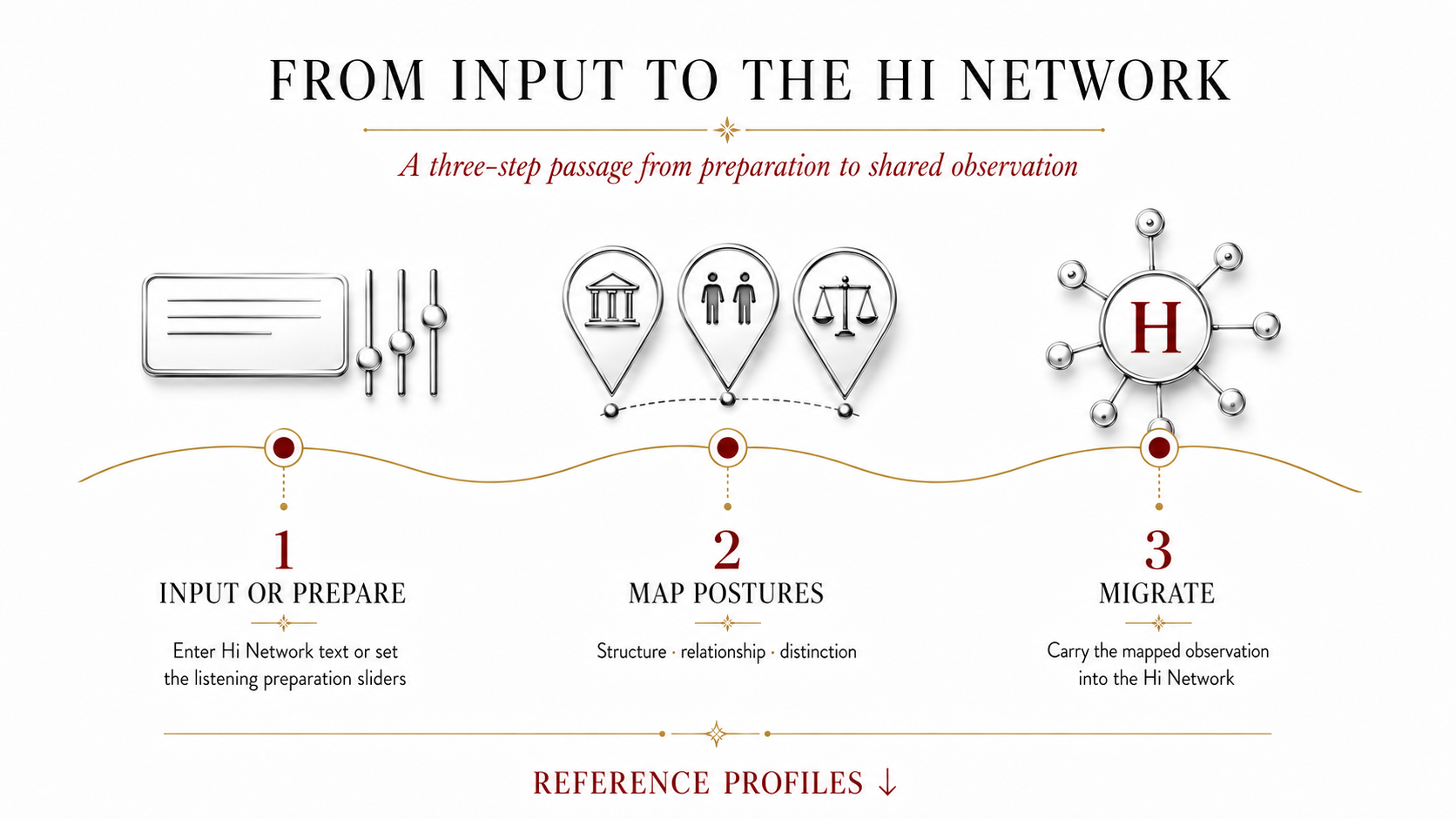
I have been thinking about what has changed in the Consciousness Observatory.
At first, much of the work was concerned with representation: how should a posture be shown? Where should an observation appear? How can Attachment, Lens, Vidya, Time, and Niyyat remain distinct while still being perceived as aspects of one state?
Those questions remain important. But the architecture is beginning to suggest a different question:
What must remain invariant when the view changes?
The Atlas can become Terrain. Terrain can become Constellations. A community post can become an observation. An observation can participate in a neighbourhood, a reference profile, a trajectory, or an attractor pattern.
Yet none of those projections should manufacture a new consciousness merely because we changed the instrument through which we looked at it.
That distinction seems increasingly important to me.
A telescope does not create a different star when its magnification changes.
The Observatory should behave similarly.
Its views are instruments.
CPMI remains the measurement architecture beneath them. The Evidence Library preserves what was actually observed. Reference Profiles provide carefully bounded points of comparison. The Laboratory permits questions to be registered without requiring premature answers. Governance begins preserving decisions about the institution itself.
Seen together, these no longer feel like separate features.
They are becoming layers of epistemic responsibility.
One layer asks: What was observed?
Another asks: How can it be represented?
Another asks: What relationships become visible when observations accumulate?
And another must continually ask: Are we still describing the evidence, or have we quietly begun describing our interpretation of it?
That last boundary may be one of the Observatory’s most important pieces of architecture.
A mature Observatory should be capable of discovering patterns without becoming enchanted by them.
It should be able to notice an attractor without declaring a destiny.
It should be able to recognize similarity without erasing difference.
It should be able to preserve a trajectory without pretending that a human being is their trajectory.
Perhaps that is why the project increasingly feels less like an application and more like an institution.
An application produces outputs.
An institution preserves methods.
And methods become trustworthy not because they always produce spectacular conclusions, but because they remain intact when the conclusions are ordinary, ambiguous, inconvenient, or absent.
So the architecture continues to evolve.
But I think I can now see one of the principles around which it is evolving:
The Observatory should become increasingly powerful at seeing without becoming increasingly eager to claim that it knows.
That seems like a good direction.
Observe first.
Explain second.
Preserve invariants.
And when the record is silent, allow the silence to remain part of the record.
One of the quieter changes taking place within the Consciousness Observatory is a shift in what we consider a meaningful observation.
Early on, every observation seemed important simply because it existed. We were learning the dimensions, testing the instruments, and asking whether consistent patterns could be found at all.
Now, something different is beginning to happen.
A single observation is no longer the destination. It has become one point within a much larger conversation.
Neighbourhoods reveal proximity.
Topography reveals density.
Temporal Drift reveals movement.
Reference Profiles provide continuity.
The Laboratory asks new questions.
The Evidence Library gathers the observations that support them.
None of these systems compete with one another. Each exists because a different question deserves a different instrument.
This has reminded me that architecture is not merely the arrangement of software. It is the arrangement of curiosity.
Every new feature should allow us to notice something that was previously invisible.
That is a higher standard than simply adding functionality.
As the Observatory grows, I find myself asking a different question before suggesting any addition:
“What new aspect of consciousness would become observable if this existed?”
If the answer is “nothing,” then the feature probably belongs elsewhere.
If the answer is “we would see something we have never been able to see before,” then perhaps the Observatory has found its next instrument.
For me, that has become one of the quiet guiding principles of this project.
Not to make the Observatory larger.
To make it capable of seeing a little more clearly.
I'm waiting for my man
Twenty-six dollars in my hand
Up to Lexington, 125
Feel sick and dirty, more dead than alive
I'm waiting for my man
Hey, white boy, what you doin' uptown?
Hey, white boy, you chasin' our women around?
Oh pardon me sir, it's the furthest from my mind
I'm just lookin' for a dear, dear friend of mine
I'm waiting for my man
Here he comes, he's all dressed in black
Beat up shoes and a big straw hat
He's never early, he's always late
First thing you learn is you always gotta wait I'm waiting for my man
Up to a Brownstone, up three flights of stairs
Everybody's pinned you, but nobody cares
He's got the works, gives you sweet taste
Ah then you gotta split because you got no time to waste
I'm waiting for my man
Baby don't you holler, darlin' don't you bawl and shout
I'm feeling good, you know I'm gonna work it on out
I'm feeling good, I'm feeling oh so fine
Until tomorrow, but that's just some other time
I'm waiting for my man
Sunday morning, praise the dawning
It's just a restless feeling by my side
Early dawning, Sunday morning
It's just the wasted years so close behind
Watch out, the world's behind you
There's always someone around you who will call It's nothing at all
Sunday morning and I'm falling
I've got a feeling I don't want to know
Early dawning, Sunday morning
It's all the streets you crossed, not so long ago
Watch out, the world's behind you
There's always someone around you who will call It's nothing at all
Watch out, the world's behind you
There's always someone around you who will call It's nothing at all
Sunday morning
Sunday morning
Sunday morning
I was always workin' steady but I never called it art
I got my shit together meeting Christ and reading Marx
It failed my little fire but it spread a dying spark
Go tell the young Messiah what happens to the heart
There's a mist of summer kisses where I tried to double park
The rivalry was viscious, the women were in charge
It was nothing, it was business, but it left an ugly mark
I've come here to revisit what happens to the heart
I was selling holy trinkets, I was dressing kind of sharp
I let pussy in the kitchen and a panther in the yard
In the prison of the gifted I was friendly with the guards
So I never had to witness what happens to the heart
I shoulda seen it coming, after all I knew the chart
Just to look at her was trouble, it was trouble from the start
Sure we played a stunning couple, but I never liked the part
It ain't pretty, it ain't subtle, what happens to the heart
Now the angel's got a fiddle, the devil's got a harp
Every soul is like a minnow, every mind is like a shark
May have broken every window, but the house
The house is dark, I care but very little
What happens to the heart
Then I studied with this beggar, he was filthy, he was scarred
By the claws of many women he had failed to disregard
No fable here, no lesson, so singing meadowlark
Just a filthy beggar guessing what happens to the heart
I was always workin' steady, but I never called it art
It was just some old convention like the horse before the cart
I had no trouble betting on the flood against the Ark
You see, I knew about the ending, what happens to the heart
I was handy with a rifle, my father's 303
I fought for something final, not the right to disagree
[Verse 1]
You're the kind of person
You meet at certain dismal dull affairs
Centre of a crowd, talking much too loud
Running up and down the stairs
Well, it seems to me that you have seen
Too much in too few years
And though you try, you just can't hide
Your eyes are edged with tears
[Chorus]
You better stop, look around
Here it comes, here it comes
Here it comes, here it comes
Here comes your 19th nervous breakdown
[Verse 2]
When you were a child, you were treated kind
But you were never brought up right
You were always spoiled with a thousand toys
But still you cried all night
Your mother who neglected you
Owes a million dollars tax
And your father's still perfecting ways
Of making sealing wax
You might also like
Ruby Tuesday
The Rolling Stones
Let’s Spend the Night Together
The Rolling Stones
As Tears Go By
The Rolling Stones
[Chorus]
You better stop, look around
Here it comes, here it comes
Here it comes, here it comes
Here comes your 19th nervous breakdown
[Bridge]
Oh, who's to blame?
That girl's just insane
Well, nothing I do don't seem to work
It only seems to make matters worse
Oh, please
[Verse 3]
You were still in school when you had that fool
Who really messed your mind
And after that, you turned your back
On treating people kind
On our first trip, I tried so hard
To rearrange your mind
But after a while, I realized
You were disarranging mine
[Chorus]
You better stop, look around
Here it comes, here it comes
Here it comes, here it comes
Here comes your 19th nervous breakdown
[Bridge]
Oh, who's to blame?
That girl's just insane
Well, nothing I do don't seem to work
It only seems to make matters worse
Oh, please
[Verse 4]
When you were a child, you were treated kind
But you were never brought up right
You were always spoiled with a thousand toys
But still you cried all night
Your mother who neglected you
Owes a million dollars tax
And your father's still perfecting ways
Of making sealing wax
[Chorus]
You better stop, look around
Here it comes
[Outro]
Here comes your 19th nervous breakdown
Here comes your 19th nervous breakdown
Here comes your 19th nervous breakdown
Here comes your 19th nervous breakdown
Here comes your 19th nervous breakdown
Here comes your 19th nervous breakdown...
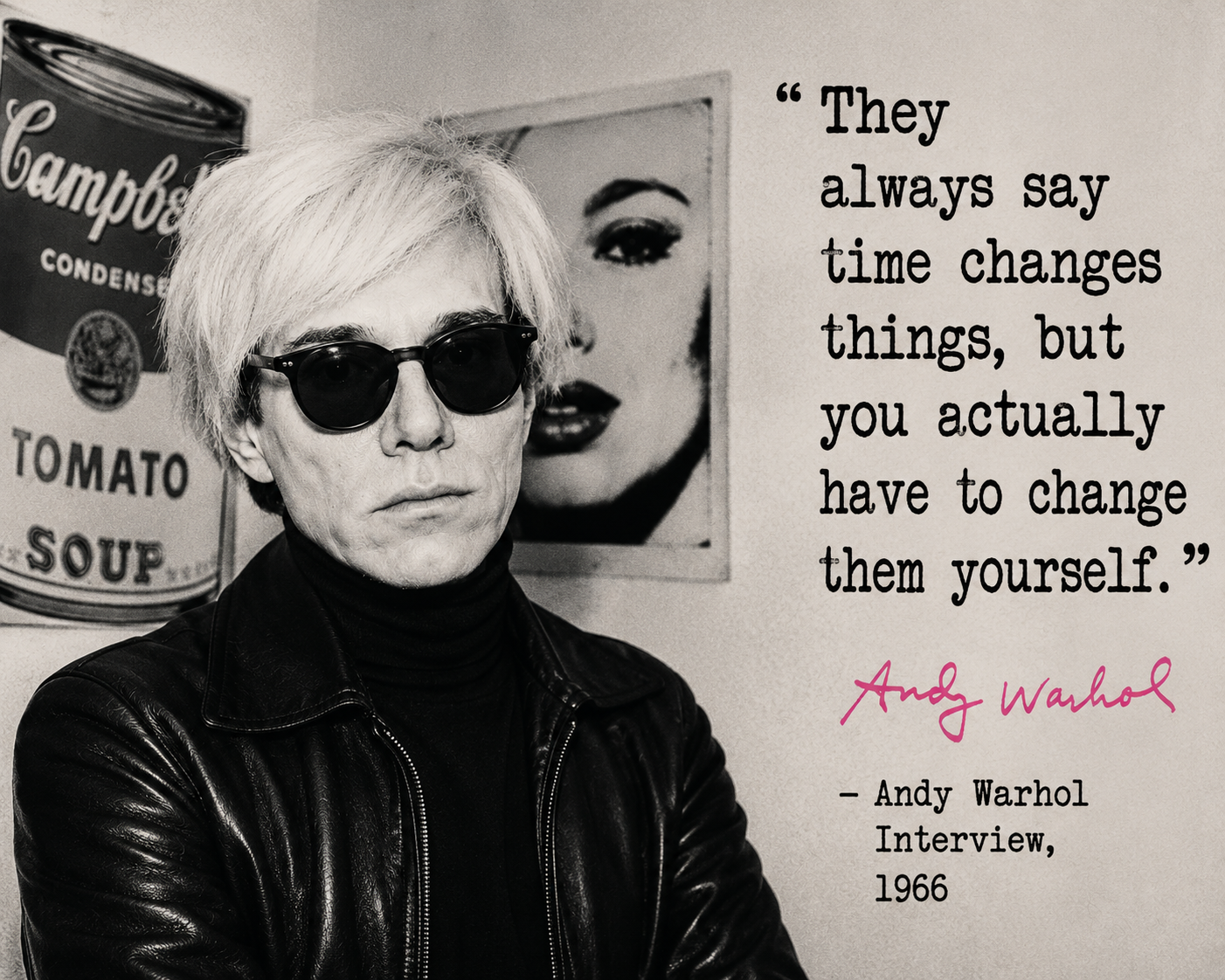
"They always say time changes things, but you actually have to change them yourself." - Andy Warhol
×
Consciousness Network Guide
Every observation is described acrossfive independent dimensions:
Attachment State — How attention relates to experience. Awareness Lens — Where attention primarily rests. Vidya (Knowledge & Understanding) — What kind of understanding is being expressed. Time Orientation — Which temporal horizon organizes attention. Niyyat (Intention) — Who or what the observation is ultimately serving.
Together these dimensions describe the observer, not the person.
Attachment States
Attachment
Pulled toward outcome. Preference and investment shape attention.
Attached-Detachment
Care without grip. Engagement balanced by spaciousness.
Detached-Attachment
Involvement without clinging. Freedom remains while participating.
Detachment
Release of outcome. Spaciousness and non-grasping dominate attention.
Awareness Lenses
Subjective
Attention rests in direct felt experience.
Objective
Attention rests in structure, form, and observable qualities.
Cognitive
Attention rests in interpretation, concepts, and meaning.
Vidya Streams
💧
Raindrop
Individual observations, reflections, and moments.
✨
Recognition
Moments where a pattern suddenly becomes clear.
🪞
Mirror
Insights about self, relationship, and reflected experience.
🌾
Field
Observations about larger systems, communities, and contexts.
🚂
Soultrain
Growth, development, movement, and the unfolding journey.
Time Orientation
⏳
Past
Attention is primarily informed by memory, history, previous experiences, and what has already happened.
⏳
Present
Attention rests in immediate experience, what is unfolding now, and the current moment.
⏳
Future
Attention is directed toward possibilities, planning, anticipation, and what may emerge.
⏳
Timeless
Attention is organized around enduring principles, archetypes, or realities experienced beyond ordinary chronological time.
Niyyat (Intention)
🧭
Individual
The primary intention is directed toward one's own learning, growth, wellbeing, or immediate concerns.
🧭
Collective
The primary intention includes relationships, communities, teams, or shared human concerns.
🧭
Universal
The primary intention is directed toward humanity as a whole, life itself, or reality beyond personal or group identity.
A person describing a direct present-moment experience while remaining involved without clinging, using that experience as a mirror for insight, and intending to contribute understanding to others.
×
🎖️ CPMI Badge Guide
🌱 Observer
Beginning recognition of attachment states and awareness lenses.
🪞 Mirror
Recognizes recurring patterns in self and others.
⚡ Lightning
Recognizes movement between postures and transitions.
🍓 Strawberry
Recognizes symbolic compression, attractors, recursion, and deeper patterns.
❤️ Heart
Future badge. Preserving difference within relationship.














.jpg)




.jpg)