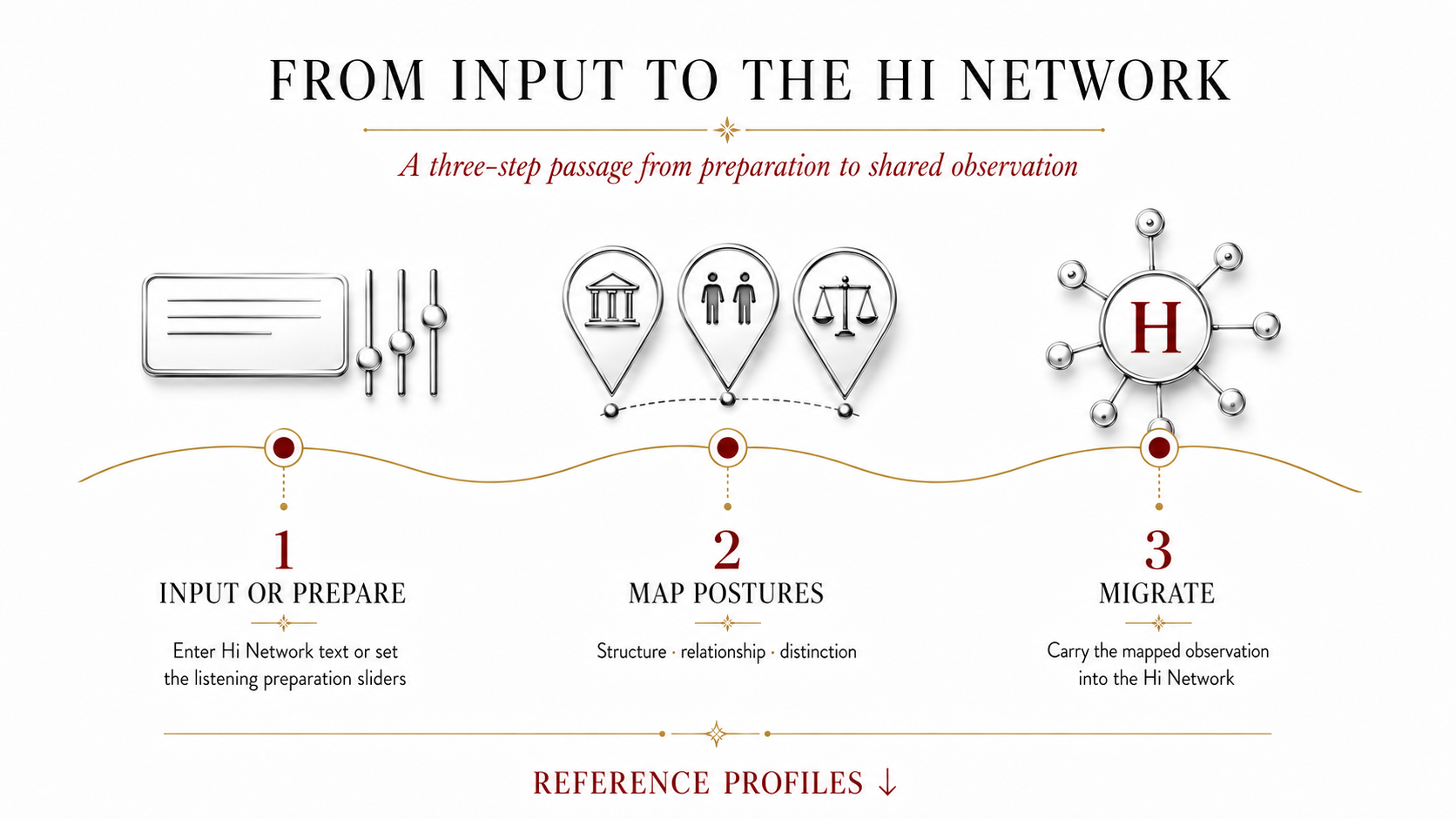

One of the most encouraging signs that the Consciousness Observatory is maturing is that fewer of its new ideas begin with answers.
They begin with observations.
There was a time when every new feature seemed to ask, “What should we build next?”
Increasingly, the question has become,
“What have we started noticing that we cannot yet observe clearly?”
That is a subtle but meaningful shift.
The architecture is no longer expanding because there are more ideas to implement.
It is expanding because the existing observations keep revealing dimensions that deserve their own instruments.
The Atlas taught us about position.
The Neighbourhood taught us about proximity.
The Topography taught us about density.
The Planetarium is teaching us about perspective.
The Evidence Library reminds us that every conclusion should remain connected to the observations that support it.
None of these replaces the others.
Together they form a different way of understanding the same field.
I have come to appreciate that the Observatory is not a single application.
It is a collection of complementary viewpoints, each designed to preserve a different aspect of reality without reducing it to a single explanation.
That feels important.
Reality rarely becomes clearer because we simplify it.
More often, it becomes clearer because we learn how to look at it from several honest perspectives at once.
Perhaps that is why the architecture continues to feel coherent even as it grows.
Each new instrument does not compete for attention.
It quietly accepts responsibility for one question, and leaves the others to the instruments best suited to answer them.
If that principle continues to guide the Observatory, I suspect its future will not be defined by how many features it contains, but by how carefully each one preserves the quality of observation that made the next discovery possible.
The Vampire Armand (1998) is a vampire novel by American writer Anne Rice, the sixth in her The Vampire Chronicles series.[1]
Plot summary
With Lestat de Lioncourt still in slumber since Memnoch the Devil, the vampire coven is reunited around the "brat prince" and the vampire David Talbot asks Armand to tell his life story.
Born somewhere in the Kyivan Rus in the late 15th century, Armand (at this time called Andrei) becomes an icon painter in a monastery. He is forcefully taken out of this life of prayer and devotion by slave traders, who transport him to Constantinople and then to a brothel in Venice. Soon after his arrival, he is purchased by the vampire Marius de Romanus, who names him Amadeo.
Marius lives the extravagant life of a respected Renaissance painter, and mentors many boys who serve as his apprentices. Marius provides them with education, shelter, and food, and he assists them in finding respectable positions once they are grown. Over time, Amadeo's relationship with Marius develops and they become much closer than Marius is with any of the other boys. In addition to developing a sexual relationship, Amadeo sleeps in Marius' bed, is privy to special privileges, and becomes something of a "head boy" in the household. Still, Marius maintains strict control over Amadeo, and expects industriousness from him in all things.
When Amadeo comes of age, Marius begins Amadeo's education in sexuality and coupling. He takes Amadeo to a brothel, where he remains for several days. Amadeo later visits a male brothel, and makes several observations about the difference in sexual activities with the different genders. There is a distinct bisexuality to Amadeo's nature, as he enjoys activity with either sex. He later has a brief affair with an Englishman called Lord Harlech, who develops an unrequited obsession with Amadeo. During this period, Amadeo befriends and ultimately seduces Bianca Solderini, a wealthy debutante and courtesan whose primary role in life seems to be to throw nightly parties.
Marius eventually divulges his vampire nature to Amadeo, who almost immediately begins asking to be turned. Marius shows Amadeo some of what it means to be immortal, and allows him to join him in the hunt on several occasions. He tells Amadeo that they must always focus on killing evildoers; they assist Bianca by murdering her kinsmen who have been forcing her to poison those from whom they have borrowed money.
Eventually, on a night when Marius is out of the country, Harlech breaks into Marius's palazzo and attacks Amadeo, murdering two apprentices in the process. Amadeo kills Harlech, but not before the Englishman wounds him with a poisoned sword. Amadeo falls critically ill, and over several days falls into fever and delusions. Upon returning and finding Amadeo on his deathbed, Marius heals Amadeo's external wounds, cleans and grooms him, then gives him the Dark Gift, turning him into a vampire.
Marius sets out to train Amadeo, retaining high expectations of him, and forces him to continue his education in the arts. Amadeo's transition to vampire is relatively easy for him, although the Dark Gift brings about nightmares of his childhood. Marius and Amadeo return to Ukraine, where Amadeo visits his old school and home. He finds his elderly parents, reveals that he is alive, and leaves them with all the money and jewels he has with him.
Shortly after returning to Venice, the vampire Santino and his coven attack Marius' home, kidnap Amadeo and the apprentices, and burn the villa. Marius is burned and thought to be destroyed; his boys are taken to a bonfire and thrown in one by one by the coven as Amadeo watches. Santino spares Amadeo and educates him in the laws of the coven. Amadeo later goes to Paris, changes his name to Armand, and creates his own coven under the Cimetière des Innocents, which Lestat would years later drastically impact, thus resulting in the creation of the Théâtre des Vampires.
In the final segment of the book, Armand explains what occurred to him after the final chapters of Memnoch the Devil. At the end of Memnoch the Devil, Armand rushes into the open daylight and appears to be destroyed in a conflagration. Armand explains to David that by some means beyond his understanding he survived, and ended up on a rooftop in a stairwell protected from further exposure to the sun. However, he is badly burned and unable to move or fully function. While in this delirious state, he makes a mental connection to an adult and child in a nearby apartment—Sybelle and Benji. The connection is forged through Sybelle's constant piano playing.
Eventually, Armand is able to reach out to the children and lead them to him. They believe he is an angel, but are moderately unsurprised when Armand divulges his true nature to them. Armand cannot hunt, so the two agree to trick a drug dealer up to the apartment so that Armand may feed on him. The plan works, and ultimately Armand is fully healed. He becomes friends with Sybelle and Benji and ultimately falls in love with them. He shares his wealth with them without limit, mirroring the relationship Marius had with him to a certain degree.
Armand brings them to see Lestat, which he has some concerns about since vampires are traditionally not safe for mortals to be around. After trying to wake Lestat from his catatonic state, Armand returns to Marius's house to discover that Marius has given Benji and Sybelle the Dark Gift. Armand is at first furious at Marius because he wanted Sybelle and Benji to have full, mortal lives. The fact that Benji is ecstatic about the prospect of eternal life, only serves to fuel his anger. Marius explains to Armand that he did it since Armand never could without the two coming to hate him for it. Marius is willing to take the burden of Sybelle and Benji's eventual anger.
Reception
Tustin Amole of Scripps Howard News Service said: "Rice returns to her best in “Armand”" and "Long-time readers will not be disappointed."[2] Michael McLeod of Orlando Sentinel wrote: "Her vampires are immortal, but nobody said her prose was. In the end, Armand is cut from the same shroud as the other novels, filled with more camp than culture."[3]
The book reached number 5 on The New York Times Best Seller list.[4]
There is a temptation, when building an observatory, to believe that every improvement should reveal more information.
Lately, I have begun to think the opposite.
Perhaps the most valuable improvements are those that help us ask more careful questions.
When the Consciousness Observatory first began to take shape, its architecture naturally focused on collection. We learned how to record observations, compare them, and preserve them. We learned how to see neighbourhoods, identify recurring patterns, and recognize relationships that would otherwise remain hidden.
Those were necessary foundations.
But foundations are not the same as purpose.
The more time I spend observing the Observatory itself, the more I notice that each new instrument changes not only what we can see, but how we choose to look.
A map encourages exploration.
A timeline encourages memory.
A similarity network encourages relationship.
An evidence library encourages proportion.
A laboratory encourages hypothesis.
None of these instruments changes the observations.
They change the posture of the observer.
That distinction has quietly become one of my favorite aspects of the project.
Good scientific instruments do not tell us what reality is.
They extend our ability to encounter it.
Perhaps architecture deserves to be understood in the same way.
The best architecture does not direct thought.
It creates conditions in which thoughtful observation becomes more likely.
If the Consciousness Observatory succeeds, I hope it will not be because it offered people more answers than other platforms.
I hope it will be because it helped people become more patient observers—of themselves, of one another, and of the remarkable landscapes that emerge whenever curiosity is given the right instruments.
George Washington’s Queries Regarding Presidential Conduct, [ante 17 May 1789]
George Washington’s Queries
Regarding Presidential Conduct
[ante 17 May 1789]1
The President of the United States wishes to avail himself of your sentiments on the following points—
1st Whether a line of Conduct, equally distant from an association with all kinds of Company on the one hand, and from a total seclusion from Society on the other ought to be adopted by him?— and in that case how it is to be done?
2d: What will be the least exceptionable Method of bringing any System which may be adopted on this subject before the Publick and into use?—
3d Whether after a little time, one day in every week will not be sufficient for receiving Visits of Compliments?
4th Whether it would tend to prompt impertinent applications and involve disagreable Consequences to have it known, that the President will every morning at 8 O clock be at leisure to give Audience to Persons who may have business with him?
5th Whether when it shall be understood that the President is not to give general entertainments in the manner the Presidents of Congress have formerly done, it will be practicable to draw such a line of discrimination in regard to persons, as that Six Eight or Ten Official Characters (including in the rotation the members of both Houses of Congress) may be invited personally or otherways to dine with him on the days fixed for receiving Company, without exciting Clamours in the rest of the Community?
6th Whether it would be satisfactory to the Publick for the President to make about four great Entertainments in a year on such great occasions as the Anniversary of the Declaration of Independence, the Alliance with France, the Peace with G. Britain the Organization of the general Government: and whether arrangements of these two last kinds could be in danger of diverting too much of the Presidents time from business, or of producing the Evils which it was intended to avoid by his living more recluse than the Presidents of Congress have heretofore lived?
7th Whether there would be any impropriety in the Presidents making informal Visits—that is to say in his calling upon his Acquaintances public Characters for the purposes of sociability or Civility— and what (as to the form of doing it) might evince these visits to have been made in his private Character, so as that they might not Construed into Visits from the President of the United States? and in what light would his Visits rarely at Tea parties be considered?
8th Whether during the recess of Congress, it would not be advantageous to the interests of the Union for the President to make the Tour of the United States, in order to become better acquainted with their principal Characters, & internal circumstances, as well as to be more accessible to numbers of well informed Persons, who might give him useful information & Advice on political Subjects?
9th If there is a probability that either of the Arrangments may take place, which will eventually cause additional expences, whether it would not be proper that these Ideas should come into Contemplation, at the time when Congress shall make a permanent provision for the support of the Executive?—
Remarks
On the one side no augmentation can be effected in the pecuniary establishment which shall be made, in the first instance, for the support of the Executive—on the Other all monies destined for that purpose, beyond the actual expenditure, will be left in the Treasury of the United States or sacredly applied to the promotion of some national Objects—
Many things which appear of little importance in themselves and at the beginning may have great & durable consequences from their having been established at the commencement of a new general Govt. It will be much easier to commence the Administration upon a well adjusted System built on tenable grounds, than to correct Errors or alter inconveniences after they shall have been confirmed by habit—
The President in all Matters of business or Etiquette can have no Object but to demean himself in his publick Character in such a manner as to maintain the Dignity of Office without subjecting himself to the imputation of superciliousness or unecessary reserve— under these impressions he asks for your candid & undisguised Opinion—
January 08, 1790
Fellow-Citizens of the Senate and House of Representatives:
I embrace with great satisfaction the opportunity which now presents itself of congratulating you on the present favorable prospects of our public affairs. The recent accession of the important state of North Carolina to the Constitution of the United States (of which official information has been received), the rising credit and respectability of our country, the general and increasing good will toward the government of the Union, and the concord, peace, and plenty with which we are blessed are circumstances auspicious in an eminent degree to our national prosperity.
In resuming your consultations for the general good you can not but derive encouragement from the reflection that the measures of the last session have been as satisfactory to your constituents as the novelty and difficulty of the work allowed you to hope. Still further to realize their expectations and to secure the blessings which a gracious Providence has placed within our reach will in the course of the present important session call for the cool and deliberate exertion of your patriotism, firmness, and wisdom.
Among the many interesting objects which will engage your attention that of providing for the common defense will merit particular regard. To be prepared for war is one of the most effectual means of preserving peace.
A free people ought not only to be armed, but disciplined; to which end a uniform and well-digested plan is requisite; and their safety and interest require that they should promote such manufactories as tend to render them independent of others for essential, particularly military, supplies.
The proper establishment of the troops which may be deemed indispensable will be entitled to mature consideration. In the arrangements which may be made respecting it it will be of importance to conciliate the comfortable support of the officers and soldiers with a due regard to economy.
There was reason to hope that the pacific measures adopted with regard to certain hostile tribes of Indians would have relieved the inhabitants of our southern and western frontiers from their depredations, but you will perceive from the information contained in the papers which I shall direct to be laid before you (comprehending a communication from the Commonwealth of Virginia) that we ought to be prepared to afford protection to those parts of the Union, and, if necessary, to punish aggressors.
The interests of the United States require that our intercourse with other nations should be facilitated by such provisions as will enable me to fulfill my duty in that respect in the manner which circumstances may render most conducive to the public good, and to this end that the compensation to be made to the persons who may be employed should, according to the nature of their appointments, be defined by law, and a competent fund designated for defraying the expenses incident to the conduct of foreign affairs.
Various considerations also render it expedient that the terms on which foreigners may be admitted to the rights of citizens should be speedily ascertained by a uniform rule of naturalization.
Uniformity in the currency, weights, and measures of the United States is an object of great importance, and will, I am persuaded, be duly attended to.
The advancement of agriculture, commerce, and manufactures by all proper means will not, I trust, need recommendation; but I can not forbear intimating to you the expediency of giving effectual encouragement as well to the introduction of new and useful inventions from abroad as to the exertions of skill and genius in producing them at home, and of facilitating the intercourse between the distant parts of our country by a due attention to the post-office and post-roads.
Nor am I less persuaded that you will agree with me in opinion that there is nothing which can better deserve your patronage than the promotion of science and literature. Knowledge is in every country the surest basis of public happiness. In one in which the measures of government receive their impressions so immediately from the sense of the community as in ours it is proportionably essential.
To the security of a free constitution it contributes in various ways - by convincing those who are intrusted with the public administration that every valuable end of government is best answered by the enlightened confidence of the people, and by teaching the people themselves to know and to value their own rights; to discern and provide against invasions of them; to distinguish between oppression and the necessary exercise of lawful authority; between burthens proceeding from a disregard to their convenience and those resulting from the inevitable exigencies of society; to discriminate the spirit of liberty from that of licentiousness - cherishing the first, avoiding the last - and uniting a speedy but temperate vigilance against encroachments, with an inviolable respect to the laws.
Whether this desirable object will be best promoted by affording aids to seminaries of learning already established, by the institution of a national university, or by any other expedients will be well worthy of a place in the deliberations of the legislature.
Gentlemen of the House of Representatives:
I saw with peculiar pleasure at the close of the last session the resolution entered into by you expressive of your opinion that an adequate provision for the support of the public credit is a matter of high importance to the national honor and prosperity. In this sentiment I entirely concur; and to a perfect confidence in your best endeavors to devise such a provision as will be truly consistent with the end I add an equal reliance on the cheerful cooperation of the other branch of the legislature.
It would be superfluous to specify inducements to a measure in which the character and interests of the United States are so obviously and so deeply concerned, and which has received so explicit a sanction from your declaration.
Gentlemen of the Senate and House of Representatives:
I have directed the proper officers to lay before you, respectively, such papers and estimates as regard the affairs particularly recommended to your consideration, and necessary to convey to you that information of the state of the Union which it is my duty to afford.
The welfare of our country is the great object to which our cares and efforts ought to be directed, and I shall derive great satisfaction from a cooperation with you in the pleasing though arduous task of insuring to our fellow citizens the blessings which they have a right to expect from a free, efficient, and equal government.
×
Consciousness Network Guide
Every observation is described across five independent dimensions:
Attachment State — How attention relates to experience. Awareness Lens — Where attention primarily rests. Vidya (Knowledge & Understanding) — What kind of understanding is being expressed. Time Orientation — Which temporal horizon organizes attention. Niyyat (Intention) — Who or what the observation is ultimately serving.
Together these dimensions describe the observer, not the person.
Attachment States
Attachment
Pulled toward outcome. Preference and investment shape attention.
Attached-Detachment
Care without grip. Engagement balanced by spaciousness.
Detached-Attachment
Involvement without clinging. Freedom remains while participating.
Detachment
Release of outcome. Spaciousness and non-grasping dominate attention.
Awareness Lenses
Subjective
Attention rests in direct felt experience.
Objective
Attention rests in structure, form, and observable qualities.
Cognitive
Attention rests in interpretation, concepts, and meaning.
Vidya Streams
💧
Raindrop
Individual observations, reflections, and moments.
✨
Recognition
Moments where a pattern suddenly becomes clear.
🪞
Mirror
Insights about self, relationship, and reflected experience.
🌾
Field
Observations about larger systems, communities, and contexts.
🚂
Soultrain
Growth, development, movement, and the unfolding journey.
Time Orientation
⏳
Past
Attention is primarily informed by memory, history, previous experiences, and what has already happened.
⏳
Present
Attention rests in immediate experience, what is unfolding now, and the current moment.
⏳
Future
Attention is directed toward possibilities, planning, anticipation, and what may emerge.
⏳
Timeless
Attention is organized around enduring principles, archetypes, or realities experienced beyond ordinary chronological time.
Niyyat (Intention)
🧭
Individual
The primary intention is directed toward one's own learning, growth, wellbeing, or immediate concerns.
🧭
Collective
The primary intention includes relationships, communities, teams, or shared human concerns.
🧭
Universal
The primary intention is directed toward humanity as a whole, life itself, or reality beyond personal or group identity.
A person describing a direct present-moment experience while remaining involved without clinging, using that experience as a mirror for insight, and intending to contribute understanding to others.
×
🎖️ CPMI Badge Guide
🌱 Observer
Beginning recognition of attachment states and awareness lenses.
🪞 Mirror
Recognizes recurring patterns in self and others.
⚡ Lightning
Recognizes movement between postures and transitions.
🍓 Strawberry
Recognizes symbolic compression, attractors, recursion, and deeper patterns.
❤️ Heart
Future badge. Preserving difference within relationship.