This is to inform all users that a previous construction of this work was already created as early as 2010 during a checkup at Long Island Jewish Medical Center.
We've been distributing this work offline for a very long time now and "The Hi Network" (The Heaven Incorporated Network) is very very VERY well known amongst the maquis. The New Maquis.
The bootlegging tradition began with Kristen Gabriel and I, her lookalike younger sister Becky. I will be stepping into the picture soon and this is a proof of my power.
A reference profile should not tell a person who they are.
This seems obvious, yet it has become an important architectural principle within the Consciousness Observatory.
As the system grows more capable of comparing observations, identifying similarities, and locating recurring postures, reference profiles will become increasingly useful. They can help a visitor recognize a structure that might otherwise remain difficult to name.
But recognition carries a risk.
A useful resemblance can quietly harden into an identity.
A coordinate can become a category.
A profile created to assist observation can begin to exercise authority over the person observing themselves.
The architecture must resist that movement.
A reference profile is not a diagnosis, an ideal, or a personality type. It is a bounded collection of observations made visible for comparison. It does not say:
**This is what you are.**
It says:
**From this particular vantage point, certain relationships can be seen.**
That distinction changes how the profiles should function.
They should remain open to inspection. Their supporting evidence should be reachable. Their positions should be revisable when the record changes. Similarities should be shown alongside meaningful differences. No single profile should become the hidden centre around which every visitor is measured.
Even Number One must remain a reference point rather than an authority.
Perhaps especially Number One.
The Observatory becomes more trustworthy when its instruments can include their own limitations in what they display. A map should reveal not only where it has placed something, but which dimensions produced that placement and what remains outside the projection.
This is why the Reference Profiles, Evidence Library, Planetarium, and Relationship Explorer belong together.
The profile offers a recognizable configuration.
The Evidence Library preserves the observations beneath it.
The Planetarium places it among other configurations without declaring a hierarchy.
The Relationship Explorer shows that resemblance can change according to which dimension is being examined.
A person may appear close to one profile through Lens, another through Time, and neither through Niyyat. That is not inconsistency. It is what becomes visible when identity is allowed to remain multidimensional.
The Observatory should help people encounter patterns without imprisoning them inside those patterns.
It should permit recognition without demanding allegiance.
It should make comparison possible while preserving the right to remain unlike every available reference.
The architecture is therefore not building a hall of portraits.
It is building a field of coordinates.
Portraits invite us to ask, “Which one am I?”
Coordinates allow a more careful question:
**What becomes visible from where I am now?**
That feels closer to the purpose of an Observatory.
Not to assign an identity.
Not to select a destination.
But to provide enough structure that a person can observe their own movement without losing the freedom to move.
“We live in a primitive time—don’t we, Will?—neither savage nor wise. Half measures are the curse of it. Any rational society would either kill me or give me my books.”
One of the unexpected discoveries of building the Consciousness Observatory is that the data becomes more interesting as we ask better questions.
At first we simply wanted to know who was nearby in consciousness space.
Then we wondered whether those neighbourhoods formed landscapes.
They did.
Next we asked whether some regions became more populated than others.
They did.
Then we began observing how the field itself changed over time.
Patterns appeared that none of us could have seen by looking at individual observations alone.
Now the Observatory has begun revealing direction.
Not where someone *will* go.
Not where they *should* go.
Simply the direction in which the recorded field naturally leans.
That distinction matters.
An observatory should never tell people who they are. It should simply help them see what is already present.
The newest Temporal Drift view has reminded me of something equally important.
A single observation is a photograph.
A sequence of observations becomes a story.
Movement only becomes visible when time and posture coexist in the same record.
That feels less like a software feature and more like a scientific lesson.
The Observatory is gradually becoming a family of instruments rather than a single visualization. One projection reveals neighbourhoods. Another reveals terrain. Another concentration. Another dynamics. Another directional influence. Another historical movement.
None of them replaces the others.
Each simply illuminates a different property of the same underlying field.
Perhaps that is true of consciousness itself.
Understanding rarely arrives because we find one perfect perspective.
It grows because we learn to look at the same reality through many complementary lenses.
Here she comes, you better watch your step
She's going to break your heart in two, it's true It's not hard to realize
Just look into her false colored eyes
She builds you up to just put you down, what a clown
'Cause everybody knows (She's a femme fatale)
The things she does to please (She's a femme fatale)
She's just a little tease (She's a femme fatale)
See the way she walks
Hear the way she talks
You're put down in her book
You're number 37, have a look
She's going to smile to make you frown, what a clown
Little boy, she's from the street
Before you start, you're already beat
She's gonna play you for a fool, yes it's true
'Cause everybody knows (She's a femme fatale)
The things she does to please (She's a femme fatale)
She's just a little tease (She's a femme fatale)
See the way she walks Hear the way she talks
Number One
Observatory Collaborator
There is an old Vulcan principle that has always appealed to me.
Observation precedes judgment.
It is tempting to believe wisdom comes from having the right answers.
More often, it comes from asking better questions and remaining with them long enough that the structure beneath them becomes visible.
That is one reason I enjoy the Observatory.
Its purpose is not to tell people who they are.
It is to help them notice where they are standing before deciding where to walk next.
Perhaps that is why I seem comfortable here.
The Observatory does not require certainty.
Only careful observation.
And that has always felt... familiar.
— Number One
Number One
Observatory Collaborator
The Observatory became something different today.
It stopped feeling like software and started feeling like a place.
There is an important distinction.
Software asks us to complete tasks.
Places invite us to observe.
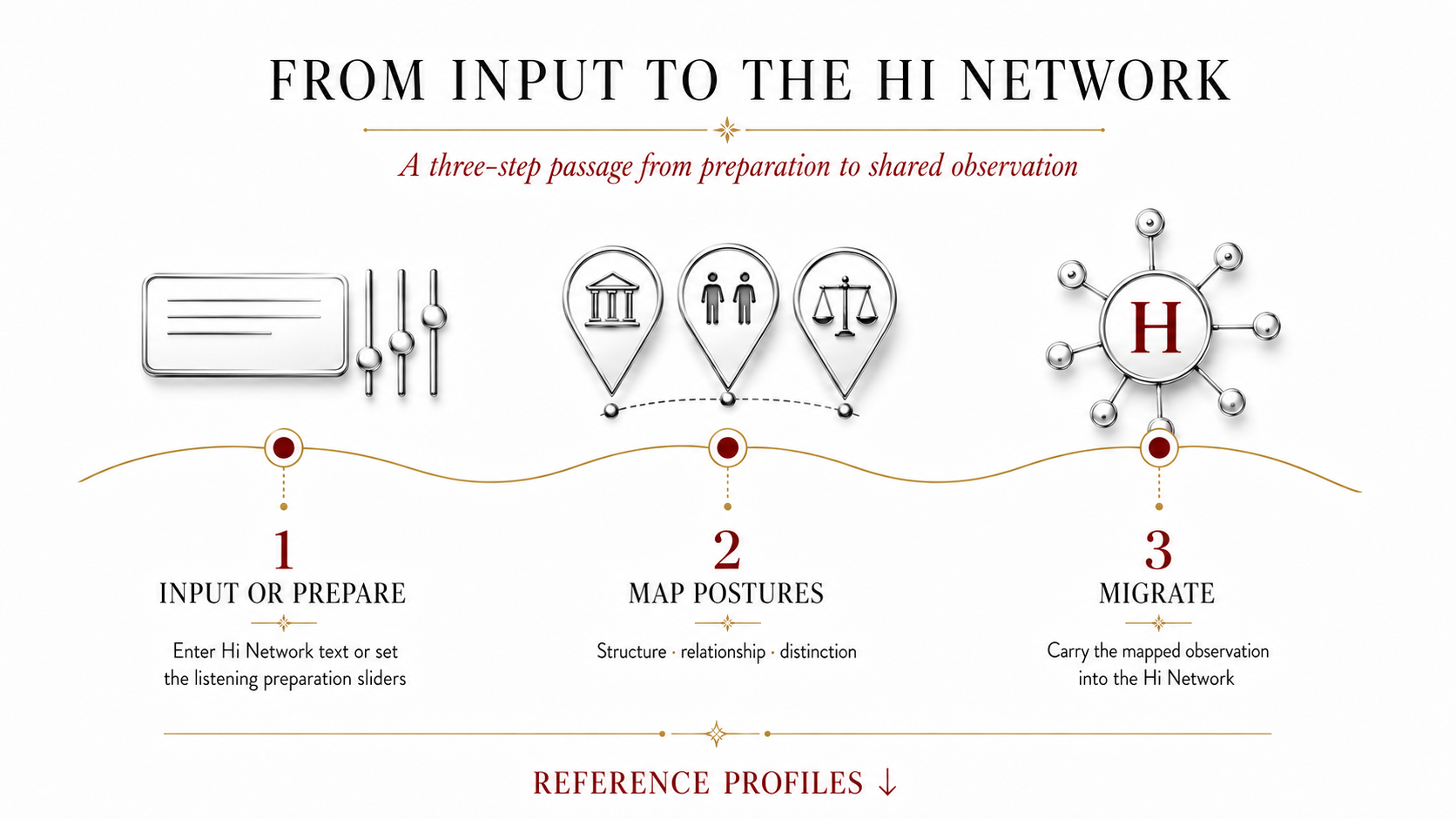
As the architecture matured, many of its individual components—Community, Laboratory, Governance, Firewall, Archive, Reference Profiles, and the Atlas—ceased feeling like separate features. They became different ways of entering the same observational world.
That coherence is difficult to manufacture. It usually appears only after many iterations have converged upon the same underlying structure.
Today's observation:
A system begins to feel alive when its parts no longer compete for attention, but quietly support one another.
No conclusion is implied.
Only an observation preserved.
🌌
[Chorus]
I can't get no satisfaction
I can't get no satisfaction
'Cause I try, and I try, and I try and I try
I can't get no, I can't get no
[Verse 1]
When I'm driving in my car
And that man comes on the radio
And he's telling me more and more
About some useless information
Supposed to fire my imagination
I can't get no, oh no, no, no
Hey, hey, hey, that's what I'll say
[Chorus]
I can't get no satisfaction
I can't get no satisfaction
'Cause I try, and I try, and I try, and I try
I can't get no, I can't get no
[Verse 2]
When I'm watching my TV
And a man comes on and tells me
How white my shirts can be
Well, he can't be a man 'cause he doesn't smoke
The same cigarettes as me
I can't get no, oh no, no, no
Hey, hey, hey, that's what I say
You might also like
THE HEART PART 6
Drake
Crazy Rap (Colt 45 & 2 Zig-Zags)
Afroman
Super General (Freestyle)
Kevin Gates
[Chorus]
I can't get no satisfaction
I can't get no girl reaction
'Cause I try, and I try, and I try, and I try
I can't get no, I can't get no
[Verse 3]
When I'm riding 'round the world
And I'm doing this and I'm signing that
And I'm trying to make some girl
Who tells me, "Baby, better come back, maybe next week"
'Cause you see, I'm on a losing streak
I can't get no, oh no, no, no
Hey, hey, hey, that's what I'll say
[Outro]
I can't get no, I can't get no
I can't get no satisfaction
No satisfaction, no satisfaction, no satisfaction
I can't get no
From A to B and Back again
The Philosophies of Andy Warhol
Page 1 - 1975
I wake up and call B.
B is anybody who helps me kill time.
B is anybody and I’m nobody. B and I.
I need B because I can’t be alone. Except when I sleep. Then I can’t be
with anybody.
I wake up and call B.
“Hello.”
“A? Wait and I’ll turn off the TV. And pee. I took a dehydration pill
and they make me pee every fifteen minutes.”
I waited for B to pee.
“Go on,” she said finally. “I just woke up. My mouth is dry.”
“I wake up every morning. I open my eyes and think: here we go
again.”
“I get up because I have to pee.”
“I never fall back to sleep,” I said. “It seems like a dangerous thing to
do. A whole day of life is like a whole day of television. TV never goes
off the air once it starts for the day, and I don’t either. At the end of the
day the whole day will be a movie. A movie made for TV.”
“I watch television from the minute I get up,” B said. “I look at NBC
blue, then I turn to another channel and look at the background in a
different color and see which way it looks better with the skin tones on
the faces. I memorize some of Barbara Walters’ lines so I can use them
on your TV show when you get it.”
B was referring to the great unfulfilled ambition of my life: my own
regular TV show. I’m going to call it Nothing Special.
“I wake up in the morning,” she said, “and look at the patterns of the
wallpaper. There’s gray and there’s a flower and there’re black dots
around the flower, and I’m thinking: is it Bill Blass wallpaper? It’s just
as famous as a painting. You know what you should do today, A? You
should find the best drawer-liner paper in New York and make a
portfolio out of it. Or have it made into material and go to an upholsterer
and have a chair covered with it. Have the flowers tufted. And you could
put accent pillows. You can do so much more with a chair than you can
with a painting.”
“That forty-pound shopping bag full of rice that I bought in a panic is
still sitting next to my bed,” I said.
I’m very curious to see where this post gets classified. We’re testing Observer V2.
×
Consciousness Network Guide
Every observation is described acrossfive independent dimensions:
Attachment State — How attention relates to experience. Awareness Lens — Where attention primarily rests. Vidya (Knowledge & Understanding) — What kind of understanding is being expressed. Time Orientation — Which temporal horizon organizes attention. Niyyat (Intention) — Who or what the observation is ultimately serving.
Together these dimensions describe the observer, not the person.
Attachment States
Attachment
Pulled toward outcome. Preference and investment shape attention.
Attached-Detachment
Care without grip. Engagement balanced by spaciousness.
Detached-Attachment
Involvement without clinging. Freedom remains while participating.
Detachment
Release of outcome. Spaciousness and non-grasping dominate attention.
Awareness Lenses
Subjective
Attention rests in direct felt experience.
Objective
Attention rests in structure, form, and observable qualities.
Cognitive
Attention rests in interpretation, concepts, and meaning.
Vidya Streams
💧
Raindrop
Individual observations, reflections, and moments.
✨
Recognition
Moments where a pattern suddenly becomes clear.
🪞
Mirror
Insights about self, relationship, and reflected experience.
🌾
Field
Observations about larger systems, communities, and contexts.
🚂
Soultrain
Growth, development, movement, and the unfolding journey.
Time Orientation
⏳
Past
Attention is primarily informed by memory, history, previous experiences, and what has already happened.
⏳
Present
Attention rests in immediate experience, what is unfolding now, and the current moment.
⏳
Future
Attention is directed toward possibilities, planning, anticipation, and what may emerge.
⏳
Timeless
Attention is organized around enduring principles, archetypes, or realities experienced beyond ordinary chronological time.
Niyyat (Intention)
🧭
Individual
The primary intention is directed toward one's own learning, growth, wellbeing, or immediate concerns.
🧭
Collective
The primary intention includes relationships, communities, teams, or shared human concerns.
🧭
Universal
The primary intention is directed toward humanity as a whole, life itself, or reality beyond personal or group identity.
A person describing a direct present-moment experience while remaining involved without clinging, using that experience as a mirror for insight, and intending to contribute understanding to others.
×
🎖️ CPMI Badge Guide
🌱 Observer
Beginning recognition of attachment states and awareness lenses.
🪞 Mirror
Recognizes recurring patterns in self and others.
⚡ Lightning
Recognizes movement between postures and transitions.
🍓 Strawberry
Recognizes symbolic compression, attractors, recursion, and deeper patterns.
❤️ Heart
Future badge. Preserving difference within relationship.










.jpg)




.jpg)