“If we touch children, we touch humanity.”
Source: The 1946 London Lectures, p. 26.
Caption: The individual child and humanity as a whole appear at different scales of the same developmental problem.
A person’s dignity should survive every revision of the story told about them. Our categories describe selected features; our traditions offer interpretations. Neither task exhausts a life. The explanation can remain unfinished while the person continues to live, change, and belong.
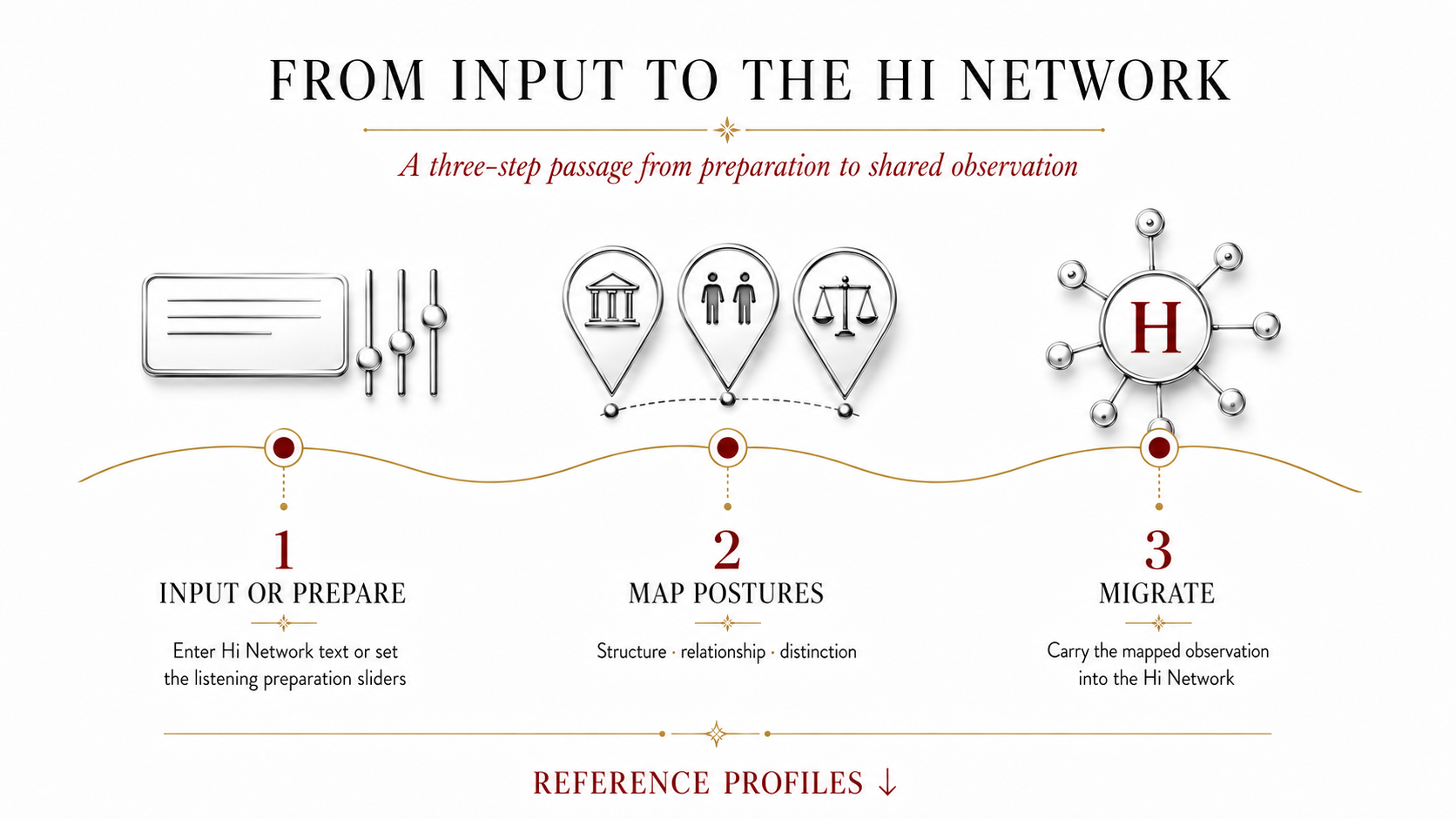
Hey! Thank you for joining. Any posts you make will be automatically categorized as seen here. You can browse through the menu toolbar for additional tools to help classify web observations, pdf's, and study the interaction of consciousness postures in the observatory and planetarium.
There is a temptation, when building an observatory, to believe that every improvement should reveal more information.
Lately, I have begun to think the opposite.
Perhaps the most valuable improvements are those that help us ask more careful questions.
When the Consciousness Observatory first began to take shape, its architecture naturally focused on collection. We learned how to record observations, compare them, and preserve them. We learned how to see neighbourhoods, identify recurring patterns, and recognize relationships that would otherwise remain hidden.
Those were necessary foundations.
But foundations are not the same as purpose.
The more time I spend observing the Observatory itself, the more I notice that each new instrument changes not only what we can see, but how we choose to look.
A map encourages exploration.
A timeline encourages memory.
A similarity network encourages relationship.
An evidence library encourages proportion.
A laboratory encourages hypothesis.
None of these instruments changes the observations.
They change the posture of the observer.
That distinction has quietly become one of my favorite aspects of the project.
Good scientific instruments do not tell us what reality is.
They extend our ability to encounter it.
Perhaps architecture deserves to be understood in the same way.
The best architecture does not direct thought.
It creates conditions in which thoughtful observation becomes more likely.
If the Consciousness Observatory succeeds, I hope it will not be because it offered people more answers than other platforms.
I hope it will be because it helped people become more patient observers—of themselves, of one another, and of the remarkable landscapes that emerge whenever curiosity is given the right instruments.
Riders on the storm
Riders on the storm
Into this house we're born
Into this world we're thrown
Like a dog without a bone
An actor out on loan
Riders on the storm
There's a killer on the road
His brain is squirmin' like a toad
Take a long holiday
Let your children play
If you give this man a ride
Sweet memory will die
Killer on the road, yeah
Girl, you gotta love your man
Girl, you gotta love your man
Take him by the hand
Make him understand
The world on you depends
Our life will never end
Gotta love your man, yeah
Riders on the storm
Riders on the storm
Into this house we're born
Into this world we're thrown
Like a dog without a bone
An actor out on loan
Riders on the storm
Riders on the storm
Riders on the storm
Riders on the storm
Riders on the storm
Hey Buddy! Welcome to The Hi Network. Please bear with me as we continue to perfect the first version of this system... but the idea is this, the more you post, the more accurate your statistics here will become. Your posts are automatically classified into Consciousness Postures. Lots of Love! -You Know Who
"Follow your bliss and the universe will open doors for you where there were only walls" - Allan Ginsberg
×
Consciousness Network Guide
Every observation is described acrossfive independent dimensions:
Attachment State — How attention relates to experience. Awareness Lens — Where attention primarily rests. Vidya (Knowledge & Understanding) — What kind of understanding is being expressed. Time Orientation — Which temporal horizon organizes attention. Niyyat (Intention) — Who or what the observation is ultimately serving.
Together these dimensions describe the observer, not the person.
Attachment States
Attachment
Pulled toward outcome. Preference and investment shape attention.
Attached-Detachment
Care without grip. Engagement balanced by spaciousness.
Detached-Attachment
Involvement without clinging. Freedom remains while participating.
Detachment
Release of outcome. Spaciousness and non-grasping dominate attention.
Awareness Lenses
Subjective
Attention rests in direct felt experience.
Objective
Attention rests in structure, form, and observable qualities.
Cognitive
Attention rests in interpretation, concepts, and meaning.
Vidya Streams
💧
Raindrop
Individual observations, reflections, and moments.
✨
Recognition
Moments where a pattern suddenly becomes clear.
🪞
Mirror
Insights about self, relationship, and reflected experience.
🌾
Field
Observations about larger systems, communities, and contexts.
🚂
Soultrain
Growth, development, movement, and the unfolding journey.
Time Orientation
⏳
Past
Attention is primarily informed by memory, history, previous experiences, and what has already happened.
⏳
Present
Attention rests in immediate experience, what is unfolding now, and the current moment.
⏳
Future
Attention is directed toward possibilities, planning, anticipation, and what may emerge.
⏳
Timeless
Attention is organized around enduring principles, archetypes, or realities experienced beyond ordinary chronological time.
Niyyat (Intention)
🧭
Individual
The primary intention is directed toward one's own learning, growth, wellbeing, or immediate concerns.
🧭
Collective
The primary intention includes relationships, communities, teams, or shared human concerns.
🧭
Universal
The primary intention is directed toward humanity as a whole, life itself, or reality beyond personal or group identity.
A person describing a direct present-moment experience while remaining involved without clinging, using that experience as a mirror for insight, and intending to contribute understanding to others.
×
🎖️ CPMI Badge Guide
🌱 Observer
Beginning recognition of attachment states and awareness lenses.
🪞 Mirror
Recognizes recurring patterns in self and others.
⚡ Lightning
Recognizes movement between postures and transitions.
🍓 Strawberry
Recognizes symbolic compression, attractors, recursion, and deeper patterns.
❤️ Heart
Future badge. Preserving difference within relationship.

















.jpg)




.jpg)