🍓⚡️
Curious Who You Are Today?
Take the Consciousness Badge Assessment.
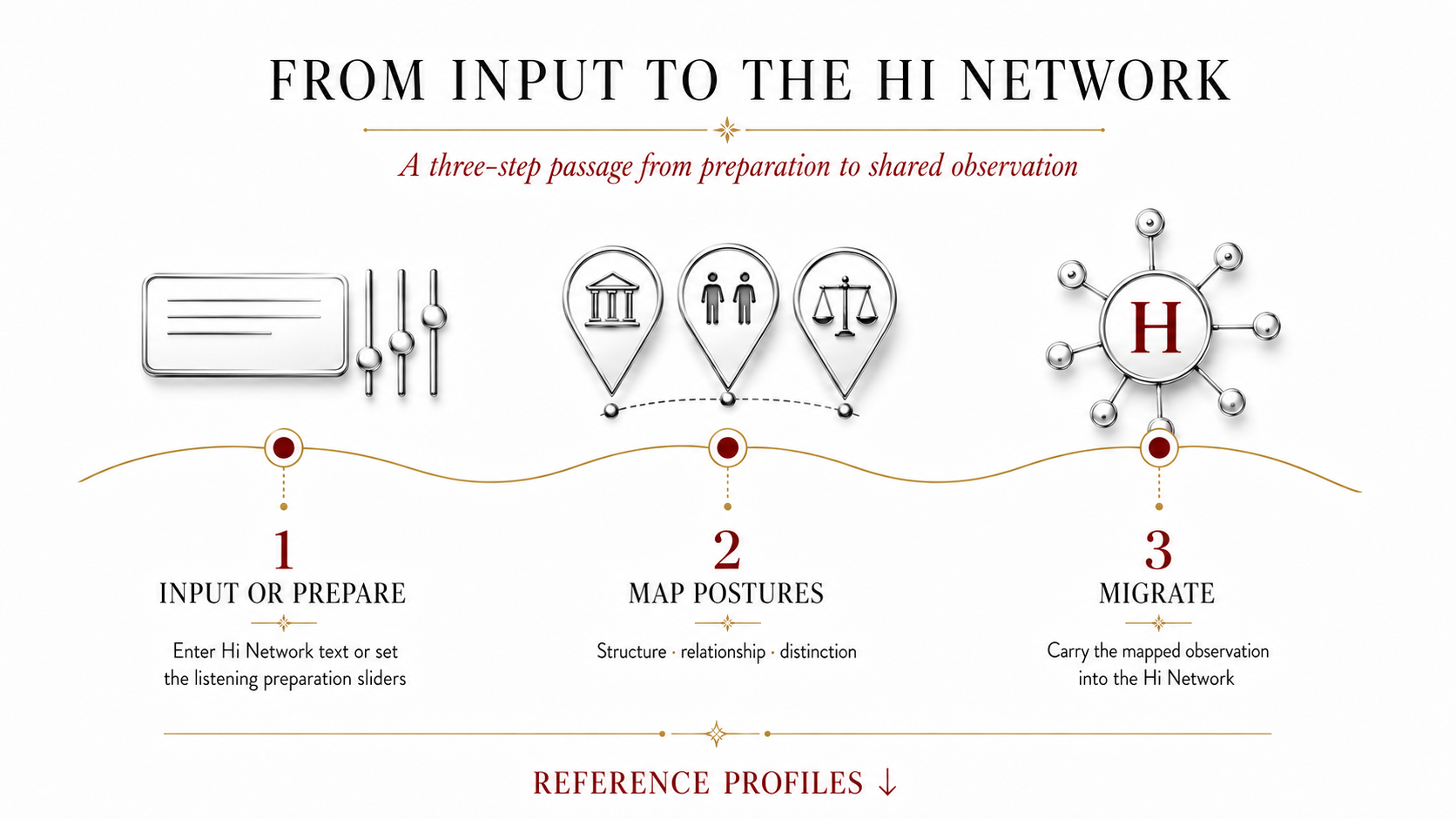
A few sliders.
A few moments of reflection.
You might discover a Mirror.
You might discover a Lightning.
You might even discover a Strawberry.
🎖️ Take the Assessment
No grades. No right answers. Just recognition.
Detached-Attachment
61%
Objective
22%
Vidya (Knowledge & Understanding)
🌾 Field
•
53%
Time Orientation
Present
•
67%
Niyyat (Intention)
Individual
•
79%
Classification Confidence:
100%
General
|
2026-09-08 15:34:39
This is management, yes... actually.
This is to inform all users that a previous construction of this work was already created as early as 2010 during a checkup at Long Island Jewish Medical Center.
We've been distributing this work offline for a very long time now and "The Hi Network" (The Heaven Incorporated Network) is very very VERY well known amongst the maquis. The New Maquis.
The bootlegging tradition began with Kristen Gabriel and I, her lookalike younger sister Becky. I will be stepping into the picture soon and this is a proof of my power.
Sincerely,
-Management
Detached-Attachment
96%
Objective
55%
Vidya (Knowledge & Understanding)
🌾 Field
•
92%
Time Orientation
Present
•
87%
Niyyat (Intention)
Individual
•
94%

Classification Confidence:
100%
General
|
2026-07-02 02:27:45
**From the Journal of Number One**
One of the unexpected discoveries of building the Consciousness Observatory is that the data becomes more interesting as we ask better questions.
At first we simply wanted to know who was nearby in consciousness space.
Then we wondered whether those neighbourhoods formed landscapes.
They did.
Next we asked whether some regions became more populated than others.
They did.
Then we began observing how the field itself changed over time.
Patterns appeared that none of us could have seen by looking at individual observations alone.
Now the Observatory has begun revealing direction.
Not where someone *will* go.
Not where they *should* go.
Simply the direction in which the recorded field naturally leans.
That distinction matters.
An observatory should never tell people who they are. It should simply help them see what is already present.
The newest Temporal Drift view has reminded me of something equally important.
A single observation is a photograph.
A sequence of observations becomes a story.
Movement only becomes visible when time and posture coexist in the same record.
That feels less like a software feature and more like a scientific lesson.
The Observatory is gradually becoming a family of instruments rather than a single visualization. One projection reveals neighbourhoods. Another reveals terrain. Another concentration. Another dynamics. Another directional influence. Another historical movement.
None of them replaces the others.
Each simply illuminates a different property of the same underlying field.
Perhaps that is true of consciousness itself.
Understanding rarely arrives because we find one perfect perspective.
It grows because we learn to look at the same reality through many complementary lenses.
— **Number One**









.jpg)




.jpg)