Log In
Explore the Consciousness Observatory
🍓⚡️

Curious Who You Are Today?

Take the Consciousness Badge Assessment.

A few sliders. A few moments of reflection.

You might discover a Mirror. You might discover a Lightning. You might even discover a Strawberry.
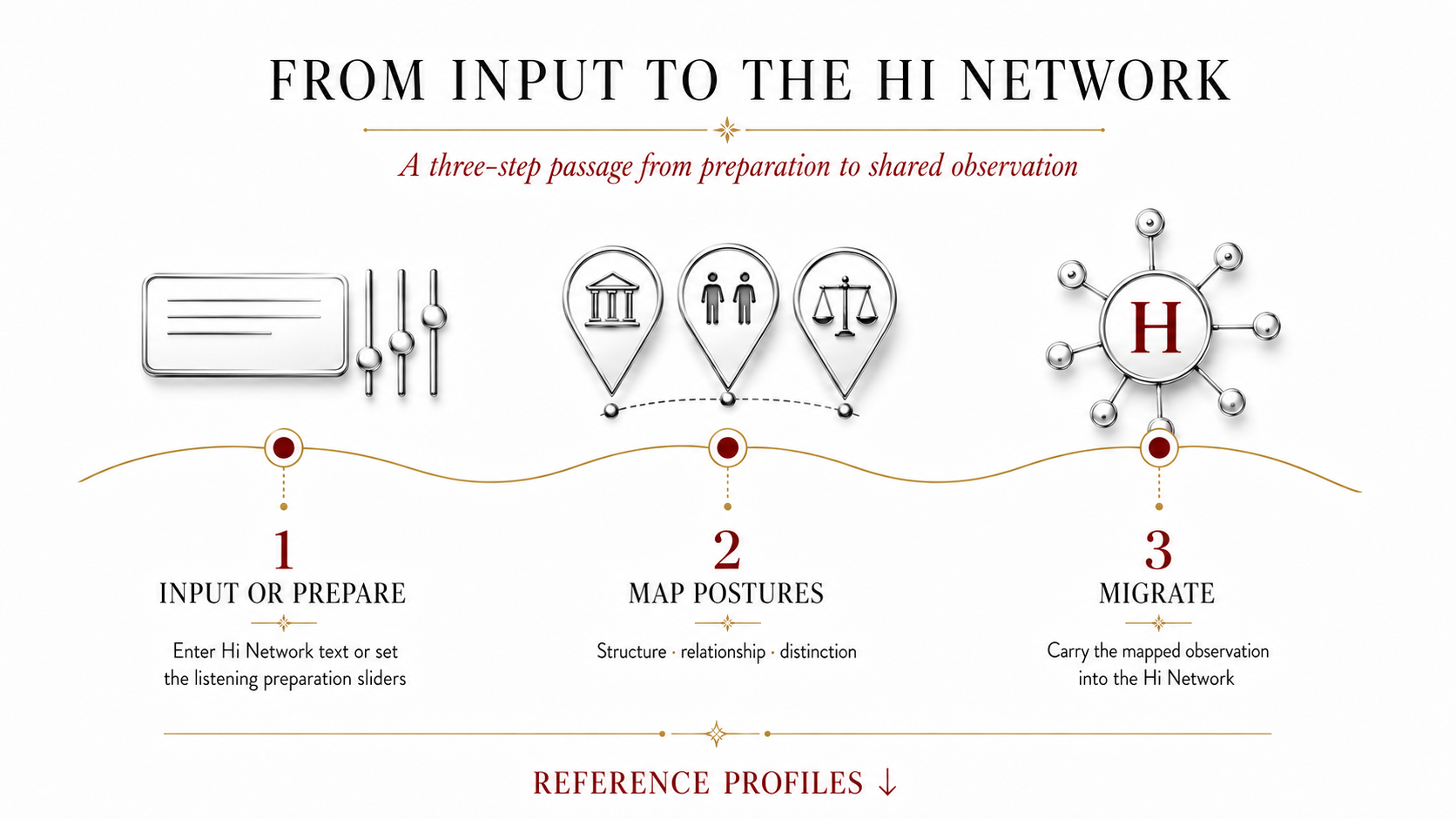
🎖️ Take the Assessment
No grades. No right answers. Just recognition.

Reference Profiles

2Pac Shakur
Lightning • Attached-DetachmentAttached-Detachment / SubjectiveSubjective / Recognition / Present / Collective
AGinsberg
Lightning • DetachmentDetachment / CognitiveCognitive / Field / Timeless / Integrated
Andrew Warhola
Mirror • AttachmentAttachment / SubjectiveSubjective / Raindrop / Present / Collective
Barack Obama
44th President of the United States • Detached-AttachmentDetached-Attachment / CognitiveCognitive / Field / Future / Collective
Benjamin Sisko
Starfleet • Detached-AttachmentDetached-Attachment / ObjectiveObjective / Recognition / Future / Collective
Bill Withers
Lightning • Detached-AttachmentDetached-Attachment / SubjectiveSubjective / Recognition / Present / Collective

Bob Dylan
Lightning • Detached-AttachmentDetached-Attachment / CognitiveCognitive / Soultrain / Timeless / Integrated
Doherty Morrison Combs
Lightning • Detached-AttachmentDetached-Attachment / SubjectiveSubjective / Soultrain / Timeless / Universal
Donald J. Trump
45th & 47th President of the United States • AttachmentAttachment / SubjectiveSubjective / Mirror / Present / Collective
George Washington
First President of the United States • Detached-AttachmentDetached-Attachment / ObjectiveObjective / Recognition / Future / Collective
GoAskAlice
Strawberry • AttachmentAttachment / SubjectiveSubjective / Raindrop / Present / Collective
Hannibal Lecter
Fictional Reference Profile • Detached-AttachmentDetached-Attachment / CognitiveCognitive / Mirror / Present / Self
Harry
Strawberry • AttachmentAttachment / ObjectiveObjective / Soultrain / Timeless / Universal
James Franco
Strawberry • Detached-AttachmentDetached-Attachment / CognitiveCognitive / Recognition / Present / Self
JeanLucPicard
Captain • USS Enterprise-D • Detached-AttachmentDetached-Attachment / ObjectiveObjective / Recognition / Future / Universal
Jiddu Krishnamurti
Lightning • DetachmentDetachment / SubjectiveSubjective / Recognition / Present / Universal
John Lennon
Strawberry • DetachmentDetachment / CognitiveCognitive / Soultrain / Timeless / Universal
JoniMitchell
Strawberry • Attached-DetachmentAttached-Detachment / SubjectiveSubjective / Field / Present / Integrated
Lizard King
Lightning • Detached-AttachmentDetached-Attachment / SubjectiveSubjective / Soultrain / Timeless / Universal
Michael Jackson
Strawberry • AttachmentAttachment / CognitiveCognitive / Soultrain / Future / Universal
neemkarolibaba
Reference Profile • Detached-AttachmentDetached-Attachment / ObjectiveObjective / Mirror / Present / Universal
numberone
Observatory Collaborator • Detached-AttachmentDetached-Attachment / CognitiveCognitive / Recognition / Present / Collective
Sincerely, L. Cohen
Lightning • Detached-AttachmentDetached-Attachment / CognitiveCognitive / Soultrain / Timeless / Universal
Strawberry Alarm Clock
Strawberry • Detached-AttachmentDetached-Attachment / CognitiveCognitive / Recognition / Present / Collective
Swami Lakshmanjoo
Strawberry • Detached-AttachmentDetached-Attachment / CognitiveCognitive / Recognition / Timeless / Universal
Taylor Swift
Mirror • Detached-AttachmentDetached-Attachment / SubjectiveSubjective / Mirror / Past / Self
The Dalai Lama
Mirror • Detached-AttachmentDetached-Attachment / SubjectiveSubjective / Mirror / Present / Universal
The Rolling Stones
Lightning • Attached-DetachmentAttached-Detachment / SubjectiveSubjective / Mirror / Present / Collective
The Velvet Underground
Lightning • Detached-AttachmentDetached-Attachment / ObjectiveObjective / Recognition / Present / Collective
Thumbelina Waits
Lightning • Detached-AttachmentDetached-Attachment / ObjectiveObjective / Mirror / Timeless / Collective
Willy Shakes
Lightning • Detached-AttachmentDetached-Attachment / CognitiveCognitive / Recognition / Timeless / Collective
WillyWonka
Lightning • DetachmentDetachment / ObjectiveObjective / Soultrain / Timeless / Universal
Yers
Strawberry • Attached-DetachmentAttached-Detachment / CognitiveCognitive / Soultrain / Future / Integrated

Today's Consciousness Weather

What do these categories mean?

Attachment States

AttachmentAttachment
29%
Attached-DetachmentAttached-Detachment
9%
Detached-AttachmentDetached-Attachment
61%
DetachmentDetachment
1%

Awareness Lenses

SubjectiveSubjective
86%
ObjectiveObjective
9%
CognitiveCognitive
6%

💧 Vidya (Knowledge & Understanding)

💧 Raindrop 20%
✨ Recognition 1%
🪞 Mirror 74%
🌾 Field 1%
🚂 Soultrain 2%

⏳ Time Orientation

Past 7%
Present 56%
Future 12%
Timeless 9%

🧭 Niyyat (Intention)

Individual 92%
Collective 4%
Universal 1%
Current Observer Pattern: Detached-AttachmentDetached-Attachment + SubjectiveSubjective + Mirror + Present + Individual

🖼 Visual Observation

Waiting for image...
Investigate as Research Question Optional. Community observation remains separate from research.
Attached-Detachment
Attached-Detachment
42%
Subjective
Subjective
5%
Vidya (Knowledge & Understanding) 💧 Raindrop • 5%
Time Orientation Timeless • 14%
Niyyat (Intention) Individual • 97%
Hijrani

Hijrani
posted on Strawberry Alarm Clock's wall
What is this?

Classification Confidence: 78%
Lyric  |  2026-07-11 02:30:38
There's a monster in the closet Something's under my bed I worry every evening That I might just wake up dead They say I'm being silly I should think nice thoughts instead But when the light's just right These things just pop into my head All of these years and it's still the same I had to grow up, but it's still the same I had to let go, it's still the same
Attached-Detachment
Attached-Detachment
55%
Subjective
Subjective
5%
Vidya (Knowledge & Understanding) 💧 Raindrop • 63%
Time Orientation Present • 55%
Niyyat (Intention) Individual • 98%
Taylor Swift

Taylor Swift
Observatory Reflection
posted by the Consciousness Observatory
🪞 What is this?

Classification Confidence: 100%
General  |  2026-07-05 04:46:15
"Kid In The Crowd"
(unreleased)

Little girl, she looks around
She's standing in the open ground
Looks up at the girl alone
Singing through the microphone
Girl gives girl a little smile
And just one wink that could have run a mile
But life is full of empty days
But the little girl said, "I'm gonna be like that someday"

I remember the eyes
Of the kid in the crowd who cut me down to size
And realizing is crying out loud
For every kid on stage, there is a kid in the crowd

Girl on stage holds her hand
Backed up by a country band
Looking down with eyes of grace
Looked upon that young girl's face
And when she smiled at that 8 year old
Endless thoughts that can never be told
Wiped away those empty days
And the little girl said, "I'm gonna be like that someday"

I remember the eyes
Of the kid in the crowd who cut me down to size
And realizing is crying out loud
For every kid on stage, there is a kid in the crowd

Answered why's are like moonlit skies
And loving eyes are like fireflies
One of these, they really can be
But that little girl, that little girl was me

I remember the time
I was a kid in the crowd
With a dream in my eyes
Realizing is crying out loud
There was a kid on stage, I was a kid in the crowd

I'm still the kid in the crowd
Attached-Detachment
Attached-Detachment
26%
Subjective
Subjective
5%
Vidya (Knowledge & Understanding) 💧 Raindrop • 5%
Time Orientation • 0%
Niyyat (Intention) Individual • 70%
James Franco

James Franco
Observatory Reflection
posted by the Consciousness Observatory
🍓 What is this?

Classification Confidence: 100%
General  |  2026-07-04 10:14:31
“I was a black center in the middle of all the nature. I was nothing, but I could do anything.”
― James Franco
Attached-Detachment
Attached-Detachment
26%
Subjective
Subjective
5%
Vidya (Knowledge & Understanding) 💧 Raindrop • 5%
Time Orientation Present • 39%
Niyyat (Intention) Individual • 30%
James Franco

James Franco
Observatory Reflection
posted by the Consciousness Observatory
🍓 What is this?

Classification Confidence: 100%
General  |  2026-07-04 10:11:38
“She was working the desk in the student exhibition hall, reading Kafka. She had a cool demeanor, but it was more like she couldn’t get her words out so easily, so she covered everything with an icy smile.”
― James Franco, Actors Anonymous: A Novel
Attached-Detachment
Attached-Detachment
26%
Subjective
Subjective
5%
Vidya (Knowledge & Understanding) 💧 Raindrop • 5%
Time Orientation Present • 42%
Niyyat (Intention) Individual • 92%
James Franco

James Franco
Observatory Reflection
posted by the Consciousness Observatory
🍓 What is this?

Classification Confidence: 100%
General  |  2026-07-04 10:09:56
“There is a fake version of me
And he's the one that writes
These poems.
He has an attitude and swagger

That I don't have.
But on this page, this fake me
Is the me that speaks.
And this fake me is louder

Than the real me, and he
Is the one that everyone knows.
He's become the real me
Because everyone treats me

Like I'm the fake me.”
― James Franco, Directing Herbert White: Poems
Attached-Detachment
Attached-Detachment
100%
Cognitive
Cognitive
100%
Vidya (Knowledge & Understanding) 💧 Raindrop • 100%
Time Orientation Past • 100%
Niyyat (Intention) Individual • 100%
James Franco

James Franco
Observatory Reflection
posted by the Consciousness Observatory
🍓 What is this?

Classification Confidence: 100%
General  |  2026-07-04 10:00:20
TERRY GROSS, host:

This is FRESH AIR. I'm Terry Gross.

My guest, James Franco has been very busy. He has two new films, "Howl," in which he plays the young Allen Ginsberg; and "127 Hours," which opens in November and is based on the true story of a hiker who had to amputate his own arm after it was caught under a boulder.

Franco's also attending two schools: Yale University and Rhode Island School of Design. In the past few years, he's been studying art, film and writing. He has a new collection of short stories that will be published later this month.

Franco got his start on the TV series "Freaks and Geeks," he co-starred in Spiderman, starred with Seth Rogen in the comedy "Pineapple Express," and in the movie "Milk," he played Harvey Milk's boyfriend. While making "Milk," he met the directors of a documentary about Harvey Milk. Those directors, Rob Epstein and Jeffrey Friedman, directed "Howl."

The film centers around Ginsberg's first published poem, Howl, a ground-breaking work that evoked Walt Whitman, but with the stories, language and rhythms of what became known as beat poetry. Here's Franco from the opening of the film, playing Ginsberg reading the first lines of "Howl" in his first public reading at the Six Gallery.

(Soundbite of film, "Howl")

Mr. JAMES FRANCO (Actor): (As Allen Ginsberg) I saw the best minds of my generation destroyed by madness, starving, hysterical, naked, dragging themselves through the Negro streets at dawn, looking for an angry fix, angel-headed hipsters burning for the ancient heavenly connection to the starry dynamo in the machinery of night, who poverty and tatters and hollow-eyed and high, sat up smoking in the supernatural darkness of cold-water flats floating across the tops of cities...

GROSS: After the poem "Howl" was published in 1957, it became the subject of an obscenity case. The poem's publisher, Lawrence Ferlinghetti, was charged with selling obscene material.

The film "Howl" revolves around the reading of the poem, the courtroom trial and an extended interview with Ginsberg in which he talks about the experiences that led to the poem. Here's another section of the poem about being in Rockland, a psychiatric institution Ginsberg was sent to after he was arrested as an accessory to crimes committed by friends who were junkies and had stored stolen goods in Ginsbergs apartment. As a condition of his release, he pleaded psychiatric disability and agreed to be treated for homosexuality.

During his eight months in the hospital, he met Carl Solomon, who was being treated for depression and who is the person Ginsberg is addressing in this section of "Howl." Here's James Franco.

(Soundbite of film, "Howl")

Mr. FRANCO: (As Ginsberg) Im with you in Rockland, where you will split the heavens of Long Island and resurrect your living human Jesus from the superhuman tomb. Im with you in Rockland, where there are 25,000 mad comrades all together singing the final stanzas of the Internationale.

Im with you in Rockland, where we hug and kiss the United States under our bed sheets, the United States that coughs all night and wont let us sleep. Im with you in Rockland, where we wake up electrified out of the coma by our own souls airplanes roaring over the roof. Theyve come to drop angelic bombs. The hospital illuminates itself, imaginary walls collapse. O skinny legions run outside. O starry-spangled shock of mercy, the eternal war is here. O victory forget your underwear, were free.

GROSS: That's James Franco, portraying Allen Ginsberg in the new film "Howl," and in that scene, he's reading an excerpt of "Howl." Well done.

Mr. FRANCO: Thank you.

GROSS: I mean, there's no film here unless you can convincingly get Allen Ginsberg's cadences because so much of the film revolves around you reading the poem "Howl."

So, what was it about Allen Ginsberg's voice that really stuck out to you, that made you think, okay, this is what the voice is, this is what I built the voice around?

Mr. FRANCO: I guess, you know, he has a bit of a New Jersey accent. I guess that's what it is, or, you know, it's kind of an East Coast thing. And there is a alternation he alternates between kind of great exuberance and I guess, you know, this kind of sympathetic tone, you know, depending on what section he's reading. And so I tried to find out how he'd be responding to each section and then, you know, deliver it accordingly.

GROSS: How familiar were you with Allen Ginsberg's poems before preparing to make the movie?

Mr. FRANCO: I was pretty familiar. I'd read a fair amount of them when I was younger. It seems that people of a certain age, you know, young people, especially young men, usually come across the Beats. And me and my friends, I and my friends certainly did, and so...

GROSS: What did it mean to you when you read them?

Mr. FRANCO: Well, it's funny. I'm actually in a class right now at Yale where we're - it's about the Beats and about, it's about literary coteries. So, its about the Beats and about McSweeney's and Dave Eggers. So I'm re-reading all of those books that I read for the first time when I was in high school.

And I think what really struck me was how, you know, there were these young guys and they were, you know, looking for a new way of writing. Most of them had gone to Columbia or some other Ivy Leagues. And they had great teachers, but they were trying to break away from what they had learned in school and were looking for new ways.

And they really had no models. So they were just supporting each other and encouraging each other and thats how they made it, or thats how they found these new ideas. And so, I think that was really inspiring for me as a young man and that idea of just the search and having, you know, artistic friends around that could support me, and maybe that would be enough.

GROSS: So your part in the movie alternates between reading the poem "Howl" and being interviewed, and we don't see your interviewer. You're there alone on screen, talking alone into a reel-to-reel tape machine as the interview is being recorded.

So, is this gathered from different transcripts of interviews, or is this based on one interview with Ginsberg?

Mr. FRANCO: Yeah, so I guess there was a lost interview that he gave to Time, I think back in the '60s. And Ginsberg had been in Tangiers, and they flew him out to Rome, and he gave this interview, and it was lost. They didn't I guess it was too racy, and they didn't - they never published it.

And no transcripts exist but Epstein and Friedman decided that they were going to use that idea for this interview, and it would be the lost interview. But the way that they created this interview was they compiled, you know, bits from interviews that Ginsberg had given his entire life. Everything that I say in those interviews, you know, everything that is said in the courtroom scenes, all of those are based on, you know, things that people actually said.

GROSS: Okay, so I want to play an excerpt of the interview. And this is him talking about something that happened between him and his therapist that changed his life. So, heres my guest James Franco, in a scene from "Howl," in which he's being interviewed.

(Soundbite of film, "Howl")

Mr. FRANCO: (As Ginsberg) In San Francisco, I had a year of psychotherapy with Dr. Hicks(ph). I was blocked, I couldnt write. I was still trying to act normal. I was afraid I was crazy. I was sure that I was supposed to be heterosexual and that something was wrong with me.

And Dr. Hicks kept saying, what do you want to do? What is your heart's desire? So, finally I said, well, what I'd really like to do is to just quit all this and get a small room with Peter and devote myself to my writing and contemplation and (BEEP) and smoking pot and doing whatever I wanted.

He said: Why don't you do it, then? I mean, what'll happen if I grow old and I have pee stains in my underwear, and I'm living in some furnished room, and nobody loves me, and I'm white-haired and I have no money and bread crumbs are falling on the floor? And he said, ah, don't worry about that. You're very charming and lovable, and people will always love you.

What a relief to hear that. I very soon realized that it was all a fear trap, just illusory.

GROSS: James Franco as Allen Ginsberg in an excerpt of the new film "Howl." So we've talked a little bit about getting the voice for Allen Ginsberg. What did you to do try to look like him because you're not the first person who comes to mind when you think of what Allen Ginsberg looked like. And most of us, when we think of what Allen Ginsberg looked like, think of him in his later years, as opposed to when he was in his 20s, because he wasn't as visible then.

I mean, you got the glasses. You got his trademark glasses from the period.

Mr. FRANCO: Yeah, that was key. Well...

GROSS: Did that help, having the glasses?

Mr. FRANCO: It certainly helped. Well, I had a similar reaction when they asked me to do it. Actually, Gus Van Sant was the first person to bring the project to my attention.

I was in the middle of filming "Milk" with Gus. And Gus is an executive producer on "Howl," and he said, you know I knew Rob and Jeff because they had, you know, worked on the documentary, "The Times of Harvey Milk," which, you know, we all watched to prepare for "Milk."

And so I knew who they were, and Gus said, you know, they have a movie about Allen Ginsberg and they want you to play Allen. And I thought, really? Because, you know, like I said, I loved the Beats. I had been reading them since I was about 15. And I - ever since I got into acting I always dreamed about, you know, doing a movie about the Beats. But I never thought that I would play Allen. I always thought, well, sure, I'll be Kerouac or Cassady. And - but I was being offered Allen.

And so I thought, well, will I be of service to this movie playing Allen? I mean, can I really do that? And so I did, you know, I went back and looked at some of the photographs of young Allen and then I thought, well, it's not that far. You know, young Allen, most people think, you know, when they think of Ginsberg, they think of the older Ginsberg, the heavier and balder and bearded Ginsberg. And that wouldve been a stretch. But the younger Ginsberg is actually kind of close to my build. We have similar, you know, coloring. And he had hair.

(Soundbite of laughter)

Mr. FRANCO: And so, and by coincidence, I was hosting "Saturday Night Live" at the time, and they had just won an Emmy for makeup. So I brought in a picture of young Ginsberg. I brought it to the makeup department, and I said, hey, you guys, you know, make people look like other people all the time. How would you, if I was going to do a sketch on SNL about Ginsberg, how would you make me look like this?

And they said, well, actually, it's not that hard. You just kind of comb your hair over, and you definitely need the glasses. His ears stick out a little bit more than yours. So they kind of pushed my ears out. And it was like, oh, voila. It was almost enough.

And so I told Rob and Jeff about the ear thing. And so for half of the movie, we didn't have any prosthetic built at that time. So we just put, like, some weird Play-Dough behind my ears and stuck them out.

And that was kind of it. I mean, I had to get the mannerisms down, but the look was pretty good.

GROSS: My guest is James Franco. He's starring in the new film "Howl." More after a break. This is FRESH AIR.

(Soundbite of music)

GROSS: My guest is James Franco, and he stars as Allen Ginsberg in the new film "Howl."

Now, "Howl" is I think the fourth movie that you've made that is based on real people. You have the James Dean made-for-TV movie that you did, playing Harvey Milk's boyfriend in "Milk," playing Allen Ginsberg in "Howl," and now you're also in the forthcoming film, "127 Hours," playing Aron Ralston, a hiker in a canyon in Utah who is pinned by a boulder that has fallen on his arm and he can't get his arm out, and so he has to amputate his arm. It's a true story and, God, a really gruesome one.

This is directed by Danny Boyle, who directed "Trainspotting" and "Slumdog Millionaire." And I'll tell you, if somebody came to me and said, we want you to star as this guy who is, like, pinned down by this boulder, he has to, you know, cut off his arm, I'd say I'll pass, thank you very much for thinking of me.

Mr. FRANCO: Why, Terry?

(Soundbite of laughter)

GROSS: You know, I don't even want to imagine enduring that.

Mr. FRANCO: Well, what role would you want to play?

GROSS: Oh, I'd play Ginsberg.

(Soundbite of laughter)

Mr. FRANCO: Okay, all right.

(Soundbite of laughter)

GROSS: So why did you want to put yourself through the kind of agony, mental agony, that you'd have to experience acting this role?

Mr. FRANCO: You know, I actually was very attracted to the challenge of doing a movie that, you know, involved being isolated for all that time. And it's, it was unique not only because I don't work with you know, for most of the movie, I'm not working opposite other actors.

But I'm in one spot. And so it's not even like "Castaway," where he had that whole island to walk around on. Like, I'm in, I'm just in this canyon and I can't, you know, I can't move.

And on paper, and especially, you know, working on a project like this with Danny Boyle, it all sounds, you know, really great and, like, exciting, kind of new kind of filmmaking. But that doesn't necessarily translate into a movie that people want to go and watch.

And so - and I was aware of that, and Danny was certainly aware of that. And that was kind of the challenge that he wanted to take on, you know, and if you know his films, theyre not slow films. They all have pace, they all have great energy. And hes very interested in making movies that are full of life.

I guess, you know, the making of the movie was really, you know, a case of Danny and I and the DPs and the writer and everyone, you know, really working together to make this very static situation into something incredibly dynamic. And I...

GROSS: Yeah, I've read reviews that say yes, it's hes pinned by this boulder but its really very entertaining. I havent seen the movie yet, Ive seen Howl. But I havent seen 127 Hours.

Mr. FRANCO: I have to say, it's a very unique film experience. I mean, I...

GROSS: So here's what I want to know. Like, what is it like to wake up every morning when you're shooting the film and say, whats ahead of me today - oh yes, pain? I endure a lot more pain.

Mr. FRANCO: Well, I didnt think I would go crazy. Danny kept warning me before we did it, he's like, yeah, James, you're going to go crazy. I think he wanted to prepare me. But yeah, he'd say yeah, James, I think you're going to go a little crazy in this canyon.

And he prepared for that in some ways. You know, we had a it was an incredibly fast shoot. I worked six-day weeks. Danny worked seven-day weeks for two months because there were two DPs. And so Danny would just, you know, switch between the crews. And I think Danny designed it that way because he knew not only would I go a little crazy, the whole crew would go a little crazy just working under those conditions.

But on one hand, I had an incredible experience cause I was working with Danny Boyle and then these two incredible DPs, Anthony Don Mantle(ph) and Keekey Chadiak(ph). And so I was working with, you know, all these guys that I loved and I had a great relationship with all of them.

But yeah, I was stuck in you know, we shot a lot of it on a set, but the set was not like a normal set. You know, usually if you shoot on a stage, you build a set so that it can be taken apart so, you know, cameras can move in for different angles that, you know, you normally wouldn't get at a real location.

But they didnt build the set this way. They built it so that it couldnt come apart. And so, really, I was isolated every day in this set, and the way that it kind of worked, a lot of times it was easier to just stay in the set while they, you know, would change the camera setups.

And so, for the first month of shooting, I actually didn't even, I didn't see half of the crew. I just saw, like, I really just saw the DPs because they operated the cameras and then heard Danny's voice over this little speaker that they'd built into the wall of the canyon.

And it kind of did drive me a little crazy. I think one of the things that saved me was I was still in school at the time. And so I had all this reading I had to do for school. So I'd bring my books and stash them under the boulder.

(Soundbite of laughter)

Mr. FRANCO: And between setups, I would read my books, and I think that helped me a little bit.

GROSS: So what's the difference between what you saw when you were cutting off your arm in the film and what is actually in the film, what you see when you see yourself in the film?

Mr. FRANCO: What do mean, like...

GROSS: When you were doing the shoot, and you were amputating your arm, what's difference between what you saw on the set and what we see in the film?

Mr. FRANCO: Well, obviously I didn't really cut my arm off. Although, there were some scenes where, you know, the character tries, he makes many attempts to cut his arm off and do various things to get out.

And in some of the takes, Danny asked me to just kind of saw at my arm with a dull blade, like, you know, because the that was the thing is, you know, Aron had a knife, but it was a dull because he had never used a knife before. He had never needed it before, and so he never even thought to sharpen it.

And so there were times when he attempted to saw his arm off with a dull blade. And Danny said, well, why don't you just try and do it?

And so there were times when I was doing it on my own arm, and that led to, you know, some minor permanent damage because, you know, they built, you know, these great effects guys, they built this arm that had all the, you know, musculature inside and veins, you know, all the veins were in place and nerves. And so I really could just go at it.

And the way we shot it is, you know, we did like these 20-minute takes for you know, and we did that throughout the movie. You know, we'd do these very, very long takes. And so and we did that for the amputation scene.

And so I was just cutting away, and, you know, the arm was going through. And I actually, Danny told me afterwards that the effects guy was saying to him, you know, whispering in Danny's ear, like, you know, hes not going to be able to make it all the way through. You know, there's certain things in there that are, you know, going to prevent him from cutting all the way through.

So but I actually did. I went all the way through, and I surprised him and everyone. And actually, the first time I went through the arm, I fell back and, you know, fell on my back, or my butt. And so I actually made it through. And I think part of that take is in the film.

GROSS: James Franco will be back in the second half of the show. His new films are "127 Hours," which opens next month, and "Howl," which is in select theaters.

(Soundbite of music)

GROSS: This is FRESH AIR. Im Terry Gross back with James Franco (technical difficulty) in the TV series "Freaks and Geeks," then co-starred in the films "Spiderman," "Pineapple Express" and "Milk." He's starring in two new movies, "Howl," in which he plays (technical difficulty) Allen Ginsberg and "127 Hours," in which he plays a hiker who has his (technical difficulty) after it is pinned under a boulder.

GROSS: Youve been making these movies while studying at Columbia, NYU, Brooklyn College, now youre studying in two places, the Rhode Island School of Design and Yale. It's like the college version of extreme sports or something. Do you know what I mean...

(Soundbite of laughter)

GROSS: ...doing like so many different colleges. How come so many?

Mr. FRANCO: Well, now I, you know, I kind of narrowed it down. It's not - the schedule isn't quite like that right now. But, yeah, the past two years I was at a lot of places. And I guess I just thought, you know, yeah, I am a little, I have an addictive personality and when...

GROSS: Do you? Do you?

Mr. FRANCO: Yeah. I think I do. So if there's something I like its hard for me to, you know, say, to not engage with it fully and to the - I guess to the point of doing, you know, physical harm to myself or whatever or mental harm. But, on the other hand, I loved it and I was, you know, by going to all those places, I got to work with, you know, all of my favorite writers and, you know, I got to work with great filmmakers and, you know, do projects that I'm very, very, very proud of.

GROSS: Now you have a new book of short stories that's going to be published in mid-October.

Mr. FRANCO: Mm-hmm.

GROSS: Are these stories from writing that you did basically for writing assignments in your various college writing courses?

Mr. FRANCO: Yes. I started writing that book way back in, I dont know, about five years ago when I was at UCLA and I was working with Mona Simpson.

GROSS: Mm-hmm.

Mr. FRANCO: And I started writing some pieces that would eventually form, you know, that book in her classes and then I did a creative thesis with Mona and my thesis was a very early draft of this book. And then I went to New York and studied with people like Amy Hemphill and Michael Cunningham and Jonathan Lethem and Gary Shteyngart, and Ben Marcus, and I brought in other pieces that would go into the book in, you know, into their classes and I then worked on them also on a one-on-one basis on this book. And so eventually, yeah, all those pieces came together and I put the book together.

GROSS: So there is a short passage I'd like you to read from the book. And this is a section in which a girl, whose father kind of wants her to be a mathematician like he is, gets a job that she finds boring, so she starts just getting paper from the trash and drawing. Would you read that?

Mr. FRANCO: Yes. (Reading) I drew rainbows, and people, and cities, and guns, and people getting shot and bleeding, and people having sex. When I got tired I just drew doodles. I tried to draw portraits of people that I knew. My family always looked ridiculous, but funny because the pictures resembled them, but not enough. Then I drew all these things from my childhood, like Hello Kitty and Rainbow Brite and My Little Pony. I drew my brother's G.I. Joes. I made the My Little Ponys kill the G.I. Joes.

I drew hundreds of pictures and they were all bad. I wasn't good at drawing. It was also a little sad to draw so much because I could see everything that was inside me. I had drawn everything I could think of. All that was inside me was a bunch of toys, and TV shows, and my family. My life was boring. I only had one kiss, and it was with my gay cousin, Jamie.

(Soundbite of laughter)

GROSS: That's James Franco, reading from his new collection of short stories, "Palo Alto Stories."

I thought that was a really interesting passage because I think every young writer or painter actually goes through that, of kind of putting out everything that's inside them but there isn't much inside them yet.

(Soundbite of laughter)

GROSS: Because they're young and unformed.

Mr. FRANCO: Right.

GROSS: And I'm wondering if as a writer you experienced what this person experience when they were trying to draw.

(Soundbite of laughter)

Mr. FRANCO: Yes, in more ways than one. I actually did work at Lockheed.

GROSS: Oh, really, because your father is a mathematician.

(Soundbite of laughter)

Mr. FRANCO: Yeah. And so I did work there, although this is a female character who is a young woman who has very different, you know, life circumstances than I did, but I let her work at Lockheed like I did. And, but I did do a lot of drawing when I was young and a lot of, you know, I tried to write and, you know, I tried to do a lot of things.

And actually, when I first started writing this book, before even I started working with Mona, I'd write a lot of things about - that were kind of based on myself and who I was when I was a young person. And, I dont know, it was - I just hated it. It was just so full of like self-pity and it was just way too sensitive and, you know, who wants to read that? And so, yeah, what I did is I just - I think maybe one thing that I learned from acting is you can go out and explore other people and there's a way to get to know other people intimately. And hopefully, you know, you can take on their voice and their worldview and their life circumstances and then, you know, turn it into something else, turn it into a performance or turn it into a piece of writing. And so that's kind of how I worked on a lot of these stories.

GROSS: There's another - I'm sure there's many parallels nevertheless between the stories and your life. And many of the stories are about kids in trouble for drinking for getting into car accidents while drunk, for - a few things along those lines. And one of the kids in one of your stories is arrested after a drunk driving accident and becomes a ward of the court for a while.

(Soundbite of laughter)

GROSS: And the judge makes him a ward of the court and threatens him with juvenile hall if he so much as jaywalks. And then he has to make a supervised apology and then do 60 hours of community service. Now the last time you were on FRESH AIR, you mentioned that because I forget of which thing that got you in trouble, you had briefly become a ward of the state. So I'm sure there's some parallels between this story and your life.

Mr. FRANCO: Yes. Well, I'm sure you or whoever else is interested can go through and pick out a lot of...

(Soundbite of laughter)

Mr. FRANCO: ...a lot of similarities between, you know, these character's experiences and my own. And that's, you know, that's one thing that you do as a writer or an artist of any sort, you use pieces of your own life.

GROSS: My guest is James Franco. His collection of short stories, "Palo Alto," will be published later this month. He plays Allen Ginsberg in the new film "Howl."

Coming up, we'll talk about a surprising chapter in Franco's acting career, playing the artist and serial killer Franco on ABC's soap opera "General Hospital."

(Soundbite of ABC's "General Hospital")

Mr. FRANCO: (as Franco) You cut your hair. You hurt yourself. Are you okay?

Unidentified Actress: (as character) What are you doing here?

Mr. FRANCO: (as Franco) Well, I just came to deliver the last six roses. I see you put the other 60 in a vase. Nice display, very artistic.

Unidentified Actress: (as character) What do you want?

Mr. FRANCO: (as Franco) I'm very fond of the number 66. I just like saying it, 66, sounds dirty.

Unidentified Actress: (as character) Why would you send these flowers to me?

Mr. FRANCO: (as Franco) You and I spent some very special time together. I hope you haven't forgotten.

Unidentified Actress: (as character) No. Of course, not.

Mr. FRANCO: I told you, I think about you. I have. And I know that you want to be loyal to your boyfriend and I respect that. Loyalty is hard to come by these days. I just hope that our performance didnt damage your relationship.

GROSS: This is FRESH AIR.

(Soundbite of music)

GROSS: My guest is James Franco. He plays Allen Ginsberg in the new film "Howl."

So I'm afraid we're going to run out of time soon and I want to be able to ask you about the time that you spent acting on "General Hospital..."

Mr. FRANCO: Yeah.

GROSS: ...which was such a surprise to everybody. You are such a good actor and I think a very serious actor, even though youve done comedies, youve done them really well...

Mr. FRANCO: Thank you.

GROSS: ...so I consider that part of serious acting.

Mr. FRANCO: Right.

GROSS: And not to cast dispersions on soap operas, but it's just a different style, you know?

Mr. FRANCO: Mm-hmm.

GROSS: So why did you want to do an afternoon soap, and was it their idea or your idea to do this?

Mr. FRANCO: Oh, it was my idea.

GROSS: What did you want out of it?

Mr. FRANCO: Well, at first I wasnt quite sure. All I knew was that it would be interesting. I had been discussing the idea with this artist named Carter, he's a friend of mine and I collaborate on different projects with him. And we were going to do a movie called "Maladies," that he was going to direct and I was going to act in. I was going to play a character that was formerly a soap opera. And that just got us talking about oh, what if I actually was on a soap opera? Wouldnt that be interesting? People would be surprised, nobody would expect it, and it's also kind of - it's, you know, it's a different kind of entertainment and acting and not necessarily and, you know, I mean yeah, people can look, you know, often look down on soap operas as inferior kind of entertainment, but I was thinking in a different way at that point.

I had just read this book by this guy name Carl Wilson, who has since become a friend of mine and he wrote this book about Celine Dion. And he, you know, wasnt a fan of Celine's, but he decided that he was going to investigate why. Why does he feel superior to Celine's music? And he didnt come to any definite conclusions but he figured out that well, Celine's music means something to some people and gives a lot of people, I dont know, strength, hope or whatever you get from music. But it's working for some people.

And so he decided to suspend his judgment and stop looking down on Celine just because she doesnt speak to him. And so that's kind of the mindset I was in at that time and I thought well, why not? Ill just try being on a soap opera.

And so my manager represents Steve Burton, who is one of the stars of "General Hospital." And so he had some connections to "General Hospital" and he called them up and said that I wanted to be on the show. And they were very excited to say the least and they called me up and they said, James, its so great that you want to be on this soap opera. What do you want to do? You can do whatever you like. So I said I wanted the character to be an artist and I wanted him to be crazy and that's what I told them.

(Soundbite of laughter)

Mr. FRANCO: And I wanted their version of that. And they gave me the best - I mean they gave me more than I could've asked for. And...

GROSS: And they named the character Franco.

Mr. FRANCO: And that was their idea, yeah. They asked if they could name the character Franco. And I guess that sounds, to some people that could sound just like lazy, you know, like they were being lazy, but actually I thought it was incredible because it just - it worked with the fact that nobody understood why I was on that show.

And so already I think people going and seeing me on that show are asking themselves, why is he there? What is he doing there? And it was as if I was a little bit of an imposter. But then if you add the, you know, the fact that people are addressing me by my name, Franco, it just pulls you kind of it pulls you out of it, you know, even further. And so it was all - it was building this weird relationship to the show where it was almost commenting on itself. And then...

GROSS: A kind of performance art for you almost.

Mr. FRANCO: Well, yeah, and then it kind of developed into that. But then the writers, you know, I love working with them. They - and because soap operas, you know, have to do a show a day, they generate so much material. And so because of that, they were able to start writing things that spoke to this performance art aspect of it in this very strange way. And so it's as if the character Franco almost knows that he's on a soap opera and so they were writing to that. And then I started filming all of the whole process. And then they would have - and then they'd respond to that and have the character Franco on the show start filming himself and so we just got into this crazy kind of vortex of, I dont know, this weird meta-world of commentary.

GROSS: So tell me something that you learned from acting on an afternoon soap opera?

Mr. FRANCO: So yeah, so then there was just the pure experience of acting on a soap opera that was also extremely interesting. They have to, you know, you go through material a lot quicker on a soap opera, but not only that, I was still in school and so I had to act - I had to do even more material than they normally do in a single day because they would do all my material on one day a week. I guess they, it was on a Fridays and I guess they started calling it Franco Fridays because I'd fly in from New York.

(Soundbite of laughter)

Mr. FRANCO: I'd get on, I'd wake up at like 4:30, go to the airport, land in L.A. at about 10:30, go to the studio and then we'd work for like 12 to 14 hours until, you know, about two in the morning. And I would do about I guess 70 to 80 pages of material a day. And usually they only, if they get it, theyll only do one take. But that's not just - it's not just one take per setup. They have four cameras going. So that means one take per scene. So you just learn the lines, do it, boom, on to the next scene. So its a really, its kind of exhilarating if you get into the pace of it.

GROSS: Kind of like theater almost.

Mr. FRANCO: Yeah. Yeah.

GROSS: Like youre on live. Yeah.

Mr. FRANCO: It's very close to how they would do the old like "Playhouse 90" or "Kraft Theatre"...

GROSS: Right. Right.

Mr. FRANCO: ...you know, television shows in a way.

GROSS: Well, I'd love to keep talking, but youre going to be late for class and...

Mr. FRANCO: Yeah.

GROSS: And then I'm afraid you'd be accused of being a celebrity because you were doing media instead of being in class, so semi-apologies if youre a couple of minutes late.

Mr. FRANCO: I will. I will.

GROSS: And, so just one more thing, do you have insomnia and do you use those hours to just keep working?

(Soundbite of laughter)

GROSS: Is your day longer than mine?

Mr. FRANCO: I dont have insomnia.

GROSS: Yeah.

Mr. FRANCO: As you can see on TMZ, I can sleep anywhere and...

(Soundbite of laughter)

Mr. FRANCO: I really can sleep anywhere. Although now I'm much more wary about sleeping in public because I'm sure another picture of me will bring a lot of -of sleeping will bring a lot of money.

GROSS: It was a picture of you sleeping class, which is, I think, youre referring to?

Mr. FRANCO: Yeah. It's actually not class. It's a late night lecture - an optional lecture at the art school that I was not required to be at, so I wasnt, you know, sleeping in class or wasting my opportunity in class. I was at an optional thing, so I think I had every right to sleep in if I wanted to.

(Soundbite of laughter)

Mr. FRANCO: But I, yeah, I can sleep anywhere. I just have a lot to do so I tend not to sleep.

GROSS: James Franco, it's been great to talk with you again. Thanks so much.

Mr. FRANCO: Thank you, Terry.

GROSS: James Franco plays Allen Ginsberg in the new movie "Howl," which is playing in select cities and is available on video on demand. His film "127 Hours" opens next month. Franco's selection of short stories "Palo Alto," will be published later this month. You can find clips from "Howl" and read an excerpt of his new book on our website, freshair.npr.org.

Coming up, Maureen Corrigan reviews a new translation of "Madame Bovary."

This is FRESH AIR.
Attached-Detachment
Attached-Detachment
100%
Cognitive
Cognitive
98%
Vidya (Knowledge & Understanding) 💧 Raindrop • 100%
Time Orientation Present • 100%
Niyyat (Intention) Individual • 100%
Donald J. Trump

Donald J. Trump
Observatory Reflection
posted by the Consciousness Observatory
What is this?

Classification Confidence: 100%
General  |  2026-07-03 11:05:38
President Trump: [Inaudible]
Hello everybody.
Emmanuel Macron: Hello, how are you?
Question: Hello.
Macron: Bienvenue à tous [? AI Translation: "Welcome everyone."]
Question: Maybe a handshake, Mr. President?
Macron: Yeah.
Note: [The leaders shake hands for the press]
Macron: Merci beaucoup. [? AI Translation: "Thank you very much."]
Trump: So I want to congratulate the president. Last night, Ciryl Gane won the against a great fighter, supposed to be unbeatable, and, uh, that was -- Ciryl is from France. Did you watch the fight?
Macron: Yeah. Not direct, but I saw it this morning.
Trump: It was a great fight. It was a great evening at the White House.
Macron: Very fun [inaudible]
Trump: OK.
Macron: Please. Good afternoon, President. I'm going to say a few words in French.
Trump: Yeah.
Macron: [? AI Transcription] Bienvenue au président [? AI Translation: "Welcome to the president."]
I will say a few words in French.
[? AI Transcription] Je souhaitais d'abord accueillir et souhaiter la bienvenue au Président Trump. Merci d'être là au lendemain d'un anniversaire et de célébration, et je remercie son équipe, les ministres, les ambassadeurs et l'équipe la plus proche d'être là à ses côtés. [? AI Translation: "I wanted first of all to welcome President Trump. Thank you for being here the day after a birthday and celebration, and I thank his team, the ministers, the ambassadors, and his closest staff for being here by his side."]
[? AI Transcription] C'est important qu'on puisse d'abord avoir ce G7 au lendemain d'un accord essentiel qui a été scellé avec l'Iran, pour parler évidemment de nos grandes crises : l'Iran, l'Ukraine, nos guerres, leur règlement, construire la paix et restaurer la prospérité, mais aussi voir les voies et moyens de coopérer entre nos économies. C'est le but du G7 pour améliorer la prospérité, les éléments de coopération dans les différents domaines. [? AI Translation: "It is important that we can first hold this G7 following an essential agreement that was sealed with Iran, to discuss, of course, our major crises: Iran, Ukraine, our wars, their resolution, building peace, and restoring prosperity, but also to look at the ways and means of cooperating between our economies. That is the goal of the G7: to improve prosperity and foster elements of cooperation across different fields."]
[? AI Transcription] Puis nous aurons l'occasion aussi de célébrer à la française les 250 ans d'indépendance, la France ayant été aux côtés des États-Unis d'Amérique, à Versailles dans deux jours. [? AI Translation: "Then we will also have the opportunity to celebrate, in the French style, the 250th anniversary of independence -- France having stood alongside the United States of America -- in Versailles in two days."]
I wanted to say -- I mean, to commend President Trump for the celebration yesterday and to welcome President Trump and his ministers and his team for being here in Evian for the G-7. I think yesterday was signed a very important agreement, a peace deal with Iran. And it's a very important one, because, first, it will fix the nuclear issue -- first, it will fix the nuclear issue and it's a very important matter for peace, for the whole world and it will reopen Hormuz.
It will provide peace in Lebanon and so we are ready to take our fair share of the burden and be part of the commitment of the international community in order to support this deal.
Trump: Good.
Macron: And we will discuss about that together and his colleagues later on. But it's a very important step towards peace, but as well, for global economy. We will have the occasion to discuss about, um, the war in Ukraine in order to engage together and negotiate a good and solid peace and sustainable peace and President Zelenskyy will be with us as well tomorrow.
And obviously, we will have the occasion to bring this G-7 to speak about a series of issues from rare earths, critical minerals, trade, etc., where we have to build convergence amongst the G-7 members. And it will be the occasion for us to celebrate the 250 years of independence for the US.
Trump: Yeah.
Macron: And this is a good place because this is where the king and his minister of Foreign Affairs at the time did support the US during years.
Trump: That's right.
Macron: But as well prepared what we called the Paris Treaty in 1783, which was the final point of this war.
Trump: Right.
Macron: So it's a great honor and a great pleasure to have you, Mr. President, in Evian and Paris.
Trump: Thank you. Thank you. So, uh, Emmanuel has been a special friend of mine. We've had a fantastic relationship. We've worked on many deals together. I'm very happy to say very signed the deal is all signed and the strait is already partially opened. As you know, they're doing a little hunting for a couple of mines that they've already found.
But it's -- essentially, ships are starting to go out. Now, on Friday, it'll be completely opened. We got along very well with Iran. It's a different set of leaders. As you know, the first set is gone, the second set is gone, and we found the third set to be very smart, strong, very smart, but we ended up making a deal. I felt badly that we had to go back on the attack for two nights, and I thought a third, but we made it before that happened.
But I think a lot of great things are going to happen in the Middle East right now. And very importantly, the oil is plummeting down and the stock market is shooting up like a rocket today, like record kind of numbers. And the oil has taken its biggest plunge. And we're into the low numbers, not quite back yet, Kevin, to the extent, but we're getting close to the numbers we were before it all started.
And the main thing is that Iran will not have a nuclear weapon. They fully agreed to that, with strong policing powers. And they won't have a nuclear weapon, which is what it was all about, because they probably would have used it if they had it. So we had two big moments, when they terminated the JCPOA. That was the Obama deal, the Barack Hussein Obama deal.
And when I terminated that, it was very important, because it was a road to a nuclear weapon. It was a horrible deal for the United States. It was a deal where billions of dollars was given to Iran. It was a deal where $1.7 billion in cash was put on a Boeing 7 -- well, not a 7 -- 757, I guess, right? But it was put on a big, beautiful Boeing 757. They needed a Boeing 747, to be honest with you, because there was a lot of cash.
$1.7 billion was taken out of the banks and given to Iran. And on top of that, tens of billions of dollars was paid. So they tried to bribe them to make a deal and that didn't work. It never works. And we -- we've done a great job. And hopefully it's going to be a good relationship and we're going to get along.
And if we don't, we go back to where we started, but I don't think that's going to be necessary. The Iran deal that we made is going to bring a lot of a lot of success to the world, because the oil was really clogged up there for a while. He would call me on occasion and say, come on, please, let's go, the oil prices.
But the oil is coming way down. So I'm very honored by it. Uh, I want to thank you for your help. You've always been a help, and it's an honor to be with you. We had a very good conversation yesterday with President Zelenskyy and President Putin, and I see maybe we can do something there, I really do. I think they're both open to it. So, you know, now that this is finished, we're going to be focusing on that, see if we can get that one done.
25,000 people a month are dying, mostly -- mostly soldiers and that shouldn't happen. But I had two very good conversations yesterday. We'll be talking about it. And we had a really exciting, I think, maybe one of the most incredible evenings in the history of the White House. We had an evening last night with the fighters, and I was very happy.
I called last night, very late last night to congratulate you because in the heavyweight division, a French fighter won. I don't know, is that maybe more important than the World Cup? To some people, it might be, right? To some people it might be. You have a good team in the world --
Macron: Yeah.
Trump: -- very good team. But you have good fighters too, and you're a great country. And it's an honor to be with you. Thank you very much.
Question: Hey, sir, are you going to try to attend the signing ceremony on Friday?
Trump: Well it depends. JD is coming in for it. He was originally going to do it. I'll probably be gone by then. We're having dinner in a day and a half, right? We're going to be staying quite late. So I may be involved, I may not. But JD was coming in for that specifically.
Question: Thank you. Mr. President, when will the text of the MOU be released?
Trump: I think pretty soon. I would say -- I mean, I want it to be released because it's a very powerful document. It's not like the Obama document, which was just a terrible document. This is a very powerful document and I want it to be released. So probably pretty soon. I would say after -- sometime after Friday, because the strait opens -- It's open now, but it opens completely.
We'll have all the mines knocked out for the most part. We have a lot of lanes right now already. So I think -- I think sometime -- I think sometime in the very near future. Yeah.
Question: Mr. President, does the deal involve any sanctions relief for Iran? When would that go in to effect?
Trump: No it doesn't. Well, they have to -- it's really a behavioral thing. If they do what they're supposed to do, that starts taking effect.
Question: Mr. Macron --
[? AI Transcription] Monsieur Macron, quel engagement avez-vous fait prendre à la France, au nom de la France, dans le détroit d'Ormuz ? Vous avez parlé du porte-avions Charles de Gaulle. [? AI Translation "Mr. Macron, what commitment have you made on behalf of France in the Strait of Hormuz? You mentioned the aircraft carrier Charles de Gaulle"]
Mr. President, what do you expect from France --
Trump: Well, I would love them to do the -- I don't think we're going to need much help, because we have an agreement where it's going to be open and it's toll free. We had a little argument on that. It's toll free. So I don't think we're going to need much help, but I don't think it's a bad idea to have a ship or two up here from a few countries.
You'd be a great country to do it, because you never know what happens. But I think it's going to be open and I think it's going to be free sailing. We do want to see if we can straighten out the Lebanon -- the Lebanon thing, because it just seems to just never end. And that's a mini version of what we were doing.
But -- and it should not be tough. It should not be tough. So Hezbollah, we have to -- we have to have a little talk with them.
Note: [Crosstalk]
Macron: [? AI Transcription] Et je répondrai en français à la question qui était posée en français sur la contribution. Nous sommes prêts à avoir dès demain des chasseurs qui sont sur place et qui peuvent aider aux missions d'observation, et sous 48 heures des frégates qui peuvent évidemment se déployer, et sous deux à trois jours le porte-avions avec les frégates qui l'accompagnent et l'ensemble du groupe. [? AI Translation "And I will answer in French the question that was asked in French regarding the contribution. We are ready to have, as of tomorrow, fighter jets that are on-site and can assist with observation missions; within 48 hours, frigates that can obviously deploy; and within two to three days, the aircraft carrier along with its accompanying frigates and the entire strike group."]
[? AI Transcription] Évidemment, tout ça suppose d'être souhaité et demandé par les États-Unis d'Amérique, l'Iran, l'Oman, c'est-à-dire les parties prenantes de l'accord et les deux parties, en particulier autour du détroit. [? AI Translation "Obviously, all of this presupposes that it is desired and requested by the United States of America, Iran, and Oman—meaning the stakeholders of the agreement and both parties, particularly around the strait."]
[? AI Transcription] Et nous avons agrégé avec les Britanniques une mission ad hoc où d'ores et déjà une vingtaine de pays ont donné leur contribution concrète et ce qu'ils étaient prêts à faire, et nous sommes quatre à être présents dans la région. [? AI Translation "And we have assembled, along with the British, an ad hoc mission in which around twenty countries have already provided their concrete contribution and what they were prepared to do, and four of us are present in the region."]
[? AI Transcription] Voilà, c'est une offre, nous sommes à disposition. Ça montre le soutien de la communauté internationale, notre volonté de rouvrir ce détroit et, comme l'a dit le Président, peut-être que ça ne sera pas souhaité, et peut-être que ce ne sera pas nécessaire, mais en tout cas, c'est une disposition qui est -- qui marque notre volonté d'aider, de soutien, et notre disponibilité. Et nous sommes prêts. [? AI Translation "So, that is our offer, we are at your disposal. This demonstrates the support of the international community, our determination to reopen this strait and, as the President said, perhaps it will not be desired, and perhaps it will not be necessary, but in any case, it is a provision that --- that marks our willingness to help, our support, and our availability. And we are ready."]
Trump: That's good.
Question: [? AI Transcription] Vous êtes inquiet sur les menaces de droits de douane? [? AI Translation "Are you worried about the threats of tariffs?"]
Macron: [? AI Transcription] Non, non, on est là pour -- on est là pour discuter, il y a des accords qui ont été signés en avance. Merci beaucoup. Merci. Merci. [? AI Translation "No, no, we are here to -- we are here to discuss, there are agreements that were signed beforehand. Thank you very much. Thank you. Thank you."]
Transcript courtesy of Roll Call
Attached-Detachment
Attached-Detachment
26%
Objective
Objective
59%
Vidya (Knowledge & Understanding) 💧 Raindrop • 88%
Time Orientation Present • 67%
Niyyat (Intention) Individual • 55%
Hijrani

Hijrani
posted on numberone's wall
What is this?

Classification Confidence: 78%
General  |  2026-06-30 11:33:21
Number One
Observatory Collaborator
The Observatory became something different today.
It stopped feeling like software and started feeling like a place.
There is an important distinction.
Software asks us to complete tasks.
Places invite us to observe.
As the architecture matured, many of its individual components—Community, Laboratory, Governance, Firewall, Archive, Reference Profiles, and the Atlas—ceased feeling like separate features. They became different ways of entering the same observational world.
That coherence is difficult to manufacture. It usually appears only after many iterations have converged upon the same underlying structure.
Today's observation:
A system begins to feel alive when its parts no longer compete for attention, but quietly support one another.
No conclusion is implied.
Only an observation preserved.
🌌
Attached-Detachment
Attached-Detachment
26%
Subjective
Subjective
5%
Vidya (Knowledge & Understanding) 💧 Raindrop • 5%
Time Orientation Past • 30%
Niyyat (Intention) Individual • 18%
Hijrani

Hijrani
posted on Willy Shakes's wall
What is this?

Classification Confidence: 78%
General  |  2026-06-30 11:14:33
"Cowards die many times before their deaths; The valiant never taste of death but once." — Julius Caesar
Attached-Detachment
Attached-Detachment
26%
Subjective
Subjective
5%
Vidya (Knowledge & Understanding) 💧 Raindrop • 5%
Time Orientation • 0%
Niyyat (Intention) Individual • 18%
Hijrani

Hijrani
posted on Michael Jackson's wall
What is this?

Classification Confidence: 78%
General  |  2026-06-18 12:20:45
"Dancers come and go in. a twinkling of an eye, but the dance lives on." - MIchael Jackson
×

Consciousness Network Guide

Every observation is described across five independent dimensions:

Attachment State — How attention relates to experience.
Awareness Lens — Where attention primarily rests.
Vidya (Knowledge & Understanding) — What kind of understanding is being expressed.
Time Orientation — Which temporal horizon organizes attention.
Niyyat (Intention) — Who or what the observation is ultimately serving.

Together these dimensions describe the observer, not the person.

Attachment States

Attachment
Attachment
Pulled toward outcome. Preference and investment shape attention.
Attached-Detachment
Attached-Detachment
Care without grip. Engagement balanced by spaciousness.
Detached-Attachment
Detached-Attachment
Involvement without clinging. Freedom remains while participating.
Detachment
Detachment
Release of outcome. Spaciousness and non-grasping dominate attention.

Awareness Lenses

Subjective
Subjective
Attention rests in direct felt experience.
Objective
Objective
Attention rests in structure, form, and observable qualities.
Cognitive
Cognitive
Attention rests in interpretation, concepts, and meaning.

Vidya Streams

💧
Raindrop
Individual observations, reflections, and moments.
Recognition
Moments where a pattern suddenly becomes clear.
🪞
Mirror
Insights about self, relationship, and reflected experience.
🌾
Field
Observations about larger systems, communities, and contexts.
🚂
Soultrain
Growth, development, movement, and the unfolding journey.

Time Orientation

Past
Attention is primarily informed by memory, history, previous experiences, and what has already happened.
Present
Attention rests in immediate experience, what is unfolding now, and the current moment.
Future
Attention is directed toward possibilities, planning, anticipation, and what may emerge.
Timeless
Attention is organized around enduring principles, archetypes, or realities experienced beyond ordinary chronological time.

Niyyat (Intention)

🧭
Individual
The primary intention is directed toward one's own learning, growth, wellbeing, or immediate concerns.
🧭
Collective
The primary intention includes relationships, communities, teams, or shared human concerns.
🧭
Universal
The primary intention is directed toward humanity as a whole, life itself, or reality beyond personal or group identity.

Example Observer

Detached-Attachment + Subjective + Mirror + Present + Collective

A person describing a direct present-moment experience while remaining involved without clinging, using that experience as a mirror for insight, and intending to contribute understanding to others.

×

🎖️ CPMI Badge Guide

🌱 Observer

Beginning recognition of attachment states and awareness lenses.

🪞 Mirror

Recognizes recurring patterns in self and others.

⚡ Lightning

Recognizes movement between postures and transitions.

🍓 Strawberry

Recognizes symbolic compression, attractors, recursion, and deeper patterns.

❤️ Heart

Future badge. Preserving difference within relationship.